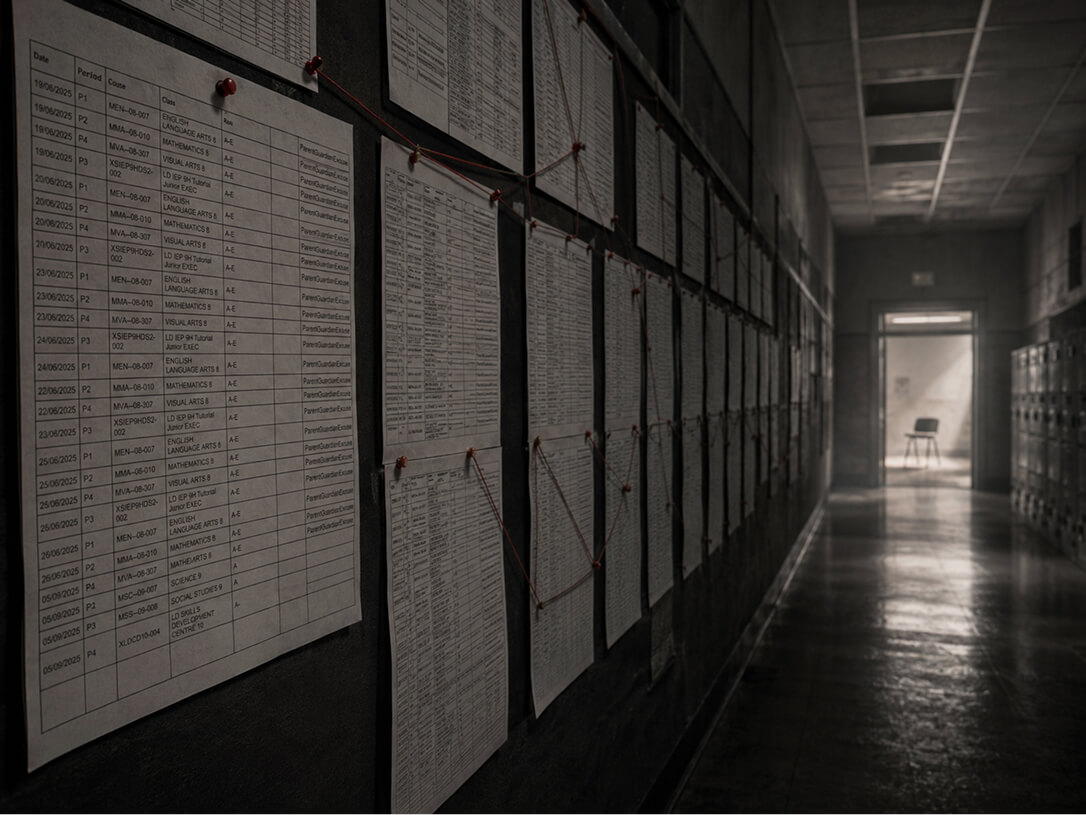
This page brings together non-emergency contacts who can support you in navigating school advocacy, along with links to articles that explain the appeals process—step by step, from lived experience.
Urgent
if you or your child is in immediate danger, dial 911 without hesitation.
Non-emergency
For non-emergency support, the following organisations offer guidance, advocacy and peer-to-peer solidarity:
- British Columbia Confederation of Parent Advisory Councils (BCCPAC)
your provincial umbrella for parent advocacy; connect with your local district parent advisory council (DPAC) via https://bccpac.bc.ca/ - Inclusion BC
provincial organisation advancing the rights and full participation of children with disabilities in education; https://inclusionbc.org - BC family support institute
peer-led network offering information, local contacts and emotional support for caregivers of children with extra needs; https://familysupportbc.com - BC human rights tribunal
for systemic or rights-based complaints related to discrimination in schooling; https://bchrt.bc.ca - See Advocacy Groups
Appeals
When a school makes a decision that harms your child—whether it’s disciplinary, academic, or related to support—most district policies expect you to “try to resolve it at the school level” before filing an appeal. But they rarely explain what that actually means. Many parents get stuck in this stage for weeks or months, waiting for replies that never come or going in circles with school staff who refuse to reconsider.
Related news
-

When advocacy stops being collaboration
You’re dealing with a school district, and a recognition is starting to settle: advocacy will not going to be easy! Meetings feel uncomfortable in ways you cannot yet fully name. Promises dissolve between conversations. Your child’s needs remain unmet despite repeated requests. Decisions…
-

Navigating school meetings without losing your mind
School meetings occupy a particular kind of hell where institutional power performs collaboration while enacting control, where districts convene parents to discuss their child’s struggles without acknowledging the system produces those struggles through inadequate accommodation, and where the meeting itself functions less as…
-

Advocacy in BC schools: a comprehensive guide for parents
When your child experiences harm in a British Columbia public school—when they are excluded, punished unjustly, denied accommodations, or subjected to practices that violate their dignity—you enter a landscape designed to exhaust rather than resolve, to defer rather than repair, to protect institutional…
-

The fallout of regressive discipline: from community trust to mental health
In schools across British Columbia and beyond, discipline often unfolds not as a considered intervention tailored to individual needs, but as a blunt, collective act that seeks to restore order quickly by suspending joy or opportunity for all. The cancellation of recess, the…
-

The paperwork trap: when doing everything right becomes your downfall
When parents follow every rule, cite every policy, and document every meeting in the British Columbia public school system, they are often framed as adversaries, not allies. This essay explores how procedural knowledge becomes a liability, how the IEP process punishes fluency as…
-

Shattered pathways of parent advocacy in BC’s public schools
It’s time to riot in the streets. We have tried everything else and our children are still being hurt. The existing systems of appeal and escalation are ineffective, more focused on preserving the institution than delivering justice. It’s time to end the engineered…
-

Why families feel betrayed when they finally reach the school board
An editorial reflection and response to The Canary Collective’s July 29 post When families reach the end of their rope with a school—when they’ve tried everything they can think of and their child is still suffering—the next instinct is often to go higher. In…
-

Vancouver School Board’s Urgent Intervention Process – purpose, process, and controversy
The Urgent Intervention Process (UIP) – formerly known as the Multi-Interdisciplinary Support Team (MIST) – is a Vancouver School Board (VSB) initiative designed to provide rapid support for schools dealing with students with extremely challenging behaviours or acute needs. The program was expanded in the mid-2010s…
-

$10K and an NDA
Would 10K and an NDA make the most excellent name for a country song? I didn’t file a Freedom of Information request to stir conflict — I filed it because nothing made sense, and I needed a clue, any thread at all, to…
-

The path to justice: legal versus public record
The courts may offer compensation, but rarely truth. The legal path demands silence in exchange for settlement. The public path asks you to speak while you’re still bleeding. Neither is easy. But only one builds a record that helps the next family survive.