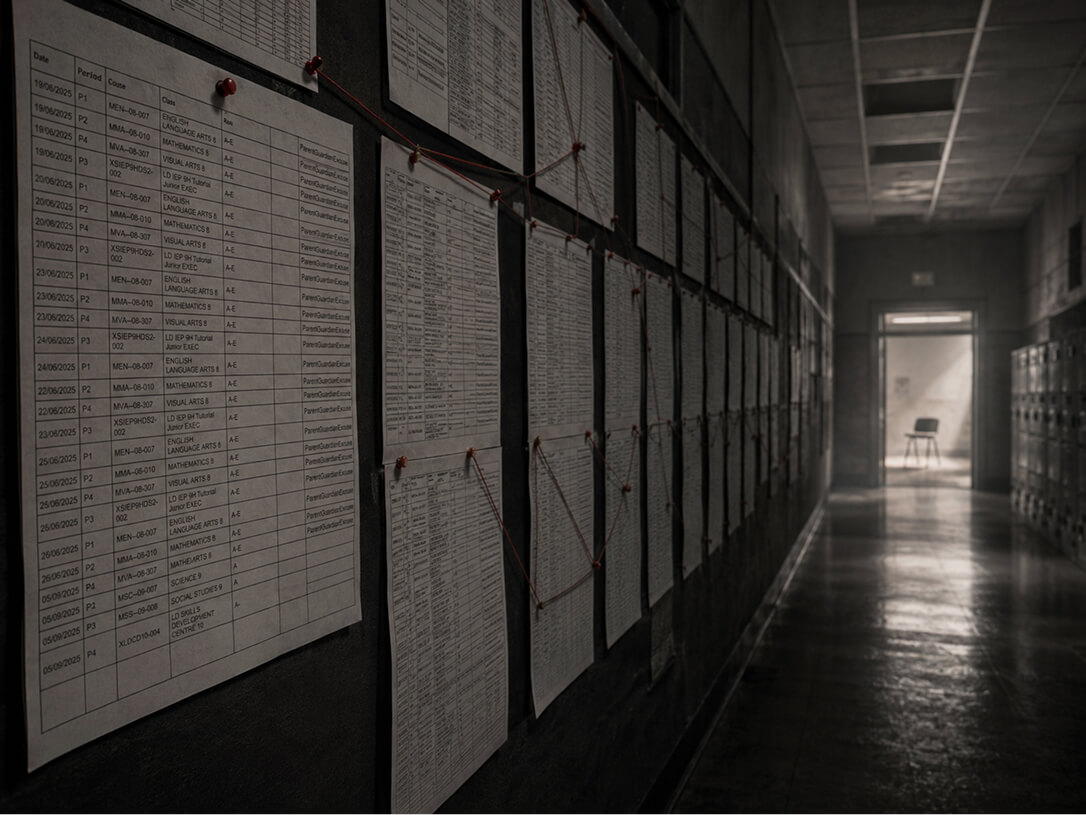
Inclusion Saskatchewan released a report in December 2025 that accomplished something most jurisdictions still consider impossible: they counted the excluded children, documented the scale of educational abandonment across an entire province, and published what school systems have long insisted remains uncountable. Their Freedom of Information requests revealed that approximately 1,250 to 1,350 disabled students were excluded from full-time school attendance during the 2024-25 year—roughly one in every nine students designated as having intensive support needs faced systematic denial of their right to education.
The numbers themselves constitute an indictment, but the methodology reveals something perhaps more damning: Saskatchewan’s Ministry of Education maintains no framework for tracking exclusions, collects no provincial data on which children are sent home, keeps no record of how long disabled students wait outside the system their tax dollars fund. Ten school divisions reported they do not monitor exclusions internally, while several divisions that did respond provided figures lower than the cases Inclusion Saskatchewan knows about through their direct advocacy work, suggesting the true scale exceeds even these conservative estimates. What the system refuses to see, it cannot be held accountable for dismantling.
The qualitative patterns mirror what we document in British Columbia and what advocates across Canada recognise as the architecture of state abandonment: parents receiving morning calls that their child’s educational assistant is unavailable so their child must stay home, “temporary” schedule modifications that become permanent reductions to thirty minutes of daily instruction, inappropriate medical exclusions stretching across months, coercive pressure toward segregated placements framed as the only pathway to full-time attendance, and the systematic exclusion of disabled students from field trips and classroom activities their peers access without question. These practices constitute ableism operationalised through administrative procedure, discrimination laundered through the language of safety and resources and temporary accommodation.
The Saskatchewan report frames exclusion correctly as a violation of the United Nations Convention on the Rights of Persons with Disabilities, the Saskatchewan Human Rights Code, and the Ministry’s own inclusive education policies, but their calls to action reveal how far we must travel toward accountability. They request that the Ministry formalize definitions for altered schedules and safety-based removals, implement mandatory tracking, publish annual data, and require divisions to document evidence-based interventions before excluding students—each recommendation exposing an absence that should be unthinkable in a system claiming commitment to inclusive education. The report asks the government to count what it harms, to name what it erases, to measure the violence it normalizes through administrative silence.
Inclusion Saskatchewan’s work demonstrates what becomes possible when advocates refuse the fiction that exclusion data remains inaccessible or that the scale of abandonment exceeds documentation. Their methodology—pairing Freedom of Information requests with qualitative case data from families they support—produces evidence that policy makers cannot dismiss as anecdotal while revealing the systematic nature of practices often framed as isolated incidents or necessary exceptions. This is the labour of making visible what institutions design to remain unseen, of transforming private suffering into public knowledge, of insisting that what happens to our children constitutes political fact worthy of measurement and remedy.
Saskatchewan families now possess what most jurisdictions still deny: quantitative proof that exclusion operates systematically across their province, documentation that transforms institutional claims of inclusion into measurable failures of access, and a roadmap toward accountability grounded in mandatory tracking and public transparency. The question facing every other Canadian province remains uncomfortably simple: when will you count your excluded children?
-

Engineered famine in public education
In British Columbia schools today, we are not facing a behaviour crisis—we are facing a famine of care. This essay weaves together personal memory, systemic critique, and deep empathy for teachers and families alike to ask why our schools are starving the very…