

Collective Punishment
Collective punishment refers to the disciplinary practice of penalising a group for the actions of one or a few individuals—often enacted in classrooms as withheld privileges, cancelled activities, or public reprimands directed at entire cohorts. Though rarely named in policy, it remains a common method of behaviour management in Canadian schools. This tag interrogates collective punishment as both a pedagogical failure and a moral harm, tracing its psychological, legal, and systemic dimensions. It includes student testimonies, parent advocacy, policy critiques, and international parallels—connecting the emotional toll of everyday discipline to deeper questions of justice, accountability, and the ethical use of power in education.
-
Collective punishment: it doesn’t work, but still it happens
Written by Dr Penny Rabiger, in 2016, this personal yet incisive piece, discusses the challenges the persistence of collective punishment in schools, despite its well-documented ineffectiveness. Drawing on both professional insight and a child’s perspective, the post illustrates how these tactics damage trust, inhibit learning, and punish children for behaviours beyond their control. The author…
-

Timelines matter
Advocating for a child’s right to an education should not feel like an uphill battle! Yet for some families navigating school exclusion across British Columbia, every step of the process can seem designed to delay, deflect, and deny necessary support. When schools fail to meet the needs of students—particularly those with disabilities or diverse learning requirements—families are…
-
A toxic classroom exposes punitive culture
An administrative investigation at Montreal’s Bedford Elementary uncovered a culture of intimidation where teachers used yelling, humiliation, and sending students to stand in hallways—sometimes for days—as disciplinary youtube.com+2montreal.citynews.ca+2montreal.citynews.ca+2. The Quebec Education Minister suspended 11 teachers linked to psychological and physical mistreatment, highlighting a systemic reliance on group-based punishment, rather than supporting individual accountability. Bernard Drainville, the…
-

Profound loss amplifies calls for better training
I was in the car with my children when I first heard the story of Chase, the 15-year-old boy who was shot and killed by police, in Surrey. It’s deeply distressing to hear this, knowing full well that my kids are recalibrating their worldview. Kids can be shot. My children sometimes process auditory information more…
-

What policy says about collective punishment in schools
Collective punishment is never explicitly mentioned in the School Act or BC education policies, but it is made very clear that the system is meant to be fair, accountable, and respectful. The School act states the discipline in schools must be “similar to that of a kind, firm and judicious parent” (Section 76(3)). I consider…
-

From corporal punishment to collective harm: why Section 43 still casts a shadow over Canadian schools
Section 43 still permits “reasonable force” in schools. This blog explores how it enables collective punishment and violates children’s rights.
-
Teacher Misconduct Case
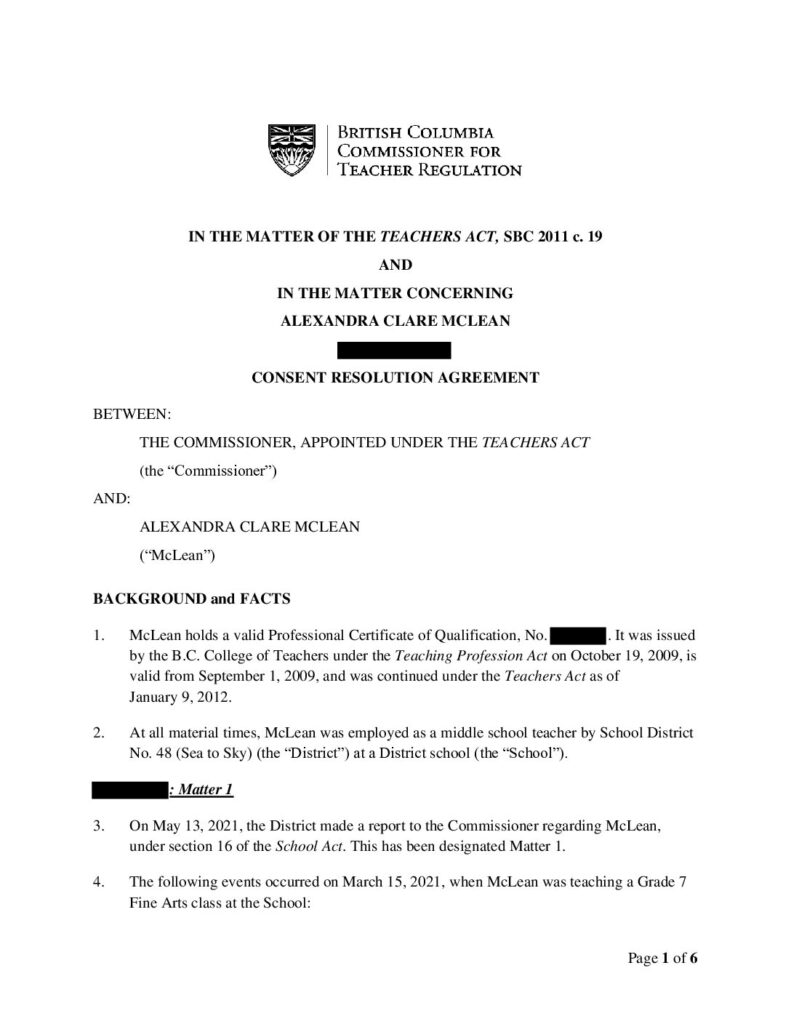
A recent case involving Alexandra Clare McLean, a BC teacher disciplined for yelling, humiliating, and physically handling students, highlights the urgent need for stronger accountability in schools. Despite multiple suspensions, warnings, and training, McLean’s harmful behaviour continued. This case reflects the broader issue of harmful disciplinary tactics like collective punishment. Both create fear, shame, and…
-
To the kid looking for answers about collective punishment
Hey, If you found your way here, maybe it’s because something happened at school that didn’t sit right. Maybe you searched for “why did my whole class get punished” or “it wasn’t my fault but we all lost recess.” Maybe a grown-up sent you here. Or maybe you just wanted to understand. If so—hi. I’m…
-

Discipline under review amid rising classroom aggression
A recent Alberta Teachers’ Association survey revealed surging aggressive student behaviour. Teachers report resorting to permanent group sanctions—like “silent lunches” or school-wide lockouts—as quick disciplinary fixesmontreal.citynews.ca+10yahoo.com+10reddit.com+10. Meanwhile, provincial cuts to Educational Assistant (EA) roles—funded through Jordan’s Principle—are worsening the problem. CUPE Alberta has warned that the loss of EAs may force schools to resort even…
-

The cost of compliance – the foundational critique and case for change
When children are dysregulated, the response from educators is too often punitive. For neurodivergent students in particular, the cost of these responses is high: shame, trauma, social exclusion, and a deep erosion of trust. But it does not have to be this way. Restorative alternatives are not new. They are ancient practices found in many…
-

Too many left behind
The Representative for Children and Youth (RCY) has released a powerful new report, Too Many Left Behind, highlighting the critical need for better services and support for children and youth with disabilities in British Columbia. According to Representative Jennifer Charlesworth, more than 83,000 young people in B.C. are not receiving adequate care, leaving families at…
-

Collective punishment in schools teaches the wrong lesson
Imagine you’re at work, focused on your tasks, when your boss announces that no one can leave until two distracted coworkers finish their work. You’d be outraged, right? Yet, this exact approach—punishing an entire group for the actions of a few—is sometimes still used in elementary classrooms. In a recent article, Blair questions the pedagogical…
-

A teacher’s perspective on collective punishment
In this powerful TikTok video, Mr Trayvon reflects on his own past use of collective punishment in the classroom—and why he no longer believes it serves students. With candour and humility, he acknowledges the harm these practices cause, particularly to children already carrying the weight of trauma, neurodivergence, or social marginalisation. His shift away from…
-
Repairing harm as a better alternative
Traditional punitive measures like collective punishment often fail to resolve behavioural issues, instead creating resentment and division. Restorative practices offer a better alternative by focusing on repairing harm, fostering empathy, and promoting accountability. This article introduces key restorative techniques for educators, including: By shifting the focus from punishment to healing, restorative practices not only improve…
-

Collective punishment–fair or farce?
The practice of collective punishment in schools sparks strong opinions among educators, parents, and students alike. While some argue it helps maintain control and sends a message about group accountability, critics point out that it unfairly penalizes uninvolved individuals and damages trust within the classroom. This article dives into the debate, exploring: The piece concludes…
-

How children evaluate collective and targeted punishment
A recent study explores how children perceive fairness in different forms of punishment. The research, conducted with children of varying ages, compares their reactions to collective punishment (where an entire group is punished for the actions of a few) versus targeted punishment (where only the individuals responsible face consequences). The findings reveal that children overwhelmingly view collective punishment as…
-

New research highlights the harmful effects of collective punishment on group relations
A study published in Political Psychology examines how collective punishment—punishing an entire group for the actions of a few—impacts intergroup relations. Researchers Mete Sefa Uysal, Sami Çoksan, and Thomas Kessler found that collective punishment: These findings, based on experiments in Turkey and Germany with over 2,000 participants, reveal that collective punishment not only fails to resolve conflicts…
-

Report highlights barriers to inclusion in Vancouver Schools
he Inclusive Education Working Group (IEWG) has released an important new report, Advocating for Equity: A Caregiver-led Examination of Inclusive Education in Vancouver Public Schools, shedding light on the systemic challenges faced by students with disabilities in Vancouver schools. The 2023–2024 school year was marked by critical shortages in both resource teachers and educational assistants,…
-
Why collective punishment doesn’t work, based on scientific evidence
When we challenge collective punishment, defenders often fall back on one refrain: it works. They say it fosters accountability, motivates group norms, and deters misbehaviour. They claim it teaches responsibility. But what if these assumptions are not only unjust, but false? A peer-reviewed study published in Scientific Reports dismantles this defence. Titled Measuring the efficacy of…
-
Why collective punishment doesn’t work
Group punishment doesn’t fix behaviour – it just makes kids hate school, in The Conversation. explains that collective punishment might seem effective in achieving short-term compliance, but is both unfair and ineffective in the long run. This article explains: Key takeaway: Collective punishment may offer a quick fix, but it erodes trust and fails to…