
Jasbir Puar
Jasbir K. Puar is a queer theorist and disability studies scholar whose work examines race, empire, sexuality, nationalism, surveillance, debility, disability, and state violence. Her key works include Terrorist assemblages: Homonationalism in queer times and The right to maim: Debility, capacity, disability. In Terrorist assemblages, Puar analyses how some queer subjects are incorporated into nationalist projects while racialised “terrorist” bodies are cast as threats. In The right to maim, she examines how states and institutions produce debility: not only through killing, but through injury, exhaustion, disablement, and managed deterioration.
For this site, Puar is useful because her work helps analyse systems that do not simply exclude or include, but manage populations through uneven exposure to harm. In education, that lens can help name how some children are kept barely inside school while being made less well, less safe, less capable, or less able to continue. It shifts the question from whether a child is formally enrolled to what the institution is doing to their body, capacity, family, and future.
-
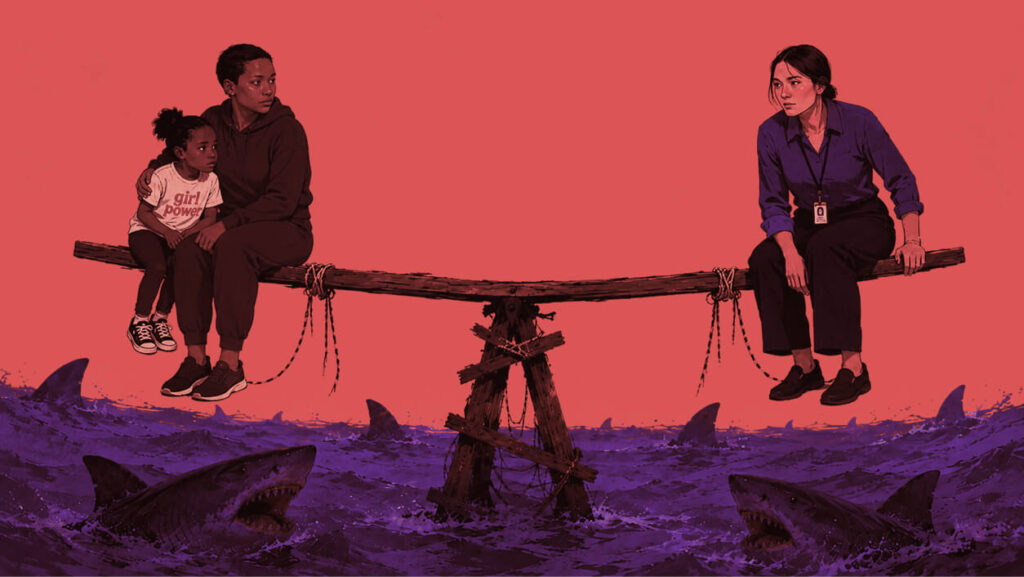
On opposite sides of the same door in BC schools
Families and teachers are describing the same failure from two positions inside it. The system survives by keeping them from recognising each other.
-

Try harder, try different
On the pedagogy of “people are not supports,” the research it misreads, and what happens when an idea is transplanted into a starved system.
-

Be pleasant so others won’t get upset
What a twelve-year mortality study measured, and what it accidentally wrote down: the code of conduct every district hands a mother on her way into the room. You learn it in your hands before you learn it anywhere else. At the table you fold them in your lap, you soften your face into the shape…
-
Iatrogenic harm and the parent advocate: how school systems produce disability in the families they fail
The body keeps the account even when the institution refuses to. What the school system produced in the parent who spent years trying to hold it accountable is not caregiver burden — a word that belongs to the person carrying it — but iatrogenic harm: specific, dated, attributable, and fully known to the institutions that…
-

Three contexts, one experience: why autism debates fracture
The fracture happens before anyone finishes speaking. One person describes autism as neurological difference observable through brain imaging and cognitive testing; another person describes autism as diagnostic category that unlocks resources within rationed systems; a third person describes autism as lived experience of navigating a world built around neurotypical assumptions about communication, sensory processing, and…
-

Why I won’t stop in 2026
The principal used collective punishment against my child almost two years ago, and yet I remain unreconciled to what she did. People suggest moving on, starting fresh, forgiving. Schools are obsessed with ‘fresh starts,’ framing each September as reset opportunity, as though institutional harm dissolves at arbitrary calendar boundaries. My daughter carries what happened in…
-

The ethics of counting crisis
I have been packing boxes between paragraphs, writing this series while selling my home—a process shaped by exclusion and the loss of stability that followed my children’s experiences in the Vancouver School District. I approach this work from a lifelong love of data and technology, aware that the same tools I value can create harm…
-
Against our will: When ‘support’ becomes institutionalised coercion
I said no. I said it plainly, early, repeatedly. I said it in writing, I said it on the phone, I said it from a place of trembling grief and exhausted clarity. I said it as a mother who had already tried everything. I said it after describing the diagnostic framework, after explaining what worked,…
-

The collective punishment of delayed care
There is a particular cruelty in delayed care, of watching a child falter for weeks or months while teams gather data, debate thresholds, and cite process. It is the cruelty of waiting for collapse before responding, of constructing intervention around crisis instead of prevention. And when the child finally does break, when their distress spills…
-

Debility is not a diagnosis: What Jasbir Puar helps us see about invisible harm in BC schools
There is a category of harm that most institutions do not name, do not track, and do not treat—because doing so would require them to admit that they caused it. This kind of harm accumulates in the body slowly, like sediment, until what once looked like coping becomes collapse. It is the product of chronic…
-
Debility versus disability: what the system cannot acknowledge
My son Robin took to bed two weeks before March break. He had been soldiering on through the aftermath of a school transfer the district assured us would help him, though his body told me otherwise from the first day he arrived. I’ve seen that kind of shutdown before—at camp, at birthday parties, in classrooms…