

Research
This site aggregates evidence that collective punishment should be banned across BC schools, demonstrating its harms. The research documented here includes parent testimonies, student accounts, policy analysis, Freedom of Information responses, media coverage, and academic literature. Schools punish entire groups for individual behaviour, educators justify it using team-building rhetoric, administrators claim no formal policy exists while permitting the practice in classrooms, and districts remain silent when asked whether they allow teachers to punish children for actions they did not commit.
-
Children already know collective punishment is unfair
Children already know collective punishment is unfair A teacher sees one student break a rule and keeps the whole class in from recess. Every parent has heard a version of this story. A 2024 study in Social Development asked the children themselves what they make of it — and the answer is clear. By age six, children…
-

When schools deny support staff, they destroy the foundation of learning
Research spanning 70 years and more than 2.6 million students confirms what parents of disabled children already know through bitter experience: children learn through relationships built on trust, consistency, and support. A comprehensive meta-analysis published in February 2025 demonstrates that positive teacher-student relationships directly improve academic achievement, behaviour, executive function, motivation, and emotional wellbeing across…
-

Loss of recess impact on chronic stress levels in elementary children
The Impact of Recess on Chronic Stress Levels in Elementary School Children illuminates the profound violence embedded in recess cancellation as punishment, revealing how schools manufacture chronic physiological harm under the guise of behaviour management. The findings demonstrate that children receiving forty-five minutes of daily recess exhibited hair cortisol concentrations significantly below both pre-pandemic normative…
-
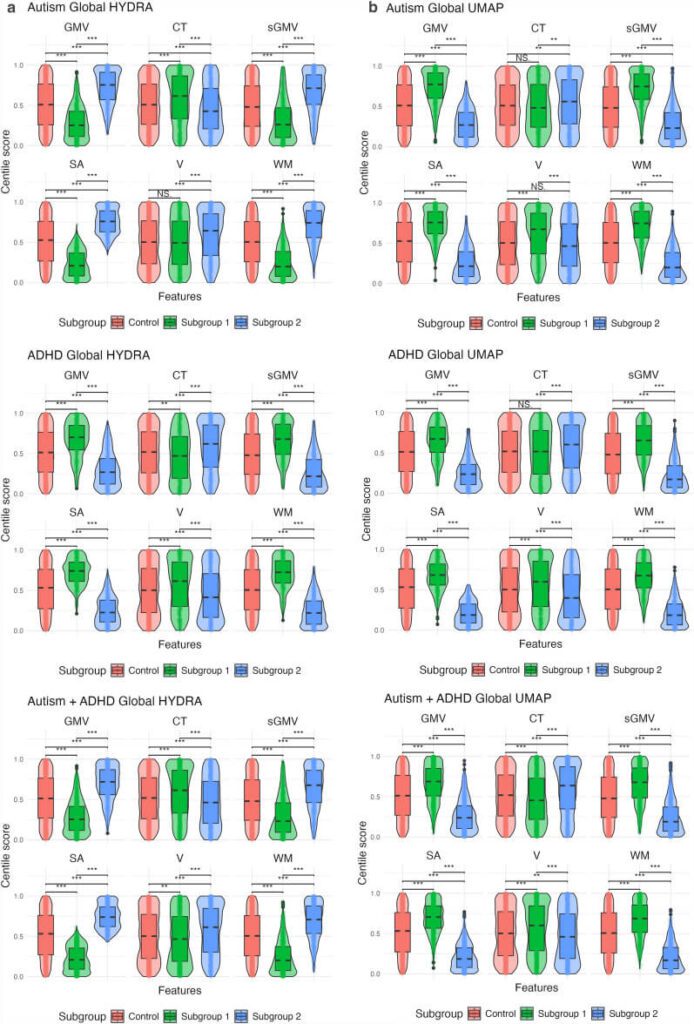
Subgrouping autism and ADHD based on structural MRI population modelling centiles
A June 2025 neuroimaging study examining brain structure patterns across individuals with autism, ADHD, and combined diagnoses, published in Molecular Autism by Pecci-Terroba and colleagues applies population modelling to cluster participants based on centile scores for cortical thickness, surface area, and grey matter volume, using HYDRA—a semi-supervised machine learning algorithm that identifies subgroups based on…
-

Three contexts, one experience: why autism debates fracture
The fracture happens before anyone finishes speaking. One person describes autism as neurological difference observable through brain imaging and cognitive testing; another person describes autism as diagnostic category that unlocks resources within rationed systems; a third person describes autism as lived experience of navigating a world built around neurotypical assumptions about communication, sensory processing, and…
-

From trauma to topology: the grotesque work of quantifying institutional denial
When institutional harm accumulates in childhood—in objects confiscated, spaces denied, bodies excluded—the evidence lives first in memory and affect. The saucer eyes of a humiliated or frightened child. The sting in the sobs of a child who just wants to be with her friends at the volleyball game. The physical weight of a garbage bag…
-

Teachers deserve compensation commensurate with the complexity of their labour
The research confirms what every parent already knows: teaching requires orchestrating dozens of simultaneous human variables inside conditions designed to foreclose success, and the work demands relentless cognitive precision, emotional attunement, and adaptive improvisation across every minute of every day. A classroom contains children processing information at radically different speeds, carrying wildly disparate skill foundations,…
-

What research says about school conduct codes and disabled students
This explainer summarises what a small but influential group of scholars have shown about school discipline policies, student codes of conduct, and how these frameworks disproportionately harm disabled and neurodivergent students. It draws especially on the work of Catherine K. Voulgarides, Russell J. Skiba, Daniel J. Losen, David Osher, and Edward Fergus. Where possible, citations…
-

New science on punishment and rewards
A growing body of research from 2023–2025 offers a transformative account of how children learn, regulate, and respond to school environments, because these studies converge on a striking and deeply consequential insight: children learn through stability, safety, and relational reward, while punitive systems generate emotional distress, behavioural escalation, and institutional inefficiency, particularly for neurodivergent and disabled students…
-
Neural evidence exposes the steep cost of sacrificing vulnerable children to punitive myths
Neural evidence from Altered Neural Responses to Punishment Learning in Conduct Disorder offers a precise account of how punitive school discipline collides with the neurodevelopmental profiles of vulnerable children, because the study shows that punishment learning relies on the anterior insula’s capacity to transform discomfort into behavioural adjustment, and this capacity expresses irregular patterns in the children…
-

Punishment is not a good learning tool
In Altered Neural Responses to Punishment Learning in Conduct Disorder, researchers examined how young people learn from punishment and reward using fMRI and computational modelling, and the findings show that punishment-based approaches produce weak and unreliable learning signals in a significant subset of youth. The study followed 174 young people (ages 9–18) who completed a…
-

Interpersonal neurobiology as a neurodiversity-affirming framework
Interpersonal neurobiology (IPNB) offers a generative way to understand children’s nervous systems, because it treats development as an emergent, relational process shaped through safety, attunement, and repair, and this orientation produces a worldview in which difference is interpreted through physiology and experience rather than compliance or performance. IPNB proceeds from the understanding that minds evolve…
-

Cultural bias and collective punishment: why school systems resist feedback
Across cultures and institutions, punishment is often mischaracterised as a neutral or corrective act—something that emerges in response to wrongdoing, rather than something shaped by norms, loyalties, and group dynamics. But when we look closely at how people learn to punish (and more importantly, whom they choose to punish), a very different picture emerges—one that…
-

Non-coercive, trauma-informed alternatives to PBS/ABA in BC schools
Positive Behaviour Support (PBS) and Applied Behaviour Analysis (ABA) are behaviourist approaches widely used in schools to manage student behaviour. However, a growing chorus of neurodivergent advocates, educators, and researchers highlight that these methods often prioritise compliance and “normalising” behaviour over student well-being rcpsych.ac.uk. By focusing on making neurodivergent children appear neurotypical (meeting neuronormative standards), traditional PBS/ABA can…
-

Collective punishment in schools: How humiliation undermines emotional safety and learning
In classrooms around the world, students are sometimes punished for the misbehavior of others. One student breaks a rule, and the entire class loses a privilege. This practice – known as collective punishment – persists even though it is broadly recognised as unjust. In fact, collective punishment is explicitly banned under Article 33 of the Geneva Conventions…
-

On the tyranny of majoritarian sentiment
in 2021, The Vancouver School Board commissioned a third-party firm, Argyle, to engage students, families, educators, and community organisations in a trauma-informed review of its School Liaison Officer (SLO) program, which placed uniformed police in schools. The study found that while many respondents were unfamiliar with the program or viewed it positively, the research found…
-

Suspending justice: What ethics can (and can’t) teach us about school discipline
In 1993, educator Martha Johnson conducted a simple but telling experiment. During a professional development session for principals and vice-principals in southern Alberta, she handed out a fictional case study: a student, suspended. Participants were asked to reflect on whether the decision was ethical—before and after being introduced to an ethical decision-making framework. What changed wasn’t the facts…
-

Whose barriers get counted in Vancouver School District?
When I first opened the Vancouver School Board’s Accessibility Engagement Summary Report, I did what I always do with these kinds of documents—I made a beeline for the methodology, the numbers, the breakdown of who actually got to speak. On page 10 I discovered that 2,855 people had participated; on page 11 I discovered that…
-

The high stakes of understanding PDA
Pathological Demand Avoidance (PDA) might sound like just another clinical term, but for many families it represents a daily struggle that is anything but trivial. PDA is a profile on the autism spectrum characterised by an extreme, anxiety-driven avoidance of everyday demands, even those the child wants to comply with drdonnahenderson.com reframingautism.org.au. This isn’t mere stubbornness or “bratty” behaviour – it’s a…
-

New research highlights the harmful effects of collective punishment on group relations
A study published in Political Psychology examines how collective punishment—punishing an entire group for the actions of a few—impacts intergroup relations. Researchers Mete Sefa Uysal, Sami Çoksan, and Thomas Kessler found that collective punishment: These findings, based on experiments in Turkey and Germany with over 2,000 participants, reveal that collective punishment not only fails to resolve conflicts…