

ADHD
ADHD (Attention-Deficit/Hyperactivity Disorder) is a form of neurodivergence that affects attention regulation, impulse control, and executive functioning. In school settings, students with ADHD are often misunderstood—not because they lack focus, but because their focus is dynamic, interest-based, and difficult to direct on command.
Common challenges include difficulty with sustained attention, time management, transitions, organization, and emotional regulation. But these behaviours are not signs of laziness or disrespect—they’re signs that the classroom environment is not built to accommodate different cognitive styles.
Students with ADHD may need to move, speak out of turn, or fidget to stay engaged. They may hyperfocus on one topic and struggle with others. They often have a strong sense of justice, high sensitivity to rejection, and a need for novelty, autonomy, and flexible support.
This tag gathers resources, reflections, and strategies related to ADHD in school—especially where punitive responses like exclusion, token economies, or discipline plans fail to account for underlying needs. We believe ADHD is not a problem to fix, but a difference to understand—and that the classroom must change before the child is asked to.
-
Exclusion is economically irrational and the hidden costs of refusing accommodation
BC schools spend more money refusing accommodation than providing it. Learn when hiring a lawyer becomes the only fiscally rational choice for your family.
-

Four years on a waitlist
Richard Hackett’s eight-year-old son Austin has waited four years for occupational therapy services in Ontario, placed on the waitlist when he was four years old and still waiting as he navigates school with a learning disability and ADHD. The family received a school-based assessment with no follow-up, no results shared, no clarity about whether support…
-

POPARD’s PDA doublespeak
I noticed that POPARD is advertising another workshop on Pathological Demand Avoidance (PDA) in April 2026, titled Pathological Demand Avoidance (PDA): What We Know & What We Are Learning. The description is familiar: PDA is framed as a “growing topic of interest,” something “some clinicians and researchers describe” as an autism profile. The language is cautious,…
-
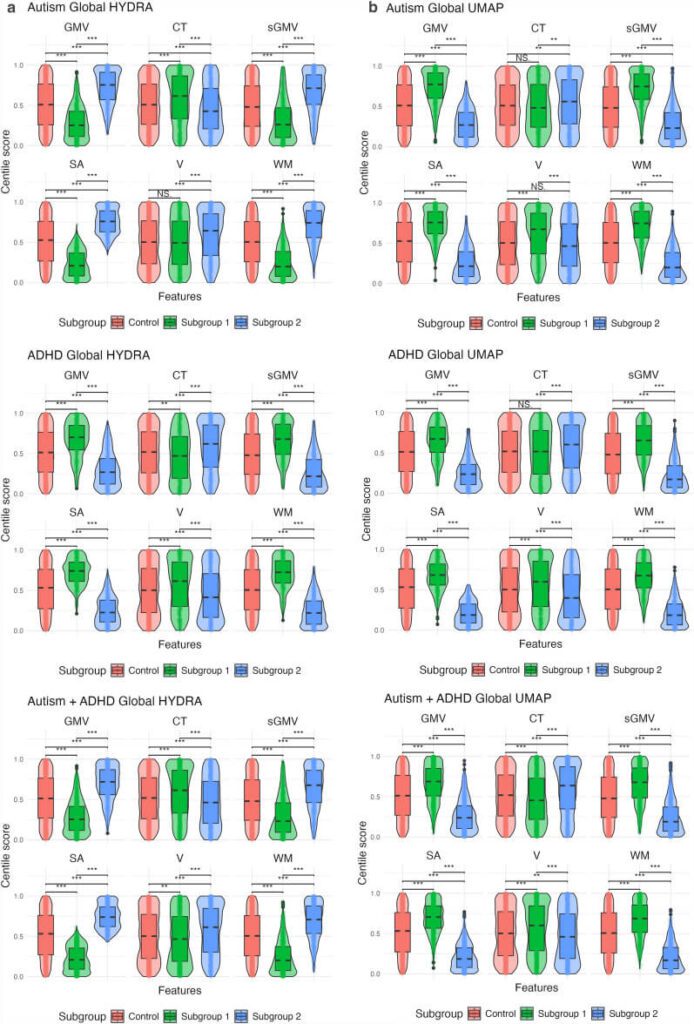
Subgrouping autism and ADHD based on structural MRI population modelling centiles
A June 2025 neuroimaging study examining brain structure patterns across individuals with autism, ADHD, and combined diagnoses, published in Molecular Autism by Pecci-Terroba and colleagues applies population modelling to cluster participants based on centile scores for cortical thickness, surface area, and grey matter volume, using HYDRA—a semi-supervised machine learning algorithm that identifies subgroups based on…
-

The return of functioning labels: How austerity turns advocacy into competition
A parent recently posted about profound autism, describing the experience of having her son’s reality erased when people say that “profound autism” doesn’t exist. Her frustration is legitimate—parents of children with intensive, lifelong support needs face profound institutional abandonment, and “profound autism” names a reality that deserves recognition and resources. But her post also illustrates…
-

Justice and dignity too expensive for BC NDP
In 2018, experts told BC exactly how to fix special education funding. The government has spent five years “consulting” instead. Meanwhile, your child sits in hallways. The 192% problem nobody wants to fund Between 2015 and 2024, autism designations in BC schools exploded by 192%. Total student enrolment? Up just 11.6%. The province knows this. They…
-

When delay becomes policy: British Columbia’s strategic abandonment of disabled students
In 2018, an independent panel reviewed how British Columbia funds kindergarten through grade twelve education and recommended a prevalence model for special education funding, a shift that would allocate resources based on statistical prevalence of disability within the general student population rather than on individual diagnostic designation. The proposal threatened to expose what the existing system carefully…
-

Why the evolving understanding of childhood terrifies systems built on scarcity
Children now arrive at school shaped by homes that honour physiology over performance, autonomy over obedience, and co-regulation over fear, and this shift grows from a decade of relational neuroscience, trauma literacy, sensory understanding, and disability justice that families have absorbed far more quickly than schools, which leaves discipline ideology standing on crumbling ground because…
-

The cancellation
When the principal cancelled the volleyball game, she did more than remove an afternoon of play from a group of eager children, she transformed what should have been a moment of joy and collective affirmation into despair and humiliation, converting what should have been an opportunity to connect and excel as a team into a…
-
No good news on government K-12 page
The BC k-12 portal promises inclusion, yet broken links and missing disability guidance reveal gaps in safety and access.
-

This isn’t a unique case, is it?
My children’s father said in a meeting: “Surely you’ve dealt with this before and you have a solution? This isn’t a unique case, is it?” The question hung in the air, simple and devastating, exposing in one breath the entire pretence on which school leadership rests. The question matters because it cuts through bureaucratic delay…
-

The fallout of regressive discipline: from community trust to mental health
In schools across British Columbia and beyond, discipline often unfolds not as a considered intervention tailored to individual needs, but as a blunt, collective act that seeks to restore order quickly by suspending joy or opportunity for all. The cancellation of recess, the revocation of a field trip, the withholding of an earned privilege—all for…
-

They keep moving the goalposts while our kids pay the price
It began with a phone call that felt like a lifeline. A new teacher was coming, they said, and maybe this would be the one to understand. We clung to that hope. We paid for another assessment, scheduled more therapy, spent weekends in waiting rooms and weekdays in meetings where the promise of change hovered…
-

The legal playbook every parent needs
When your child’s education is on the line, every conversation with a school team feels like walking a tightrope: you want collaboration, but you also carry the weight of knowing that human rights are not polite suggestions — they are legal obligations owed to your child. And here’s the truth: the minute you bring up the Human…
-

PTSD, big reactions, and school’s responsibility for care
The presence of PTSD—whether diagnosed formally or manifesting in trauma-linked behaviours—does nothing to diminish a student’s legal right to safety, dignity, and education. Schools are bound by law to provide accommodations and proactive support to every student, including those whose distress may surface as loud, sudden, or intense reactions. PTSD can be the direct result…
-

When schools say a child went from “zero to sixty”
Let’s rip the mask off this polite, professional charade: when schools say a child went from “zero to sixty,” they are lying to protect themselves. They are covering for the adults who ignored every warning, missed every signal, and left a child to be harassed, baited, and humiliated until their nervous system screamed for survival.…
-

The infection of neoliberalism in Canadian public education
The ideology of neoliberalism, with its relentless emphasis on competition, individual responsibility, and market logic, has seeped deeply into Canadian public education. It presents itself as pragmatic and modernising, promising efficiency, innovation, and responsiveness to “stakeholders.” Yet beneath this rhetoric lies a corrosion of the foundational principles of public schooling — equity, universality, and the…
-

ADHD and autism aren’t phases
We don’t expect a wheelchair user to “earn” the right to walk by graduation. We don’t tell a student with diabetes that the goal is to get off insulin. And yet, in schools across our district, support for autistic and ADHD students is treated like a ladder they’re supposed to climb once and throw away…
-

The orange shirt I folded
I was folding laundry late one night, brain running on the kind of background grief that rarely quiets, when my hand closed around the orange shirt. I moved to set it aside—automatically, instinctively—because I remembered September was coming, school would be starting, and Orange Shirt Day would follow quickly after. That shirt would be needed…
-

Flourishing as an ethical imperative
Like many of you, I caught CBC’s Ideas episode the other day, where philosopher Angie Hobbs spoke about the ancient Greek concept of eudaimonia—a term sometimes translated as happiness or welfare, but more richly understood as human flourishing. In a world flooded by crisis, it may seem indulgent or impractical to contemplate the good life,…