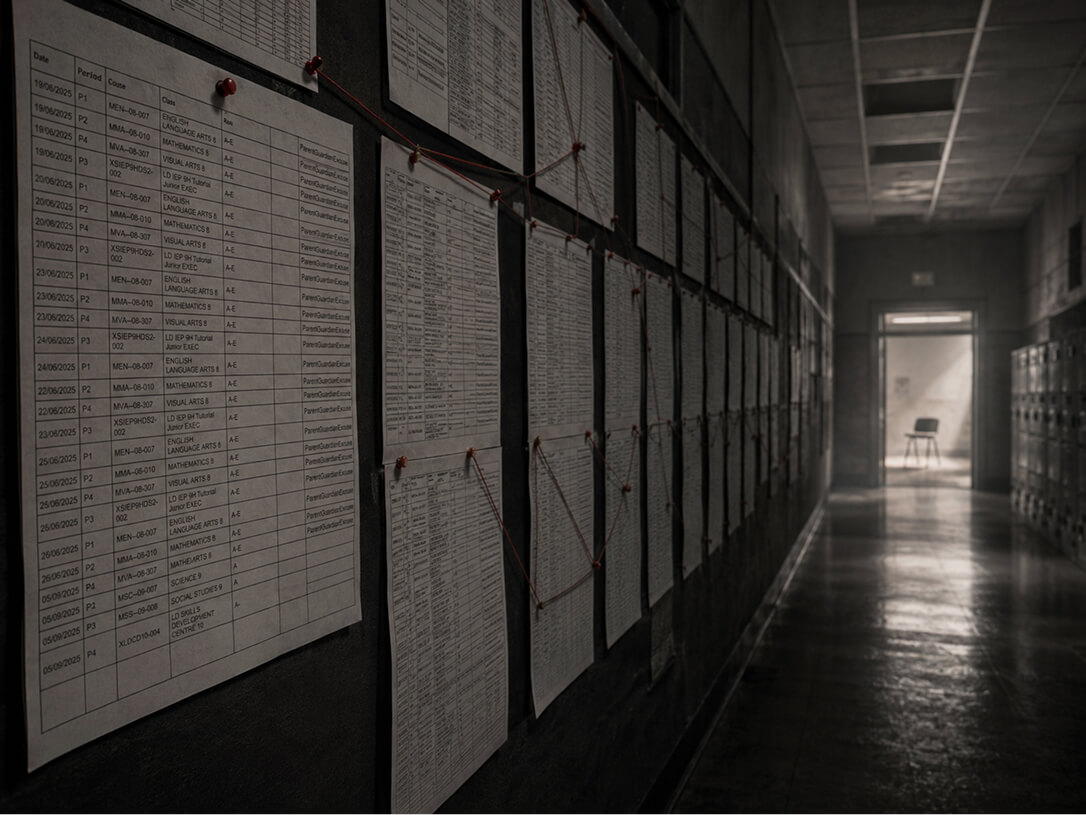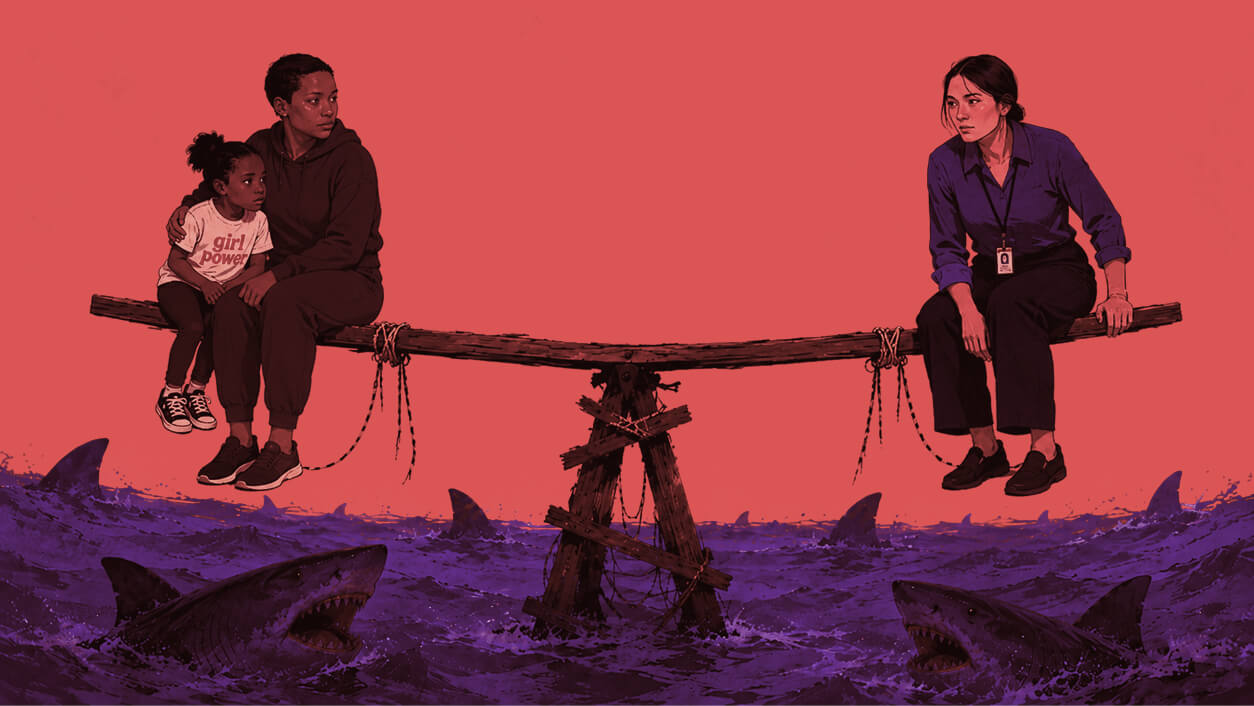
Eight years without a lawyer cost one family hundreds of thousands of dollars in lost income, forced career stagnation, and accumulated harm to their children. What would have happened if they got a lawyer in the first year?
Summary
- BC school districts have built a system that costs more to refuse accommodation than to provide it, then blame families for the expense
- The meeting process is often not collaboration—it is designed to make minimal temporary concessions, while it exhausts families into withdrawal before legal enforcement becomes necessary
- Administrators were promoted for saying “no” without political consequences, not for understanding that refusal creates huge costs absorbed by families
- Districts externalise catastrophic expenses onto families (forced career stagnation or withdraw, lost income, trauma, relationship dissolution) while claiming budget constraints
- The Schools Protection Program creates asymmetric legal capacity: districts access free defence after you escalate, but only your lawyer costs money
- Legal intervention is not escalation—it is the introduction of accountability a system was designed to avoid
- Once lawyers are involved, “impossible” accommodations appear because delay shifts from invisible to expensive
- Meeting theatre costs districts thousands while producing little, but appears as responsiveness rather than resistance
- Educational leaders lack training to evaluate costs landing outside their budget line—they optimise for short-term containment, not systemic efficiency
- Resistance persists because scarcity management “works” from the district’s perspective: families absorb damage privately, the system remains politically stable
- Hiring a lawyer forces hidden costs into visibility, converts exhaustion spending into accommodation spending, and creates records protecting future families
- When multiple families coordinate legal action, systemic patterns become undeniable and districts shift behaviour to avoid compounding exposure
- Parent-blaming rhetoric (“Karen,” “you chose this,” “think of other kids”) functions economically to delay legal enforcement and preserve the meeting phase
- The dangerous tipping point has arrived: legal enforcement is now cheaper than self-advocacy, revealing a system designed to harm families until they cannot afford to stop it
The accusation
Every parent who persistently advocates for a disabled child in a British Columbia public school eventually encounters the same cluster of accusations. They are rarely stated in policy language. They arrive instead as social sanctions: comments in parent groups, snide remarks said under the breath of staff, overheard conversations on the playground:
- You’re taking resources from other kids.
- Stop being a Karen.
- You chose to have children—make it work, or homeschool.
These statements differ in tone but not in function. Each reframes a legal entitlement as a moral failing. Each positions the parent as a threat to the collective rather than a claimant within it. And each carries the same underlying message: disabled children are burdens, and parents who insist on their rights are parasites draining a fragile system.
This framing is not accidental. It performs an essential economic role. It obscures the real question—which is not whether accommodation costs money, but whether refusing accommodation is actually cheaper. It redirects attention away from institutional behaviour and onto parental character. And it relies on a crucial assumption: that advocacy itself is the expensive thing.
That assumption is wrong.
In fact, once advocacy passes a modest threshold of persistence—typically several meetings with no material change—self-advocacy becomes the most expensive possible strategy, both for families and for school districts. At that point, hiring a lawyer is no longer an escalation of cost. It is a cost-containment intervention.
Understanding why requires examining three things: what “working collaboratively” actually costs in staff time and family labour, and why the meeting process itself functions as expensive theatre rather than problem-solving.
Once these costs are visible, the accusations collapse. Parents who hire lawyers are not draining the system. They are stopping it from draining itself.
To understand why legal intervention is fiscally rational, we need to start with basic arithmetic—specifically, the cost of “doing nothing” through meetings.
Consider a very typical trajectory before any lawyer is involved.
The meeting arithmetic
A parent raises a concern. The school responds with meetings.
Three school-level meetings is conservative.
- 3 attendees (principal, teacher, resource teacher)
- 1.5 hours per meeting
- 3 meetings
- Average loaded hourly cost (salary + benefits + overhead): ~$50/hour
That is: 3 × 1.5 × 3 × $50 = $675
Then come district meetings.
- 4-5 attendees (district administrator, principal, teacher, resource teacher, sometimes psychologist or inclusion support)
- 2 hours per meeting
- 3 meetings
- Average loaded hourly cost: ~$60/hour
Using 4.5 as average attendance: 4.5 × 2 × 3 × $60 = $1,620
At this point, the district has spent $2,295 in staff time alone.
Now add the cost everyone pretends does not exist: the parent’s labour.
Most parents in this position spend at least four hours preparing for each meeting—reviewing documents, writing summaries, tracking incidents, responding to emails. Over six meetings, that is 24 hours. If the parent is a professional—and many are—that labour has a real market value.
At a conservative professional rate of $100–200/hour, that is $2,400–4,800 of unpaid labour extracted from the family.
The total economic cost of six meetings that produce zero accommodation is therefore in the range of: $4,695–7,095
And that figure excludes the cost of the child’s escalating distress, classroom disruptions, staff burnout, and the administrative overhead of documentation itself.
This is what “working collaboratively” actually costs before a lawyer enters the picture. The meetings feel collaborative. They produce binders full of notes, action items, and timelines. What they do not produce is lasting or often meaningful accommodation. And because little changes and changes are often temporary, the cycle continues—more meetings, more staff time, more family labour, more harm.
But these district costs, while real, are trivial compared to what families absorb.
What happens when you hire a lawyer
Now compare that to what typically happens when a lawyer is retained after six failed meetings.
Accommodation is implemented within weeks, not months or years. Meetings become brief and purposeful, or stop entirely. Promises are documented and therefore kept. Follow-through occurs because delay now carries risk.
The legal cost for this intervention is usually $2,800–5,000.
Crucially, that cost often replaces, rather than adds to, ongoing meeting expenditure. Without legal intervention, the district is on track to spend another $5,000–10,000 over the next year in escalating meetings, administrative review, and internal consultation—still without accommodating the child.
The arithmetic is not subtle. Hiring a lawyer after six failed meetings costs roughly the same as continuing the meeting process for another year. The difference is that the lawyer produces quick and collaborative accommodation. The meetings do not.
But this comparison still radically understates the true cost, because it focuses only on what districts spend. The devastating expense is what families absorb.
The real cost: What families lose
Consider one parent’s actual trajectory. Over 8.5 years of self-advocacy through meetings and official channels, she absorbed conservatively five years salary in hard costs—forced career stagnation, years of lost raises and promotions, relationship strain, and accumulated trauma to her children. When she finally hired a lawyer, the legal intervention cost $2,800 and produced warm tidings and promises to collaborate quickly.
This is the dangerous tipping point: when legal enforcement becomes cheaper than collaboration, something has already gone badly wrong in system design. And when families absorb huge financial costs and heartbreaking damage to their mental health while districts spend thousands debating whether to provide tens of thousands in support, the system is not managing scarcity. The system is externalising catastrophic costs onto families.
But understanding the cost of meetings only explains why resistance is expensive. It does not explain why districts resist anyway. That requires understanding the legal architecture behind them.
Endless meetings as exhaustion strategy
From the outside, the escalation process in education looks like due diligence. From the inside, it functions as attrition.
The escalation ladder
Parents are moved through a predictable hierarchy:
Teacher → Principal → District team → District administrators → Senior administrators → Associate Superintendent
At each level, the hourly cost increases, direct knowledge of the child decreases, and authority to implement accommodation becomes more abstract. By the time a vice-superintendent is involved, the conversation is often about process, not the child.
Consider the economics of a single high-level meeting. A vice-superintendent earning approximately $275,000/year attends a 2.5-hour meeting with five other staff. At a conservative average loaded rate of $75/hour, that meeting costs approximately $940.
That money could fund weeks of educational assistant support. Instead, it funds a conversation about why the support cannot be provided.
This is not oversight. It is expensive theatre, and its script is remarkably consistent across districts.
-

Real leaders lead by example
In May 2025, the Vancouver School Board (VSB) quietly enacted wage cuts that stripped contracted workers—specifically bus drivers and special education attendants—of their living wage top-ups. At the same time, VSB senior leadership quietly accepted significant raises. This decision will result in a…
The endless meeting trap
The content of these meetings rarely varies.
“Let’s observe and gather data.”
“The challenges are complex; let’s try some strategies.”
“Results are mixed; let’s adjust and give it more time.”
“We’re seeing some progress.” (There is none.)
“We need to involve the district team.”
“The district needs time to review.”
“We’re bringing in senior leadership to ensure appropriate support.”
“Urgent Intervention is doing an observation and will produce a report.”
The system is not failing to act. It is acting very effectively to delay. Each meeting produces documentation that can later be presented as evidence of responsiveness. Each timeline extension can be framed as prudent caution. Each escalation to higher authority can be described as taking the matter seriously.
Meanwhile, the child is still being removed from classrooms, still without support, still accumulating harm. Or there is a very slight temporary reprieve. The family is still spending hours preparing for meetings that produce little lasting impact. And the district is still spending thousands of dollars in staff time to avoid spending hundreds of dollars on accommodation.
The reason this continues is simple: during the meeting phase, delay costs less than compliance. Administrators are evaluated on staying within budget, not on legal compliance. Staff time is a sunk cost. Accommodation is a new expense, that was not budgeted before and budgets are a religion. The incentive is to extend the process until the family either accepts partial measures or withdraws entirely, or until you wind up in a new budget year. Budget years don’t matter to little kids…
A lawyer does not attend meeting eight. A lawyer sends a letter. Maybe has a short without prejudice meeting with another lawyer.
“Seven meetings over six months have produced no accommodation. Please confirm in writing within ten business days when the legally required supports will be implemented, failing which we will proceed with formal complaint.”
The theatre ends because the cost of continuing the performance now exceeds the cost of compliance. Once SPP is involved, the calculus changes. Legal documentation makes delay visible and attributable. Non-compliance creates discoverable records that outlive individual administrators. Superintendents track how often their district requires SPP intervention. And most critically, defending a case with clear facts—meetings occurred, accommodation was refused, harm is documented—costs more in legal time and potential settlement than simply accommodating would have cost in year one.
This pattern repeats across hundreds of families, which raises a question: why do administrators—who are generally well-intentioned, hardworking professionals—participate in a system this economically irrational?
-

Navigating school meetings without losing your mind
School meetings occupy a particular kind of hell where institutional power performs collaboration while enacting control, where districts convene parents to discuss their child’s struggles without acknowledging the system produces those struggles through inadequate accommodation, and where the meeting itself functions less as…
Promoted for managing scarcity, not understanding cost
The behaviour described above is not the result of individual malice. It is the predictable outcome of how educational leaders are selected and rewarded.
Promoted for the wrong skills
The typical leadership trajectory runs: Teacher/Resource teacher → Administrator → Senior administrator → Vice-Superintendent
At every step, advancement depends on one core competency: managing scarcity.
These professionals were promoted because they could keep classrooms running despite understaffing, stretch inadequate resources, deflect or contain parent complaints, find workarounds that did not require new spending, and say “no” without triggering political fallout.
These are survival skills. They are exceptionally effective at keeping a system functioning under constraint. They are not trained to ask whether the constraints themselves are rational, or to evaluate costs that land outside their immediate budget line.
Gatekeeping instead of guarding
Techniques that work in a classroom with 30 students—triage, delay, deflection, attrition—become destructive when scaled to district-wide decision-making.
What once protected daily operations now suppresses lawful access to support across hundreds of families. The costs created by this suppression do not appear on education budgets. They appear in healthcare, social services, the justice system, lost tax revenue, lower GDP, and family breakdown.
Administrators do not see these costs because they were never trained to look for them. They aren’t economists. Their performance is evaluated on whether they stayed within budget this fiscal year, not on whether their decisions created half a million dollars in downstream damage to a single family over a decade.
The economic illiteracy of refusing accommodation
When a district refuses $15,000/year in support, it believes it has saved money.
What it has actually done—often to a single family—is extract costs on the order of 10-15x or more over time through forced labour-market exit, lost tax revenue, increased healthcare utilisation, trauma-related education costs later, and housing instability or family dissolution.
From a systems perspective, this is not thrift. You may as well light the economy on fire in a dumpster.
But because these costs land elsewhere, the refusal is rewarded. The administrator who said “no” is seen as fiscally responsible. They are seen as strategic and experienced,. The family that absorbed the damage is invisible to the budget process. And the system learns that exhaustion works.
This is why the meeting theatre persists. Administrators are not trying to harm children. They are doing what they were trained and promoted to do: manage immediate resource constraints without triggering political consequences. The fact that this practice creates far greater costs elsewhere is not legible within their professional framework.
My lawyer makes it legible. Legal action forces costs into visibility, creates records that persist beyond individual administrators, and converts hidden damage into explicit liability. This is why hiring a lawyer is not an escalation of conflict. It is an introduction of accountability the system was designed to avoid.
“You’re taking resources from other kids”
This accusation collapses completely once the economics are made explicit.
Money spent on accommodating a disabled child goes directly to learning, safety, and legal compliance. Money spent fighting a family goes to administrators, lawyers, and meetings that produce nothing.
Parents who hire lawyers are not diverting resources from other children. They are forcing resources to be used for their legally required purpose instead of institutional self-protection.
Within the SPP framework, districts already accept that legal liability exists. The only question is whether that liability will be managed efficiently or expensively. Prolonged resistance is the expensive option on a per case basis. Accommodation following legal demand is the efficient one.
When districts spend $15,000 in meeting costs to avoid providing $10,000 in support, they are not protecting other children’s resources. They are lighting money on fire to preserve the appearance of control. But they are doing it because so few parents persist. 1000s of parents accept scarcity or exit the system and while this incentive continues, districts will continue to resist.
Your child’s rights do not depend on whether accommodation is convenient. They do not disappear because budgets are tight. And they are not negated by the discomfort of administrators.
When you hire a lawyer, you are not draining the system. You are stopping it from draining itself. You are acknowledging the communication and collaboration are not working and finding someone to stop that dysfunction.
“Stop being a Karen”
“Karen” has become shorthand for a particular kind of social offence: a woman who insists on service, accountability, or standards, especially in public-facing institutions. It is rarely applied to men. It is almost always deployed when a woman refuses to absorb inconvenience quietly.
When parents—overwhelmingly mothers—are called Karens for demanding legally required accommodations for disabled children, the insult performs a specific function. It reframes rights-based advocacy as narcissism. It shifts the focus from institutional obligation to personal temperament. And it signals that the problem is not what is being asked for, but who is asking and how persistent they are.
In this context, “Karen” means: Know your place. Accept what you are given. Do not make professionals uncomfortable.
This is not accidental rhetoric. It is a control mechanism, and it functions economically by keeping parents in the meeting phase longer.
Why districts prefer Karens to lawyers
From an institutional perspective, a “Karen” is manageable.
A Karen can be tone-policed, labelled emotional or unreasonable, sent back to process, exhausted through delay, and reassured without delivery. Most importantly, a Karen eventually runs out of time, money, or energy.
A lawyer does not.
A lawyer cannot be dismissed as hysterical. A lawyer does not accept verbal reassurances. A lawyer does not get tired in the same way, because delay increases their billable record rather than draining their capacity. And most critically, a lawyer triggers the transition from the meeting phase—where delay is cheap—to the legal phase, where delay becomes expensive.
This is why districts invest so heavily in encouraging parents to remain in the Karen role—persistent enough to absorb blame, but not empowered enough to compel action. The tone-policing extends the meeting phase. It shifts focus from “Is the district providing legally required support?” to “Is this parent behaving appropriately?” And it creates social pressure that discourages other parents from escalating.
When someone tells you to “stop being a Karen,” the real message is: Keep advocating in ways that are easy to ignore. Do not introduce accountability we cannot manage.
The correct response is not to stop. It is to escalate.
Be the Karen. Then hire the lawyer.
-

Poise as pedagogy
There is a cost to composure that institutions never count. When schools reward mothers for staying calm in the face of harm, they turn grace into a gatekeeping tool and punish those who dare to grieve out loud.
“You chose to have kids”
This argument sounds commonsensical until examined closely.
Yes, parents chose to have children. But school districts chose to operate public education systems. These are not symmetrical choices. One creates a private family. The other creates public legal obligations.
Public education in British Columbia is not a discretionary service. It is a statutory entitlement. When the state chooses to provide education, it binds itself to human rights law, education law, and constitutional principles that prohibit discrimination on the basis of disability.
“You chose to have kids” is therefore not a legal argument. It is an attempt to privatise the consequences of a public obligation.
The implication versus the law
The implication is clear: your child’s disability is your private problem.
The law is equally clear: it is not.
Human rights jurisprudence has consistently rejected the idea that public institutions can avoid accommodation by suggesting withdrawal from the service. “Homeschooling” is not a lawful remedy for discrimination. “Making it work” is not a defence against rights violations.
Choosing to have children does not waive those children’s rights. And a district’s discomfort with those rights does not nullify them.
When districts deploy parent-blaming rhetoric, they are not making a policy argument. They are signalling that they hope you will internalise responsibility for a failure that is legally theirs.
This rhetoric also serves an economic function: it discourages parents from pursuing legal enforcement by framing the entire situation as a personal choice rather than an institutional obligation. If you believe your child’s exclusion is your fault, you are less likely to hire a lawyer to address the district’s non-compliance.
The correct response is to recognise this as deflection and proceed with enforcement anyway.
-

The moral cost of leaving children in fight-or-flight
Robin was eleven the day he fell and came up swinging. It was recess, and something had happened—a misstep, a bump, a collision on uneven ground. His body hit the pavement. And when he rose, disoriented and humiliated, the first thing in his path was his best friend. So he struck him, over and over. That friend, Michael, had constituted one of the few stable social anchors tethering…
What actually happens when you hire a lawyer: A case pattern
By the time many families hire a lawyer, they have already done everything “right.”
They have documented incidents meticulously, used proper channels, maintained professional tone, attended countless meetings, accepted trial periods and reviews, provided external assessments, and made reasonable, legally grounded requests.
And nothing has changed.
In many cases, the child has been repeatedly removed from classrooms, endured the humiliation of room clears, melted down publicly over and over, or left without support while adults debate process. The harm is ongoing and visible. The refusal is documented. The system remains unmoved.
Then a lawyer sends a letter. Within weeks, the impossible becomes possible, especially if you don’t want a cash settlement, because you know what matters is their budget.
The pattern
Consider a family—call them Family A—who attended 14 meetings over 18 months while their autistic child was removed from class 87 times through a practice the school called “safety planning” or a partial schedule, but which functioned as systematic exclusion without accommodation. The parents documented each incident, requested an educational assistant, and escalated through every available channel. The district responded with more meetings, more data collection, and repeated assurances that they were “working on it.”
Two weeks after the family retained legal counsel, the district implemented educational assistant support, discontinued the room removals, and created an actual support plan that might work. The accommodation that had been described as unfeasible, requiring “more time to assess,” and dependent on “resource availability” appeared fully formed within 10 business days.
The district did not suddenly acquire resources. The district did not suddenly develop expertise. The district simply recalculated whether continued refusal was cheaper than compliance.
It was not.
The arithmetic when multiple families hire lawyers
What districts truly fear is not litigation. It is coordination.
One family with a lawyer is manageable. The district accommodates that child. The lawyer disengages. The system returns to baseline.
Five families with lawyers is different.
Now patterns emerge. Refusals become comparable. Documentation accumulates. Budgets are impacted! Political oversight becomes possible. Media interest becomes plausible.
At that point, resistance is no longer cheaper than compliance.
-

Why BC publishes data on Indigenous students but hides data on restraint and seclusion
Every fall the BC Ministry of Education and Child Care releases an annual Aboriginal Report – How Are We Doing? covering Indigenous (First Nations, Métis, Inuit) student outcomes in public schools. For example, the 2023/24 edition (dated November 2024) tracks graduation rates, test scores, course marks, special education designations, survey results, and related indicators for Indigenous and non-Indigenous students media.sd5.bc.ca fnesc.ca. Content warning: This article discusses historical and ongoing institutional harm…
Why districts isolate families
This is why districts insist every case is unique. It is why parents are discouraged from talking to one another. Told everything is confidential. It is why advocacy is framed as individual conflict rather than systemic practice.
Coordination converts private suffering into public risk. Once multiple families pursue legal enforcement, districts often shift behaviour pre-emptively. Accommodation happens earlier. Refusals are reconsidered. Policies are quietly adjusted to avoid further exposure.
Your lawyer does not just help your child. Your lawyer increases the marginal cost of refusal for the system as a whole, making it fractionally more expensive for the district to delay the next family’s accommodation.
This is why hiring a lawyer is not a selfish act. It is a structural intervention that benefits children you will never meet.
What you are actually doing when you hire a lawyer
Hiring a lawyer is often framed as adversarial. In reality, it functions as an accountability mechanism.
You are not punishing the system. You are correcting its incentives.
Specifically, you are forcing the system to spend money where the law requires, making delay financially visible, creating records that protect future families, demonstrating that non-compliance has consequences, and converting hidden costs into explicit ones.
Before legal intervention, money is spent on exhaustion: meetings, internal memos, risk assessment, and narrative management. After legal intervention, money is spent on accommodation.
That is not escalation. It is redirection.
Being “difficult” is the most responsible thing you can do
The system needs parents to be “reasonable” in a very specific way.
Reasonable parents accept partial compliance, token inclusion, tolerate broken promises, allow indefinite timelines, absorb harm privately, and eventually disengage.
Being “difficult” means something else entirely. It means expecting legal compliance, not goodwill. It means escalating when delay becomes harmful. It means setting timelines based on children’s needs, not institutional convenience. It means refusing to absorb systemic failure privately. It means hiring a lawyer when collaboration becomes theatre.
This kind of difficulty is not antisocial. It is economically and ethically responsible. It converts advocacy from an ignorable complaint into a legally significant demand. It forces the system to confront the true cost of its own behaviour.
-

Protecting the ledger over the learner: operationalising scarcity in BC School Districts
British Columbia’s public schools are mandated to provide inclusive education for all students, but they do so in a context of chronic resource scarcity. Scarcity in education means there are not enough funds, staff, skills, or services to fully meet all student needs. School districts…
The collective responsibility argument, reversed
“Think of the other kids” is often deployed as the final moral checkmate against parents who escalate. It suggests that advocacy is selfish, that insistence on rights harms the collective, and that restraint is a civic virtue.
This argument collapses under scrutiny.
When you hire a lawyer and force accommodation, you are not acting against other children. You are creating documentation that future families can rely on, establishing patterns of non-compliance that cannot be denied, making it harder for districts to claim ignorance, forcing money to flow toward actual supports instead of administrative resistance, and demonstrating that exhaustion is no longer a viable strategy.
When the children who need support get support, it’s easier for every other child in the classroom to learn.
When you give up quietly, the opposite happens. The pattern remains intact. The district learns that delay works. The next family encounters the same refusal, the same meetings, the same harm. The system becomes more confident in its ability to externalise costs onto families.
What I wish I had known in year one
Many families spend years doing everything “right.”
They attend meetings. They document carefully. They stay polite. They escalate through approved channels. They believe that collaboration will eventually produce results.
The cost of this belief is enormous.
Careers stall or end. Income drops. Relationships fracture under chronic stress. Children accumulate trauma that later requires far more intensive—and expensive—support. The family absorbs these costs privately, while the institution remains financially insulated.
Had a lawyer been hired in year one, the outcome would likely have been radically different. Accommodation would have been implemented early. Children would have been spared years of harm. Parents could have remained in the labour market. Marriages might have survived. The district would have spent less money overall.
The reason many parents delay legal action is not irrational. It is moral conditioning. They are told that lawyers are adversarial. That escalation damages relationships. That collaboration is better for children. That legal action is a last resort.
But the relationship was already adversarial. The conflict already existed. Legal action did not create it—it named it and forced resolution.
The correct time to hire a lawyer is not when you are broken. It is when it becomes clear that meetings are theatre and delay rather than problem-solving.
The closing calculation
One final time, without sentiment.
- Cost of accommodation districts claim they cannot afford: Educational assistant support, sensory tools, modified instruction: $10,000–20,000 per year
- Cost of resisting families who request it: Six meetings alone: $4,695–7,095 in combined staff and family time, producing no accommodation
- Ongoing resistance over two years: $15,000–30,000 in meetings, internal consultation, documentation and review
- Cost when a lawyer is involved:
- Accommodation: $10,000–20,000 per year
- Legal response (year one): $2,800–5,000
- Ongoing years: accommodation only
- Cost to families who wait:
- Years of self-advocacy: $200,000–500,000 in lost income, forced career exit, relationship strain, healthcare costs, and accumulated harm to children
The lawyer makes accommodation cheaper than resistance for districts. The lawyer makes survival possible for families.
This is why districts fear lawyers. You are not escalating conflict. You are forcing the system to stop draining itself through legally indefensible resistance, and you are stopping it from destroying your family in the process.
What would actually change this system
This system does not fail because accommodation is too expensive. It fails because refusing it is temporarily cheaper on paper for the people who control the budget.
That choice is economically irrational, socially destructive, and legally indefensible. Once meetings become a strategy of delay rather than problem-solving, hiring a lawyer is no longer optional—it is the only rational course of action. Legal enforcement ends the theatre, makes costs legible, and redirects spending from resistance to support.
If the presence of a lawyer is what makes a public system behave sensibly, then the problem is not litigious parents. The problem is a system that only responds to accountability when it becomes unavoidable.
If a full school year of collaboration has passed and your child is still being removed, unsupported, or harmed, the evidence is already there. Do you want 12 more years of the same?
Legal disclaimer
I am not a lawyer. This analysis reflects my personal experience navigating BC’s education system and my understanding of publicly available information about district practices, the Schools Protection Program, and human rights law as it applies to education accommodation.
Legal outcomes vary based on individual circumstances, jurisdictions, and the specific facts of each case. The costs, timelines, and strategies described here are based on patterns observed across multiple families and publicly available data, but your experience may differ.
This article is not legal advice. It is advocacy writing designed to make visible the economic structure of a system I believe harms families. Before making decisions about legal action, consult with a qualified education lawyer or human rights lawyer in your jurisdiction who can assess your specific situation. Many lawyers offer a free short consultation.