
I noticed that POPARD is advertising another workshop on Pathological Demand Avoidance (PDA) in April 2026, titled Pathological Demand Avoidance (PDA): What We Know & What We Are Learning. The description is familiar: PDA is framed as a “growing topic of interest,” something “some clinicians and researchers describe” as an autism profile. The language is cautious, hedged, and provisional—positioning PDA as speculative rather than as a real neurodevelopmental profile with immediate implications for accommodation.

What makes this notable is not the caution itself, but the timeline. POPARD already hosted a two-day conference on PDA in November 2022. Three years later, the organisation is still publicly asking whether PDA is real, still presenting it as unresolved, still declining to commit to what it means for practice in schools. This is not a gap in knowledge. It is a pattern of institutional ambivalence.
A contradiction POPARD has been hosting for years
The 2022 conference featured two fundamentally incompatible frameworks. One presentation, by Laura Kerbey, emphasised that PDA requires abandoning traditional autism strategies such as reward systems, prioritising autonomy, and treating parents as experts on their own children. Another presentation, by Merrill Winston, framed all demand avoidance as escape‑maintained behaviour responsive to reinforcement manipulation.
POPARD created a platform for both perspectives without resolving the contradiction between them. This allows the organisation to appear responsive to emerging research while preserving orthodox practice. PDA can be discussed in workshops, but dismissed when parents request PDA‑informed accommodations. Curiosity is permitted; commitment is not.
-

When provincial bodies dismiss parental expertise: POPARD, sticker charts, and the refusal of heterogeneity
In the previous essay, I examined neuroimaging research demonstrating that autism and ADHD are not internally homogeneous diagnostic categories but rather contain multiple neurologically distinct subgroups, often with opposite patterns of brain structure alterations relative to controls. The Pecci-Terroba study reveals what categorical…
The violence of the metaphor
Winston’s presentation does not merely advance a behavioural framework; it wraps that framework in a Star Wars metaphor titled ESE Wars Episode III: The Return of Darth Task Evader. This is not a harmless pop‑culture flourish. Metaphors matter because they reveal how a speaker conceptualises the problem they claim to be solving.
War metaphors frame relationships in terms of enemies, battles, strategy, and victory. In Winston’s framing, the child who avoids demands becomes a villain to be defeated, educators become warriors armed with superior tactics, and compliance becomes triumph. Resistance is not information to be interpreted; it is an obstacle to be overcome.
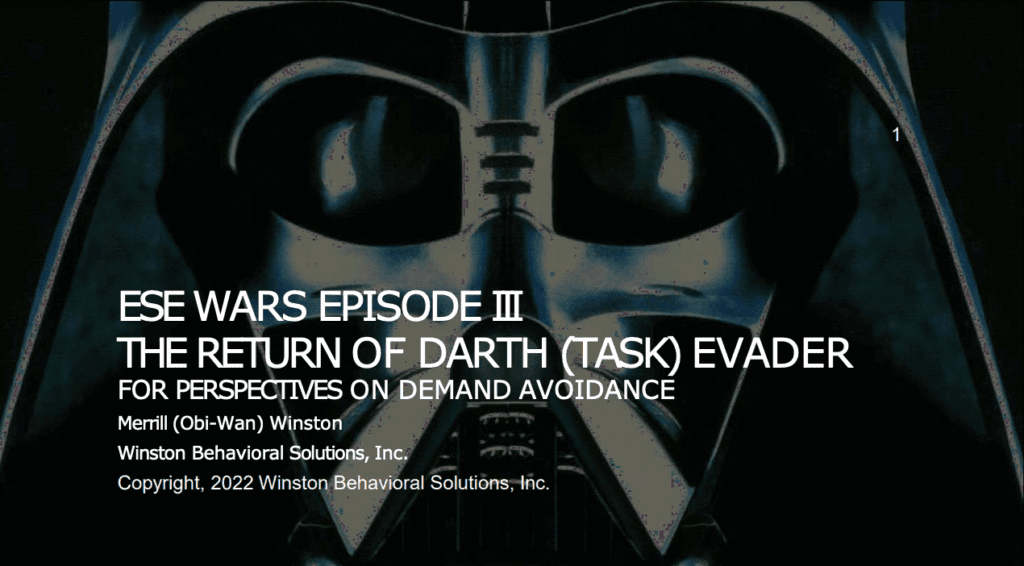
This is not playful. It is dehumanising.
Casting children as Darth Vader figures positions their nervous‑system responses as moral failure or antagonism. It invites professionals to view refusal as something sinister and strategic rather than as communication. It normalises escalation. After all, in war, escalation is not only justified—it is expected.
The metaphor also reveals the emotional stance of orthodox ABA toward non‑compliance: impatience with ambiguity, contempt for refusal, and a deep comfort with coercion so long as it is framed as evidence‑based.
Why this metaphor is especially obscene in the context of PDA
The Star Wars framing is particularly grotesque given the topic. PDA is characterised by threat responses to perceived loss of control. Framing intervention as a battle all but guarantees that the adult will escalate control when the child resists, precisely the dynamic that intensifies distress and refusal.
A child whose nervous system is already interpreting demands as threat is then placed inside a narrative where their distress is read as villainy and the adult’s task is to outmanoeuvre it. This is not misunderstanding; it is conceptual violence.
Even more damning is the organisational context. POPARD hosted this presentation at a conference explicitly asking whether PDA is real. On the same programme, another presenter explained that traditional compliance‑based strategies are contraindicated for PDA students. Yet Winston’s framing turns those same students into adversaries in a behavioural arms race.
If students are cast as Darth Vader and behaviour analysts as Luke Skywalker, then POPARD occupies the role of the Empire: claiming order, rationality, and evidence while systematically crushing difference that refuses to conform, occasionally gesturing toward rebellion without ever relinquishing power.
Metaphor as policy
This is not a question of taste. When professionals are trained using metaphors of war, those metaphors shape intervention choices. They make it easier to justify sticker charts, extinction procedures, and compliance targets because the child has already been cast as someone who must be brought under control.
By the time a parent says, “This harms my child,” the metaphor has already done its work. Harm becomes collateral damage. Resistance becomes proof that the strategy must be intensified. The possibility that the framework itself is wrong disappears.
This is why the metaphor matters. It is not decoration. It is a window into how children are being seen—and why their refusal is so often met with force rather than care.
The role of diagnostic nihilism
Winston’s framework relies heavily on a philosophical move that treats diagnoses as causally inert labels—names applied to behaviour clusters that do not reflect underlying neurological differences. From this perspective, the child is “the same person five minutes before and after diagnosis,” and diagnostic categories have no explanatory power.
This stance is often presented as intellectual sophistication, but in practice it functions as gatekeeping. If diagnoses are merely social constructs, then a profile like PDA—especially one not codified in the DSM—can be dismissed as trendy relabelling rather than a legitimate basis for accommodation. The argument collapses the distinction between how diagnoses are identified and whether the differences they describe are real.
Neuroimaging research directly contradicts this reductionism. Autism and ADHD are not neurologically homogeneous categories; they contain multiple subgroups with distinct, sometimes opposing, brain-structure patterns. The fact that we currently identify these subgroups through behavior rather than biomarkers does not make them fictional. Diagnosis exists to make invisible differences legible so that support, access, and accommodation become possible.
When diagnostic frameworks are treated as meaningless, the predictable outcome is not neutrality—it is denial of support.
-

Neural evidence exposes the steep cost of sacrificing vulnerable children to punitive myths
Neural evidence from Altered Neural Responses to Punishment Learning in Conduct Disorder offers a precise account of how punitive school discipline collides with the neurodevelopmental profiles of vulnerable children, because the study shows that punishment learning relies on the anterior insula’s capacity to transform discomfort…
Why behavioural reductionism cannot explain PDA
Winston’s analysis reduces demand avoidance to motivation problems: insufficient reinforcers, poorly aligned incentives, or competing sources of reinforcement. His solutions all involve manipulating contingencies—interrupting preferred activities, increasing reward magnitude, or refining reinforcement schedules until compliance outweighs resistance.
This framework cannot account for demand avoidance driven by autonomic threat responses to perceived loss of control. For PDA students, the demand itself—not the task, not the reward structure, not the effort required—triggers distress. Increasing reinforcement does not reduce avoidance; it intensifies the sense of coercion.
The ice cream problem

The limits of behavioural reductionism become impossible to ignore in a simple example from my own child.
My son loves ice cream. This is not ambiguous. He would light up when he saw it, move toward it, cry when he could not access it, and choose it over almost any other food. Ice cream was maximally reinforcing. There was no skill deficit, no task aversiveness, no lack of motivation to be solved.
Yet as a young child, he would sometimes refuse ice cream outright, even while visibly distressed about wanting it. The refusals were not random. They were entirely dependent on how the ice cream was offered.
If I asked, “Do you want ice cream?” he would say no. Not a casual no, but a rigid, panicked refusal—sometimes escalating to tears or screams. The question itself functioned as a demand. It required a response. It positioned me as the gatekeeper of the ice cream. It made access contingent on compliance with my question.
Importantly, questions are not neutral for children with PDA. A question still demands processing, still requires a choice, still asserts adult control over timing and access. “Do you want ice cream?” may sound optional, but it is not. The adult controls whether ice cream exists, when it is offered, and whether the child’s answer will be accepted. For a PDA nervous system, that loss of autonomy is sufficient to trigger threat.
If instead I said, “Here, have some ice cream,” the outcome was often the same. The directive framing removed autonomy even more explicitly. I was telling him what to do. Even though the content of the instruction aligned perfectly with his desires, the experience of being directed made accepting the ice cream intolerable.
In both cases, refusing the ice cream did not bring relief. He was not asserting power or enjoying defiance. He was distressed, frustrated, and sometimes angry at himself for being unable to accept something he wanted. This is a crucial point that behavioural models erase: refusal was not rewarding. It was painful.
But when I said, “I put some ice cream on the table,” and then walked away, the outcome changed completely. He would pause—clearly assessing whether this was a trap, whether I expected anything of him—then, once satisfied that no response or compliance was required, he would go to the table and happily eat the ice cream.
Nothing about the ice cream changed. The value of the reinforcer did not change. His motivation did not change. The only thing that changed was the control dynamic.
“I put some ice cream on the table” is not a question. It does not require an answer. It does not require eye contact, verbal response, or immediate action. It does not position the adult as granting or withholding access based on compliance. It provides information and leaves the child fully autonomous to decide whether, when, and how to act.
Behavioural frameworks cannot explain this. In Winston’s model, refusal of a highly preferred item can only mean one of three things: the item is not actually reinforcing, the child has access to a more powerful competing reinforcer, or the refusal itself is being reinforced. None of these explanations fit.
The ice cream was reinforcing. There was no competing reward. The refusal did not produce pleasure, attention, or relief. What it produced was distress. He got to watch his sisters, He got to watch his sisters, eat their ice cream, and enjoy it.
PDA explains this cleanly. For some children, perceived external control activates an autonomic threat response. When the offer is framed as a question or directive, the nervous system responds as if autonomy is being taken away, and refusal becomes compulsory—even when refusal blocks access to something deeply desired. When the same information is conveyed without demand, the threat response does not activate, and the child can act freely.
This is why saying that “questions are demands” is not rhetorical exaggeration. For PDA profiles, questions function as demands because they still impose obligation: to answer, to choose, to comply with the social expectation embedded in the interaction. Treating questions as inherently benign reveals a profound misunderstanding of how control, autonomy, and threat are experienced by these children.
The harm of getting this wrong
A framework that misreads PDA as wilful noncompliance or escape behaviour does not merely fail—it actively harms. Interventions such as sticker charts, reinforcer interruption, or extinction procedures escalate distress, increase perceived coercion, and transform neutral or pleasurable activities into sources of anxiety and conflict.
When I objected to sticker charts for my son in February 2023, POPARD staff dismissed my concerns by claiming PDA was not a real diagnosis in the DSM and saying they had to use ‘evidence-based strategies.” This from someone without a psychology. Surely my son’s psychologist’s recommendations could hold some weight?
Yet three months earlier, their own conference had taught why such strategies are contraindicated for PDA students in Laura Kerbey’s presentation. “Traditional Rewards and Sanctions systems will not work” said Kerbey.
The framework you pick has consequences.
Professional ambivalence as institutional betrayal
POPARD’s ongoing refusal to resolve this contradiction reveals a deeper problem. Ambivalence is not neutral when children are being disciplined, coerced, or denied access in the meantime. Treating PDA as perpetually “emerging” allows institutions to delay change indefinitely while children bear the cost.
The issue is no longer scientific uncertainty. It is whether professional organisations are willing to tolerate clarity when clarity would require them to change practice, relinquish control, and accept parental expertise as legitimate knowledge rather than anecdote.
In continuing to debate whether PDA is “real,” organisations are asking a question that neuroscience has already rendered obsolete. Current research increasingly demonstrates that neurodevelopmental conditions are heterogeneous and that effective support depends on individualised understanding, not categorical purity.
Schools did not need to decide whether PDA belongs in a diagnostic manual to support my child. They needed only to read his psychological report, which explicitly advised against reward charts due to demand resistance. Ignoring that recommendation because it lacked the preferred label was not neutrality or rigour; it was a choice to privilege institutional comfort over a child’s wellbeing.
-

New science on punishment and rewards
A growing body of research from 2023–2025 offers a transformative account of how children learn, regulate, and respond to school environments, because these studies converge on a striking and deeply consequential insight: children learn through stability, safety, and relational reward, while punitive systems generate emotional…
Who pays for ambivalence
POPARD’s continued framing of PDA as a question rather than a reality does not distribute harm evenly. The cost is borne almost entirely by children whose nervous systems respond to control as threat, and by families who must repeatedly justify accommodations that already work.
For these children, behavioural interventions are not neutral experiments. Each sticker chart, each compliance demand, each reinforcement schedule is another exposure to distress framed as therapy. When these approaches fail—as they predictably do for PDA profiles—the failure is attributed not to the model but to the child or the parent: insufficient consistency, poor implementation, unrealistic expectations.
Ambivalence at the organisational level translates into gaslighting at the family level.
The illusion of neutrality
By continuing to host both autonomy-based and compliance-based frameworks, POPARD presents itself as balanced. But neutrality is an illusion when one framework preserves institutional authority and the other requires it to change. In moments of actual accommodation requests—when a parent says, “This will harm my child”—the system reliably defaults to the framework that maintains control.
This is why the contradiction matters. It is not an academic disagreement. It is the difference between communication that preserves dignity and interventions that escalate distress; between support and punishment; between access and exclusion.
-

Engineered famine in public education
In British Columbia schools today, we are not facing a behaviour crisis—we are facing a famine of care. This essay weaves together personal memory, systemic critique, and deep empathy for teachers and families alike to ask why our schools are starving the very…
What clarity would require
Clarity would require POPARD to do something it has so far avoided: state plainly that some forms of demand avoidance are not behavioural problems to be fixed but neurological realities to be accommodated. It would require acknowledging that evidence-based practice includes knowing when not to apply a tool, and that parental expertise is not a threat to professional authority but an essential data source.
Most importantly, clarity would require abandoning the comfort of perpetual inquiry when inquiry has already yielded enough information to prevent harm.
Until that happens, children with PDA profiles will continue to be disciplined for refusing control that their nervous systems cannot tolerate, while institutions reassure themselves that they are still learning.
-

Why the evolving understanding of childhood terrifies systems built on scarcity
Children now arrive at school shaped by homes that honour physiology over performance, autonomy over obedience, and co-regulation over fear, and this shift grows from a decade of relational neuroscience, trauma literacy, sensory understanding, and disability justice that families have absorbed far more…