

Documentation burden
The unpaid, emotionally draining task of proving harm again and again — through emails, logs, incident reports, and data collection no one trained you to do.
-

Changes to Designation Checklists
There is a lot of discussion right now about B.C.’s new inclusive education funding checklists. Some of that discussion is useful. The forms have changed. Some requirements that were previously buried in the Ministry manual are now printed directly on the checklists. That may change how consistently districts document what they are doing. But families…
-
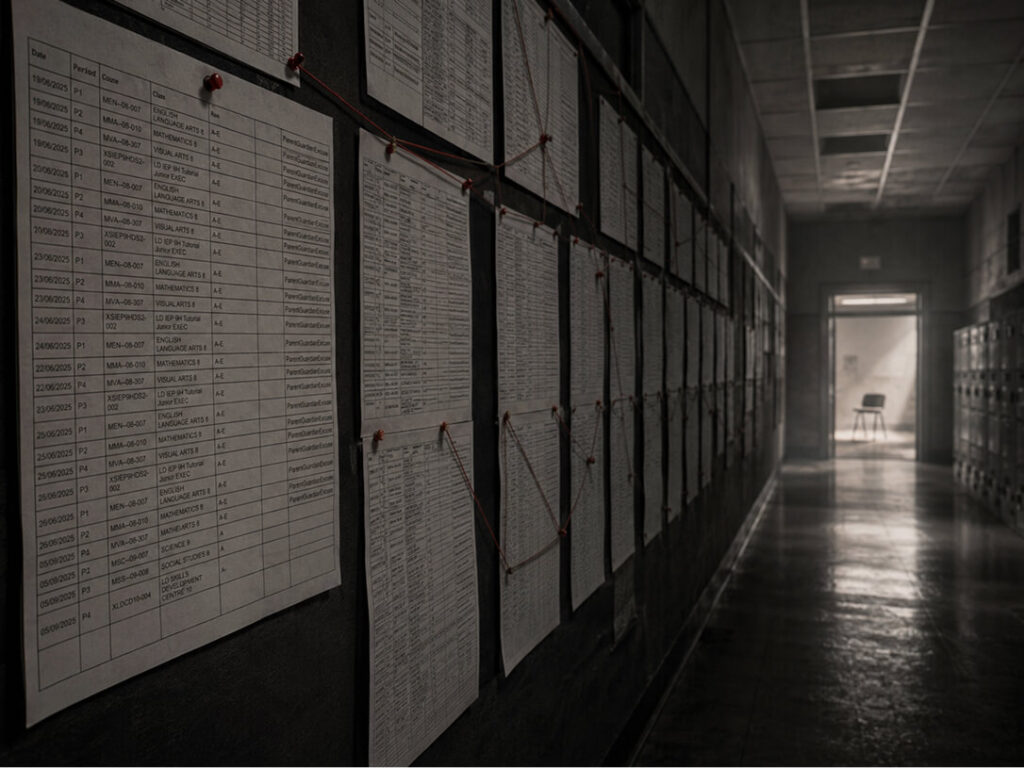
ParentGuardianExcuse: no excuse for exclusion in BC schools
The reason column in my son’s permanent record is mostly blank. When a reason survives, it’s ParentGuardianExcuse.
-

When advocacy stops being collaboration
You’re dealing with a school district, and a recognition is starting to settle: advocacy will not going to be easy! Meetings feel uncomfortable in ways you cannot yet fully name. Promises dissolve between conversations. Your child’s needs remain unmet despite repeated requests. Decisions appear to be made elsewhere. Something about the process feels designed to…
-

Navigating school meetings without losing your mind
School meetings occupy a particular kind of hell where institutional power performs collaboration while enacting control, where districts convene parents to discuss their child’s struggles without acknowledging the system produces those struggles through inadequate accommodation, and where the meeting itself functions less as problem-solving forum than as liability management theatre, generating documentation that protects the…
-

BCTF lobbies for changes to new literacy screening mandate
The BC Ministry of Education and Child Care announced a new mandate this week requiring literacy screening for all kindergarten students beginning in the 2025–26 school year, expanding to K–3 students the following year. The British Columbia Teachers’ Federation published their response, which deserves careful attention. No budget for implementing literacy screening Everyone can see…
-

Kamloops mother speaks after district ignored daughter’s dyslexia for thirteen years
‘She was failed’: Mother speaks out after Kamloops student’s dyslexia ignored tell the story of Heather Morrison. She spent thirteen years asking teachers and principals to assess her daughter for learning disabilities, watching her child move through kindergarten to graduation while reading at an elementary level, her distress mounting with each deflection, each dismissal, each…
-

Justice and dignity too expensive for BC NDP
In 2018, experts told BC exactly how to fix special education funding. The government has spent five years “consulting” instead. Meanwhile, your child sits in hallways. The 192% problem nobody wants to fund Between 2015 and 2024, autism designations in BC schools exploded by 192%. Total student enrolment? Up just 11.6%. The province knows this. They…
-

When delay becomes policy: British Columbia’s strategic abandonment of disabled students
In 2018, an independent panel reviewed how British Columbia funds kindergarten through grade twelve education and recommended a prevalence model for special education funding, a shift that would allocate resources based on statistical prevalence of disability within the general student population rather than on individual diagnostic designation. The proposal threatened to expose what the existing system carefully…
-

Advocacy in BC schools: a comprehensive guide for parents
When your child experiences harm in a British Columbia public school—when they are excluded, punished unjustly, denied accommodations, or subjected to practices that violate their dignity—you enter a landscape designed to exhaust rather than resolve, to defer rather than repair, to protect institutional reputation rather than protect children. This guide maps that terrain, naming the…
-

The children don’t see autism, they see meanness
How schools weaponise ableism through gendered care expectations. Harm amplified by systemic ableism The principal once told me, almost as an aside, that the children “don’t see autism, they see meanness.” It was meant as an explanation, but to me it landed as an indictment of a school culture—to let that ableist misunderstanding stand unchallenged.…
-

Flourishing as an ethical imperative
Like many of you, I caught CBC’s Ideas episode the other day, where philosopher Angie Hobbs spoke about the ancient Greek concept of eudaimonia—a term sometimes translated as happiness or welfare, but more richly understood as human flourishing. In a world flooded by crisis, it may seem indulgent or impractical to contemplate the good life,…
-

The paperwork trap: when doing everything right becomes your downfall
When parents follow every rule, cite every policy, and document every meeting in the British Columbia public school system, they are often framed as adversaries, not allies. This essay explores how procedural knowledge becomes a liability, how the IEP process punishes fluency as threat, and why the most thorough advocates are the ones most likely…
-

The compliance economy
In their article Of Sinners and Scapegoats: The Economics of Collective Punishment, J. Shahar Dillbary and Thomas J. Miceli argue that collective punishment emerges not merely as a failure of precision or fairness, but as a deliberate mechanism for preserving internal group cohesion. The scapegoat, must be non-random, visible, and different, and their suffering must be…
-

The truth shall set us free: healing from institutional violence in BC public schools
Healing doesn’t begin with massages or mindset shifts. It begins with telling the truth about what was done to us—about what it means to watch your child collapse under institutional betrayal, to be praised for your composure while they take away his lifeline. The system demands civility while delivering harm. This essay is a witness…
-
Why clarity gets punished
I’ve written about documentation, tone policing, gatekeeping, gaslighting, institutional betrayal, and grievability and legitimacy separately, butsometimes it helps to see those pieces in conversation—because together, they reveal something larger. This post draws together the threads of clarity, competence, and credibility, and asks: why do systems recoil when mothers speak plainly about harm? Why does it…
-

15 red flags your child’s school is running the playbook on you
How to spot coercive proceduralism before it drains your energy, your trust, and your child’s future. You may have been advocating for your child for months—attending meetings, responding to emails, following every process they set out—yet the accommodations you discussed never seem to appear in the classroom. You might notice your child’s struggles at school…
-

$10K and an NDA
Would 10K and an NDA make the most excellent name for a country song? I didn’t file a Freedom of Information request to stir conflict — I filed it because nothing made sense, and I needed a clue, any thread at all, to understand what had just happened to my family. I call FOIs the…
-

The path to justice: legal versus public record
The courts may offer compensation, but rarely truth. The legal path demands silence in exchange for settlement. The public path asks you to speak while you’re still bleeding. Neither is easy. But only one builds a record that helps the next family survive.
-

A landmark case for educational justice in BC
The May 2025 decision from the BC Human Rights Tribunal in Parent obo Student v. BC Ministry of Education and another, 2025 BCHRT 112 carries profound implications for families fighting systemic discrimination in education—particularly those challenging collective punishment, exclusion, and partial-day attendance programs imposed on disabled students. While the complaint against the Ministry was dismissed, the Tribunal…
-

Rethinking accessibility leadership, training, and labour in BC public education
In accessibility work, most transformative insights come directly from disabled people. Lived experience is primary data; manuals and metrics are, at best, secondary literature. In schools, teachers are experts in pedagogy, yet few are trained in disability or neurodivergence. That absence is not incidental—it is engineered, and the consequences are everywhere. The current failure—and promise—of…