

Education Policy
Laws, regulations, and governance decisions that shape the daily realities of students, families, and educators. This tag includes critical analysis of ministry directives, district implementation practices, funding structures, and systemic accountability mechanisms. It also traces the dissonance between policy ideals—such as inclusion, safety, and equity—and the actual experiences of those navigating the system, particularly disabled and neurodivergent students and their caregivers.
Inclusion BC is an excellent reference—particularly for a neurodiversity-affirming, disability justice–aligned perspective on education policy in British Columbia. Their work foregrounds the rights of disabled students and families, and they consistently critique systemic ableism, segregation, and policy failures in public education. They also engage directly with provincial ministries, making them both a watchdog and a thought leader.
-

No accidents left to excuse
When I first read the Canary Collective’s Systemic Abuse in Education: Breaking the Cycle and Kim Block’s companion essay Is this Systemic Oppression or Systemic Abuse?, I did not feel revelation so much as recognition. I have called what happens to disabled and neurodivergent children in British Columbia’s schools abuse for years, because the word fits the scale…
-

The long tail of Covid: on disability and school absences
I would like to acknowledge the shared labour of our community, because this interpretation arises from absorbing the stories that circulate within our community, where families describe the daily calculus of parenting, the emotional and physical toll of mornings, and the persistent hope that someone will finally recognise the scale of labour required simply to…
-

Bearing witness to truth
Every once in a while, a piece of writing crystallises what thousands of parents have been living for years — the quiet collapse of public education as a place of belonging for disabled children. Kim Block, Chair of BCEdAccess, has written such a piece. Her essay, published on October 18, 2025 and reprinted by the…
-

North Okanagan-Shuswap (SD83): a neurodiversity-informed policy critique
School District 83’s Policy 310 Student Code of Conduct, amended December 14, 2021, presents itself as a framework for “safe, respectful, and inclusive learning and working environments for all members of its school communities.” The policy commits to restorative approaches, acknowledges that consequences should be “preventative and restorative in nature,” and states explicitly that “appropriate…
-

Care and support for children with disabilities within the family
Children thrive when their caregivers thrive. The Special Rapporteur reminds us that the well-being of children with disabilities is bound to the well-being of their families—especially mothers, who carry most of the invisible labour. When schools fail to support families, they create conditions that push children toward exclusion or even institutionalisation. Families are often forced…
-

Advocacy in BC schools: a comprehensive guide for parents
When your child experiences harm in a British Columbia public school—when they are excluded, punished unjustly, denied accommodations, or subjected to practices that violate their dignity—you enter a landscape designed to exhaust rather than resolve, to defer rather than repair, to protect institutional reputation rather than protect children. This guide maps that terrain, naming the…
-
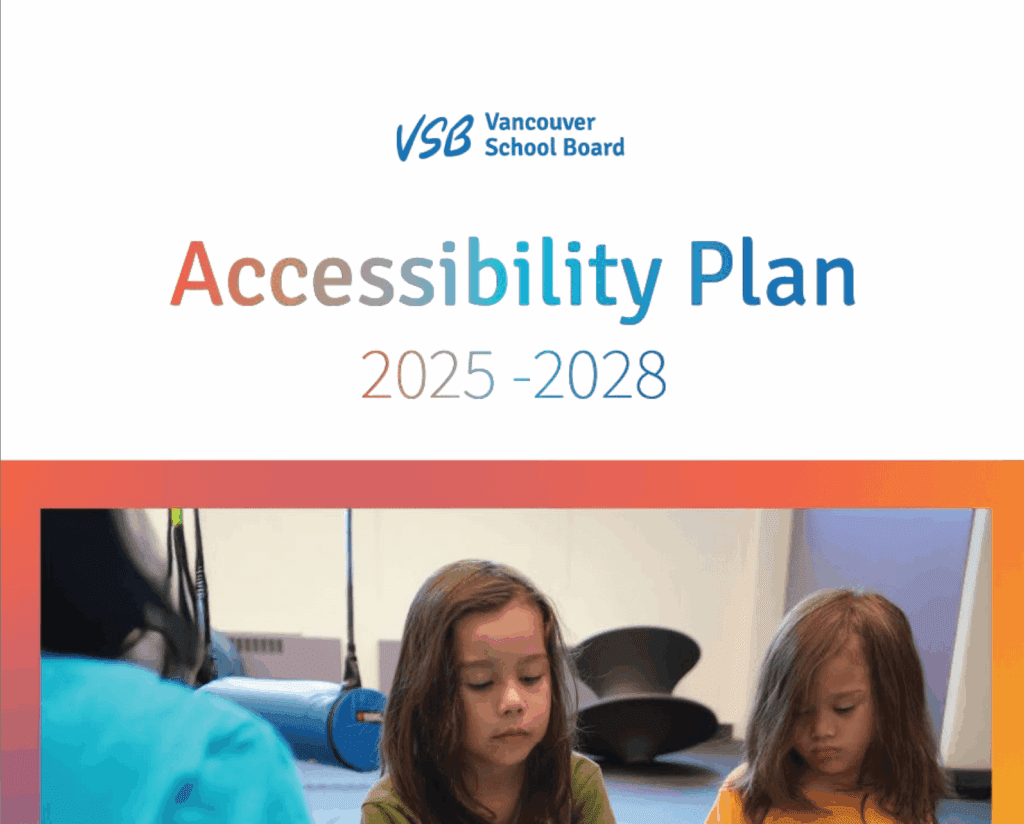
Side-by-side comparison of the VSB plan and a meaningful accessibility plan
The Vancouver School Board has released an accessibility plan that presents itself as a generous gesture toward inclusion, offering aspirational statements about equity, belonging, and shared responsibility, yet the document carries a softness that obscures the lived gravity of disabled students’ experiences and the profound emotional labour that families expend while navigating systems shaped by…
-

Serpentine Heights Elementary (SD36): a neurodiversity-informed policy critique
Serpentine Heights presents its Code of Conduct as an affirmation of safety, inclusion, and communal care. The opening commitments describe a school that values belonging, co-constructed routines, and dignity for every learner, offering a vision of education rooted in relational safety and shared citizenship (p. 1) . This framing gestures toward a caring culture, one…
-

Urgent behaviour intervention teams in major BC school districts
Across British Columbia, many school districts have developed internal teams or programs designed to respond to urgent behavioural situations—such as elopement, aggression, or significant dysregulation—particularly when students are perceived as posing a safety risk or disrupting the learning environment. While these interventions are often framed as supportive or inclusive, families report that they can feel…
-
Safety plans, billion-dollar scripts, and the harm they keep in place
When a parent hears the words safety plan, there is often a breath held in the chest — a brief hope that the school has recognised the reality of the child’s distress, that they have stepped back to consider what would truly help, that they are inviting the parent to build something together that will let…
-

This isn’t a unique case, is it?
My children’s father said in a meeting: “Surely you’ve dealt with this before and you have a solution? This isn’t a unique case, is it?” The question hung in the air, simple and devastating, exposing in one breath the entire pretence on which school leadership rests. The question matters because it cuts through bureaucratic delay…
-

Fraser Cascade School District (SD78): a neurodiversity-informed policy critique
The updated 2024 Code of Conduct for SD78 arrives in the context of a newly adopted Diversity, Equity, and Inclusion policy that promises proactive protection for students across multiple identity dimensions. At first glance, the Code carries forward much of the language from its 2017 predecessor—including commitments to prevention, fairness, and restorative practice—and now adds a new section…
-

They keep moving the goalposts while our kids pay the price
It began with a phone call that felt like a lifeline. A new teacher was coming, they said, and maybe this would be the one to understand. We clung to that hope. We paid for another assessment, scheduled more therapy, spent weekends in waiting rooms and weekdays in meetings where the promise of change hovered…
-

ADHD and autism aren’t phases
We don’t expect a wheelchair user to “earn” the right to walk by graduation. We don’t tell a student with diabetes that the goal is to get off insulin. And yet, in schools across our district, support for autistic and ADHD students is treated like a ladder they’re supposed to climb once and throw away…
-

When the bell rings but the doors stay shut: why withholding recess is a breach of children’s rights
Few topics ignite as much debate as the cancellation of recess. Threads often begin with a frustrated parent describing how an entire class lost recess because of one student’s behaviour, or a teacher recounting the expectation to withhold outdoor play for incomplete work. Commenters share stories of children sitting silently at their desks while watching…
-
Flourishing as an ethical imperative
Like many of you, I caught CBC’s Ideas episode the other day, where philosopher Angie Hobbs spoke about the ancient Greek concept of eudaimonia—a term sometimes translated as happiness or welfare, but more richly understood as human flourishing. In a world flooded by crisis, it may seem indulgent or impractical to contemplate the good life,…
-

7 signs your child (or you) is being positioned as the problem to preserve the group
When a parent becomes too precise, too prepared, or too emotionally honest, the school system may cast them—or their child—as the problem. This essay outlines seven signs that scapegoating is being used to preserve group harmony at the cost of justice, with particular attention to how this dynamic unfolds in British Columbia public schools.
-

The paperwork trap: when doing everything right becomes your downfall
When parents follow every rule, cite every policy, and document every meeting in the British Columbia public school system, they are often framed as adversaries, not allies. This essay explores how procedural knowledge becomes a liability, how the IEP process punishes fluency as threat, and why the most thorough advocates are the ones most likely…
-

Collective punishment: how schools displace guilt, erase harm, and preserve the collective
One of the things that was so traumatising about the collective punishment that was callously perpetrated against my daughter was the light and evasive tone of the principal. She said that the punishment had to be “swift.” I frequently wondered about the choice to psychologically wound disabled children while treating the infliction of that wound…
-
How schools weaponise growth against disabled students
In the architecture of public education, few concepts are more universally praised—or more fatally misunderstood—than independence. Cloaked in progressive language about agency, resilience, and growth, the independence mandate is often wielded less as a vision for liberation than as a strategy of withdrawal. For disabled students, particularly those who have learned to endure, mask, or…