
POPARD
POPARD (the Provincial Outreach Program for Autism and Related Disorders) is a publicly funded service in British Columbia, created to support schools in working with autistic students. Despite branding that gestures toward inclusion, POPARD’s leadership continues to sanction ABA-based strategies—including token economies, behaviour charts, and compliance tracking—even when families explicitly withdraw consent. This tag collects documentation and analysis of POPARD’s practices, and explores the systemic harm caused when behavioural control is prioritised over dignity, autonomy, and trauma-informed support.
-
Happy belated PDA Day
I have written about Pathological Demand Avoidance (PDA) quite a bit over the past year, so for PDA Day / PDA Action Week I thought I would do a small review of the themes I keep returning to. It’s not wilful behaviour, usually Schools often read demand avoidance as refusal, manipulation, defiance, escape, or “not…
-

They still haven’t learned: POPARD and PDA
POPARD’s internal PDA training materials have been circulating through parent communities this week, released through a freedom of information request to a BC school district, and what they reveal is something more structurally damning than a policy directive to dismiss Pathological Demand Avoidance — they expose the precise mechanism by which an organisation can train…
-

POPARD’s PDA doublespeak
I noticed that POPARD is advertising another workshop on Pathological Demand Avoidance (PDA) in April 2026, titled Pathological Demand Avoidance (PDA): What We Know & What We Are Learning. The description is familiar: PDA is framed as a “growing topic of interest,” something “some clinicians and researchers describe” as an autism profile. The language is cautious,…
-

When provincial bodies dismiss parental expertise: POPARD, sticker charts, and the refusal of heterogeneity
In the previous essay, I examined neuroimaging research demonstrating that autism and ADHD are not internally homogeneous diagnostic categories but rather contain multiple neurologically distinct subgroups, often with opposite patterns of brain structure alterations relative to controls. The Pecci-Terroba study reveals what categorical intervention logic refuses to accommodate: diagnosis alone cannot determine whether a specific…
-
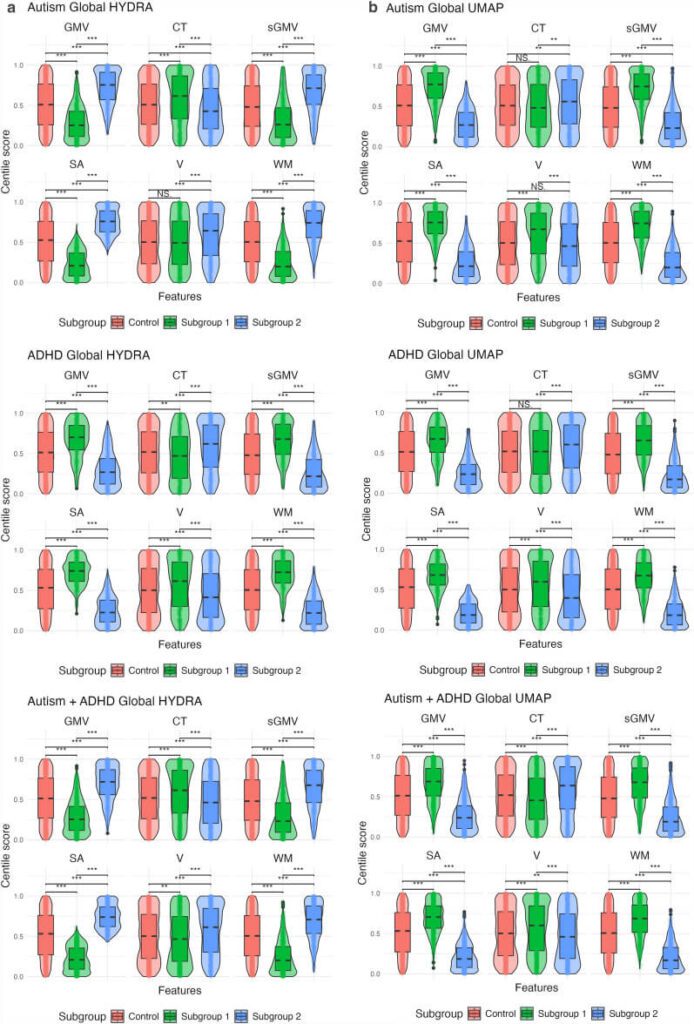
Subgrouping autism and ADHD based on structural MRI population modelling centiles
A June 2025 neuroimaging study examining brain structure patterns across individuals with autism, ADHD, and combined diagnoses, published in Molecular Autism by Pecci-Terroba and colleagues applies population modelling to cluster participants based on centile scores for cortical thickness, surface area, and grey matter volume, using HYDRA—a semi-supervised machine learning algorithm that identifies subgroups based on…
-

The material costs of educational harm
My son no longer attends school. He no longer wants anything the education system offers. He has taught himself programming, navigates Linux with expertise that exceeds my own knowledge, learns alone in his room because learning with others became too expensive to survive. The district asks affectionately how he is, suggests I login to their…
-

From trauma to topology: the grotesque work of quantifying institutional denial
When institutional harm accumulates in childhood—in objects confiscated, spaces denied, bodies excluded—the evidence lives first in memory and affect. The saucer eyes of a humiliated or frightened child. The sting in the sobs of a child who just wants to be with her friends at the volleyball game. The physical weight of a garbage bag…
-

7 signs your child (or you) is being positioned as the problem to preserve the group
When a parent becomes too precise, too prepared, or too emotionally honest, the school system may cast them—or their child—as the problem. This essay outlines seven signs that scapegoating is being used to preserve group harmony at the cost of justice, with particular attention to how this dynamic unfolds in British Columbia public schools.
-

Vancouver School Board’s Urgent Intervention Process – purpose, process, and controversy
The Urgent Intervention Process (UIP) – formerly known as the Multi-Interdisciplinary Support Team (MIST) – is a Vancouver School Board (VSB) initiative designed to provide rapid support for schools dealing with students with extremely challenging behaviours or acute needs. The program was expanded in the mid-2010s as part of VSB’s special education support model, with the stated goal…
-

Confident Parents, Thriving Kids—unless you’re autistic
Why school systems should reject behaviourist programs disguised as mental health support. Our daughter was melting down almost every day after school. She would cling to me at drop-off like she was drowning—like she had to hold onto me or she would lose herself, unable to breathe, unable to bear it. She was already telling…
-

Against our will: When ‘support’ becomes institutionalised coercion
I said no. I said it plainly, early, repeatedly. I said it in writing, I said it on the phone, I said it from a place of trembling grief and exhausted clarity. I said it as a mother who had already tried everything. I said it after describing the diagnostic framework, after explaining what worked,…
-

Non-coercive, trauma-informed alternatives to PBS/ABA in BC schools
Positive Behaviour Support (PBS) and Applied Behaviour Analysis (ABA) are behaviourist approaches widely used in schools to manage student behaviour. However, a growing chorus of neurodivergent advocates, educators, and researchers highlight that these methods often prioritise compliance and “normalising” behaviour over student well-being rcpsych.ac.uk. By focusing on making neurodivergent children appear neurotypical (meeting neuronormative standards), traditional PBS/ABA can…
-

I only asked for gentleness: on parenting a PDA child in a punishing world
There is a certain kind of child—intuitive, emotionally articulate, wired with a startling perceptiveness about power and tone, about coercion and choice, about the invisible terms of adult authority—whose presence in the classroom becomes, almost immediately, a threat to the institution’s rhythm, a disruption to its hierarchy, a mirror held up to its limitations.
-

The bait and switch: What inclusion really looks like at the VSB
Every September, I walk into school meetings with the same cautious hope. We’ve done everything right. The diagnoses are up to date. The IEP is in place. The reports are filed — more than thirty of them over the years, from audiologists, psychiatrists, speech-language pathologists, behaviour consultants, and occupational therapists. You’d think that would mean…
-

Rot at the root: Why POPARD must be dismantled from the top down
When I first objected to the strategies POPARD proposed, I tried—truly—to assume good intent: that if I just gave them the right information, the clearest language, the most generous interpretation of their mandate, they would course-correct and stop pushing reward charts onto an already-traumatised child. I wrote careful emails, cited the psychologist’s diagnosis, offered specific…
-

Shut it down: Why POPARD cannot be trusted to support neurodivergent children
We asked for help.We got a behaviour chart. We invited experts into our child’s life, hoping they would help school staff understand his anxiety, his trauma responses, his fiercely sensitive nervous system. We asked for relational strategies grounded in respect and attunement. We shared research. We named his diagnosis. We explained, in plain terms, what…