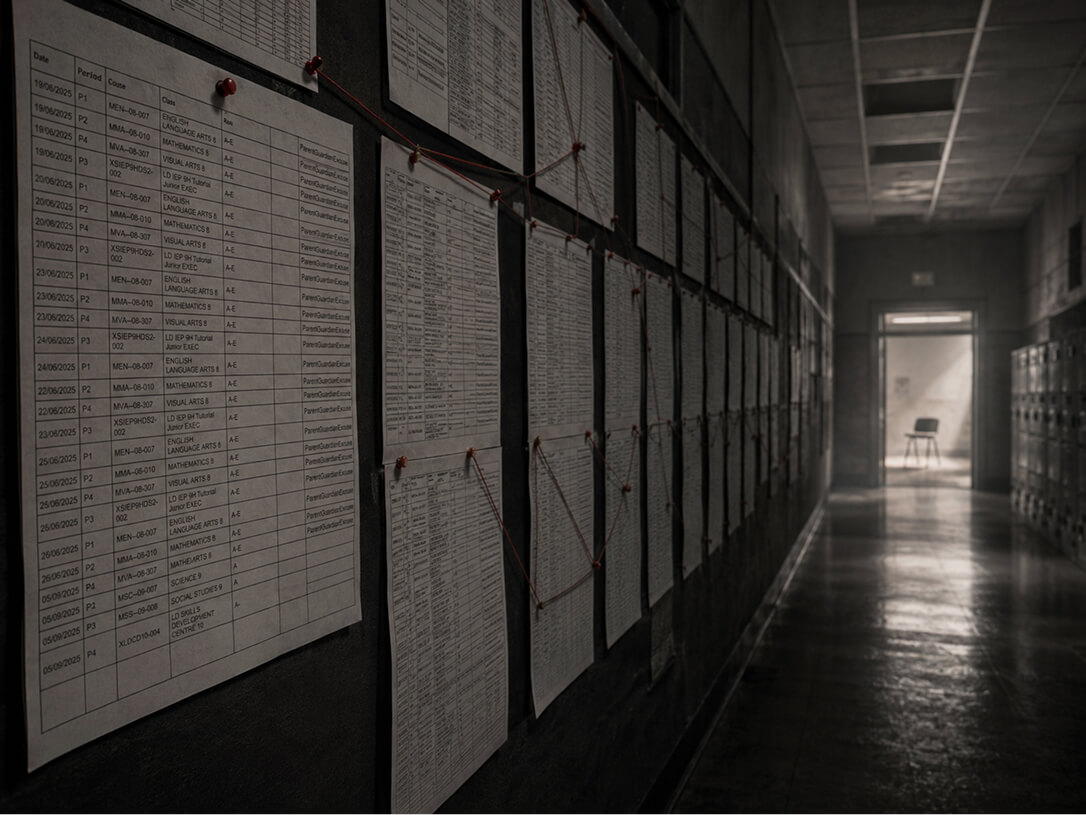
Kootenay Lake School District is moving toward a staffing change in Indigenous Education that families say will remove teacher-led Indigenous Education from elementary and middle schools and replace the teacher with Indigenous Support Worker positions.
On paper, this may look like a staffing model change. One role is removed. Other roles are added. A budget line remains. The district can still say Indigenous Education funding exists; it can still say Indigenous students will receive support; it can still say a process was followed.
But a budget line cannot hold a relationship.
Families in SD8 are describing something concrete and fragile: children who have built a relationship with their Indigenous Education teacher; children who have started to feel proud of being Indigenous because someone in their school sees them, knows them, and teaches from a place of relationship.
That is what SD8 is proposing to disrupt. The district appears to be treating relationship-based Indigenous Education as an administratively replaceable service — a staffing category, a funding stream, a model that can be moved from one community to another like furniture between rooms.
The budget story
The budget context matters because it shows how easily public systems convert living obligations into numbers that can be rearranged.
SD8’s public budget materials project a decline of 109 student FTE, or 2.4%, for 2026–2027. The preliminary budget shows $67.0 million in operating revenue and $67.2 million in operating expenses, with the district planning to use about $0.6 million from accumulated operating surplus for technology, school furniture, equipment, and ongoing commitments. The district also says enrollment is declining while staffing levels are being maintained to support classrooms and student success. (Meeting Minutes)
That is the first layer of the story: enrollment is down, costs are up, and the district must pass a balanced budget.
But this is where the language starts to do political work.
Declining enrolment does not mean declining obligation. Fewer students does not mean fewer Indigenous students need connection, culture, identity, instruction, and belonging. It does not mean reconciliation becomes cheaper. It does not mean the children who remain require less.
Yet budget processes often treat anything outside the core machinery of the system as discretionary. Salaries, buildings, utilities, and contractual obligations become fixed. The programs that make school accessible, relational, culturally safe, or meaningful become the flexible part of the spreadsheet.
That is how reconciliation becomes a line item.
Follow the money
Indigenous Education funding in BC includes targeted funding that is supposed to be additional to the basic per-pupil allocation. The Ministry says Indigenous Education Targeted Funding is for enhanced Indigenous education programs and services for students who self-identify as Indigenous, in addition to other programs and services to which students are eligible. (K-12 Funding – Indigenous Education)
The Ministry’s Indigenous Education Council policy also says boards must seek input and advice from the IEC and obtain IEC approval for Indigenous Education Targeted Funding plans, spending, and reporting. The policy says prior-year unspent IETF also needs IEC approval and must be handled according to Ministry direction. (Indigenous Council)
That makes the budget question direct: if certified teacher-led Indigenous Education is being reduced and replaced with lower-cost support roles, how will the full Indigenous Education funding be spent?
SD8’s public budget webinar says additional operating expenses are partly offset by “lower expenditures associated with reduced carry-forward balances in Indigenous targeted and Indigenous Education Capacity funding,” along with other cost reductions from a review of discretionary spending. (Meeting Minutes)
That does not, by itself, prove misuse of targeted funding. But it does raise a legitimate transparency question. Families are entitled to know whether any labour-cost savings from this staffing change will be reinvested in Indigenous Education in the affected schools, carried forward for Indigenous Education purposes, or used to ease broader budget pressure.
The budget documents I reviewed do not clearly itemise that.
Budgets cry wolf and Three Stooges governance
In The budget that cries wolf: SD61’s deficit cycle, BCEdAccess has documented a disturbing pattern across BC school districts: boards warn of budget crisis, remove supports and accommodations for vulnerable children, and then later end the year with a surplus.
As BCEdAccess outlined in Say here, if I call your name, we’re tired of the excuses. We do not want these Three Stooges excuses for continuing to destroy the supports that allow our children to attend school:
When disabled children are excluded, the system can look like Three Stooges governance:
1. the Ministry points at districts,
2. districts point at schools,
3. schools point back at funding, staffing, policy, or “complexity,” and everyone insists the problem belongs somewhere else.
But families are not watching a comedy routine.
They are watching a public system pass responsibility around while their children lose access to school.
Parents should not have to care which hand dropped the ball. Public education is one system, and services for disabled children should be guaranteed.
Every year, schools have to present a balanced budget, and every year that means shaving off something critical for disabled or vulnerable children. This year in SD8, that has meant trying to find a couple hundred thousand to close the gap — and finding it in the Indigenous Education program. Robbing these children who are finding connection to their indigenous heritage through a teacher they trust.
Then come the children
Children have watched their teacher make space in the school for Indigenous identity to feel visible, ordinary, proud, and connected. Children may not have the language for colonial history or district governance, but they know exactly what it feels like to have a trusted adult create a room where they belong.
Families report that, at one affected school, a single Indigenous Education teacher serves a large student population, brings Elders into the school, supports school-wide programming, and leads cultural learning that reaches far beyond individual student support.
The budget can say one model replaces another. But children do not experience a model. They experience a person. They experience continuity. They experience whether the adults in their school have made Indigenous identity something honoured, taught, and carried through daily life — or something reduced to a line item and a laminated poster.
This is not an equivalent replacement
The replacement roles are being described by families as Indigenous Support Workers.
Indigenous Support Workers may be skilled, culturally grounded, and deeply valuable. They may build relationships with students. They may do important work. The issue is not whether those workers matter. They do.
The issue is what is being removed.
An Indigenous Education teacher holds a different position inside the school. A teacher can lead curriculum, design instruction, support colleagues, build school-wide learning, organise programming, work with Elders, and help shape the pedagogical life of the building.
A support worker — however essential — carries a different role within the institutional hierarchy and does not hold the same authority to shape curriculum, direct school-wide learning, or embed Indigenous Education across the life of a school.
SD8 appears to be moving Indigenous Education away from teacher-led pedagogy, curriculum, relationship, identity, and school-wide transformation, and toward a support-worker model that risks narrowing the work into individualised assistance for Indigenous students.
That is not an equivalent replacement.
It is a philosophical retreat dressed as a staffing plan.
Consultation after the fact is not consultation
SD8’s Indigenous Education Council is newly formed and includes representatives from the Ktunaxa, Syilx, and Secwépemc Nations and the West Kootenay Métis Society. (Indigenous Education Council Policy)
The public record also does not show meaningful local consultation with the affected Nelson-area school communities before this staffing change. Public IEC minutes show planned school visits to L.V. Rogers Secondary and Redfish Elementary on April 14, 2026. I did not find comparable public documentation showing visits to Trafalgar, South Nelson, Rosemont, Hume, Wildflower, W.E. Graham, or Blewett before the decision. (Meeting Minutes)
That matters.
A district-level council may have a role. But council-level approval is not the same as local consultation with the families, Elders, students, teachers, and school communities who know what exists in a specific place.
The concern is not necessarily that a support-worker model is wrong everywhere. It may work in some communities. It may reflect local relationships, local staffing realities, and local priorities.
But Creston is not Nelson.
A staffing model that works in one community cannot be copy-pasted into another as though history, Nation relationships, staffing pools, school culture, and community trust are portable commodities.
The Sinixt absence is not neutral
The Sinixt absence is not a side issue.
The Supreme Court of Canada’s 2021 decision in R. v. Desautel recognised that the Lakes Tribe could be considered a modern-day successor group to the Sinixt and part of the “Aboriginal peoples of Canada” under section 35 of the Constitution. The Court accepted that the Lakes Tribe is a successor group to the Sinixt people, whose territory extended into what is now British Columbia and Washington State.
That matters because decisions about Indigenous Education in Nelson-area schools are being made in a region where Sinixt erasure is not abstract history. The Canadian state once declared the Sinixt “extinct,” despite the continued existence of Sinixt people and descendants.
Sinixt people are returning, reconnecting, and rebuilding visible presence in their territory. A decision about Indigenous Education in Nelson-area schools cannot credibly proceed as though Sinixt absence from the governance structure is a neutral omission.
A district can speak the language of reconciliation while reproducing the administrative logic of erasure. It can acknowledge land while excluding people whose relationship to that land has been denied by the state. It can create an Indigenous Education Council while still leaving out a people whose erasure is central to the colonial history of the region.
If Indigenous Education is supposed to help students understand land, history, belonging, and colonial harm, then the process used to govern Indigenous Education must not reproduce the very erasure it should be teaching students to recognise.
The board cannot hide behind the council
The school board cannot disappear into the council process.
The Council has an important statutory role in approving plans and spending for Indigenous Education Targeted Funding. But the board and district still remain responsible for staffing, budgeting, implementation, and the educational services provided to children.
“The council decided” can become another accountability shield.
The board points to the council. The district points to process. The budget points to enrollment. The staffing plan points to a new title. Families are left watching a program that was working get dismantled while everyone insists the decision belongs somewhere else.
If the board is still hiring the roles, paying the wages, and deciding what happens in schools, then the board is still accountable.
Full stop.
The recruitment question nobody has answered
There is also a practical question that should have been answered before implementation: does Nelson have the Indigenous staffing pool to fill these positions?
Families report that Indigenous Education staffing has already been difficult to recruit in at least one affected school. If that is true, what is the plan for recruiting multiple Indigenous Support Workers in the Nelson area?
That question is not a minor implementation detail. It is the difference between a real service and a paper service.
If September arrives and the district cannot fill these positions, then the model does not expand Indigenous Education. It removes a functioning relationship and replaces it with vacancies, patchwork coverage, or generic support.
More bodies do not automatically mean more reconciliation. More staff do not automatically create more curriculum, more cultural safety, more continuity, or more relationship. If the teacher role disappears, something real disappears with it.
And if the replacement roles cannot be filled, what remains is a budget line pointing to an empty room.
What SD8 should do now
SD8 should pause the implementation of this change.
The district should explain the implementation timeline, disclose the budget implications of the staffing change, and meet directly with Indigenous families, students, Elders, teachers, and community members before teacher-led Indigenous Education is removed.
It should explain whether the full Indigenous Education grant will continue to be spent on Indigenous Education in the affected schools.
It should explain why teacher-led Indigenous Education is being removed from elementary and middle schools while teacher-led positions remain in secondary settings.
It should address Sinixt representation directly.
And it should stop treating reconciliation as something that can be proven by process alone.
A budget line cannot hold a relationship
Families are not fighting for a line item.
They are fighting for a teacher their children know. They are fighting for a room that has become a place of belonging. They are fighting for Elder relationships, school-wide learning, cultural continuity, and the fragile, irreplaceable work of helping children feel good about who they are in a system that has not always wanted them there.
Across public education, districts are learning how to keep the language of equity while thinning the structures that make equity real. They preserve the title, rename the role, consult the advisory body, balance the budget, and call the result responsible governance. But children know the difference between a relationship and a replacement. They know who is there. They know who is gone.
And if SD8 proceeds without listening to the families, students, Elders, teachers, local communities, and Sinixt voices affected by this decision, then the district will have taught a lesson far more powerful than anything written in its Indigenous Education plan.
It will have taught children that reconciliation can be spoken fluently by institutions that still do not know how to listen.