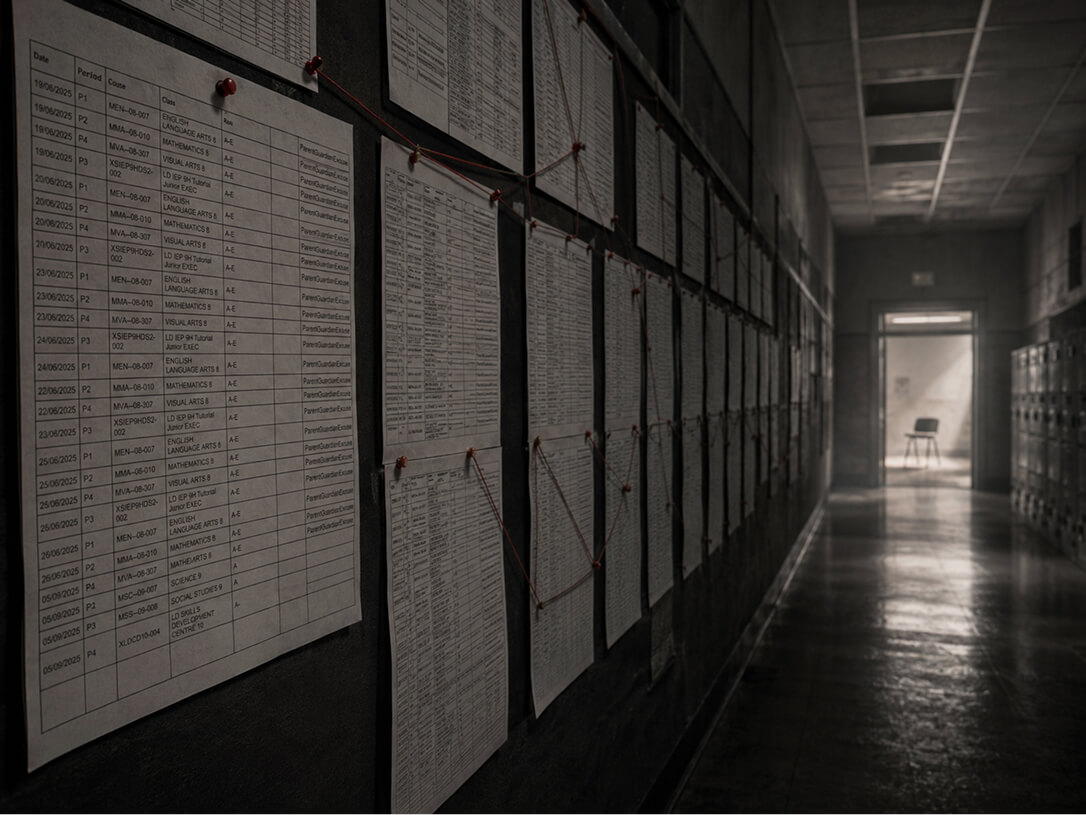
You ask your child’s school for the safety plan. Staff assure you it exists, that they follow established practice, that every decision serves your child’s best interest; then you wait, and the folder that finally arrives mostly empty.
British Columbia’s Freedom of Information watchdog has just shown that government does this to itself, at scale. Drawing Access Together, published on 15 June by Spencer Izen for the BC Freedom of Information and Privacy Association, spent four years using freedom of information to study freedom of information — obtaining the policies, training decks, and process maps of more than fifty public bodies to ask how the machinery of access actually runs. The answer is sobering for anyone who has filed an FOI to document what a school did to their child.
Izen finds that most public bodies leave the standard unwritten. There is rarely an agreed rule for how records are retrieved or how they are severed. He finds that the duty to document, which the province once trumpeted as a Canadian first, withered on contact, surfacing years later in one ministry’s network manual as a “new” expectation it had already decided it met.
And he finds that the documents themselves invoke “established standards” pointing to instruments no one can name or produce — phantom references he reads, by way of Harry Frankfurt, as bullshit in the technical sense, language disconnected from any concern with whether the thing it names is real.
The business-process maps perform the final sleight of hand, quietly converting the thirty-day statutory maximum into the everyday mean. Speed becomes the only virtue the system can measure; correctness goes unrecorded.
Bill 9 was approved
Three weeks before the report landed, the province moved in the opposite direction. Bill 9 passed third reading on 28 May, swapping the duty to respond “without delay” for the roomier “without unreasonable delay,” and widening the grounds on which a public body may disregard a request — now reaching requests deemed abusive, malicious, excessively broad, or liable to interfere with government operations.
Government has granted itself more discretion to refuse on grounds of efficiency, precisely as an independent study demonstrates that the inefficiency flows from its own refusal to keep records properly in the first place. Izen’s fifth recommendation asks that correctness replace timeliness. Bill 9 loosens the clock and leaves the empty file intact.
For families, this reads as the obvious shape of things. The missing record is the method. The safety plan that cannot be produced, the “best practice” that can’t be looked up, the policy that isn’t found in writing — these are the same empty folder Izen found in the ministries. Freedom of information is how we turn that absence into evidence; it is how we build receipts the institution declined to keep for itself. Bill 9 narrows that tool at the exact moment a four-year study confirms how much there is to find.
So we keep asking. We keep the receipts the system declines to keep, and we treat every “no record exists” as a finding rather than an ending.
Read Izen’s report in full.