
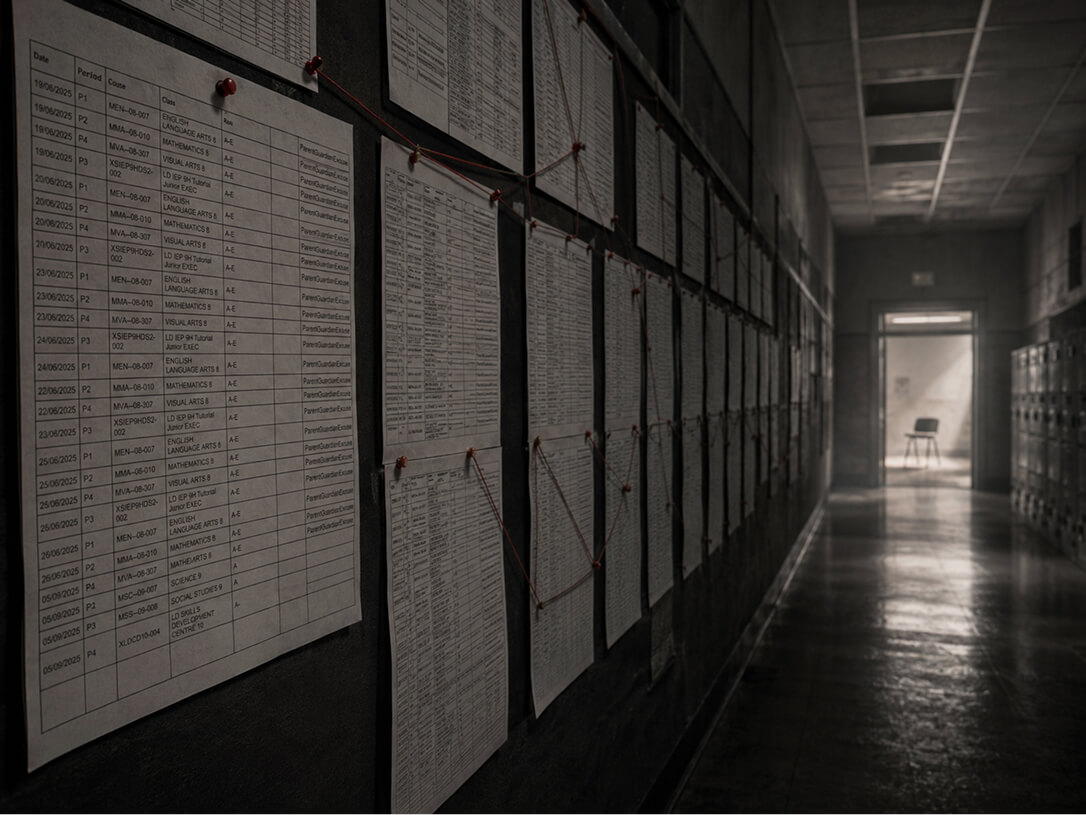
Designed to exhaust
A structural tactic embedded in institutional systems that functions not through overt denial but through the slow erosion of energy, clarity, and will. It refers to the repeated use of delay, deflection, procedural ambiguity, and reputational threat to drain the caregiver—most often the mother—of her capacity to advocate, document, or resist. Rather than silencing her outright, the system places the burden of persistence entirely on her shoulders, requiring infinite patience, strategic fluency, emotional restraint, and self-sacrifice to obtain even the most basic support. The exhaustion is not accidental—it is a feature of the design. It ensures that only those who comply are heard, and those who refuse collapse under the weight of their knowing. This exhaustion becomes both the method and the justification for further exclusion.
-
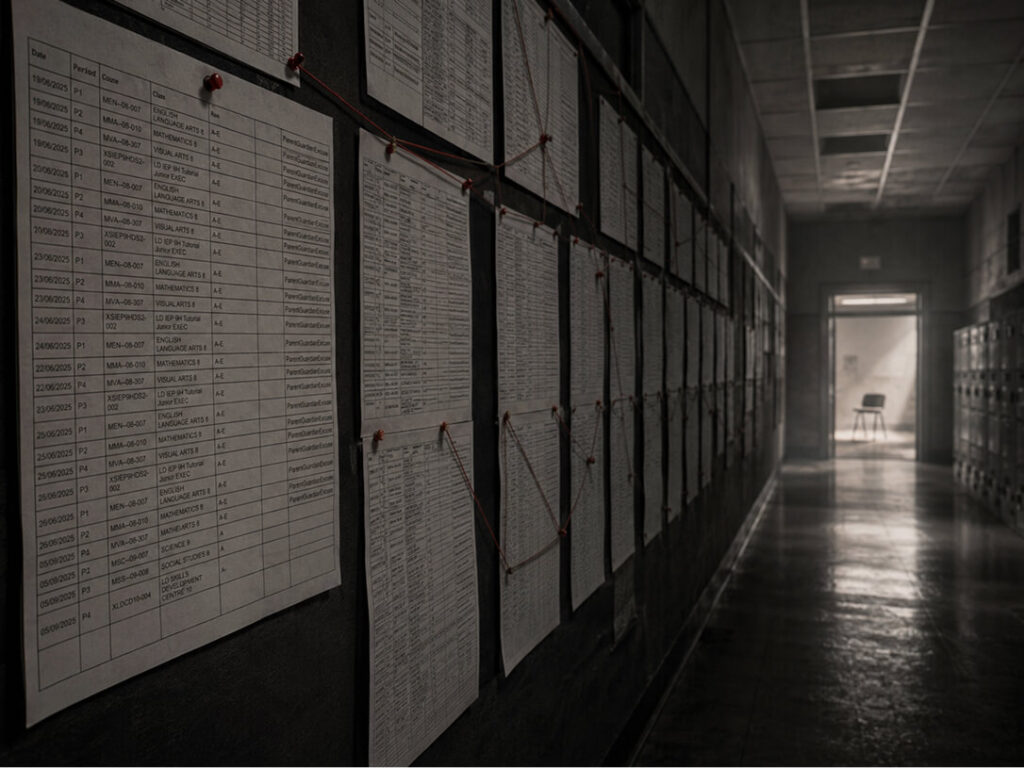
ParentGuardianExcuse: no excuse for exclusion in BC schools
The reason column in my son’s permanent record is mostly blank. When a reason survives, it’s ParentGuardianExcuse.
-

Transparency systems must themselves be transparent: FOI revelations
FOI is supposed to help the public hold government accountable. In schools, families often use it to learn what was never recorded, or what was hidden behind redactions. A new FIPA process analysis report raises concerns about how consistent and transparent that process really is.
-

A summer reading list for education leaders
The Canary Collective went upstream this week, and the gloves came off. In “Delay, Distract, and Deny”, Wren takes the old public-health parable about pulling bodies from a river and turns it into an indictment: while families stand waist-deep in the current keeping disabled children afloat, almost no one walks up the bank to ask who…
-

My Ollie is missing a lot of school
My Ollie has barely left his room since he came home exhausted from school one day last spring. He slept twenty-three hours a day for months. He barely spoke for months and had difficulty with basic hygiene. School chronically withdrew the supports he needed and pushed him to mask and comply until his nervous system…
-

Slack off and succeed — the grey rock method for institutional advocacy
Schools feed on your emotional participation. Grey rock is the refusal to be raw material. Stop justifying. Stay flat. Reclaim your evenings.
-

Iatrogenic harm and the parent advocate: how school systems produce disability in the families they fail
The body keeps the account even when the institution refuses to. What the school system produced in the parent who spent years trying to hold it accountable is not caregiver burden — a word that belongs to the person carrying it — but iatrogenic harm: specific, dated, attributable, and fully known to the institutions that…
-

The cost of defending scarcity: moral injury and the exhaustion economy
The BC education system spends extraordinary resources defending scarcity while positioning that defence as fiscal responsibility, generating an exhaustion infrastructure that operates across every population the system touches—teachers, families, disabled children, administrators, support staff—all labouring to maintain stories that protect individual dignity within conditions designed to make moral action impossible. A recent analysis on Fund…
-

Exclusion is economically irrational and the hidden costs of refusing accommodation
BC schools spend more money refusing accommodation than providing it. Learn when hiring a lawyer becomes the only fiscally rational choice for your family.
-

The business process trap
I’m a business analyst by trade, so I naturally wanted to understand how things work in schools, but resist the temptation to let schools draw you in!!! School districts speak a language designed to obscure accountability, using administrative complexity as armour against obligation, converting urgent need into bureaucratic procedure, and replacing immediate legal duty with…
-

Discipline outcomes and statistics in BC school districts: what the statistics reveal about institutional protection
Schools are quick to label children as dysregulated when they struggle to process harm, respond slowly under stress, or push back against systems that have failed them. These labels carry consequences. What is less often examined is how institutions respond when they behave in the same way. A note I support parents making complaints when…
-

BCTF lobbies for changes to new literacy screening mandate
The BC Ministry of Education and Child Care announced a new mandate this week requiring literacy screening for all kindergarten students beginning in the 2025–26 school year, expanding to K–3 students the following year. The British Columbia Teachers’ Federation published their response, which deserves careful attention. No budget for implementing literacy screening Everyone can see…
-

Scapegoats for austerity: BC education funding excludes disabled children
BC education funding scapegoats disabled children, using collective punishment and performative inclusion to divide parents and maintain austerity.
-

The cost of saying ‘change costs nothing’
Long before it became common sense, the spherical shape of the Earth was already known. Astronomers, mathematicians, and navigators across multiple ancient cultures—within the Hellenic world, in ancient India, in Islamic scholarship—had measured the Earth’s curvature, calculated its circumference with remarkable accuracy, and built navigational systems that depended on that knowledge. This was not speculative…
-

When provincial bodies dismiss parental expertise: POPARD, sticker charts, and the refusal of heterogeneity
In the previous essay, I examined neuroimaging research demonstrating that autism and ADHD are not internally homogeneous diagnostic categories but rather contain multiple neurologically distinct subgroups, often with opposite patterns of brain structure alterations relative to controls. The Pecci-Terroba study reveals what categorical intervention logic refuses to accommodate: diagnosis alone cannot determine whether a specific…
-

The material costs of educational harm
My son no longer attends school. He no longer wants anything the education system offers. He has taught himself programming, navigates Linux with expertise that exceeds my own knowledge, learns alone in his room because learning with others became too expensive to survive. The district asks affectionately how he is, suggests I login to their…
-

Kamloops mother speaks after district ignored daughter’s dyslexia for thirteen years
‘She was failed’: Mother speaks out after Kamloops student’s dyslexia ignored tell the story of Heather Morrison. She spent thirteen years asking teachers and principals to assess her daughter for learning disabilities, watching her child move through kindergarten to graduation while reading at an elementary level, her distress mounting with each deflection, each dismissal, each…
-

Three contexts, one experience: why autism debates fracture
The fracture happens before anyone finishes speaking. One person describes autism as neurological difference observable through brain imaging and cognitive testing; another person describes autism as diagnostic category that unlocks resources within rationed systems; a third person describes autism as lived experience of navigating a world built around neurotypical assumptions about communication, sensory processing, and…
-

The return of functioning labels: How austerity turns advocacy into competition
A parent recently posted about profound autism, describing the experience of having her son’s reality erased when people say that “profound autism” doesn’t exist. Her frustration is legitimate—parents of children with intensive, lifelong support needs face profound institutional abandonment, and “profound autism” names a reality that deserves recognition and resources. But her post also illustrates…
-

Why I won’t stop in 2026
The principal used collective punishment against my child almost two years ago, and yet I remain unreconciled to what she did. People suggest moving on, starting fresh, forgiving. Schools are obsessed with ‘fresh starts,’ framing each September as reset opportunity, as though institutional harm dissolves at arbitrary calendar boundaries. My daughter carries what happened in…
-

The principal’s casualness reveals authorisation to harm
When a principal cancelled my daughter’s volleyball game with bureaucratic ease, her comfort while causing harm revealed systematic institutional authorisation.