

Collective Punishment
Discipline strategies that penalise whole groups for the actions of one or a few, including lost recess, public shaming, and group rewards.
-
Collective punishment: how schools displace guilt, erase harm, and preserve the collective
One of the things that was so traumatising about the collective punishment that was callously perpetrated against my daughter was the light and evasive tone of the principal. She said that the punishment had to be “swift.” I frequently wondered about the choice to psychologically wound disabled children while treating the infliction of that wound…
-

Why we keep returning to collective punishment
This site is about collective punishment, so naturally we have to write about it on a fairly regular basis and it’s become an interesting experience of returning again and again. Every time we write about collective punishment, it feels like tracing a wound the system keeps trying to call a scar—something old, something resolved, something…
-

Cultural bias and collective punishment: why school systems resist feedback
Across cultures and institutions, punishment is often mischaracterised as a neutral or corrective act—something that emerges in response to wrongdoing, rather than something shaped by norms, loyalties, and group dynamics. But when we look closely at how people learn to punish (and more importantly, whom they choose to punish), a very different picture emerges—one that…
-
Joy is rationed for disabled kids in school
When disabled children are excluded from field trips, they are being punished for their needs. These joyful, formative experiences become conditional—offered only to those who mask well, follow rules, and cause no disruption. In British Columbia, this widespread practice violates both law and conscience. Inclusion that ends when the bus departs is not inclusion at…
-

The afterlife of austerity
When public institutions are forced to survive under prolonged austerity, something deeper than budgets begins to break—something in the connective tissue of trust, of care, of the quiet, ordinary belief that systems exist to serve people. The myth of resilience—the comforting story we tell ourselves about teachers with hearts of gold and staff who always…
-
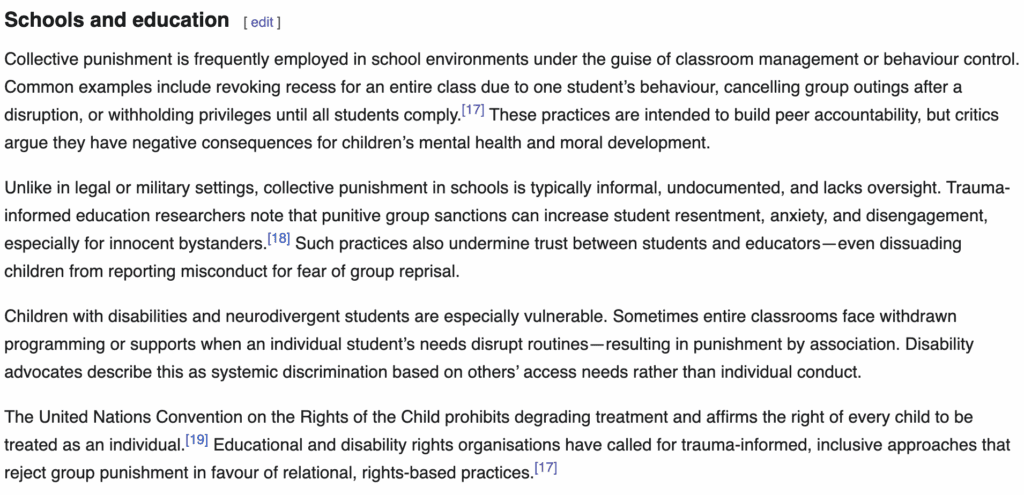
Why we added schools to the Wikipedia page on collective punishment
I started this site because I could not believe that our school principal and our school district thought that collective punishment was remotely appropriate at school. Collective Punishment is when: We built our site—End Collective Punishment in BC Schools—to advocate for the end of collective punishment in schools. We assumed this was just a backwards…
-

What are we teaching them in gym?
After months of thinking about collective punishment, I was drawn to memories of my own painful experiences in gym in highschool. I reflected on the experience of our PE teacher hitting boys in the head with volleyball balls when they misbehaved. Also, I thought of the time my child was struck with a badminton racket…
-

One-pager about collective punishment
If you are a teacher, a classroom assistant, a support worker, or even a school leader who still spends time in rooms with students, then you already understand how hard it is to manage a group when things begin to fall apart. You know the claustrophobic tension of a lesson unravelling before it begins. You…
-

15 red flags your child’s school is running the playbook on you
How to spot coercive proceduralism before it drains your energy, your trust, and your child’s future. You may have been advocating for your child for months—attending meetings, responding to emails, following every process they set out—yet the accommodations you discussed never seem to appear in the classroom. You might notice your child’s struggles at school…
-
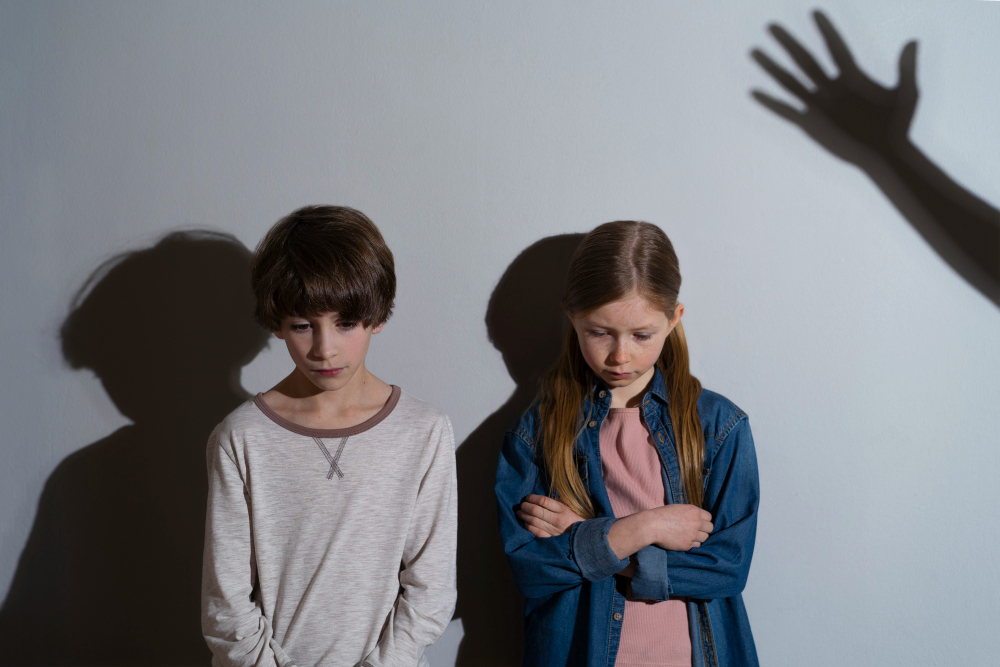
Collective punishment in schools: How humiliation undermines emotional safety and learning
In classrooms around the world, students are sometimes punished for the misbehavior of others. One student breaks a rule, and the entire class loses a privilege. This practice – known as collective punishment – persists even though it is broadly recognised as unjust. In fact, collective punishment is explicitly banned under Article 33 of the Geneva Conventions…
-

Managing your class without collective punishment
In his article, Managing your class without collective punishment, educator Matthew Ebert acknowledges that even well-meaning teachers—himself included—sometimes resort to collective punishment out of frustration or exhaustion, despite its well-documented ineffectiveness. He frames those moments not as irredeemable failures but as crucial opportunities for modelling vulnerability, repair, and growth in front of students. The central…
-

The history of this website
What began as one mother’s refusal to accept the institutional cruelty of collective punishment has grown into a vast, strategic, and emotionally searing archive—a living infrastructure of truth-telling and resistance, built from grief, fuelled by clarity, and shared in solidarity with every family navigating harm inside a system that punishes children for being disabled.
-
Debility is not a diagnosis: What Jasbir Puar helps us see about invisible harm in BC schools
There is a category of harm that most institutions do not name, do not track, and do not treat—because doing so would require them to admit that they caused it. This kind of harm accumulates in the body slowly, like sediment, until what once looked like coping becomes collapse. It is the product of chronic…
-

Ava and the Geneva Convention
It began, as so many modern parables do, with a child who told the truth—and a parent who shared it. The image was ordinary: a school feedback form, completed in pencil, uneven in its lines, confident in its voice. The caption read: “My daughter actually submitted this feedback at school. Not sure if I should ground…
-

Resist the urge: A student’s call to end collective punishment
Sometimes, the clearest truths are spoken by those closest to the harm, and in this compelling public speaking presentation, one student delivers a simple, resonant message with unmistakable clarity: resist the urge to punish everyone for one person’s mistake. Across just eight minutes, this speaker distils the emotional cost, logical failure, and enduring relational harm caused…
-

Structuring your site when your thoughts feel chaotic
A guide to emotional architecture: building a site that honours your spiralling thoughts and empowers your audience. You don’t need to organise your pain into neat folders to begin.
-
Tell the Ministry: end collective punishment in BC schools
BCEdAccess recently reminded us that if families don’t speak up, the system assumes everything is fine. Writing letters to the Ministry of Education and Child Care is one way we can make our children’s experiences count—especially when those experiences involve exclusion, loss of support, or group-based discipline that punishes kids for behaviours linked to unmet…
-

Why we’re tracking collective punishment across Canada
In classrooms across this country, children still lose recess for things they didn’t do. Field trips are cancelled because someone else acted out. Privileges are revoked—en masse—because a teacher felt the group needed a lesson. These are not isolated incidents. They are symptoms of a widespread practice known as collective punishment: the disciplining of a group…
-

When compensation is mistaken for capacity: why I support Dyslexia BC
In every school, there are those children—gifted and hyper-conscientious—who stay behind after the bell has rung, who do the homework even when no one collects it, who chase perfection out of a desperation to stay afloat in a system that offers no life raft for those who do too well to be noticed. These are…
-

Food, rewards, and collective punishment in the classroom
It might seem harmless. A teacher stands before a class with a box of lollipops or a bag of Freezies, offering them as a reward for good behaviour. But there’s a catch: everyone only gets one if everyone behaves. What appears—on the surface—as a treat, quickly becomes a threat. For neurodivergent children, food-based group rewards…