
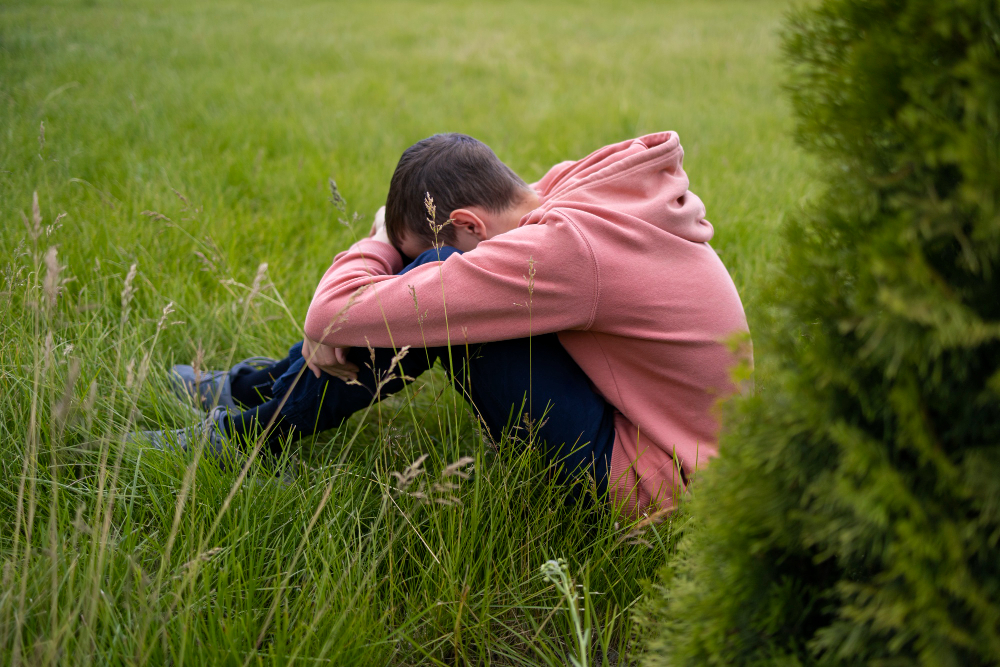
Collective Punishment
Discipline strategies that penalise whole groups for the actions of one or a few, including lost recess, public shaming, and group rewards.
-
When fairness fractures: A response to “Collective Punishment in Schools” by Serene Leeyc
A recent article by Serene Leeyc, titled Collective Punishment in Schools: Fairness or Fostering Division?, offers a welcome and accessible overview of collective punishment in school settings—a practice that, while common, remains shockingly under-examined in public discourse. The piece attempts to understand the teacher’s dilemma, surveys common classroom scenarios, and suggests positive alternatives like restorative justice…
-
Lawyers over learning: how much is VSB paying Harris & Co
As a parent of two children with learning challenges, I found myself deep in the Vancouver School Board’s appeals process. Early on, I heard officials say our children would be supported with “inclusive” classroom resources. In reality, every step felt like an uphill battle. For example, during our Level 1 appeal meeting the board’s own summary…
-
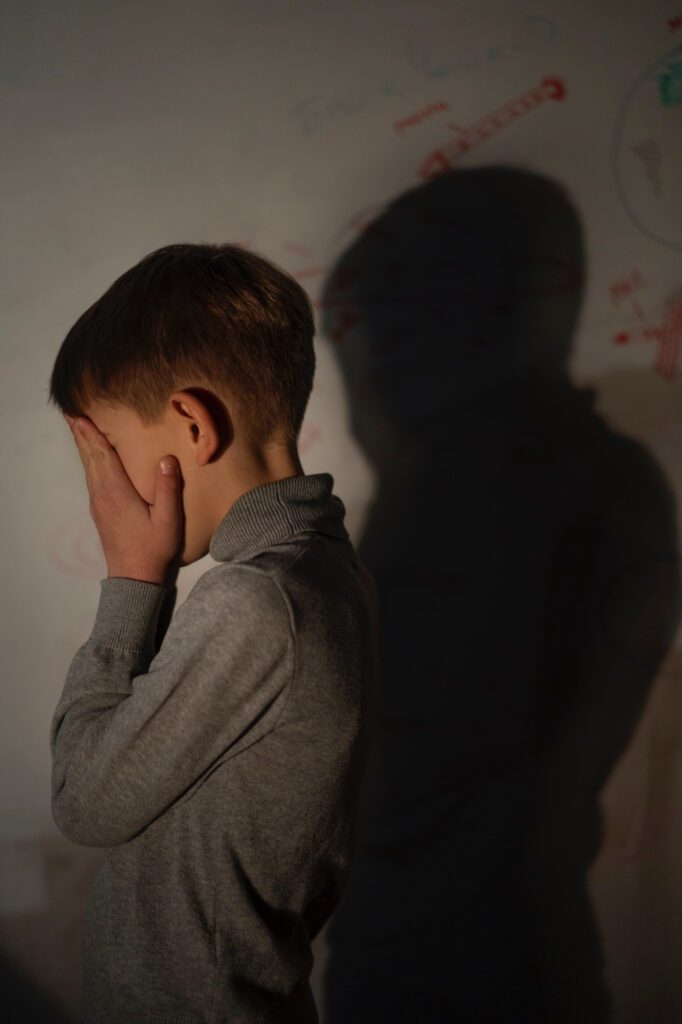
The days my children cried, and I told them it would be okay
When your trust has already been broken—by people who were supposed to care for you, protect you, believe you—every new betrayal lands like confirmation. I didn’t come to school meetings as a blank slate. I came with a trauma history. So when they dismissed my child’s needs, ignored the signs, or punished their distress, it…
-
The problem with the appeals process
When something goes wrong at school—when a child is excluded, harmed, or unsupported—families are told to “work it out with the school first.” That sounds reasonable on paper. But in practice, it’s vague, unstructured, and often retraumatising. I’ve gone through the Vancouver School Board (VSB) appeals process more times that I’d wish upon anyone. Here’s…
-
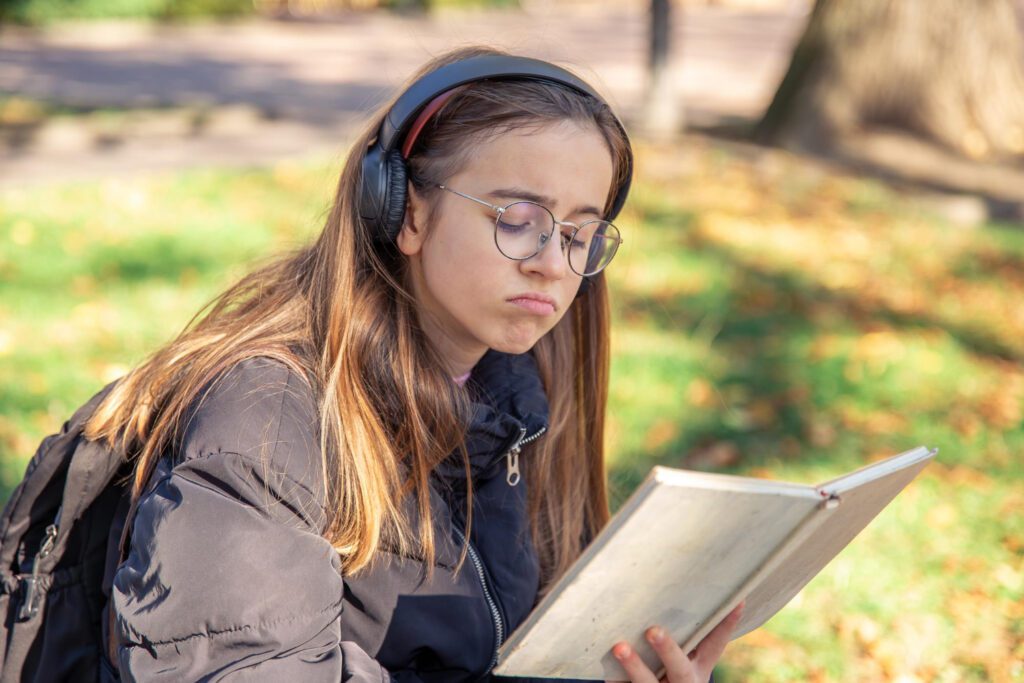
When school discipline undermines trust at home
There’s a problem in our schools. You’ll see it on a child’s face when they come home. You’ll hear it in the way they describe something that left them feeling humiliated, angry, or confused—and often, all three at once. It happens when school staff use discipline strategies that completely contradict the values a student has…
-

On moral injury and collective punishment
I did not want to file a complaint. I still don’t—not in the sense that people imagine, with anger or vengeance or a desire for punishment. What I wanted, what I asked for again and again with patience and clarity and increasing despair, was for the district to acknowledge that collective punishment is not just…
-

Rot at the root: Why POPARD must be dismantled from the top down
When I first objected to the strategies POPARD proposed, I tried—truly—to assume good intent: that if I just gave them the right information, the clearest language, the most generous interpretation of their mandate, they would course-correct and stop pushing reward charts onto an already-traumatised child. I wrote careful emails, cited the psychologist’s diagnosis, offered specific…
-

Reconciliation demands that we put collective punishment aside
Collective punishment in residential schools did more than punish children—it shattered the bonds between parents and children. For many parents who survived, the fear, shame, and trauma they endured complicated their ability to nurture trust in their own parenting. Emotional disconnection and disrupted parenting Adults who attended residential schools often struggle to form secure attachments…
-

The space between my brain and the page
My parents never sent me to kindergarten, so when I started first grade, it was a bit mysterious to me. I had been living on the side of a mountain, chasing garter snakes, and picking wild strawberries. While the class attempted to learn the alphabet, my parents had already been reading chapter books to me…
-

A perspective taking primer for educators
Perspective taking is the disciplined art of stepping outside one’s own cognitive scaffolding and entering, as fully as possible, into the sensorium of another person. It is not sympathy, which radiates concern from a safe emotional distance, nor is it projection, which mistakes one’s own feelings for universal truth. Instead, it is an intentional, methodical…
-
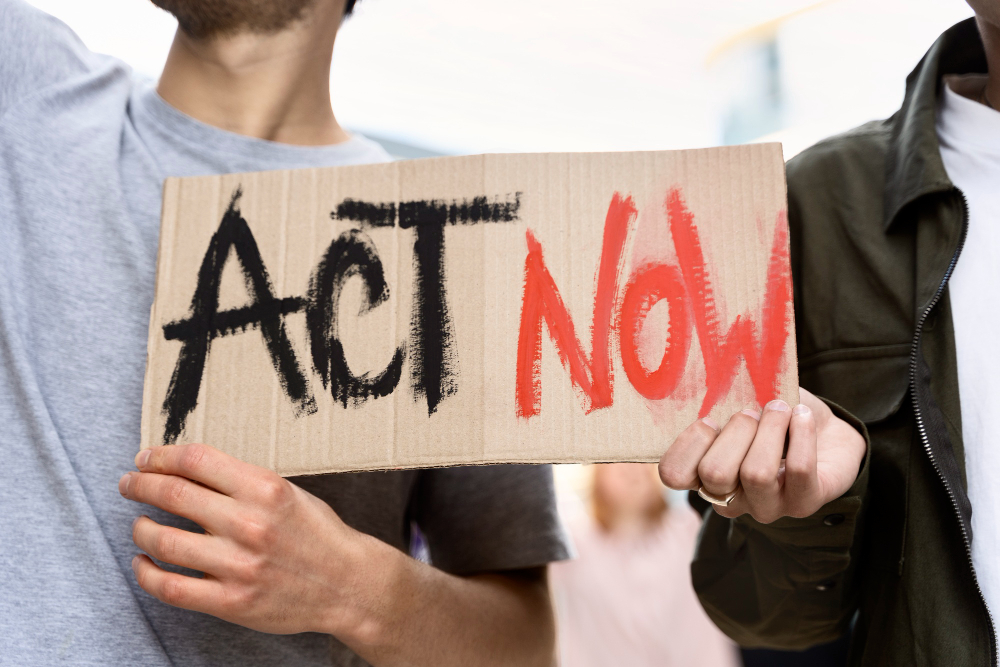
Collective punishment: unjust in schools, unjust everywhere
Collective punishment—punishing a group for the actions of an individual—is widely recognised as a violation of human rights. It is condemned in international law, yet it persists in various forms worldwide. From China’s persecution of human rights defenders’ families to Israel’s blockade of Gaza and the Taliban’s illogical governance, collective punishment disproportionately harms innocent people.…
-
The stories we carry: how schoolyard legends and classroom fear shape us
When I was in grade three, I attended an alternative school that felt like a sun-dappled meadow. We painted. We played outside. We had a math teacher who made learning feel like a game, not a test. There was room to breathe. I remember it as freedom. Then, in grade four, everything changed. My new…
-

Help please: call for Indigenous perspectives on collective punishment in BC schools.
We are seeking contributions from Indigenous scholars, knowledge-keepers, writers, parents, educators, and community leaders on discipline, punishment, exclusion, and accountability in British Columbia’s public schools. This project began from a concern that some school discipline practices — including collective punishment, exclusion, surveillance, public shaming, and informal removal — may sit within longer histories of colonial…
-

Calling the exclusion line
Every morning, when we dial the school’s sick line, we enact a ritual that ought to acknowledge more than a fever or a stomach ache. In theory, this system exists to safeguard children who cannot attend school due to illness. In practice, it masks the institutional harms that shape our decisions, erasing critical context from…
-

Collective punishment: it doesn’t work, but still it happens
Written by Dr Penny Rabiger, in 2016, this personal yet incisive piece, discusses the challenges the persistence of collective punishment in schools, despite its well-documented ineffectiveness. Drawing on both professional insight and a child’s perspective, the post illustrates how these tactics damage trust, inhibit learning, and punish children for behaviours beyond their control. The author…
-
A toxic classroom exposes punitive culture
An administrative investigation at Montreal’s Bedford Elementary uncovered a culture of intimidation where teachers used yelling, humiliation, and sending students to stand in hallways—sometimes for days—as disciplinary youtube.com+2montreal.citynews.ca+2montreal.citynews.ca+2. The Quebec Education Minister suspended 11 teachers linked to psychological and physical mistreatment, highlighting a systemic reliance on group-based punishment, rather than supporting individual accountability. Bernard Drainville, the…
-
What policy says about collective punishment in schools
Collective punishment is never explicitly mentioned in the School Act or BC education policies, but it is made very clear that the system is meant to be fair, accountable, and respectful. The School act states the discipline in schools must be “similar to that of a kind, firm and judicious parent” (Section 76(3)). I consider…
-
From corporal punishment to collective harm: why Section 43 still casts a shadow over Canadian schools
Section 43 still permits “reasonable force” in schools. This blog explores how it enables collective punishment and violates children’s rights.
-
Teacher Misconduct Case
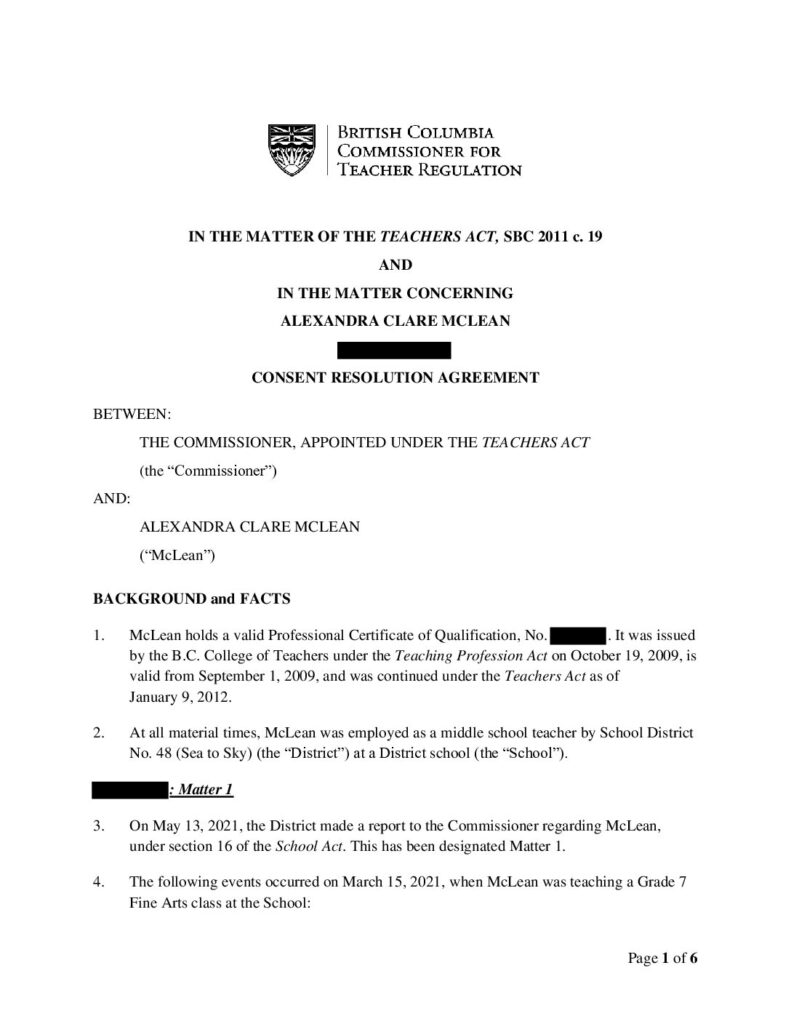
A recent case involving Alexandra Clare McLean, a BC teacher disciplined for yelling, humiliating, and physically handling students, highlights the urgent need for stronger accountability in schools. Despite multiple suspensions, warnings, and training, McLean’s harmful behaviour continued. This case reflects the broader issue of harmful disciplinary tactics like collective punishment. Both create fear, shame, and…
-
To the kid looking for answers about collective punishment
Hey, If you found your way here, maybe it’s because something happened at school that didn’t sit right. Maybe you searched for “why did my whole class get punished” or “it wasn’t my fault but we all lost recess.” Maybe a grown-up sent you here. Or maybe you just wanted to understand. If so—hi. I’m…