

Legal and ethical
Includes the laws, policies, complaint routes, records, oversight bodies, and accountability tools families use to challenge exclusion, discrimination, delay, denial of accommodation, and procedural harm in schools.
-

SJ Burnside Continuing Education (SD61): a neurodiversity‑informed policy critique
SJ Burnside Education Centre is an Alternative Education program serving youth aged 13–18 in a small-group, flexible setting. Its published Code of Conduct emphasises high standards of conduct, honesty, integrity, and cooperation during all school-sponsored activities. It explicitly promotes peaceful problem-solving, community engagement, and maintains a personal device policy (e.g., cell phones may be removed if abused). Student Code of Conduct SJ Burnside conduct decision…
-

Rot at the root: Why POPARD must be dismantled from the top down
When I first objected to the strategies POPARD proposed, I tried—truly—to assume good intent: that if I just gave them the right information, the clearest language, the most generous interpretation of their mandate, they would course-correct and stop pushing reward charts onto an already-traumatised child. I wrote careful emails, cited the psychologist’s diagnosis, offered specific…
-
The high stakes of understanding PDA
Pathological Demand Avoidance (PDA) might sound like just another clinical term, but for many families it represents a daily struggle that is anything but trivial. PDA is a profile on the autism spectrum characterised by an extreme, anxiety-driven avoidance of everyday demands, even those the child wants to comply with drdonnahenderson.com reframingautism.org.au. This isn’t mere stubbornness or “bratty” behaviour – it’s a…
-

He doesn’t go from zero to sixty
“He’s not a car,” I said, exasperated, after someone described Robin as going from zero to sixty. The withering look I received in return was pure disgust—as though I had interrupted a sacred adult ritual, as though I may as well have had a huge boil in the middle of my forehead, oozing pus. But…
-

Reconciliation demands that we put collective punishment aside
Collective punishment in residential schools did more than punish children—it shattered the bonds between parents and children. For many parents who survived, the fear, shame, and trauma they endured complicated their ability to nurture trust in their own parenting. Emotional disconnection and disrupted parenting Adults who attended residential schools often struggle to form secure attachments…
-

Data tracking in the residential school system
The Canadian Residential School system (circa 1870s–1990s) was a network of church-run boarding schools funded by the government to forcibly assimilate Indigenous children. In theory, such a large system might have been guided by careful data collection – tracking student health, education outcomes, and well-being. In reality, government officials prioritized ideological goals and cost-saving “optics” over…
-
Collective punishment: unjust in schools, unjust everywhere
Collective punishment—punishing a group for the actions of an individual—is widely recognised as a violation of human rights. It is condemned in international law, yet it persists in various forms worldwide. From China’s persecution of human rights defenders’ families to Israel’s blockade of Gaza and the Taliban’s illogical governance, collective punishment disproportionately harms innocent people.…
-

Shut it down: Why POPARD cannot be trusted to support neurodivergent children
We asked for help.We got a behaviour chart. We invited experts into our child’s life, hoping they would help school staff understand his anxiety, his trauma responses, his fiercely sensitive nervous system. We asked for relational strategies grounded in respect and attunement. We shared research. We named his diagnosis. We explained, in plain terms, what…
-
Pathological Demand Avoidance (PDA)
Pathological Demand Avoidance is a neurobiological profile of autism rooted in anxiety, autonomy, and nervous system threat perception. For children with PDA, even simple requests can register as danger. A question, a suggestion, a cheerful invitation—all of these may activate a survival response, because the child’s nervous system experiences demand as threat. When this pattern…
-

Restraint and isolation in British Columbia schools
Physical restraint and isolation—sometimes termed “seclusion”—remain legally unregulated in British Columbia schools, even as provincial guidelines seek to limit their use to moments of extreme risk. Physical restraint is defined as any method of restricting a student’s freedom of movement to maintain safety, while seclusion involves involuntary confinement in a space from which the student…
-

From corporal punishment to collective harm: why Section 43 still casts a shadow over Canadian schools
Section 43 still permits “reasonable force” in schools. This blog explores how it enables collective punishment and violates children’s rights.
-
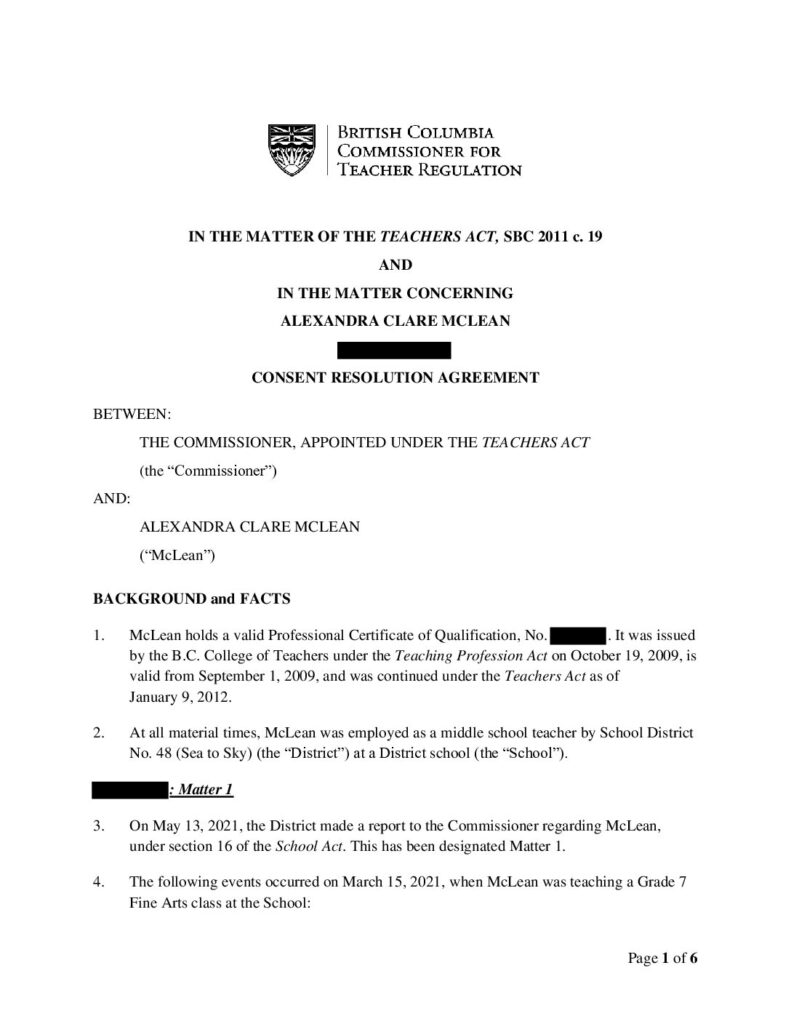
Teacher Misconduct Case
A recent case involving Alexandra Clare McLean, a BC teacher disciplined for yelling, humiliating, and physically handling students, highlights the urgent need for stronger accountability in schools. Despite multiple suspensions, warnings, and training, McLean’s harmful behaviour continued. This case reflects the broader issue of harmful disciplinary tactics like collective punishment. Both create fear, shame, and…
-

Three-quarters of Nunavut teachers witnessed or dealt with violence at school: survey
In June 2024, the Nunavut Teachers’ Association released findings from a territory-wide survey that captured what many educators already knew: violence and burnout in Nunavut schools are endemic—and escalating. Teachers weren’t asking for harsher discipline. They were asking for help. Violence isn’t the story—it’s the signal Educators in the survey overwhelmingly described these behaviours not as…