The numbers arrived quietly, published in an interim report from the National Exclusion Tracker — five months of data collected since the tracker expanded from a BC-only tool to a national one, capturing the experiences of families across eleven provinces and territories.
6,783 reported incidents of exclusion from K–12 education since September.
68% of them ongoing, meaning these are not isolated events that resolved themselves over a weekend but sustained conditions, chronic states of partial or total removal from learning that have become, for these children and their families, the texture of ordinary life.
The report is careful to note that these figures reflect reports submitted, not overall prevalence. This is the methodological caveat that should keep every reader awake at night, because what it means, stated plainly, is that this data represents only the families who found the tracker, recognised what was happening to their child as something nameable, understood that a reporting mechanism existed, and completed the submission. The full population — the parents who were told this was normal, the children whose exclusions were never written down, the families who accepted shortened hours as a reasonable arrangement because no one told them it was a rights violation — remains uncounted, invisible, structurally protected from ever appearing in any dataset at all.
The violence is in the informality
Exclusion from K–12 education most commonly occurs through informal and partial-access practices rather than formal disciplinary measures, the report states, and this observation is the analytical core of everything that follows.
- The most frequently reported form of exclusion is being sent home early, at approximately 43% of respondents.
- Shortened hours or school days follow at roughly 36%.
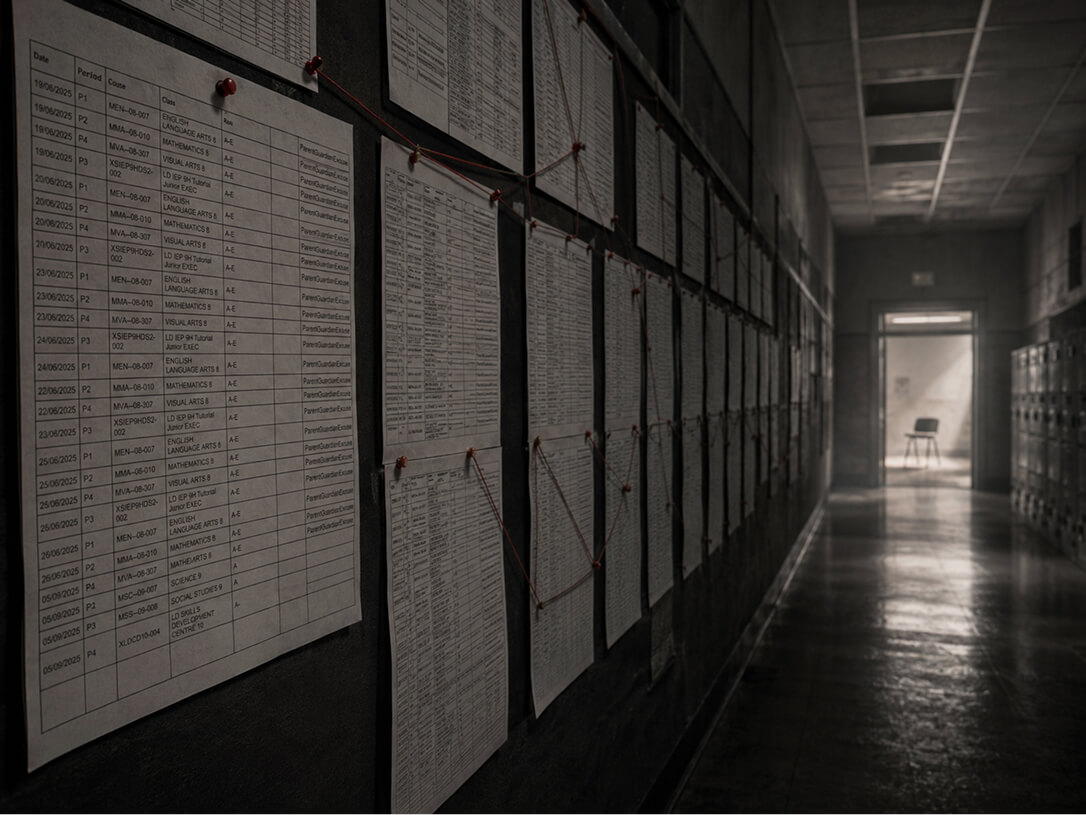
Excluded from activities or programs, told not to attend, kept home — these are the modalities through which Canadian schools manage disabled children, and every one of them shares a defining characteristic: they produce no formal record, trigger no mandatory review, and generate no data that school boards are required to report to ministries or the public.
Formal suspension sits at approximately 13%. The system has not abandoned the exclusion of disabled children; it has perfected the art of accomplishing exclusion through mechanisms that render it administratively invisible.
“Cannot accommodate needs” is a legal confession
Respondents were asked what reasons the school gave for excluding their child.
- Behaviour concerns appeared at roughly 51%.
- Safety concerns at approximately 48%.
- And then, at 40%: cannot accommodate needs.
Forty percent of respondents report that the school cited its own incapacity as justification for removing a disabled child from their education. This is not a staffing complaint or a resource lament. Under the Canadian Charter of Rights and Freedoms and provincial human rights frameworks, the duty to accommodate disabled students extends to the point of undue hardship — a threshold that requires substantial, documented evidence to meet, and that schools are citing, apparently routinely, without consequence. “Cannot accommodate needs” is a legal confession masquerading as an administrative explanation, and the fact that it appears in 40% of these reports suggests that schools have learned they can state it openly because no one is coming for them, to make them accountable.
Five percent
Restraint appears at approximately 5% of K–12 respondents. Five percent of families in a self-selected, advocacy-adjacent sample report that their child was physically restrained. Physical restraint — the use of bodily force to restrict a child’s movement — is presented in this chart on the same axis as “sent home early” and “gradual entry,” as though these occupy the same register of administrative response. They do not. Restraint is the school system placing hands on a disabled child’s body. The research on its harms is extensive and unambiguous: it causes trauma, it disproportionately targets autistic and developmentally disabled children, and it occurs overwhelmingly in the absence of any external oversight.
Who these children are
79.2% percent of the children represented in this data have more than one disability or support need.
Exclusion Tracker
The most commonly reported categories are:
- developmental disability,
- attention and executive functioning differences,
- intellectual disability,
- communication or speech disability, and l
- earning disability
Indigenous children represent 19.6% of reported cases, a figure that names the intersection of ableism and colonialism operating through the ordinary machinery of the school day.
These 6,783 reports are not anomalies. They are a signal from the families who found the words. The question the system has yet to answer is what it owes the ones who did not.