
Collective Punishment
Collective punishment refers to the disciplinary practice of penalising a group for the actions of one or a few individuals—often enacted in classrooms as withheld privileges, cancelled activities, or public reprimands directed at entire cohorts. Though rarely named in policy, it remains a common method of behaviour management in Canadian schools. This tag interrogates collective punishment as both a pedagogical failure and a moral harm, tracing its psychological, legal, and systemic dimensions. It includes student testimonies, parent advocacy, policy critiques, and international parallels—connecting the emotional toll of everyday discipline to deeper questions of justice, accountability, and the ethical use of power in education.
-
The orange shirt I folded
I was folding laundry late one night, brain running on the kind of background grief that rarely quiets, when my hand closed around the orange shirt. I moved to set it aside—automatically, instinctively—because I remembered September was coming, school would be starting, and Orange Shirt Day would follow quickly after. That shirt would be needed…
-

7 signs your child (or you) is being positioned as the problem to preserve the group
When a parent becomes too precise, too prepared, or too emotionally honest, the school system may cast them—or their child—as the problem. This essay outlines seven signs that scapegoating is being used to preserve group harmony at the cost of justice, with particular attention to how this dynamic unfolds in British Columbia public schools.
-
The paperwork trap: when doing everything right becomes your downfall
When parents follow every rule, cite every policy, and document every meeting in the British Columbia public school system, they are often framed as adversaries, not allies. This essay explores how procedural knowledge becomes a liability, how the IEP process punishes fluency as threat, and why the most thorough advocates are the ones most likely…
-

The compliance economy
In their article Of Sinners and Scapegoats: The Economics of Collective Punishment, J. Shahar Dillbary and Thomas J. Miceli argue that collective punishment emerges not merely as a failure of precision or fairness, but as a deliberate mechanism for preserving internal group cohesion. The scapegoat, must be non-random, visible, and different, and their suffering must be…
-

The truth shall set us free: healing from institutional violence in BC public schools
Healing doesn’t begin with massages or mindset shifts. It begins with telling the truth about what was done to us—about what it means to watch your child collapse under institutional betrayal, to be praised for your composure while they take away his lifeline. The system demands civility while delivering harm. This essay is a witness…
-

Collective punishment: how schools displace guilt, erase harm, and preserve the collective
One of the things that was so traumatising about the collective punishment that was callously perpetrated against my daughter was the light and evasive tone of the principal. She said that the punishment had to be “swift.” I frequently wondered about the choice to psychologically wound disabled children while treating the infliction of that wound…
-

Why we keep returning to collective punishment
This site is about collective punishment, so naturally we have to write about it on a fairly regular basis and it’s become an interesting experience of returning again and again. Every time we write about collective punishment, it feels like tracing a wound the system keeps trying to call a scar—something old, something resolved, something…
-

Cultural bias and collective punishment: why school systems resist feedback
Across cultures and institutions, punishment is often mischaracterised as a neutral or corrective act—something that emerges in response to wrongdoing, rather than something shaped by norms, loyalties, and group dynamics. But when we look closely at how people learn to punish (and more importantly, whom they choose to punish), a very different picture emerges—one that…
-
Joy is rationed for disabled kids in school
When disabled children are excluded from field trips, they are being punished for their needs. These joyful, formative experiences become conditional—offered only to those who mask well, follow rules, and cause no disruption. In British Columbia, this widespread practice violates both law and conscience. Inclusion that ends when the bus departs is not inclusion at…
-

Vancouver School Board’s Urgent Intervention Process – purpose, process, and controversy
The Urgent Intervention Process (UIP) – formerly known as the Multi-Interdisciplinary Support Team (MIST) – is a Vancouver School Board (VSB) initiative designed to provide rapid support for schools dealing with students with extremely challenging behaviours or acute needs. The program was expanded in the mid-2010s as part of VSB’s special education support model, with the stated goal…
-

Confident Parents, Thriving Kids—unless you’re autistic
Why school systems should reject behaviourist programs disguised as mental health support. Our daughter was melting down almost every day after school. She would cling to me at drop-off like she was drowning—like she had to hold onto me or she would lose herself, unable to breathe, unable to bear it. She was already telling…
-
The afterlife of austerity
When public institutions are forced to survive under prolonged austerity, something deeper than budgets begins to break—something in the connective tissue of trust, of care, of the quiet, ordinary belief that systems exist to serve people. The myth of resilience—the comforting story we tell ourselves about teachers with hearts of gold and staff who always…
-
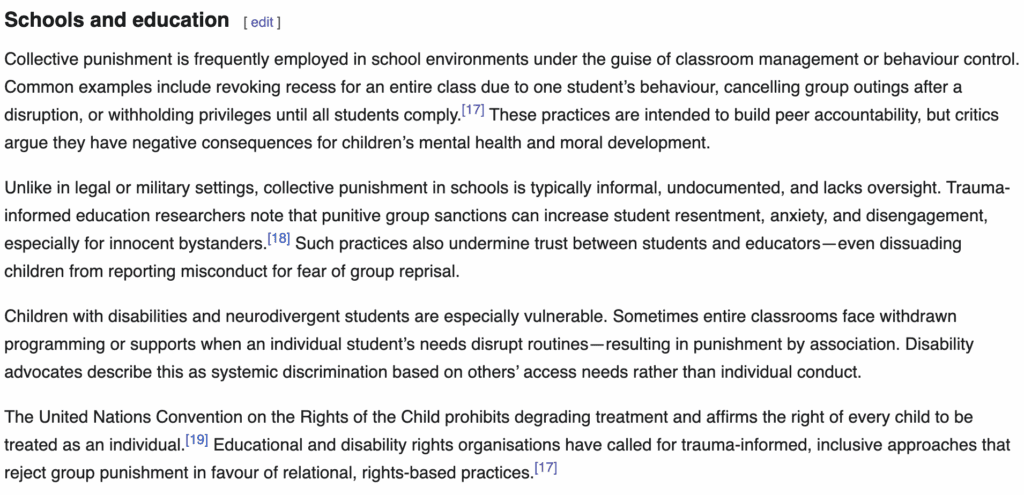
Why we added schools to the Wikipedia page on collective punishment
I started this site because I could not believe that our school principal and our school district thought that collective punishment was remotely appropriate at school. Collective Punishment is when: We built our site—End Collective Punishment in BC Schools—to advocate for the end of collective punishment in schools. We assumed this was just a backwards…
-
One-pager about collective punishment
If you are a teacher, a classroom assistant, a support worker, or even a school leader who still spends time in rooms with students, then you already understand how hard it is to manage a group when things begin to fall apart. You know the claustrophobic tension of a lesson unravelling before it begins. You…
-
15 red flags your child’s school is running the playbook on you
How to spot coercive proceduralism before it drains your energy, your trust, and your child’s future. You may have been advocating for your child for months—attending meetings, responding to emails, following every process they set out—yet the accommodations you discussed never seem to appear in the classroom. You might notice your child’s struggles at school…
-
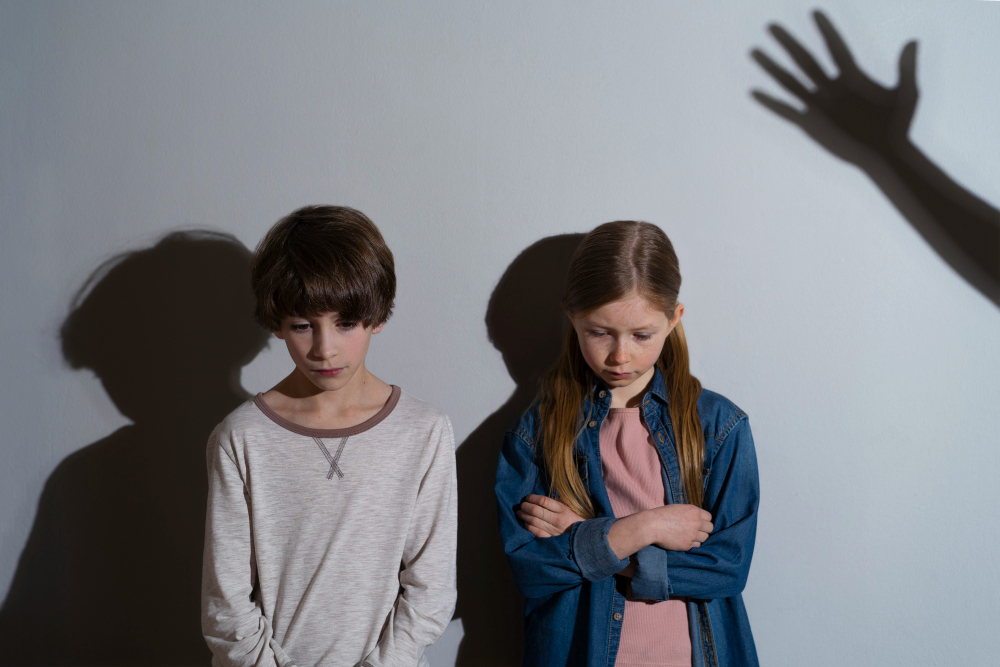
Collective punishment in schools: How humiliation undermines emotional safety and learning
In classrooms around the world, students are sometimes punished for the misbehavior of others. One student breaks a rule, and the entire class loses a privilege. This practice – known as collective punishment – persists even though it is broadly recognised as unjust. In fact, collective punishment is explicitly banned under Article 33 of the Geneva Conventions…
-

Managing your class without collective punishment
In his article, Managing your class without collective punishment, educator Matthew Ebert acknowledges that even well-meaning teachers—himself included—sometimes resort to collective punishment out of frustration or exhaustion, despite its well-documented ineffectiveness. He frames those moments not as irredeemable failures but as crucial opportunities for modelling vulnerability, repair, and growth in front of students. The central…
-

The history of this website
What began as one mother’s refusal to accept the institutional cruelty of collective punishment has grown into a vast, strategic, and emotionally searing archive—a living infrastructure of truth-telling and resistance, built from grief, fuelled by clarity, and shared in solidarity with every family navigating harm inside a system that punishes children for being disabled.
-

Double the love, double the discrimination
Public education systems punish families of multiples by forcing impossible choices between their children—often withholding support until one child reaches visible crisis, while the other’s suffering is quietly disregarded. The statistical reality schools refuse to prepare for Schools are rarely prepared for what families of multiples often bring to the classroom: These families often arrive…
-

The collective punishment of delayed care
There is a particular cruelty in delayed care, of watching a child falter for weeks or months while teams gather data, debate thresholds, and cite process. It is the cruelty of waiting for collapse before responding, of constructing intervention around crisis instead of prevention. And when the child finally does break, when their distress spills…