

Law
Posts tagged with law explore the legal frameworks that shape students’ rights in BC schools. Topics include human rights, disability accommodation, the duty to consult, procedural fairness, and the legal obligations of school boards and ministries. We offer plain-language analysis, strategic insight, and lived experience navigating legal processes—from internal appeals to tribunal complaints and civil litigation.
-
When the complaint becomes the problem
The Canary Collective has published a piece Risk Assessment and Liability Management: The Hidden Function of Complaints that describes the process by which a parent raising legitimate concerns about their child’s education is transformed, through careful documentation and strategic delay, into a risk to be managed rather than a voice to be heard. The article…
-

When the system refuses to repair itself: external complaint options that actually exist
You have tried everything inside the building, climbed every rung of the internal complaint ladder, watched your carefully documented concerns disappear into administrative silence or get redirected back to the very people who created the harm in the first place. You are exhausted, your child is still being excluded or denied accommodations or subjected to…
-

25 things you can ask for on your child’s IEP
Individualised Education Plans (IEPs) in BC carry significant weight even though they are not legally binding contracts. Schools have policy obligations to follow them, they serve as evidence in Human Rights Tribunal complaints, and they document what your child needs to access their education. The language matters. The framing matters. What gets written shapes what…
-

Midwifery and inclusive education: how holistic models become public infrastructure
Midwifery offers something rare in policy discourse: a concrete, recent example of how a holistic, person-centred model of care moved from the margins into stable public funding without diluting its philosophy or abandoning its core practices. The model succeeded because practitioners organised collectively, defined clear boundaries around safe practice, and presented government with a credible,…
-
The equilibrium of refusal: what a decade of legal spending reveals about BC schools
Between 2012 and 2022, British Columbia’s Schools Protection Program spent $4,420,252.58 responding to human rights claims filed against public schools, according to this FOI release. Of that total, $752,525.34 went to indemnity—settlements and compensation paid to claimants. The remaining $3,635,085.21 funded legal defence. The ratio is precise: for every dollar spent remedying harm, the system…
-

What BC spends to avoid accountability
The numbers arrived in a single-page response to a freedom of information request. Between January 2022 and February 2024, British Columbia’s Schools Protection Program—the provincial insurance mechanism that shields school districts from liability—spent $1,340,772.33 responding to discrimination claims filed against public schools. Of that sum, $252,000 went to settlements or indemnity payments across sixteen resolved…
-

The cost of partial inclusion in schools
I have returned to writing after a long silence—one imposed less by choice than by survival. The move was necessary, a matter of financial gravity after years of lost income entwined with the harm my children endured within an ableist school system. Leaving our home felt like surrendering a life I had fought to sustain,…
-

After Moore: why winning didn’t fix public education
When the Supreme Court of Canada ruled in favour of Jeffrey Moore and his family in 2012, affirming that meaningful access to public education was not a luxury but a legal right for disabled students, it seemed as though the tide had turned. The Court’s decision, rooted in the BC Human Rights Code and later…
-
Why families feel betrayed when they finally reach the school board
An editorial reflection and response to The Canary Collective’s July 29 post When families reach the end of their rope with a school—when they’ve tried everything they can think of and their child is still suffering—the next instinct is often to go higher. In British Columbia, that usually means the Board of Education. The assumption, deeply…
-

Shining a legal light on advocacy conversations
How to speak from a foundation of human rights while staying grounded in care. Firm, quietly defiant responses for families navigating school denial, delay, or deflection—centred on Kim Block’s Summer Series on the duty to accommodate. Each tip translates legal obligation into everyday language, illuminating the difference between disagreement and discrimination.
-

We’re exploring remedies for discrimination — and we want your feedback
We know that students with disabilities experience disproportionate harm in BC schools. We know that many families carry stories of exclusion, silence, loss, and survival — stories that have never been formally acknowledged, let alone repaired. We believe that no remedy can be effective unless it begins by listening. We’re considering a larger investigation into…
-

Ava and the Geneva Convention
It began, as so many modern parables do, with a child who told the truth—and a parent who shared it. The image was ordinary: a school feedback form, completed in pencil, uneven in its lines, confident in its voice. The caption read: “My daughter actually submitted this feedback at school. Not sure if I should ground…
-
Don’t wait until the lawsuits
By the time harm becomes legally actionable, it has already become unbearable. If people are still talking to you, they are still hoping you will change. Institutions often ask the wrong question When institutions receive stories of harm—when a parent names systemic exclusion, or a student speaks quietly of despair, or a staff member shares…
-

Repairing institutional harm after coercive control
This piece is written in memory of a friend whose life was slowly extinguished by institutional betrayal, coercive control, and the grinding weight of being unheard. When a school inadvertently contributes to coercive control, the harm may be quiet, but it is not small. For the child, it means being unprotected. For the parent, it…
-

The path to justice: legal versus public record
The courts may offer compensation, but rarely truth. The legal path demands silence in exchange for settlement. The public path asks you to speak while you’re still bleeding. Neither is easy. But only one builds a record that helps the next family survive.
-

The bait and switch: What inclusion really looks like at the VSB
Every September, I walk into school meetings with the same cautious hope. We’ve done everything right. The diagnoses are up to date. The IEP is in place. The reports are filed — more than thirty of them over the years, from audiologists, psychiatrists, speech-language pathologists, behaviour consultants, and occupational therapists. You’d think that would mean…
-
Right to no discrimination
Every child has the right to learn and belong at school without being treated unfairly because of who they are. In British Columbia (B.C.), this Right to No Discrimination means public schools must welcome all students on equal terms, regardless of their race, Indigeneity, colour, ancestry, place of birth, religion, family background, sex, sexual orientation, gender identity, disability,…
-

Comparison of Provincial and Territorial rules on collective punishment in schools
Across Canada, policies on student discipline vary widely—but only one province, Nova Scotia, has taken the decisive step of explicitly banning collective punishment in schools. In April 2025, Nova Scotia revised its Provincial School Code of Conduct Policy to require individualised responses to student behaviour, affirming that group-based discipline is not just ineffective but unjust.…
-
Lawyers over learning: how much is VSB paying Harris & Co
As a parent of two children with learning challenges, I found myself deep in the Vancouver School Board’s appeals process. Early on, I heard officials say our children would be supported with “inclusive” classroom resources. In reality, every step felt like an uphill battle. For example, during our Level 1 appeal meeting the board’s own summary…
-
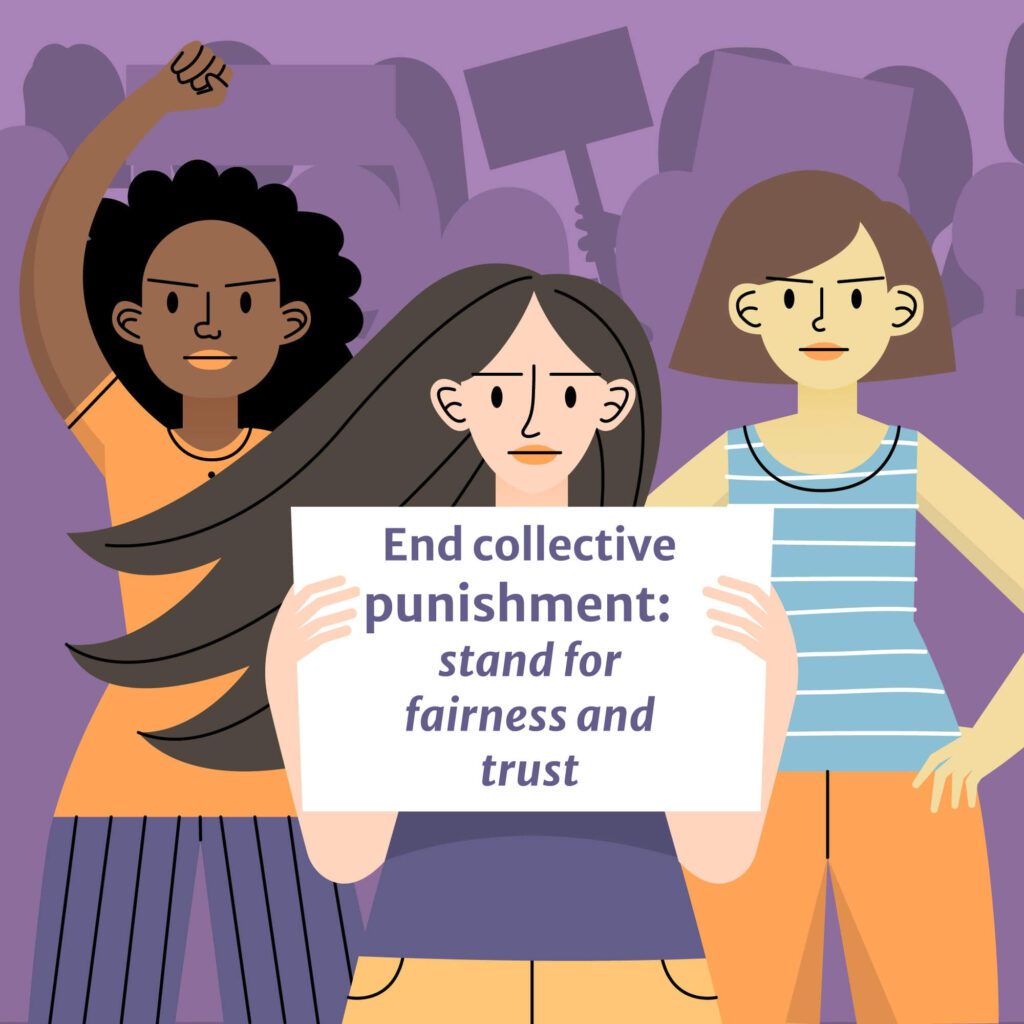
Collective punishment: unjust in schools, unjust everywhere
Collective punishment—punishing a group for the actions of an individual—is widely recognised as a violation of human rights. It is condemned in international law, yet it persists in various forms worldwide. From China’s persecution of human rights defenders’ families to Israel’s blockade of Gaza and the Taliban’s illogical governance, collective punishment disproportionately harms innocent people.…