
The numbers arrived in a single-page response to a freedom of information request. Between January 2022 and February 2024, British Columbia’s Schools Protection Program—the provincial insurance mechanism that shields school districts from liability—spent $1,340,772.33 responding to discrimination claims filed against public schools. Of that sum, $252,000 went to settlements or indemnity payments across sixteen resolved matters. The remainder, $1,088,772.33, funded legal defence across seventy-one transactions.
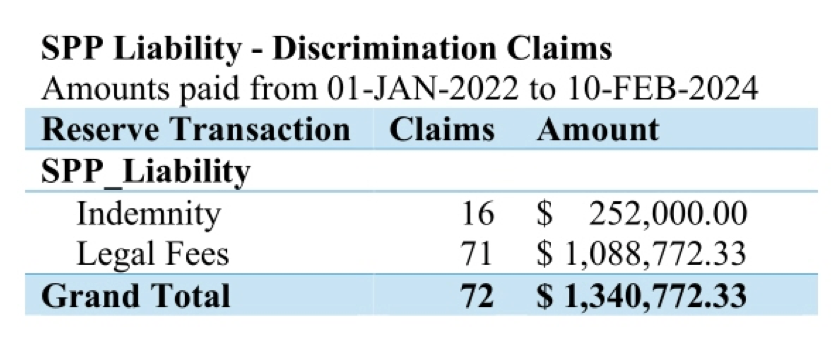
The ratio speaks plainly: for every dollar paid to compensate harm, the system spent more than four dollars contesting it.
This is what happens when institutions design remedies that discourage the people who carry the heaviest losses from seeking them at all.
The missing calculus
Human rights complaint processes promise redress for discrimination, framing themselves as pathways to justice for those denied accommodation, excluded from education, or subjected to systemic harm. The rhetoric positions these mechanisms as corrective—tools meant to acknowledge wrongdoing, repair damage, and deter future violations. Yet the economics of participation tell a different story entirely.
Settlement amounts in discrimination cases rarely attempt to make complainants economically whole. Lost wages might appear in calculations, discounted and partial. Lost career momentum does not. Foregone promotions, pension or retirement savings impacts, compound investment growth over decades, a house sold at an inopportune time as a marriage crumbled under pressure—these disappear from view, treated as speculative or too remote to quantify. The remedies available through human rights processes cluster in the tens of thousands, occasionally reaching low six figures for cases involving prolonged and egregious conduct.
For a parent forced out of the workforce to manage a child’s exclusion from school, for a professional whose career trajectory fractured under the pressure of advocating against systemic refusal, for anyone whose earning capacity is substantial and whose losses compound over time, these figures represent a fraction—often a small one—of the actual economic damage sustained.
I’ve never been able to work full time again, since my son experienced exclusion and trauma in kindergarten.
Just a parent
In one case I examined closely, because it was mine, a preliminary and conservative attempt to estimate economic loss produced a seven-figure sum. That calculation included only lost earnings and the opportunity cost of foregone investment growth, using modest assumptions about salary progression and market returns. It did not account for reputational harm, the erosion of professional networks, the cognitive and emotional toll of sustained advocacy, or the long-term impacts on pension and retirement security. It was not a damages claim. It was a reality check—a measure of what walking away actually costs.
When the best plausible outcome through a human rights process might recover 1-2 percent of that loss, the calculus shifts. Participation becomes economically irrational. The question is no longer whether harm occurred, but whether the expected value of continuing justifies the cost of engagement.
The opportunity cost of justice
Human rights complaints are slow. They unfold over years, requiring sustained emotional labour, extensive documentation, repeated retelling of traumatic events, and exposure to reputational risk. For individuals whose professional skills command market value, the act of pursuing a complaint deepens the loss it seeks to remedy. Hours spent drafting submissions, attending mediation, preparing evidence—these are hours unavailable for paid work, career development, or simply recovering enough to return to productive capacity.
The process itself becomes extractive, demanding resources from people who have already been depleted by the harm they experienced. And because remedies are capped far below the threshold of actual loss, the rational actor does not ask whether they were harmed. They ask what participation will cost them, and whether the system’s ceiling is worth the floor it demands.
The answer, for many, is no.
This is not about greed or litigiousness. It is about opportunity cost—the recognition that pursuing justice through a system designed to minimise payouts while maximising procedural burden is a losing proposition for anyone with significant earning potential or the capacity to rebuild elsewhere. The system selects for complainants who can afford to participate not because they are wealthy, but because their losses are small enough that modest compensation still holds meaning, or because they lack the option to exit.
Those who carry the greatest financial harm—the people for whom discrimination produced cascading economic consequences—are precisely the ones incentivised to walk away.

What institutions spend to say no
Public institutions, meanwhile, operate under a different logic. Their risk is reputational and precedential, not financial in the immediate sense. Settling early at amounts that reflect full economic loss could establish expectations, invite future claims, and expose budgets to demands the system cannot contain. Defending aggressively, even at significant cost, limits precedent, preserves control, and signals to future complainants that the process will be adversarial, protracted, and unlikely to yield transformative outcomes.
The freedom of information response confirms this strategy in numbers. Legal spending is not inefficiency or oversight—it is rational behaviour within a system where the primary goal is cost containment, not harm repair. Spending a million dollars on legal fees to avoid paying out a million dollars in settlements makes sense when the calculus includes not just the immediate claim, but the dozen or hundred claims that might follow if precedent shifts.
The result is a structure optimised to exhaust complainants rather than address their grievances, to make the pursuit of accountability so burdensome that only the most determined—or the most desperate—persist.
The distortion in the data
When individuals with high economic losses exit the system, they take their stories with them. The harms they experienced do not appear in settlement data, complaint registries, or policy analyses. What remains is a distorted sample: cases involving complainants whose losses were modest enough that limited remedies still felt worth pursuing, or whose circumstances left them with no alternative but to continue.
Policymakers and administrators then rely on this skewed dataset to assess the scope and severity of discrimination. If settlements cluster in the tens of thousands, the inference is that harms are correspondingly modest. If complaints resolve without transformative costs to institutions, the conclusion is that the system functions adequately. The feedback loop tightens: low remedies justify low expectations, which justify continued under-compensation, which ensures that only low-loss claimants remain visible.
Severe forms of discrimination—the kind that fracture careers, destabilise families, and produce compounding economic consequences—become statistically invisible, not because they are rare, but because the people who experience them are economically rational enough to recognise that the system offers them nothing.
The arithmetic of exhaustion
This is what the numbers reveal: BC spends four times as much contesting claims as compensating them, that structures remedies to discourage participation by those with the highest losses, and that mistakes the absence of high-value settlements for the absence of high-value harms.
None of this requires attributing bad faith to decision-makers or institutions. The problem is structural, embedded in the misalignment between the scale of remedies available and the scale of losses actually sustained. When the ceiling on compensation sits far below the floor of real damage, participation becomes a tax on the already harmed—a process that extracts time, energy, and hope in exchange for outcomes that leave people materially worse off than if they had simply walked away.
Meaningful reform would not require radical redesign. Greater transparency in cost accounting, earlier resolution mechanisms with economic teeth, clearer acknowledgment of long-term and compound losses—these shifts would alter the incentive landscape, making it possible for people with substantial harm to pursue redress without bankrupting themselves in the process.
Until then, the quiet truth persists: for many of those most harmed, the most rational choice is not to seek justice at all. The system does not fail because complainants are apathetic or because discrimination is infrequent. It fails because it is designed to reward exit, and the people who carry the heaviest losses are the ones most capable of recognizing that staying is a choice they cannot afford.
-

Human Rights Tribunal complaints are designed to exhaust
There is a silent calculus embedded in every human rights complaint: how much of…