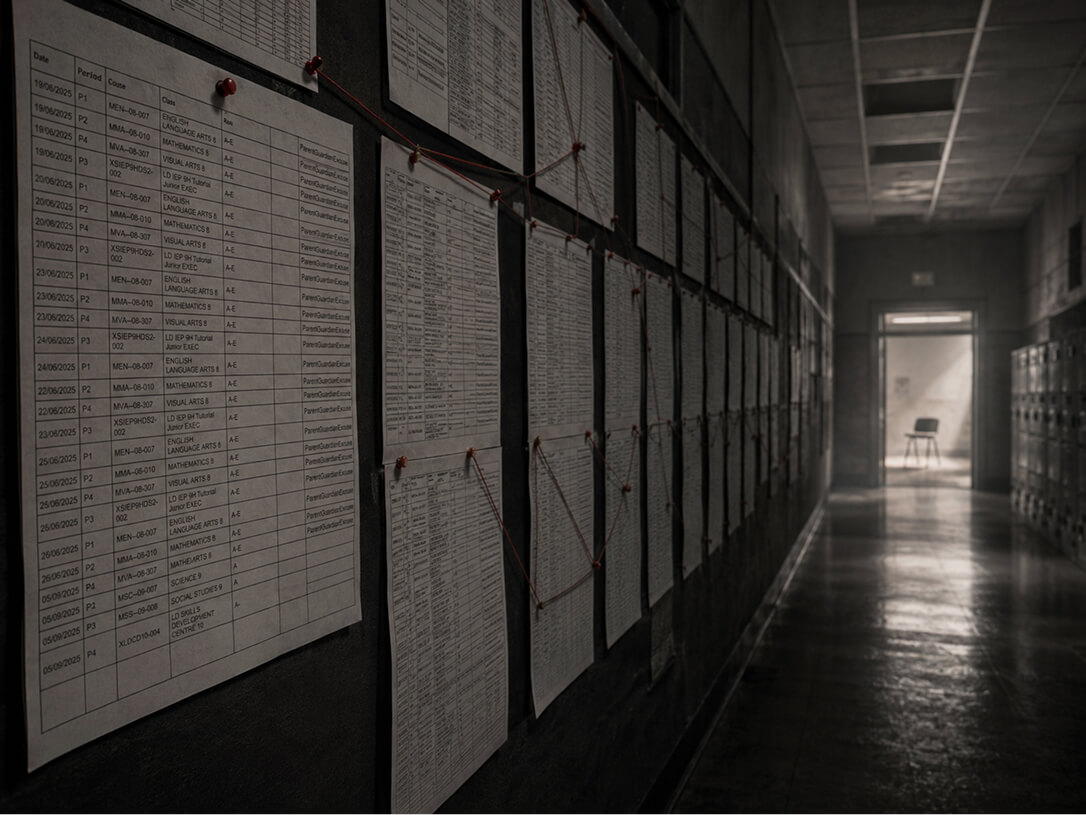
Between 2012 and 2022, British Columbia’s Schools Protection Program spent $4,420,252.58 responding to human rights claims filed against public schools, according to this FOI release. Of that total, $752,525.34 went to indemnity—settlements and compensation paid to claimants. The remaining $3,635,085.21 funded legal defence.
The ratio is precise: for every dollar spent remedying harm, the system allocated $4.83 to contesting it.
This is not a recent development or a temporary imbalance awaiting correction. It is a stable equilibrium, sustained across a decade, across changes in government, across waves of public rhetoric about inclusion and equity, across the Supreme Court of Canada’s Moore v British Columbia (Education) decision affirming the constitutional obligation to accommodate disabled students, and across repeated findings by the BC Ombudsperson that students with disabilities are being systematically excluded from meaningful access to education.
What a decade of spending reveals is not dysfunction but design: a system optimised to resist accountability rather than repair harm, one that has transformed discrimination claims from opportunities for correction into threats requiring aggressive institutional defence.
-

Human Rights Tribunal complaints are designed to exhaust
There is a silent calculus embedded in every human rights complaint: how much of…
The pattern across time
The consistency is what demands attention. In 2013, legal fees consumed $352,527.49 while indemnity payments totalled $62,250. In 2019, the gap widened further: $439,252.28 in legal defence against $56,650 in settlements. By 2021, legal spending reached $278,018.12 while compensation sat at $70,500.
Some years tilt slightly higher toward defence; others slightly lower. But the structure never shifts. Over ten years, the proportion remains remarkably stable.
This stability suggests something deeper than resource scarcity or competing budget priorities. The money exists—$4.4 million over ten years is substantial. The question is not whether funds are available, but how they are allocated and to what end. The data answers plainly: British Columbia consistently chooses to spend its resources defending discrimination claims rather than addressing the underlying harms, regardless of legal precedent or public scrutiny.
The equilibrium is not accidental. It reflects institutional priorities that value precedent control over harm repair, and that treat each claim as a threat to budgetary predictability rather than an opportunity to correct systemic failures. Legal defence spending functions as institutional insulation: it raises procedural barriers, increases the cost of participation for families, and contains the financial exposure of districts.
What the system purchases
A decade of spending bought something specific: the capacity to say no.
It funded prolonged litigation, procedural complexity, repeated adjournments, and the slow exhaustion of complainants. It preserved discretion—the ability for school districts to continue making accommodation decisions without meaningful external accountability, to maintain exclusionary practices without direct financial consequence, and to frame discrimination as unavoidable resource limitation rather than rights violation.
This is not speculative. It aligns closely with what freedom of information requests and oversight reports reveal about accommodation practices across BC school districts. Documented practices include:
- shortened or partial school days framed as supports rather than exclusion;
- room clears treated as de-escalation rather than removal from instruction;
- behavioural or safety plans used as substitutes for academic programming; and
- repeated refusals to implement accommodations on grounds of cost, staffing, or disruption.
When families challenge these practices through human rights complaints, the system’s response is rarely to examine whether the refusal was justified in light of legal obligations. Instead, it deploys legal resources to defend institutional discretion.
The legal fees ensure a system in which accommodation remains effectively optional, and in which schools retain authority to decide which students are too expensive, too disruptive, or too complex to serve.
The legal standard after Moore
In Moore v British Columbia (Education), the Supreme Court of Canada rejected the idea that special education is an optional add-on subject to available resources. Writing for a unanimous court, Justice Abella held that adequate special education is not “a dispensable luxury,” but rather the means by which students with disabilities gain meaningful access to education.
Critically, the Court clarified that the proper comparator is not other students with disabilities, but students in the general education system. Where a failure to accommodate denies a student meaningful access to education, discrimination is established unless the respondent can justify that failure under the stringent standard of undue hardship.
The Court explicitly rejected budgetary constraint as a blanket justification, noting that governments cannot rely on how they have chosen to allocate resources to excuse rights violations.
In principle, Moore should have altered how school districts approach accommodation decisions and how human rights complaints are resolved. In practice, the spending data suggests that it did not penetrate the economic logic governing institutional responses. Defence spending remained steady. Settlement amounts remained bounded. The defence-to-remedy ratio barely moved.
-

The moral cost of leaving children in fight-or-flight
Robin was eleven the day he fell and came up swinging. It was recess,…
Tribunal remedies and institutional incentives
Part of this equilibrium is produced by the structure of the BC Human Rights Tribunal itself. Remedies are compensatory, not punitive. Awards for injury to dignity, feelings, and self-respect—particularly in education cases—remain relatively modest, even where discrimination is found. Parties generally bear their own legal costs, regardless of outcome.
This structure has predictable effects. From an institutional perspective, prolonged defence carries limited downside risk: even an adverse decision is unlikely to result in damages that exceed the cost of defending the claim, and there is no routine cost-shifting to penalize unreasonable resistance.
For families, the calculus is reversed. Human rights proceedings are slow, often taking years. Legal representation is expensive, and self-representation carries significant risk. The emotional and financial toll compounds over time, particularly for families already managing exclusion, reduced employment, or escalating care needs.
The result is a system that rationally selects for low-loss claims—those where the potential remedy is large enough to justify participation, but not so large that prolonged defence becomes economically irrational for the respondent.
The distortion in visibility
When high-loss claimants exit the system—and a decade of capped remedies ensures they do—their absence creates a data vacuum that shapes policy.
What remains visible are claims brought by individuals whose losses were modest enough that settlements in the tens of thousands still held meaning, whose circumstances prevented exit, or whose determination outweighed economic rationality. These cases become the dataset from which policymakers draw conclusions about the severity and frequency of discrimination in schools.
If settlements cluster within predictable ranges, the inference is that harms themselves are correspondingly limited. If claims resolve without major budgetary impact, the conclusion is that the system functions adequately.
Meanwhile, the most damaging forms of exclusion disappear from view: the parent forced out of the workforce to manage a child’s exclusion; the professional whose career fractures under sustained advocacy demands; the family whose financial stability collapses under the weight of fighting for access to education. These harms are not rare. They are simply economically filtered out.
A decade of data therefore captures not the full scope of discrimination, but only the subset of harms whose victims could afford to remain visible.
Ombudsperson findings and systemic continuity
Concerns about exclusion in BC schools are not new, but they have historically remained diffuse, fragmented, and easy for institutions to absorb without structural change.
That changed in January 2025, when the BC Ombudsperson announced a province-wide systemic investigation into the exclusion of students from K–12 public schools. In doing so, the Ombudsperson publicly acknowledged receiving complaints from across the province about students—including students with disabilities—being excluded from school or receiving little or no instruction, often through informal practices such as shortened school days or being asked to stay home.
The significance of this announcement lies not only in its findings, but in its timing. By 2025, the defence-over-remedy spending equilibrium documented in the Schools Protection Program data had already been stable for more than a decade. The Ombudsperson’s investigation did not coincide with a change in spending patterns; it followed them. Oversight recognition arrived after years in which exclusionary practices had already been normalised, defended, and financially insulated.
This sequencing matters. It shows that the system was able to absorb complaints, parental advocacy, and even growing public concern without altering how it allocated resources. The absence of earlier sweeping intervention is not evidence that exclusion was rare or insignificant, but evidence that the institutional mechanisms available were insufficient to disrupt the underlying incentive structure.
When oversight finally escalated to a systemic investigation, the defence-to-remedy ratio remained unchanged. Legal fees continued to dwarf compensation. This continuity underscores a central point: oversight findings, no matter how serious, do not themselves reconfigure institutional behaviour when the economic logic of defence remains intact.
-

What BC spends to avoid accountability
The numbers arrived in a single-page response to a freedom of information request. Between January 2022 and February 2024, British Columbia’s Schools Protection Program—the provincial insurance mechanism that shields school districts from liability—spent $1,340,772.33 responding to discrimination claims filed against public schools. Of that sum, $252,000 went to settlements or indemnity payments across sixteen resolved matters. The remainder, $1,088,772.33, funded legal defence across seventy-one transactions. The ratio speaks plainly: for every dollar paid to compensate harm, the system spent more than four dollars contesting it. This is what happens when institutions design remedies that discourage the people who carry the…
The policy feedback loop
The data distortion feeds directly into policy.
Policymakers see settlements in the tens of thousands and infer that discrimination, while regrettable, produces limited damage. They observe that districts are not financially imperilled and conclude that the system strikes a reasonable balance between rights and sustainability.
What they do not see is the population filtered out before resolution. Families who exit early, settle cheaply, or never file at all are absent from the record. Their absence is misread as absence of harm rather than rational withdrawal from an economically hostile system.
This feedback loop is self-reinforcing. Low remedies discourage high-loss claims. Low-loss claims generate data suggesting limited harm. That data justifies continued low remedies.
The cost of stability
A decade and $4.4 million purchased stability—but at a cost far beyond the budget line.
It purchased the stability of a system in which accommodation remains conditional, where schools retain discretion to exclude students deemed too costly or complex, and where families bear the economic burden of enforcing rights the law already guarantees.
It purchased stability of denial: the ability to frame exclusion as resource constraint, to treat discrimination as episodic rather than systemic, and to point to modest settlements as evidence of adequacy.
The costs of this stability are externalised. Legal defence is collectivised across districts. The economic losses borne by families are private, invisible, and uncompensated.
What breaks an equilibrium
Equilibria persist until the underlying incentives change.
A decade of consistent spending ratios suggests that incremental pressure—precedent, oversight, advocacy—has not been sufficient. Breaking the equilibrium would require altering the cost structure: making defence more expensive than remedy, exclusion more costly than inclusion, and prolonged resistance riskier than early accountability.
This could include fee-shifting when discrimination is proven, statutory damages that reflect compound harm, or structural limits on defence spending relative to remedy. Transparency matters as well. Publishing not just settlement amounts, but the documented losses claimants advanced and the accommodations denied, would expose the gap between harm and remedy.
Most fundamentally, it requires reframing the absence of high-value settlements as evidence of system failure rather than success. Silence is not proof of equity; it is often proof of rational exit.
The arithmetic of a decade
Ten years. $4.4 million. A five-to-one ratio of defence over remedy, sustained across governments, court decisions, and investigations into systemic exclusion.
This is not a story about scarcity or inefficiency. It is a story about incentives. Until the cost of maintaining this equilibrium exceeds the cost of disrupting it, nothing suggests it will shift.
-
What BC spends to avoid accountability
The numbers arrived in a single-page response to a freedom of information request. Between…