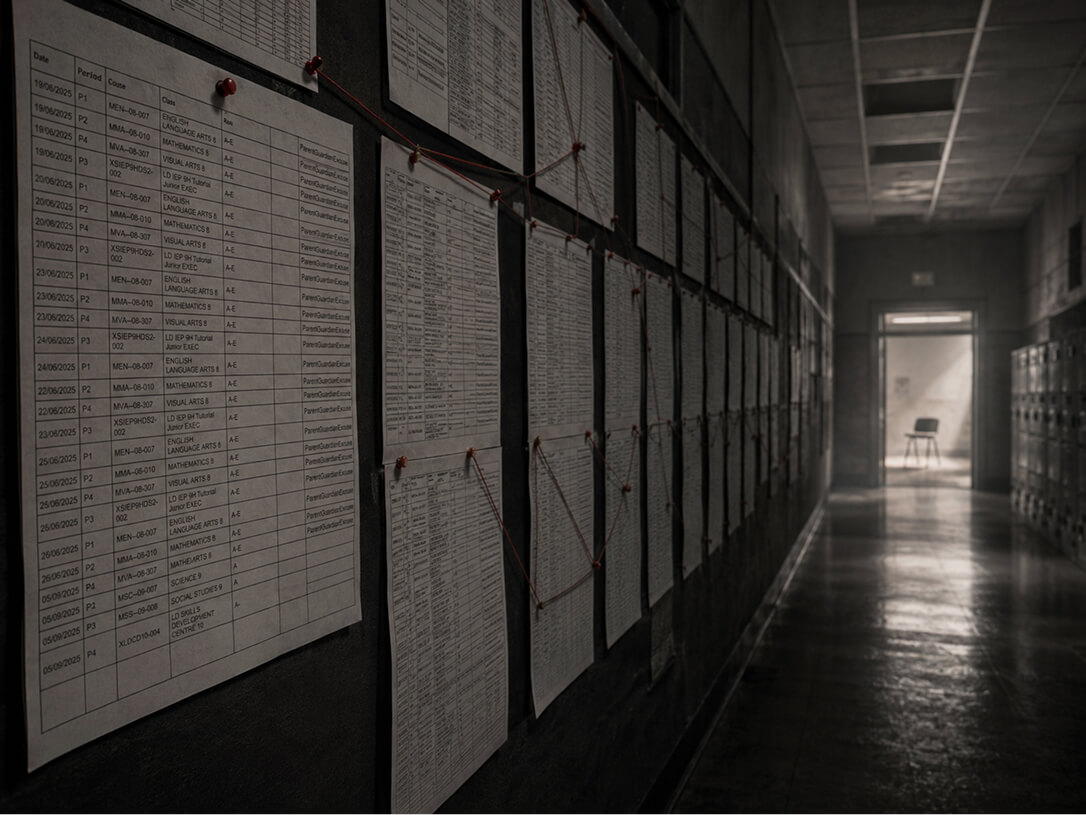
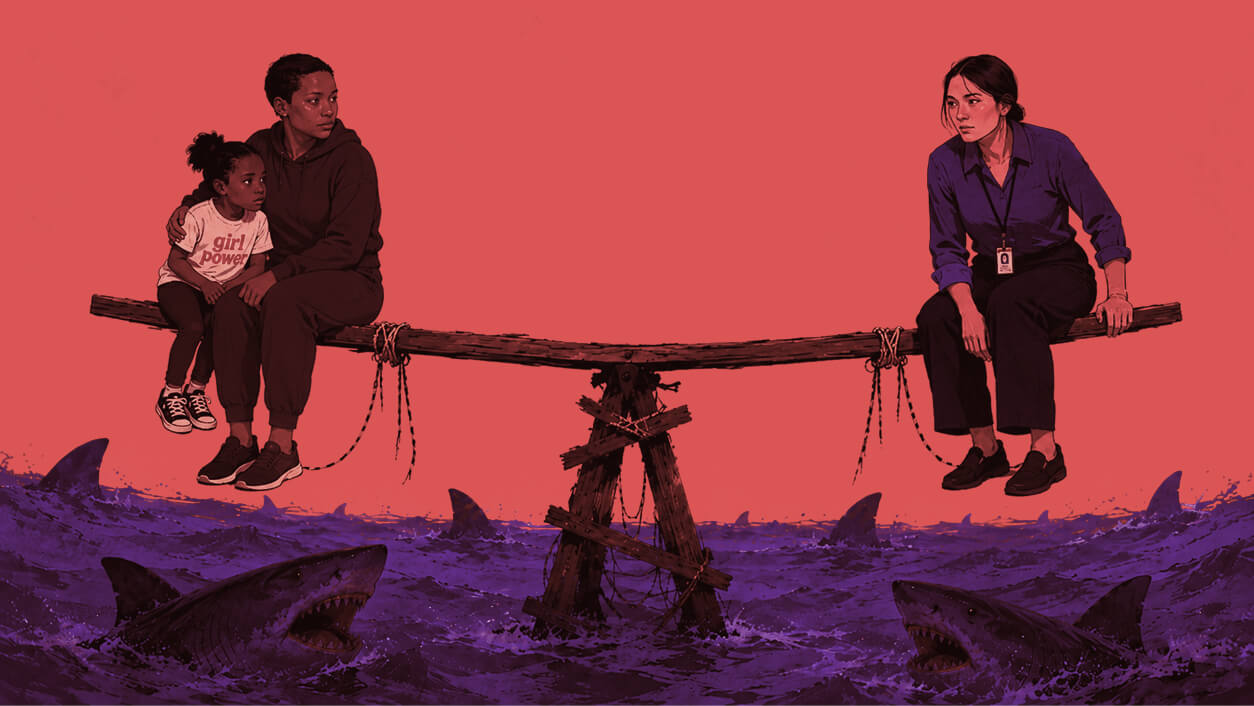
In schools across British Columbia, decision makers hold extraordinary influence over the daily lives of children—setting codes of conduct, approving behaviour plans, allocating staff time, and interpreting what counts as safety, regulation, disruption, or belonging.
While educators may implement the strategies most visible to families, it is decision makers who define the parameters within which those strategies unfold: the policy language that obscures harm, the data systems that equate compliance with success, and the staffing ratios that guarantee unmet needs.
This page offers a point of entry for those willing to examine the foundations of school culture—not in defence of the status quo, but in recognition of its failure to uphold dignity, justice, or care.
Here you will find writing and resources that challenge the deeply held assumption that children must be controlled to be educated, that discomfort is a necessary rite of passage, and that exclusion is the natural outcome of disorder. These are not isolated missteps by individual teachers or misbehaving students. These are systemic failures engineered through scarcity logic, institutional ableism, and policy inertia—and they demand decision makers who are brave enough to choose a different path.
Resources
This section includes essays, frameworks, and practical tools to support school decision makers in building cultures of accountability, care, and inclusion. You will find analysis of codes of conduct, critiques of dominant behavioural paradigms, position papers on collective punishment, and writing that reveals the emotional and political costs of institutional harm. These resources are designed for superintendents, principals, vice-principals, district administrators, school trustees, policy drafters, and all others whose decisions shape the conditions under which students and educators attempt to survive.
Whether you are ready to act, unsure where to begin, or reckoning with past decisions, this is a place to listen, reflect, and rebuild.
-

Where Surrey’s $6.3 million went
I recently reviewed the provincial budget tables and buried within Table 17 (2024/25 Amended Annual Budgeted Operating Expenditures of Program 1.10 Inclusive Education by Object) and Table 26 (2024/25 Actual…
-

What districts refuse to count, they refuse to see
Canary Collective makes explicit what current FESL reporting renders invisible: the exclusionary practices that shape access to learning but disappear from accountability structures because districts are not required to document…
-
VSB’s FESL report: the aesthetics of performative accessibility
An analysis of how VSB’s FESL report performs inclusion through language and process while avoiding measurement, accountability, and material change.
-
Surrey FESL report shows why FESL is designed to fail
Surrey School District’s 2025-26 Enhancing Student Learning Report spans 42 pages across two documents, presenting what appears at first glance as a model of comprehensive educational accountability—extensive data visualisations tracking…
-
What Arrow Lakes reveals about BC’s FESL
School District 10, Arrow Lakes, is often described, including by itself, as a best‑case scenario for public education in British Columbia. It is small, rural, relational, and values‑driven. It knows…
-

Surrey School District is self congratulatory while exclusions continues
Surrey Schools’ International Day of Persons with Disabilities announcement celebrates procedural progress at the very moment families continue pressing for basic transparency around exclusionary practices. On December 3, the district…
-

How FESL enables ongoing exclusion of disabled children
In 2020, the British Columbia Ministry of Education and Child Care brought into force the Framework for Enhancing Student Learning, a policy architecture ostensibly designed to guide the province’s approach to…
-
The affective architecture of room clears
Room clears should be rare. In adequately resourced classrooms with sufficient staffing, with educational assistants trained in co-regulation, with adults who understand that compliance is not wellness and frozen silence…
-

The architecture of absence data in Canada
A CBC investigation maps the landscape of what we choose to measure and what we choose to obscure, revealing a system where the simple act of knowing why children disappear from classrooms…
-
Government funding for education fails to keep pace with known needs
The Education and Childcare Estimate Notes 2025 reveal a province experiencing an enormous rise in disability designations while preparing the minister with polished assurances that gesture toward progress, equity, and…
-

Why the SD23 suspensions report matters for exclusion analysis
While I was looking for more disclosures from school districts to the Ombudsperson, I stumbled on this older document that summarises suspensions in School District 23. The document offers a…
-

Why disabled kids are missing more school than peers
Tara Carman recently wrote an article about rising absences from school and suggested that the trend may be linked to a growing mental health crisis: Why are so many kids…
-
Why I’m tracking exclusions no one else is measuring
I’ve been reading exclusion data that most people will never see. Two BC school districts—New Westminster (SD40) and Southeast Kootenay (SD5)—publicly released their submissions to the BC Ombudsperson’s investigation into…
-

Partial exclusion, full harm
The Tribunal’s decision in Student Y by Grandparent S v. Board of Education of School District No. X, 2024 BCHRT 353, with refusing the application to dismiss, affirms that partial school days,…
-

SD83 publicly acknowledges Ombudsperson investigation and releases updated exclusion procedure
School District 83 (North Okanagan-Shuswap) has released one of the most transparent updates to date on the BC Ombudsperson’s province-wide investigation into student exclusion. The district’s October 21, 2025 Regular Board…
-

A data story from Southeast Kootenay District
I lived in Nelson as a child. The racial diversity was low. I know it has increased over time, yet it remains a small community, and when a young child…
-

District exclusion reasons
A review of exclusion records from New Westminster (SD40) and Southeast Kootenay (SD5) reveals a consistent pattern: the stated reasons for exclusion drift toward biography, circumstance, and administrative decisions rather…
-
The New Westminster submission to the Ombudsperson
Kudos to New West for being the first district I’ve identified to have released their report to the Ombudsperson. The New Westminster submission provides ~three years of exclusion data incidents…