School District 10, Arrow Lakes, is often described, including by itself, as a best‑case scenario for public education in British Columbia. It is small, rural, relational, and values‑driven. It knows its learners. It emphasises inclusion, connection to land, and collaboration. If any district should be able to identify and respond to exclusion quickly, it is this one.
Yet a close reading of Arrow Lakes’ Framework for Enhancing Student Learning (FESL) reports from 2023, 2024, and 2025 reveals something more troubling: the very structure of the Framework makes exclusion difficult to see, easy to rationalise, and almost impossible to name. This is not a failure of goodwill or professionalism. It is a failure of design.
-

How FESL enables ongoing exclusion of disabled children
In 2020, the British Columbia Ministry of Education and Child Care brought into force the Framework for Enhancing Student Learning, a policy architecture ostensibly designed to guide the province’s approach to continuous improvement in public education, with particular attention to improving equity for Indigenous…
A district that does everything “right”
Across three consecutive reports, SD10 demonstrates exemplary compliance with the Ministry’s expectations. The reports are detailed, reflective, and methodical. They include district context, demographic data, strategic alignment, engagement processes, and a full suite of ministry‑mandated outcomes: literacy, numeracy, belonging, graduation, and transitions.
The district repeatedly emphasises its strengths:
- small class sizes
- inclusive classrooms
- strong relationships with families
- knowing each learner
- collaborative inquiry and professional learning
In many respects, Arrow Lakes models exactly what the Framework appears to envision: thoughtful educators engaged in continuous improvement through reflection, data analysis, and iterative adjustment.
And yet.
Inclusion as assertion, not outcome
Across all three years, inclusion is treated as a given rather than something to be tested. Students with disabilities are consistently referred to as “students with diverse needs,” a category that is acknowledged but rarely interrogated.
The reports note, year after year, that:
- students with diverse needs are more likely to be emerging or developing in literacy and numeracy
- fewer Indigenous students and students with diverse needs are “on track” in key areas
- some cohorts require “more targeted support”
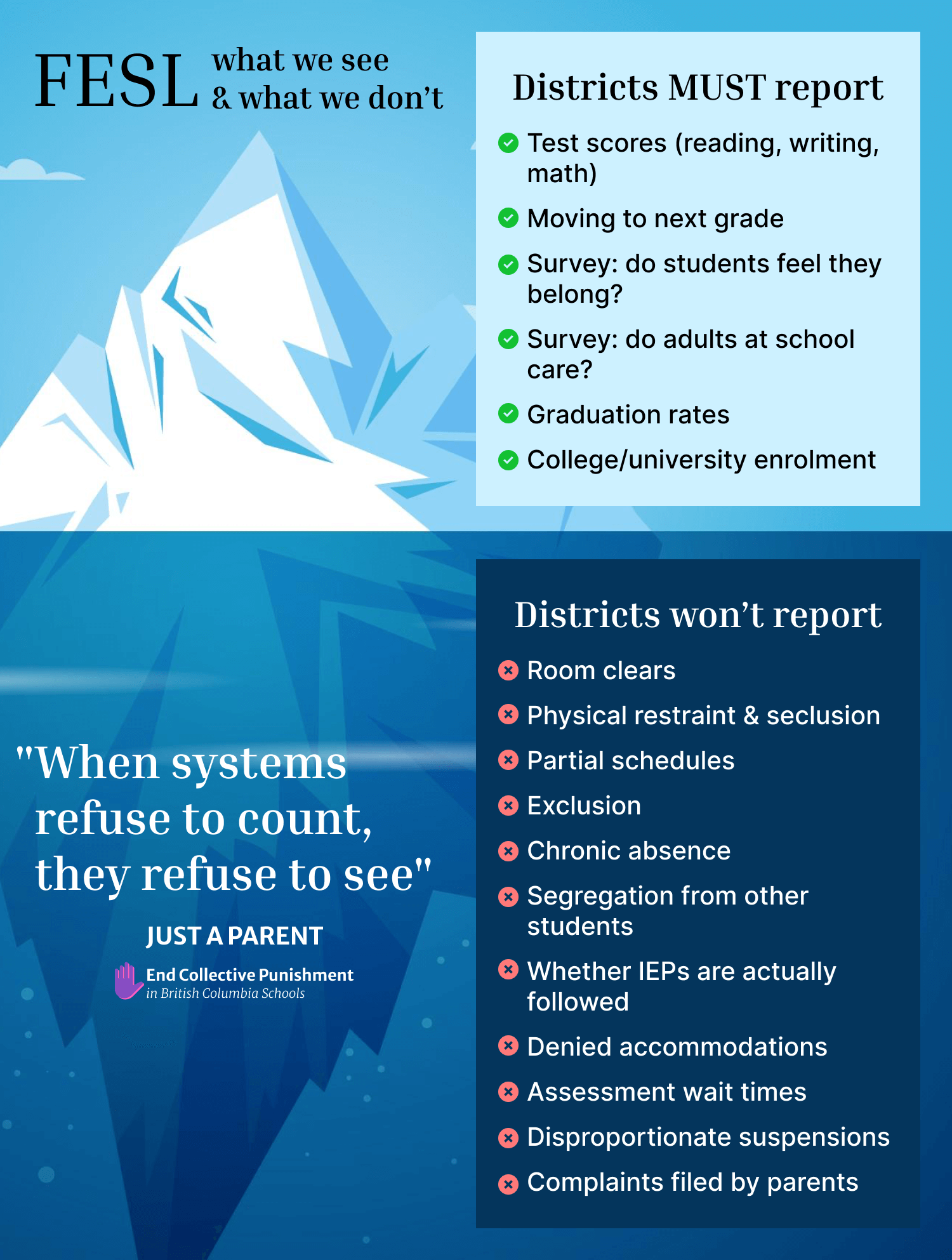
What never appears alongside these acknowledgements are concrete indicators of access:
- time spent in class
- instructional minutes received
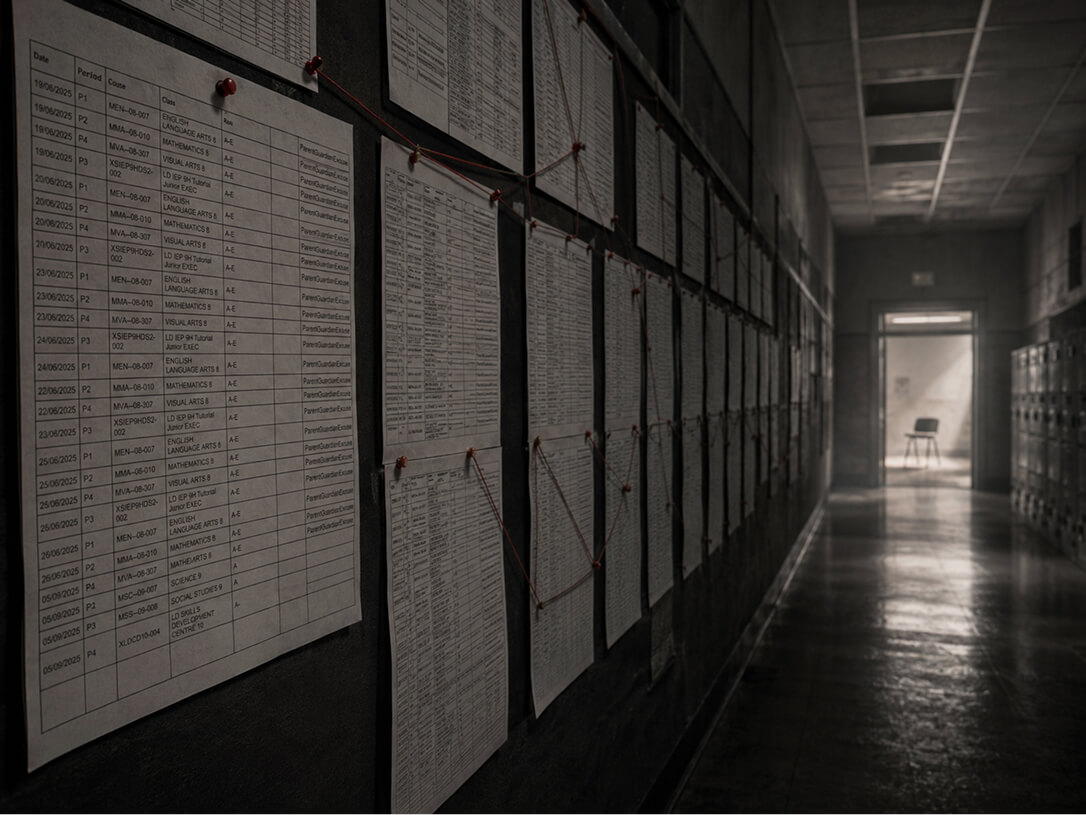
- partial‑day schedules
- exclusions from instruction
- placement decisions
- use of reduced or modified programs
In other words, the Framework measures performance without measuring access. If a child is present only two hours a day, the system still records their literacy level — but never asks why they were absent for the other four.
The masking effect of small numbers
Arrow Lakes repeatedly invokes small cohort sizes to explain data instability and masking. This is statistically true — and structurally revealing.
In a district of just over 500 students, many sub‑population outcomes are masked or suppressed to protect privacy. As a result, the students most vulnerable to exclusion are the least visible in the public record.
This creates a paradox at the heart of the Framework:
The smaller the district, the easier it should be to notice exclusion — yet the Framework produces less visibility, not more.
When combined with assurances that “we know each learner,” masking functions as a substitute for accountability. Knowledge is claimed, but not demonstrated. Action is implied, but not evidenced.
What is never named
Perhaps the most telling absence in all three reports is language.
Nowhere do we see:
- exclusion
- discrimination
- denial of access
- human rights obligations
- the duty to accommodate
This silence is not accidental. The Framework does not require districts to look for exclusion, so even the most conscientious districts do not report it.
A revealing contrast
Arrow Lakes’ Indigenous education work provides an important counterpoint. Where the district chose to look directly — through equity scans, student voice, and named goals — it identified problems and implemented tangible changes: Elders‑in‑Residence, dedicated spaces, improved connectedness, and clearer acknowledgment of remaining gaps.
This matters because it shows capacity.
The district can act decisively when the system asks it to see.
FESL, however, does not ask districts to see exclusion of disabled students. It asks them to manage outcomes.
The real lesson of Arrow Lakes
Arrow Lakes is not an outlier. It is the proof.
If a small, relational, well‑resourced rural district — doing everything the Framework asks — cannot clearly identify or prevent exclusion, then the problem is not local practice. It is provincial design.
The Framework for Enhancing Student Learning is often described as supportive and non‑punitive. In practice, it is also non‑protective. By prioritizing reflection over obligation and outcomes over access, it allows exclusion to persist without ever being named.
When small is not safe, no district is.
What Arrow Lakes shows us is not failure — but the limits of a framework that confuses improvement with justice.
-
Government funding for education fails to keep pace with known needs
The Education and Childcare Estimate Notes 2025 reveal a province experiencing an enormous rise in disability designations while preparing the minister with polished assurances that gesture toward progress, equity, and commitment, and this dual presentation of crisis beneath a veneer of stability creates…