Surrey School District’s 2025-26 Enhancing Student Learning Report spans 42 pages across two documents, presenting what appears at first glance as a model of comprehensive educational accountability—extensive data visualisations tracking student outcomes across multiple measures, disaggregated by Indigenous identity, English language learner status, and disability designation, accompanied by detailed narrative analysis of gaps, strategic responses, and planned adjustments. The report demonstrates meticulous compliance with every requirement the Framework for Enhancing Student Learning establishes, documenting Surrey’s commitment to equity, continuous improvement, and evidence-based decision-making with the kind of procedural rigour the Ministry of Education explicitly requests.
Yet something essential remains absent from these 42 pages, something that renders all this sophisticated measurement ultimately incapable of revealing whether disabled children in BC’s largest school district actually access the education they’re entitled to receive, or whether they experience systematic exclusion the Framework’s data architecture carefully hides from view.
What Surrey measures
The numbers Surrey reports paint a troubling portrait of educational outcomes for disabled students. Grade 4 literacy proficiency dropped from 66% of students on-track or extending in 2018-19 to 57% in 2023-24, with students designated with diverse abilities falling to just 40% meeting provincial standards. Indigenous students reached only 41% proficiency, while English language learners achieved 47%. The gap between disabled students and their peers without designation sits at 29 percentage points—nearly one-third of disabled children failing to meet Grade 4 literacy benchmarks.
Grade 7 numeracy reveals similar patterns: 39% of students with diverse abilities reach on-track or extending levels, compared to 68% of students without designation. Indigenous students with disabilities fare even worse, though Surrey’s report does not provide intersectional data making visible how disability and Indigeneity compound to produce educational outcomes the district itself describes as “concerning.”
Student Learning Survey data shows disabled students reporting lower rates of intellectual engagement, social connection, and school belonging than their peers. Grade 4 students with diverse abilities report 77% intellectual engagement compared to 84% district-wide. By Grade 7, disabled students’ sense of belonging drops to 63%, falling below both district averages and the experiences of their non-disabled peers at every grade level Surrey measures.
Post-secondary transition data—theoretically tracking Grade 12 students’ pathways after graduation—reveals that students with diverse abilities transition to post-secondary education at rates dramatically lower than district averages, though Surrey’s report provides insufficient detail to determine whether this reflects genuine educational barriers, inadequate transition planning, systemic ableism in post-secondary institutions, or measurement problems failing to capture disabled students’ actual post-graduation experiences.
Surrey presents all this data with appropriate concern, describing gaps as “troubling,” outcomes as “requiring attention,” and disparities as “highlighting the need for continued focus.” The district demonstrates awareness that disabled students experience measurably worse educational outcomes than their peers, acknowledges this as inconsistent with equity commitments, and commits to ongoing efforts addressing the patterns the data reveals.
What Surrey investigates
When confronted with declining outcomes, Surrey’s response follows a predictable pattern the Framework’s architecture enables and encourages—convert urgent need for intervention into patient process of investigation, treating each concerning data point as invitation for deeper inquiry rather than evidence requiring immediate remedial action.
Grade 4 literacy dropped from 66% to 57% proficient? Surrey commits to “further triangulation of data” and “continued and deeper inquiry into factors contributing to student success.” The phrase “triangulation” appears throughout the report, suggesting rigorous analytical method while deferring concrete action until multiple data sources align to confirm what single sources already reveal—that disabled children aren’t learning to read at rates approaching their peers.
Indigenous students’ sense of belonging declined 10-15 percentage points across multiple grade levels? Surrey describes this as “troubling” and “highlighting the need for further investigation and targeted action,” yet provides no timeline specifying when investigation concludes and targeted action begins, no benchmarks determining what would constitute sufficient evidence to move from studying the problem to solving it, no accountability mechanisms ensuring investigation doesn’t substitute indefinitely for intervention.
The linguistic architecture throughout Surrey’s report treats every concerning outcome as prompting more questions rather than demanding urgent answers. Grade 10 to Grade 11 transition rates for Indigenous students dropped to 89%—concerning, yes, but the response is “implementing strategies to determine individual students’ context and needs” rather than implementing strategies ensuring all students actually transition. Post-secondary transitions for Indigenous students fell from 45% to 26%—an area of concern, certainly, but Surrey wants to “collect data from students to ensure we capture all of their intended plans” rather than accepting the data might accurately reflect that fewer students are pursuing post-secondary education and this represents educational failure requiring immediate remedy.
This converts accountability into perpetual investigation, transforming each data point into invitation for another planning cycle, another round of inquiry, another year of “further triangulation” while children experiencing harm today cannot wait for continuous improvement processes that might eventually translate investigation into intervention at some unspecified future point after they’ve already left the system that failed them.
-

How FESL enables ongoing exclusion of disabled children
In 2020, the British Columbia Ministry of Education and Child Care brought into force the Framework for Enhancing Student Learning, a policy architecture ostensibly designed to guide the province’s approach to continuous improvement in public education, with particular attention to improving equity for Indigenous…
What Surrey never reveals
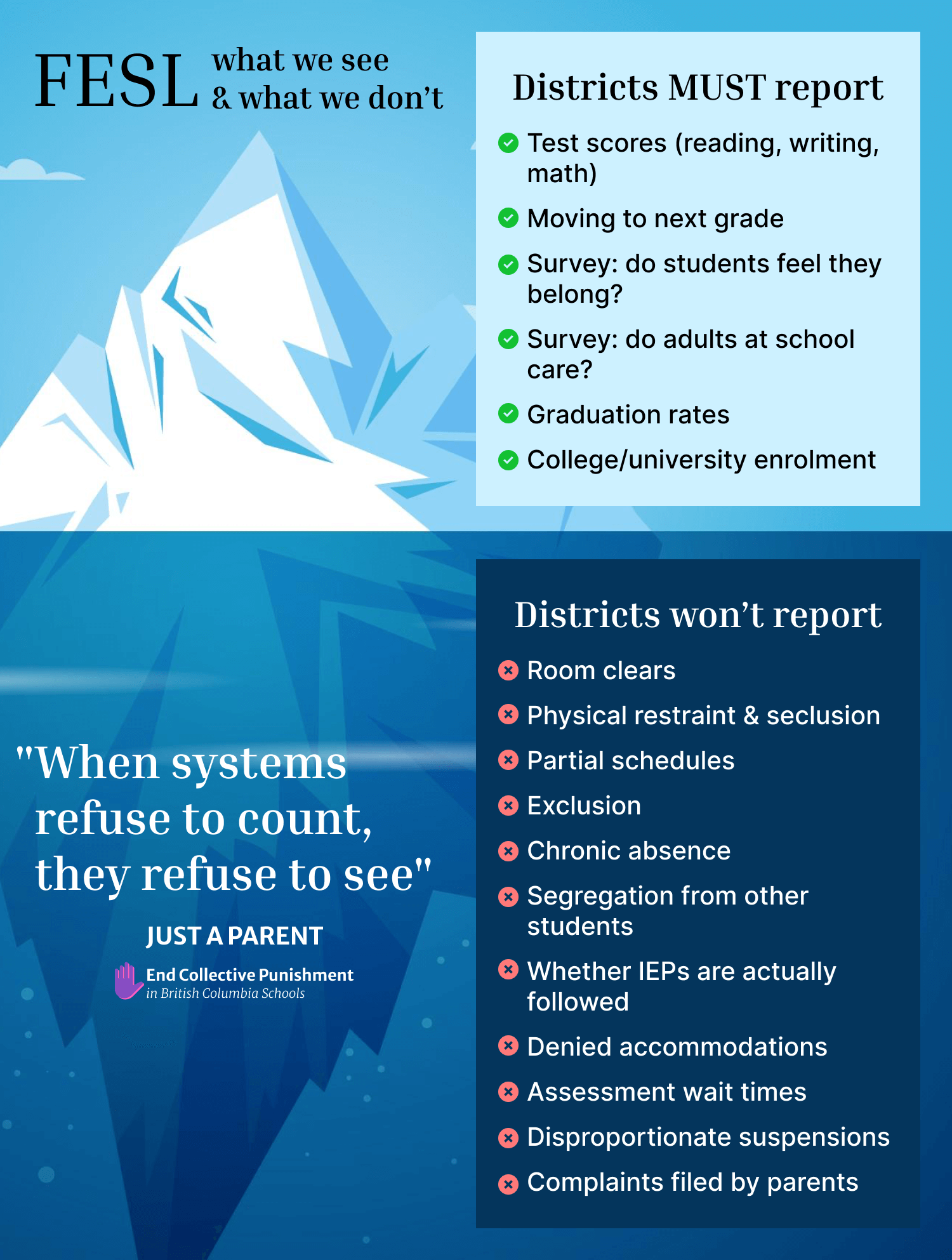
Forty-two pages of comprehensive reporting, extensive data visualization, sophisticated statistical analysis disaggregated across multiple dimensions—and yet Surrey’s report contains zero information about whether disabled students actually attend school, remain in instructional settings when they arrive, access general education classrooms, receive services their IEPs specify, or experience exclusionary discipline practices at rates disproportionate to their peers.
The Framework requires districts to report on Foundation Skills Assessment scores, Student Learning Survey results, grade-to-grade transitions, graduation assessments, completion rates, and post-secondary transitions. Surrey reports all of this meticulously. The Framework does not require districts to report on attendance rates by designation, chronic absence patterns, suspension or expulsion incidents, informal exclusions, room clear frequency, physical restraint or seclusion, time spent in general versus segregated settings, IEP implementation rates, accommodations requested versus provided, assessment wait times, or the proportion of students receiving modified versus adapted programming.
Surrey reports none of it.
This creates an analytical impossibility at the heart of every FESL report the Framework produces—we can measure outcomes rigorously while remaining structurally incapable of determining whether poor outcomes result from disability itself or from exclusionary practices the data architecture refuses to make visible. When 40% of disabled Grade 4 students meet literacy benchmarks compared to 69% of their non-disabled peers, is this because disabled children face inherent barriers to literacy acquisition, or because they’re not attending school due to partial schedules, being removed from literacy instruction during room clears, placed in segregated settings without access to evidence-based reading intervention, holding IEPs that specify literacy goals but never receive the services those IEPs promise, or waiting months for assessments that might identify their specific learning needs and appropriate instructional responses?
The Framework’s data architecture ensures we never know. Surrey cannot report what Surrey is not required to measure, and the Ministry has designed reporting requirements that meticulously track academic outcomes while systematically obscuring access to the instruction producing those outcomes.
This is not accidental oversight—this is foundational design. A Framework genuinely committed to inclusion would measure inclusion as rigorously as it measures literacy, would track exclusionary practices with the same statistical sophistication currently devoted to Foundation Skills Assessment scores, would disaggregate room clear incidents and partial schedules and chronic absence by designation with the same granularity Surrey applies to Student Learning Survey responses.
The Framework does not do this because making exclusion visible would require addressing it, would create accountability for practices districts currently deploy with impunity, would transform concerning data points from invitations for investigation into evidence of rights violations requiring immediate remedy.
What Surrey cannot afford
Buried in Surrey’s narrative about literacy improvement efforts sits a revealing detail about MathMinds implementation—a research-based mathematics program the district knows produces better outcomes for students, evidenced by the fact that schools using MathMinds demonstrate stronger numeracy results than schools not yet implementing the program. Surrey has been rolling out MathMinds for four years. After four years of knowing this program works, only 18 of 24 elementary schools actually use it.
Why would a district continue allowing six schools to provide less effective mathematics instruction when they know which program produces better results? The report never states this explicitly, but the implication registers clearly—capacity constraints, resource limitations, insufficient funding to implement known-effective programs at scale across all schools simultaneously.
Children in those six schools without MathMinds continue receiving less effective instruction not because Surrey doesn’t know what works, not because the district lacks commitment to numeracy, not because administrators haven’t prioritized mathematics outcomes, but because knowing what works and affording to do what works for all children right now remain entirely separate questions, and the Framework pretends this gap doesn’t exist.
Surrey’s strategic plan commits to evidence-based literacy instruction, comprehensive professional development, formative assessment capacity, targeted interventions for struggling learners, culturally responsive pedagogy, trauma-informed practices, and inclusive classroom environments. These commitments cost money—for additional educational assistants, smaller class sizes, specialist teachers, assessment tools, intervention programs, professional learning time, and all the infrastructure inclusion genuinely requires.
The Framework imposes significant procedural obligations—strategic planning, stakeholder engagement, data analysis, report preparation, ministry review—without providing dedicated funding for any of it. Surrey must reallocate existing resources to meet Framework requirements, spreading already inadequate capacity even thinner, producing the sophisticated compliance documentation the Ministry requests while serving students with the same insufficient resources that produced concerning outcomes in the first place.
This is budget ventriloquism elevated to provincial policy—forcing districts to narrate existing inadequate spending as Framework-aligned, describing resource scarcity as strategic priority-setting, presenting triage decisions as evidence-based continuous improvement. Surrey demonstrates exemplary compliance while trapped in impossible position of being underfunded yet expected to serve all students, over-reported yet given no additional resources for reporting work, under-supported yet held responsible for outcomes, and unaccountably accountable through a Framework that gives districts no enforceable standards, adequate resources, or consequences for persistent failure.
What genuine accountability would require
If the Framework existed to protect disabled children rather than protect districts from accountability for excluding them, Surrey’s report would look fundamentally different. Instead of 42 pages measuring outcomes while hiding exclusion, it would track whether disabled students actually access instruction with the same rigour currently devoted to whether they meet academic benchmarks after that instruction.
It would report: attendance rates disaggregated by designation and reason for absence, distinguishing between illness and informal exclusion through partial schedules or parent-requested shortened days. Room clear incidents by student designation, duration, frequency, and whether alternative instruction provided during removal. Physical restraint and seclusion incidents, including what precipitated each incident and whether less restrictive alternatives were attempted first. Time spent in general education settings versus segregated placements, tracking how many disabled students receive instruction alongside non-disabled peers.
-

Government funding for education fails to keep pace with known needs
The Education and Childcare Estimate Notes 2025 reveal a province experiencing an enormous rise in disability designations while preparing the minister with polished assurances that gesture toward progress, equity, and commitment, and this dual presentation of crisis beneath a veneer of stability creates…