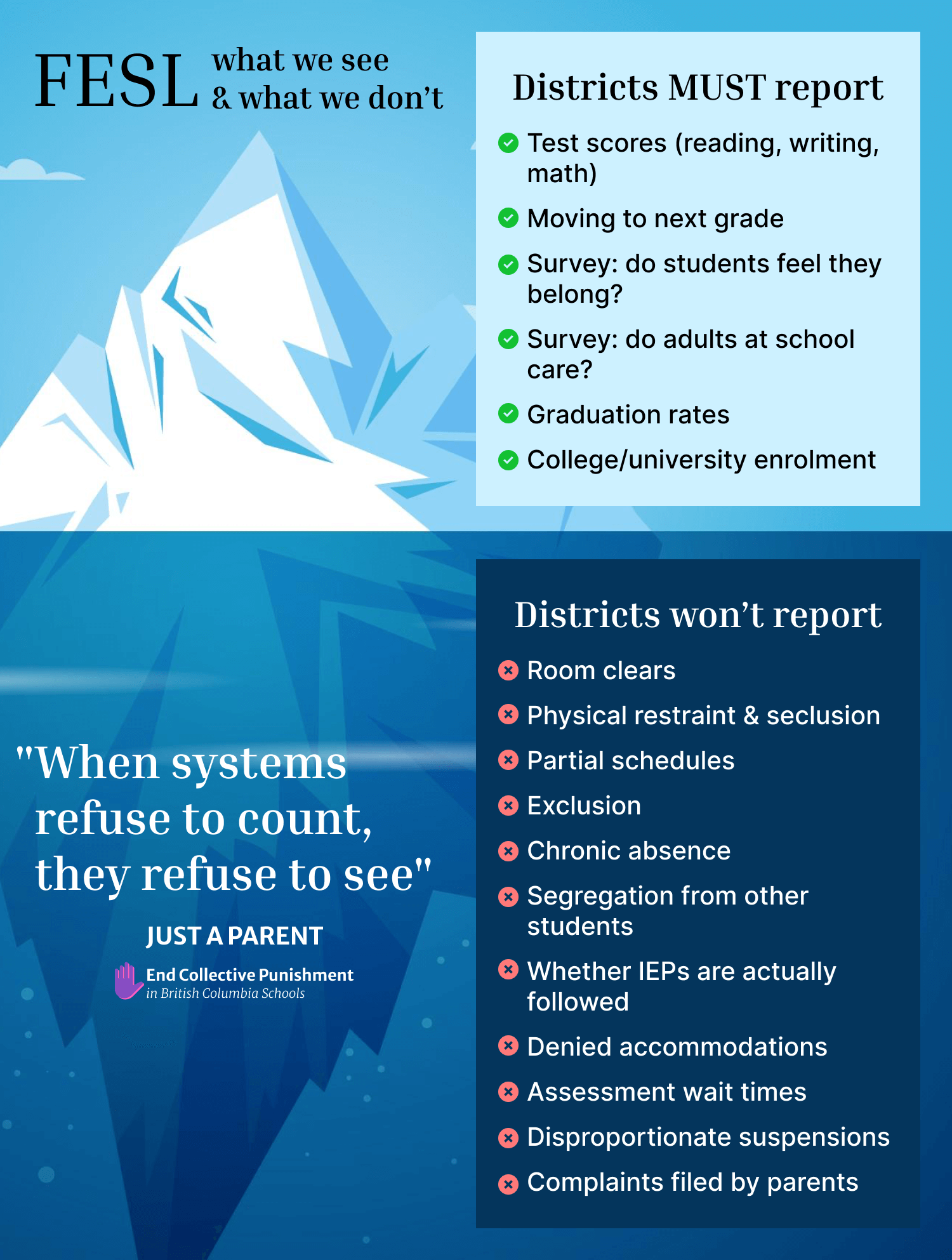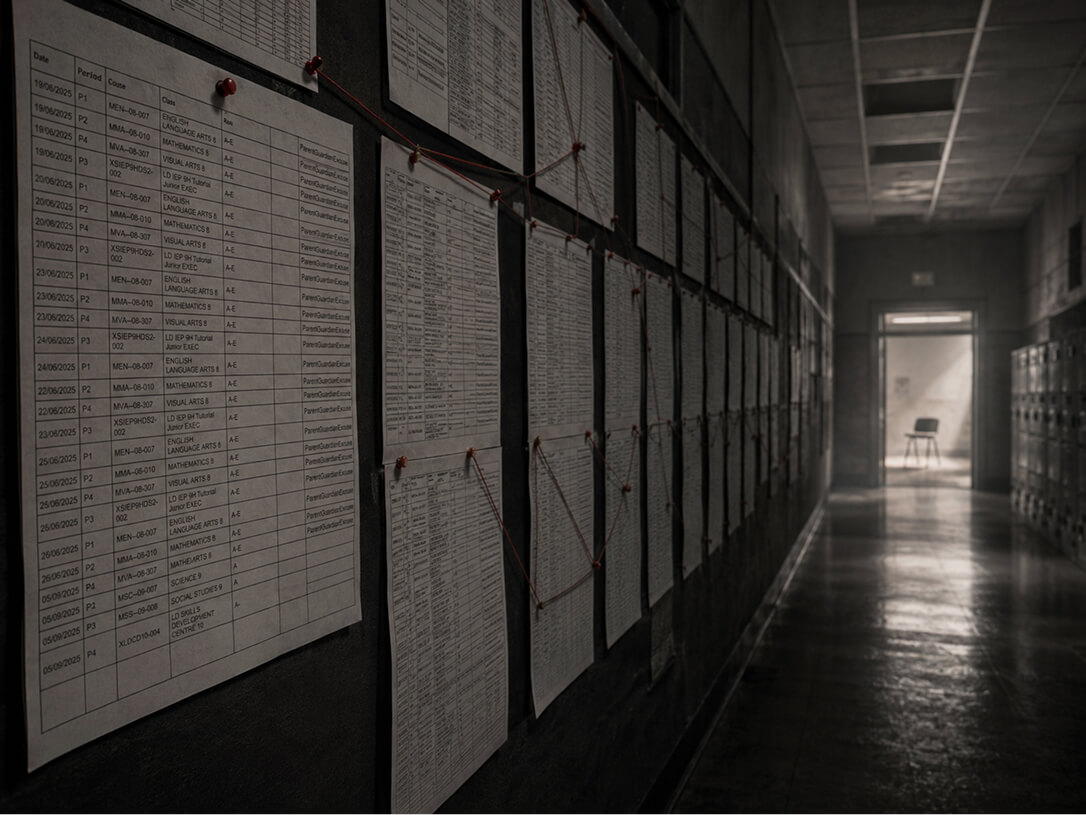
The Vancouver School Board’s Framework for Enhancing Student Learning (FESL) report presents itself as a comprehensive, data-informed account of how the district is improving outcomes for all learners. It adopts the language of inclusion, equity, and continuous improvement, and aligns closely with Ministry requirements and contemporary policy norms. On the surface, it appears rigorous, responsive, and values-driven.
This essay argues that the report’s strength is largely aesthetic rather than material. While it performs concern for accessibility and inclusion through framing, language, and process, it avoids measuring—and therefore confronting—the structural conditions that most directly shape learning outcomes for marginalized students. Inclusion is articulated as an aspiration, not operationalized as a set of enforceable obligations. Improvement is described as ongoing, but never defined in terms of sufficiency, timelines, or accountability.
At the core of the report is a continuous improvement model better suited to optimizing processes than to addressing life-critical system failures. When applied to education—particularly in contexts involving disability, exclusion, and human rights—this model functions as a form of risk management rather than transformation. It allows the system to demonstrate activity without demonstrating adequacy, and responsiveness without redistribution.
Through an analysis of framing, the continuous improvement logic, keyword frequency, stated commitments, and critical data absences, this essay examines how the report substitutes planning for provision and language for leverage. It asks a simple but consequential question: what would this document look like if its primary purpose were not to demonstrate compliance or effort, but to materially improve learning conditions for students most at risk of exclusion?
What emerges is not a lack of good intentions, but a system structured to talk about accessibility without being forced to deliver it.
On framing
The Vancouver School Board introduced its 2024-2025 Framework for Enhancing Student Learning report with a sentence so perfectly calibrated to institutional self-regard that it deserves extended attention:
“As required annually by the Ministry of Education, the District drafted an Annual Framework for Enhancing Student Learning (FESL) Report.”
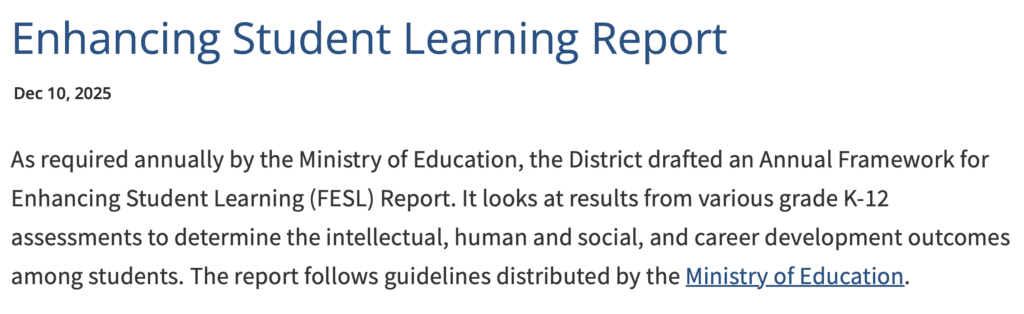
Not “the District analyzed student outcomes.” Not “we examined equity gaps.” Not even “we assessed our progress toward inclusion.” The District drafted a report.
The action being described is the production of compliance documentation itself, the achievement celebrated is having created the document the Ministry requires, the work acknowledged is the paperwork—regardless of whether that text reveals anything useful, commits to anything enforceable, or translates into material change for any actual student experiencing exclusion in any actual Vancouver classroom.
This is institutional purpose collapsed entirely into procedural performance, where the report becomes the deliverable, the district fulfils its obligation by generating the required text, and having produced the document constitutes evidence of having done the work.
The architecture of required curiosity
The framing continues: “As required annually by the Ministry”—even the grammatical construction centres obligation upward to provincial authority rather than commitment downward to children and families. Vancouver drafted this report because the Ministry demanded it, because the Framework mandates annual submission, because compliance architecture requires feeding the bureaucratic apparatus documentation proving the district participated in required processes.
Not because disabled students deserve transparency about whether they’re actually accessing education. Not because families need information about exclusionary practices the district deploys. Not because outcome gaps demand urgent intervention. Because the Ministry said districts must produce FESL reports annually, so Vancouver produced one, and having produced it, Vancouver fulfilled the requirement.
The entire opening performs exactly what the analysis keeps revealing: accountability converted into aesthetic, substance replaced by procedure, institutional purpose reduced to demonstrating institutional compliance regardless of whether that compliance produces anything remotely resembling justice for disabled children.
-

How FESL enables ongoing exclusion of disabled children
In 2020, the British Columbia Ministry of Education and Child Care brought into force the Framework for Enhancing Student Learning, a policy architecture ostensibly designed to guide the province’s approach to continuous improvement in public education, with particular attention to improving equity for Indigenous…
What “enhancing student learning” means
Vancouver just told you everything about how they understand this exercise. They drafted a report. That’s the work. That’s the achievement. That’s what “enhancing student learning” means in practice—producing documents the Ministry requires on schedule, following templates provided, filling in data fields correctly, submitting by deadline.
The report itself becomes both method and outcome, process and product, the thing being done and the evidence it was done. Vancouver enhanced student learning by drafting the enhancement report. The circle closes perfectly, hermetically sealed against any question about whether actual students experienced actual enhancement in actual schools.
This is governance as documentation, improvement as reporting, accountability as submission of required forms. The work is the paperwork. The achievement is having achieved compliance with reporting requirements. The outcome is the outcome document.
The aesthetics of annual obligation
Consider the phrase “as required annually.” This temporal marker does critical work—it situates the report not as urgent response to crisis, not as moral reckoning with systematic exclusion, but as calendar obligation, routine administrative task, scheduled procedural event occurring with the regularity of seasons.
The district drafts this report annually because annual drafting is required, because the calendar demands it, because the Ministry expects it, because that’s what districts do once yearly whether anything has changed or not. The requirement is annual. The drafting is annual. The compliance is annual.
But the exclusion is daily. The harm is immediate. The denial of education happens now, today, this morning when the child arrives at school and gets sent home by lunch because the system prefers their absence to their accommodation.
Vancouver converts urgent crisis into annual curiosity, transforms rights violations into scheduled reflection, treats disabled children’s exclusion from education as interesting question to investigate when the reporting cycle comes around again, as required annually.
On continuous improvement
At the centre of the Framework for Enhancing Student Learning is a “continuous improvement” model, typically represented as a cyclical process of monitoring, reviewing, aligning, implementing, and engaging. Vancouver’s FESL report, like those of other districts, explicitly situates its analysis and planning within this model. The language of continuous improvement is presented as evidence of responsiveness, learning, and accountability.
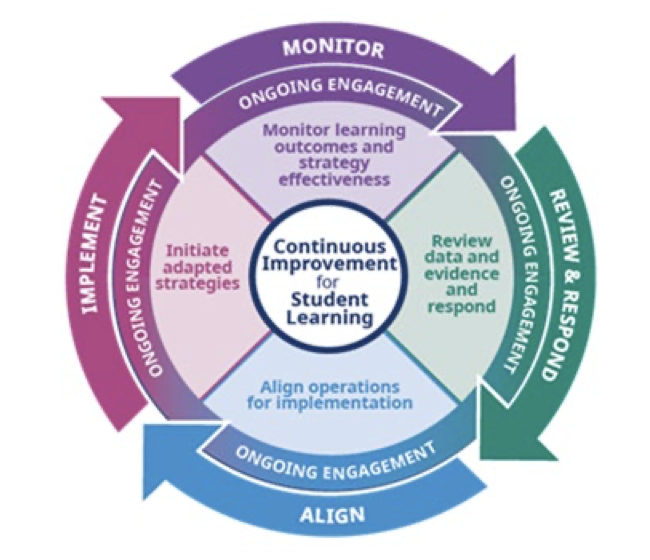
Yet when examined closely, this model reveals a fundamental limitation: it is a governance tool designed to manage performance, not a framework capable of addressing rights violations, structural exclusion, or urgent harm.
The continuous improvement model originates in industrial quality assurance and managerial governance, where systems are assumed to be fundamentally sound and problems are understood as issues of alignment, implementation, or efficiency. Within this logic, failure is not something that demands interruption or redress; it is a signal for further analysis, adjustment, and iteration. The cycle continues indefinitely, regardless of the severity or persistence of the problem being observed.
When applied to education—and particularly to inclusion—this logic becomes deeply problematic.
From harm to “data”
Within the continuous improvement model, all outcomes are treated as data points. Declining achievement, diminished sense of belonging, uneven participation, or widening gaps are not interpreted as evidence of systemic harm, but as indicators requiring further monitoring and inquiry. The framework prescribes reflection rather than interruption.
This matters because many of the most serious issues facing disabled students are not matters of instructional quality or strategic alignment. They are matters of access. Students who are placed on partial-day schedules, repeatedly removed from class, informally excluded, or educated in segregated settings are experiencing immediate and concrete harms. These are not abstract trends to be monitored over time; they are conditions that directly undermine students’ legal rights and educational opportunities.
Yet within the continuous improvement cycle, such harms are converted into neutral signals. Reduced attendance becomes an engagement issue. Exclusion from class becomes a behaviour-support challenge. Diminished belonging becomes a climate concern. Each is absorbed into the cycle as evidence to be reviewed rather than as a violation requiring remedy.
In this way, the model does not deny harm—it neutralises it.
Endless motion, no resolution
The defining feature of the continuous improvement model is that it has no endpoint. Monitoring leads to review, review leads to alignment, alignment leads to implementation, and implementation leads back to monitoring. This perpetual motion is often framed as a strength: systems are always learning, always adapting, always improving.
But for students experiencing exclusion, this endless cycle produces delay rather than protection.
When a child is excluded from full-day schooling, the harm is immediate. When a student is repeatedly removed from class, the loss of instructional time is cumulative. When social isolation persists, the impact compounds over months and years. These realities are time-bound and irreversible. A Grade 3 student cannot recover lost learning time through a future strategic alignment. A Grade 7 student cannot retroactively experience belonging once the school year has passed. I child cannot learn from their bed in burnout.
The continuous improvement model stretches these urgent realities across extended planning horizons. It treats each year’s outcomes as inputs for the next year’s cycle, ensuring that resolution is always deferred. Every year a fresh start to try again. The system can remain in motion indefinitely without ever reaching a point at which exclusion must stop.
In this sense, continuous improvement functions less as a mechanism for change than as a mechanism for postponement.
Process replaces accountability
The Ministry describes FESL as an accountability framework. In practice, accountability within the continuous improvement model is defined almost entirely through process adherence. Districts are accountable for producing reports, engaging with data, identifying focus areas, and articulating next steps. They are not accountable for meeting enforceable standards related to inclusion.
There are no thresholds that trigger intervention when exclusion persists. There are no requirements to demonstrate that disabled students are attending school full-time. There are no consequences for maintaining partial-day schedules, segregated placements, or exclusionary discipline practices. As long as the district can demonstrate that it has reviewed the data and initiated adapted strategies, it remains compliant.
This creates a form of accountability that is procedural rather than substantive. The system is accountable for how it responds, not for what it permits. Harm can continue indefinitely as long as it is accompanied by documentation, reflection, and planning.
In this context, continuous improvement becomes a substitute for accountability rather than its expression.
Why inclusion cannot be “continuously improved”
The continuous improvement model assumes that improvement is incremental and that all problems are amenable to gradual refinement. Inclusion does not fit this assumption.
Inclusion is not a strategy to be optimized over time. It is a condition that must exist in the present. A student is either included in a classroom or excluded from it. They are either permitted to attend school for the full day or they are not. They are either supported to remain with peers or removed.
These are not matters of degree; they are matters of fact.
By treating inclusion as something to be improved rather than something to be ensured, the continuous improvement model reframes exclusion as an acceptable interim state. It suggests that partial inclusion, delayed inclusion, or aspirational inclusion are legitimate stopping points within the cycle. For disabled students, this framing has profound consequences: it normalizes exclusion as part of the system’s learning process.
A model well suited to scarcity
The persistence of the continuous improvement framework is not accidental. It is particularly well suited to environments of constrained resources. By emphasizing alignment, engagement, and adaptation rather than enforcement or investment, the model allows systems to manage inequity without confronting its causes.
In the context of chronic underfunding for inclusive education, continuous improvement offers a way to acknowledge problems without committing to the structural changes required to resolve them. It shifts attention away from questions of adequacy—of staffing, supports, and capacity—and toward questions of implementation fidelity within existing constraints.
The result is a framework that is fully compatible with ongoing exclusion, even as it speaks the language of equity and inclusion.
A harm-neutral governance tool
Ultimately, the continuous improvement model is not designed to ask whether a system is causing harm. It is designed to ensure that the system is always doing something in response to the data it produces. This distinction is crucial.
For students who are excluded, restrained, segregated, or denied access to education, the question is not whether the system is learning—it is whether the system is stopping the harm. A framework that cannot make that determination, let alone require that response, is insufficient.
By embedding Vancouver’s FESL report within this model, the framework ensures that exclusion can be endlessly managed, studied, and revisited, while remaining fundamentally intact.
If inclusion is truly an educational priority, it cannot be governed through a cycle that treats harm as a signal and delay as progress. It requires clear standards, enforceable obligations, and immediate remedies—none of which the continuous improvement model is designed to provide.
Optimising widgets in a life-critical system
For anyone with experience in business analysis or systems design, the application of continuous improvement models to inclusive education represents a fundamental misclassification of system type—a category error that reveals dangerous assumptions about what kinds of failure can be tolerated, deferred, or corrected through iteration.
Continuous improvement frameworks excel at refining products and processes where failure remains tolerable, reversible, and incremental: manufacturing processes that can absorb defects and adjust production parameters, supply chains optimised for efficiency gains, consumer products refined across market cycles. These systems accommodate testing, adjustment, and rework without lasting consequence. If the next iteration performs better, the model succeeds.
Education—particularly inclusive education for disabled students—does not share these properties.
Life-critical systems demand different standards
What is being governed here is not a widget awaiting optimisation but a life-critical environment where access constitutes a baseline condition rather than an aspirational outcome.
For disabled students, school participation is not a performance metric subject to gradual refinement; it is a non-negotiable requirement without which the system cannot claim basic integrity.
Just a Parent
When the system fails to provide sufficient supports, the result is not a marginally diminished outcome correctable in the next cycle but exclusion, lost learning time, psychological harm, erosion of trust—none of which reverse through subsequent adjustment.
In engineering terms, this situation more closely resembles spacecraft design than consumer product development. A spacecraft cannot operate on the assumption that errors will be gradually reduced while occupants remain aboard; certain conditions must be met continuously, immediately, and without exception. Oxygen levels cannot be “continuously improved” toward adequacy. Structural integrity cannot be “aligned over time” with safety thresholds. Life-support systems must function fully from the moment of operation, or the mission fails categorically.
Inclusive education operates under parallel constraints: students must be present, supported, safe. These are not aspirational targets to be approached through iterative cycles but baseline conditions without which the system cannot claim to function at all.
-

Few of us remain our best selves in a room starved of air
If you are a parent of a neurodivergent child, you can recite the script before the phone even buzzes. “[Child] had a very good day and really showed leadership with the younger kids” Pause. “But in the afternoon [Child] had some unexpected behaviour. [Child] is waiting at the office.” Praise is meant to help us feel that everything hasn’t gone to hell. I instantly wonder: what happened before that? I have answered those calls so many times that my body memorised the choreography. Laptop slammed shut. Keys already in hand. Car on the highway, while tears burn my cheeks. Desperate calls to…
When optimisation obscures design failure
The continuous improvement model obscures this reality by treating exclusion as performance variance rather than system failure, assuming the system is fundamentally sound and merely requires better implementation or alignment. From a systems perspective, this constitutes critical error: when people are being pushed out entirely, the problem is not optimisation but design adequacy.
A model appropriate for refining widgets is not appropriate for governing environments where human participation, dignity, and safety are at stake. Applying it here does not demonstrate rigour or professionalism; it signals failure to distinguish between systems that can tolerate gradual improvement and systems that must meet non-negotiable conditions in the present.
If the goal is inclusion, the governing framework must reflect the reality that some failures are unacceptable, some thresholds cannot be crossed, and some harms cannot be deferred to the next reporting cycle.
Keyword analysis
One way to assess whether a policy report is genuinely oriented toward materially improving learning outcomes is to examine its vocabulary. The language a framework permits—and the language it avoids—reveals what kinds of problems it is structurally capable of recognising.
If the purpose of the Framework for Enhancing Student Learning were to improve outcomes for a diverse student body, we would expect sustained, specific engagement with the conditions that shape learning access, reflected not only in data but in terminology.
What follows is an outline of keyword domains that would reasonably be expected in such a report, alongside analysis of how FESL-style reporting typically engages with—or omits—them.
Table 1. Words that should appear — frequency = zero or near-zero
A report concerned with learning outcomes cannot avoid naming the learning profiles of students: learning disability, intellectual disability, autism, ADHD, dyslexia, dysgraphia, dyscalculia, developmental disability, neurological conditions, sensory processing, communication disorders, physical disability, mental health conditions. These terms matter because they anchor outcomes in actual learner needs, not abstract performance categories.
In FESL reporting, disability is typically referenced only through broad administrative labels without engagement with specific neurodevelopmental realities. The absence of diagnostic or functional language makes it impossible to connect outcomes to evidence-based instructional approaches. Learning differences are flattened into a single category, severed from pedagogy.
These terms are foundational to materially improving learning outcomes for disabled and marginalised students.
| Term (expected in a serious learning framework) | Frequency |
|---|---|
| Accommodation | 0 |
| Modification | 0 |
| Human rights | 0 |
| Autism / autistic | 0 |
| ADHD | 0 |
| Dyslexia | 0 |
| Intellectual disability | 0 |
| Learning disability | 0 |
| Exclusion / exclusionary | 0 |
| Segregation | 0 |
| Partial-day | 0 |
| Suspension (as exclusionary outcome) | 0 |
| Restraint | 0 |
| Seclusion | 0 |
| Educational assistant (EA) | 0 |
| Speech-language pathologist | 0 |
| Occupational therapist | 0 |
These are not obscure terms. They are the mechanisms through which learning access is either enabled or denied. Their total or near-total absence tells us that the framework is not designed to see exclusion even when it occurs.
Table 2. Rights-adjacent language — present but neutered
Any system claiming to serve all students must situate itself within the legal obligations that govern access to education: accommodation, adaptation, modification, Individual Education Plan, human rights, Charter rights, discrimination, barriers, accessibility, Universal Design for Learning. These terms signal that learning outcomes are constrained not just by pedagogy but by compliance with rights frameworks.
| Term | Frequency | Notes |
|---|---|---|
| Discrimination | 3 | Appears only in high-level policy references |
| Barrier / barriers | 3 | Never operationalised |
| Accessibility | 13 | Used aspirationally, not materially |
| IEP | 2 | Not linked to outcomes or compliance |
| Attendance | 7 | Not disaggregated; no access analysis |
FESL reports tend to rely on aspirational equity language while avoiding rights-based terminology. The near-total absence of words like discrimination, barriers, or human rights reframes exclusion as an instructional challenge rather than a legal failure. This linguistic shift has material consequences: problems framed as pedagogical can be deferred; problems framed as rights violations cannot.
Table 3. Jargon and managerial language — high frequency, low meaning
These words dominate the document.
| Term | Frequency |
|---|---|
| Support | 148 |
| Framework | 68 |
| Respond / responding | 26 |
| Priority | 26 |
| Belonging | 24 |
| Equity | 17 |
| Engagement | 15 |
| Inclusive / inclusion | 14 |
| Accessibility (non-operational) | 13 |
| Reflect / reflection | 8 |
| Alignment | 7 |
| Capacity | 7 |
| Monitor / monitoring | 6 |
| Continuous improvement | 4 |
That is not an accident. It is a governance choice.
From a business analysis or systems perspective:
- The report is semantically rich in motion
- Semantically barren in constraint
- Verb-heavy, obligation-light
- Designed to signal care, not guarantee access
It is not what you would expect from a document genuinely intended to materially improve learning outcomes for a diverse student body.
Insights
Support and service terms
Learning outcomes are shaped by the availability and deployment of supports: special education, resource teacher, educational assistant, speech-language pathologist, occupational therapist, school psychologist, counsellor, individualised support, tiered intervention, Response to Intervention.
FESL reports tend to reference “supports” abstractly, without naming roles, ratios, or service gaps. This obscures the material conditions under which learning occurs and prevents meaningful discussion of capacity constraints.
Outcome and equity measures
A framework serious about equity must disaggregate outcomes in ways that expose structural patterns: achievement gaps, graduation and completion rates, attendance rates, suspension and exclusion rates, post-secondary transition outcomes, employment outcomes, disproportionality.
FESL reports often include disaggregated achievement data but exclude disaggregated access data. Attendance, exclusion, and instructional time are rarely foregrounded, despite their direct relationship to learning outcomes. This omission allows the system to measure results without measuring participation.
Pedagogical approaches
Improving outcomes requires engagement with how learning is actually supported: differentiated instruction, scaffolding, co-teaching, collaborative teaching, trauma-informed practice, culturally responsive pedagogy, strength-based approaches.
While some pedagogical language appears in FESL reports, it is often decoupled from specific learner needs. Without anchoring pedagogy to disability, language acquisition, or trauma, these terms function as generalities rather than actionable strategies.
Systemic and structural factors
No serious analysis of learning outcomes can ignore system design: resource allocation, funding formula, class size and composition, professional development, training, capacity, workload.
These terms are frequently minimised or treated as background context rather than causal variables. By underplaying structural constraints, the framework implicitly suggests that outcomes can be improved primarily through better alignment and engagement rather than through material investment.
What the keyword gaps reveal
The absence of these terms is not accidental. It reflects a framework designed to manage outcomes without interrogating the conditions that produce them. By constraining the vocabulary of analysis, FESL constrains the range of solutions that can be considered legitimate.
A report that does not name disability, exclusion, barriers, rights, or capacity cannot meaningfully claim to improve learning outcomes for a diverse student body. It can only document variation and propose refinement.
The keyword gaps in FESL reporting are not a failure of language—they are evidence of the framework’s purpose: designed to observe, not to intervene; to describe, not to enforce; to improve performance metrics without confronting whether the system itself is fit for the learners it serves.
What the report actually commits to
Commitment, in a policy and accountability context, is not defined by aspiration or intention, but by the allocation of resources, the setting of timelines, and the establishment of measurable expectations. This section examines what the report moves beyond description and strategy to formally commit to—that is, actions for which responsibility, resourcing, and implementation can reasonably be assessed.
While the report contains a large number of stated priorities and initiatives, relatively few rise to the level of material commitments. Most actions are framed in language that signals continuity rather than change (“continue,” “support,” “enhance,” “explore”), and are presented without associated budgets, staffing ratios, outcome targets, or deadlines. In these cases, responsibility for improvement is implicitly shifted to schools and educators, without corresponding commitments to alter the conditions under which they are expected to succeed.
This section isolates those instances where the report specifies concrete inputs—such as funded positions, mandated tools, defined implementation windows, or documented interventions—and distinguishes them from initiatives that remain conceptual or procedural. It also assesses whether the commitments that do exist are proportional to the scale of the gaps identified earlier in the report, and whether they are structured in a way that would allow progress to be independently verified.
By narrowing the focus to what is resourced, time-bound, and measurable, this analysis clarifies the gap between stated goals and enforceable action. The intent is not to catalogue every initiative mentioned, but to identify which commitments meaningfully alter system capacity—and which function primarily as signals of effort rather than mechanisms of change.
Commitments with some material substance
- Universal literacy screener (K–3): Clear timeline (2025–2027), but no targets or timelines from screening to intervention
- 18 Curriculum Enhancement Teachers: Real staffing increase, but no metrics on reach or impact
- Spaces EDU rollout: Clear implementation timeline, but no evidence of impact on learning
- Chapter One tutoring expansion: Strongest commitment, with documented outcomes, though eligibility, timeline, and total cost remain unclear
- Mandatory RT/SSA training: Specific timeline, but no outcome metrics or accompanying workload adjustments
Commitments without resources or metrics
Most strategies rely on vague language—continue, enhance, explore, support—with no specified funding, staffing, timelines, or outcome targets. Many initiatives are continuations of existing practices despite declining outcomes.
The accountability gap
The report identifies gaps, then responds by continuing existing strategies without explaining what will change or why different results should be expected. There are:
- No staffing ratio commitments
- No instructional time guarantees
- No accommodation timelines or enforcement
- No prohibition or tracking of exclusionary practices
- No assessment of resource adequacy
The continuous improvement model substitutes planning for accountability. When outcomes worsen and the response is to “continue” current approaches, iteration becomes an accountability shield rather than a solution.
What the report does not measure
What a system chooses to measure determines what it can see, what it can manage, and what it can be held accountable for. Conversely, what remains unmeasured is not neutral. In the context of public education—particularly inclusive education—the absence of data functions as an implicit policy decision, shaping which experiences are rendered visible and which are allowed to disappear.
The report presents extensive outcome data on academic proficiency, graduation, and post-secondary transitions, while systematically omitting data on the material conditions that produce those outcomes. There is little to no measurement of instructional access, service provision, exclusionary practices, or resource adequacy—despite repeated acknowledgements elsewhere in the document that belonging, safety, attendance, and accommodation are foundational to learning. As a result, the report evaluates performance without measuring access, and assesses equity without measuring exposure to barriers.
These omissions are especially consequential for students who are already structurally marginalized. Without disaggregated and intersectional data, the system cannot identify who is being excluded through chronic absence, partial schedules, informal removals, unmet accommodation needs, or service delays. Nor can it distinguish between lack of progress caused by instructional failure and lack of progress caused by reduced opportunity to learn. In practice, the absence of measurement shifts responsibility onto students and families while insulating institutional practices from scrutiny.
This section documents the specific data that are absent from the report—attendance, discipline, instructional time, service access, accommodation implementation, and resource allocation—and explains why their exclusion undermines the report’s stated commitment to continuous improvement. Without measuring these domains, the system lacks the capacity to diagnose root causes, evaluate the adequacy of its responses, or determine whether “improvement” reflects meaningful change or merely refined reporting.
Attendance and absence data
The report repeatedly identifies attendance as foundational—“a key indicator of belonging, safety, welcome, and adult connections” (p. 22)—yet never provides disaggregated attendance data by population. This omission is striking given that:
- Student Learning Survey data shows persistent gaps in belonging and connection for priority populations
- Grade-to-grade transitions suggest some students “may have stopped attending, withdrawn, or moved out of the province” (p. 17)
Without disaggregated attendance data, the system cannot identify which populations experience chronic absence, partial schedules, or informal exclusion prior to withdrawal. Attendance is named as a priority, but rendered analytically invisible.
Exclusionary discipline and instructional removal
The report provides no data on exclusionary practices, including:
- Suspension rates by population
- Classroom removals or room clears
- Partial-day schedules or modified attendance
- “Safety plans” that reduce instructional time
- Informal exclusions that do not register as suspensions
These practices are absent from the data section despite being well-documented concerns in inclusive education advocacy. Without measuring exclusionary practices, the system cannot determine who is being pushed out of learning environments or why.
Participation without explanation
While assessment participation rates are reported, the report never disaggregates reasons for non-participation, such as:
- Lack of adaptations versus family opt-out
- Absence on assessment days versus refusal
- Exclusion through partial schedules or alternative placements
The report suggests that declining proficiency may be linked to “more diverse student data being collected” (p. 9), but does not examine whether increased participation reflects genuine inclusion or merely improved documentation of students already present.
Intersectional erasure
Across the report, student populations are treated as discrete categories, preventing analysis of compounded disadvantage.
- Disabled Indigenous students: Indigenous status and disability are never intersected, making it impossible to assess compounded barriers or outcomes.
- Disabled students in care: CYIC data is largely masked due to small cohorts and never intersected with disability, despite higher likelihood of identified needs.
- ELL students with disabilities: Language acquisition and disability are tracked separately, obscuring delayed identification or differential outcomes.
- Racialized students with disabilities: Disability data is not disaggregated by race beyond the Indigenous/non-Indigenous binary.
Without intersectional data, disproportionality cannot be identified, let alone addressed.
Service access and quality
The report discusses supports in general terms but provides no data on whether they are delivered.
Accommodation provision
- No data on IEP implementation rates
- No timelines from identification to service
- No data on accommodation refusal or reduction
Educational Assistants
- No data on EA hours per student
- No staffing ratios or assignment consistency
- No information on training or qualifications
Instructional time
- No measurement of instructional hours by disability category
- No data on prevalence of partial schedules
- No comparison of time in general education versus alternative settings
As a result, inclusion is asserted but not measured.
Specialized programs and credentials
The report claims reduced referrals to specialized programs reflect increased inclusion, yet provides no data on:
- Placement patterns by disability category
- Duration of specialized placements
- Outcomes for students in specialized versus neighbourhood schools
- Return rates to neighbourhood schools
Similarly, while Evergreen Certificates are discussed, the report provides no data on:
- Evergreen rates by disability or Indigenous status
- Availability of Dogwood pathways
- Post-school outcomes for Evergreen completers
Outcomes beyond academics
Non-academic outcomes are discussed rhetorically but not measured.
- Post-secondary transitions exclude employment, apprenticeships, and community participation
- Social-emotional data is limited to broad survey items, with no data on bullying, isolation, mental health service access, or crisis incidents
Resource allocation and adequacy
The report provides no transparency on:
- Per-student spending by disability category
- Staffing ratios or caseload sizes
- Wait times for assessment or therapy
- Gaps between identified need and service delivery
Capacity constraints are acknowledged, but never analysed as a function of inadequate resources.
Why these absences matter
These gaps prevent the system from:
- Identifying compounded disadvantage
- Measuring actual inclusion rather than rhetorical inclusion
- Tracking exclusionary practices
- Evaluating whether resources are adequate
- Holding itself accountable for outcomes
What remains visible—achievement, graduation, transitions—are outcome measures divorced from the conditions that produce them.
Conclusion
This analysis began with the report’s framing and moved through its operational logic, language choices, measurement practices, and stated commitments. Across these sections, a consistent pattern emerges: the report is highly developed as a planning document, but structurally weak as an accountability instrument.
The framing positions the Framework for Enhancing Student Learning as a neutral, cyclical process oriented toward continuous improvement. In practice, this framing narrows the scope of inquiry to what is already being measured, emphasizes iteration over adequacy, and treats persistent gaps as technical challenges rather than as indicators of structural failure. The continuous improvement model, as applied here, functions less as a mechanism for correction and more as a stabilizer for the status quo—allowing systems to adapt around exclusion rather than confront it directly.
The keyword analysis makes this dynamic visible at the level of language. Terms associated with disability, legal rights, exclusion, accommodation enforcement, staffing ratios, and instructional time are absent or rare, while abstract and euphemistic terms—“support,” “capacity,” “engagement,” “enhance,” “continue”—appear frequently and without operational definition. The result is a document that appears active and responsive while remaining materially non-committal. Language substitutes for obligation, and intention substitutes for provision.
Where the report does make concrete commitments, they are limited in number and uneven in scale. A small set of initiatives—such as targeted literacy interventions, funded staffing roles, and mandated assessment tools—include identifiable resources and implementation windows. These stand in contrast to the majority of strategies, which are continuations of existing practice, pilots of unspecified scope, or framework-development exercises unaccompanied by staffing, budgets, or outcome targets. Even where gaps are explicitly acknowledged—particularly for Indigenous students, students with disabilities, and students experiencing exclusion—the response is most often to “continue” current approaches, despite evidence that those approaches have not produced improvement.
Equally significant is what the report does not measure. The absence of disaggregated attendance data, instructional time, exclusionary discipline practices, accommodation implementation, service wait times, staffing ratios, and intersectional outcomes prevents the system from seeing how exclusion is produced in practice. Without these measures, inclusion cannot be evaluated as a material condition; it exists only as a stated value. Outcomes such as graduation rates and assessment proficiency are presented without the contextual data necessary to explain how students arrived there—or what barriers shaped their trajectories.
Taken together, these omissions are not incidental. They systematically obscure the conditions under which learning occurs and limit the kinds of questions the system can ask of itself. What remains visible are outcomes divorced from inputs, aspirations divorced from enforcement, and improvement processes divorced from thresholds of adequacy.
If the purpose of the FESL is genuinely to enhance student learning, then future iterations must move beyond process fidelity and rhetorical alignment. Accountability would require the report to specify minimum conditions for inclusion, track whether those conditions are met, and commit resources at a scale proportionate to the disparities identified. This includes measuring exclusion directly, enforcing accommodation obligations, guaranteeing instructional time, and disaggregating outcomes across intersecting identities.
Absent these shifts, the framework risks becoming self-referential: a system that continually refines how it talks about improvement while leaving unchanged the material realities that determine who is able to learn, belong, and succeed.