I recently reviewed the provincial budget tables and buried within Table 17 (2024/25 Amended Annual Budgeted Operating Expenditures of Program 1.10 Inclusive Education by Object) and Table 26 (2024/25 Actual Operating Expenses of Program 1.10 Inclusive Education by Object) of British Columbia’s 2024/25 operating budget documents lies evidence of what can only be described as designed abandonment—Surrey School District allocated $175,060,699 for Program 1.10 Inclusive Education, the provincial budget category specifically designated for supporting students with personal circumstances, spent $168,745,784, and allowed $6,314,915 to remain unspent while the district accumulated a $68,035,857 surplus and families documented systematic exclusion through room clears, partial schedules, and denied accommodations that have become the texture of daily educational violence for disabled children.
This is institutional betrayal.
The anatomy of $6.3 million in unspent resources
Program 1.10 Inclusive Education represents British Columbia’s primary funding mechanism for supporting students with diverse abilities and personal circumstances, encompassing specialised instruction, educational assistant support, resource teacher allocation, behavioural consultation, therapeutic services, and assistive technology—the budget category through which provincial policy translates rhetorical commitment to inclusive education into operational resources that should materialise as actual support in schools where accommodation happens or fails to happen through the daily mechanics of who receives assistance and who experiences abandonment.
Surrey’s 3.6% underspend within this specific program might appear modest when stated as percentage, yet the absolute figure—$6,314,915—represents resources explicitly allocated for students requiring accommodation and support (Table 17 shows amended budget, Table 26 shows actual expenditure), funding designated within provincial frameworks as essential for educational access, money that moved through budget approval processes, ministerial allocation formulas, and district planning documents before vanishing into fiscal prudence rather than materialising as educational assistance positions, specialised equipment, behavioural support, therapeutic intervention, or any of the myriad supports that transform budget lines into embodied experience for children whose educational access depends entirely on whether institutional systems convert allocated dollars into actual service delivery.
This is money meant to make students feel like they belong and have the support they need to participate.
The provincial pattern contextualises Surrey’s choices: across all sixty school districts, British Columbia left $50,811,164 in Program 1.10 Inclusive Education budgets unspent during 2024/25, a 1.9% provincial underspend rate that establishes Surrey’s 3.6% as nearly double the system-wide pattern, positioning Surrey as the second-largest absolute contributor to provincial underspend after only the consolidated provincial summary line itself, surpassing Vancouver’s underspend despite Surrey’s smaller overall budget scale, exceeding even districts like Sea to Sky which achieved a shocking 32.5% underspend rate but on much smaller absolute allocation amounts.
Surrey chose this outcome through specific budget execution decisions that merit forensic examination.
-

Surrey School District is self congratulatory while exclusions continues
Surrey Schools’ International Day of Persons with Disabilities announcement celebrates procedural progress at the very moment families continue pressing for basic transparency around exclusionary practices. On December 3, the district marked the day by releasing a progress report on its three-year accessibility plan.…
Following the salary lines: Unfilled positions as policy
The inclusive education budget disaggregates into object codes that reveal spending patterns by category, and within Surrey’s $6.3 million Program 1.10 underspend, salary line items expose the mechanism through which allocated resources fail to materialise as human support—educational assistant salaries within inclusive education specifically, budgeted at $27,423,545, reached only $26,565,424 in actual expenditure, leaving $858,121 unspent within this single program area (Table 17, Table 26), while specialised teacher salaries within inclusive education programs, allocated $17,099,512, spent merely $14,726,871, an underspend of $2,372,641 representing a 13.9% gap between budgeted and actual teacher salary expenditure that suggests not marginal hiring delays but systematic failure to staff specialised education positions throughout the fiscal year.
The EA staffing crisis extends beyond Program 1.10: district-wide EA salary budgets across all programs show Surrey allocated $91,311,790 but spent only $89,467,172, leaving $1,844,618 unspent in total EA compensation—a 2% underspend that reveals EA shortage as systematic across elementary support, secondary support, English language learning, and all other program areas where educational assistants provide student support (Table 2: Summary of 2024/2025 Educational Assistants Salaries – Budgets Planned Versus Spent by District), yet this district-wide pattern positions Surrey as relatively successful compared to provincial norms—the provincial EA underspend reached $19,513,964 (3% of $673,396,267 allocated), indicating Surrey’s 2% EA underspend actually performs better than system average even while leaving nearly $2 million in EA salaries unspent and families report chronic EA shortage affecting accommodation implementation.
These are not abstract budget variances.
These are unfilled human positions, educational assistants never hired despite allocated salary budgets, specialised teachers whose positions remained unfilled, even as budget documents recorded funding available, support workers who never materialised in classrooms where children waited for promised one-to-one assistance that existed on budget spreadsheets but never manifested as embodied presence in the schools where accommodation happens or fails to happen through the daily mechanics of who shows up and who receives support.
Even one or two weeks lacking the proper support can mean the world to a child. It can fundamentally sour their relationship to school and leave lasting scars.
The teacher salary underspend within Program 1.10 merits particular scrutiny: a 13.9% gap between budget and actual spending suggests Surrey either dramatically overestimated hiring needs (unlikely given persistent reports of inadequate support), experienced extraordinary difficulty recruiting specialised teachers (possible but requiring explanation of recruitment efforts), or made conscious decisions to leave positions unfilled while accumulating surplus (the pattern suggested by overall fiscal outcomes), and each explanation demands investigation because when teacher salary budgets remain unspent within programs specifically designated for students requiring specialised instruction, the result is not fiscal responsibility but educational abandonment.
We’d love to know what happened, so if you are staff member in Surrey and wish to anonymously report the cause, please be in touch!
Surplus accumulation while students go unserved
Surrey concluded 2024/25 with total revenues of $1,189,119,535 and total expenditures of $1,121,083,678 (Table 28: 2024/25 Operating Revenues by Source, Table 29: 2024/25 Operating Expenditures by Function), producing a $68,035,857 surplus that positions the district as fiscally prudent within provincial accounting frameworks while revealing institutional priorities through what money accomplishes versus what money prevents—the $6.3 million Program 1.10 underspend represents 9.3% of Surrey’s total surplus, meaning nearly one-tenth of the district’s year-end accumulated funds originated from allocated-but-unspent resources explicitly designated for disabled students, money that could have hired educational assistants, contracted behavioural consultants, purchased assistive technology, funded therapeutic interventions, supported transition planning, or addressed any of the documented support gaps that families navigate daily while budget documents record adequate allocation.
Provincial policy requires districts to maintain operating reserves between 1-3% of total budget, a fiscal prudence measure designed to ensure districts can manage unexpected expenses or revenue shortfalls without service disruption, yet Surrey’s 5.7% surplus ($68M against $1.19B revenue) exceeds minimum reserve requirements by substantial margin, raising the question of what institutional purposes are served by accumulating surplus beyond required minimums while leaving inclusive education budgets systematically underspent.
This is scarcity manufactured through budget execution choices that prioritise fiscal accumulation over service delivery.
The pattern reveals itself through comparison: Richmond overspent its Program 1.10 Inclusive Education allocation by $980,000 (2% over budget), demonstrating that some districts manage to deploy allocated resources fully and even exceed budget when student needs require additional investment, while Saanich underspent by $2,012,833 (10.4%) (Tables 17 and 26), showing variance in district commitment to inclusive education spending even within similar fiscal constraints and labour market conditions, yet Surrey’s combination of significant inclusive education underspend paired with massive overall surplus distinguishes the district as exemplifying designed denial—the systematic structuring of budget processes to prevent allocated resources from reaching students who require them.
The room clear documentation: Numbers meeting testimony
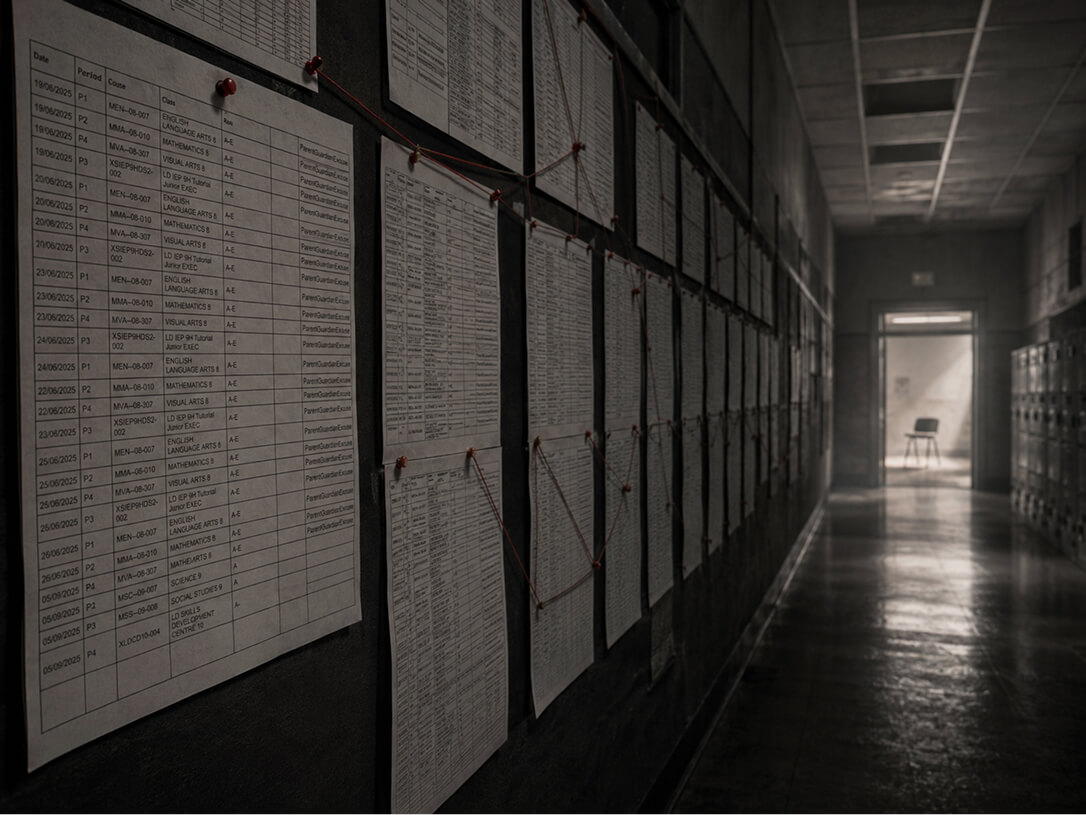
These budget figures exist not in isolation but in direct relationship to documented student experiences that have been systematically tracked through advocacy infrastructure built by families whose children have been excluded—[room clear data, partial schedule documentation, and accommodation denial records compiled across Surrey schools] reveal the operational reality that budget underspend produces in children’s daily lives, the connection between $858,121 in unspent educational assistant salaries and the documented instances of students sent home early because “not enough staff today,” between $2.4 million in unspent specialised teacher salaries and the IEP goals never implemented because no resource teacher was assigned, between $6.3 million in total inclusive education underspend and the systemic pattern of responding to student distress not with increased support but with exclusionary discipline that removes the student rather than adding the accommodation.
This is where fiscal analysis meets institutional ethnography.
Budget documents don’t merely describe resource allocation; they reveal the administrative machinery through which educational systems convert public funding into particular forms of student experience, and when inclusive education budgets remain systematically underspent while districts accumulate surplus and families document exclusion, the pattern exposes not resource scarcity but ideological commitment—a belief structure that positions disabled student support as expendable, that treats accommodation as optional enhancement rather than legal requirement, that understands fiscal prudence as more valuable than educational access, that builds reserve funds while leaving students unserved.
The grade seven band program cancellations, announced mid-year with explanation of budget constraints, occurred within a district that would conclude the fiscal year with $68 million in surplus and $6.3 million in unspent inclusive education allocation, suggesting that “budget constraints” functioned as institutional rhetoric justifying predetermined cuts rather than describing actual fiscal limitation.
This is how budget underspend operates as designed denial.
-
Surrey FESL report shows why FESL is designed to fail
Surrey School District’s 2025-26 Enhancing Student Learning Report spans 42 pages across two documents, presenting what appears at first glance as a model of comprehensive educational accountability—extensive data visualisations tracking student outcomes across multiple measures, disaggregated by Indigenous identity, English language learner status,…
Manufactured crisis: The EA “shortage” as administrative choice
Surrey, like districts across British Columbia, reports difficulty hiring educational assistants, describes an EA “shortage” that necessitates reduced support hours or denied accommodation requests, yet the $1,844,618 district-wide underspend in EA salary budgets reveals this shortage as manufactured through district choices about wage rates, employment conditions, position structures, and recruitment investments that together create labour market conditions guaranteeing hiring failure, then position that failure as external constraint rather than institutional design—when salary budgets remain unspent while districts simultaneously report inability to hire, the pattern suggests not genuine shortage but inadequate compensation for the emotional labour, physical demands, behavioural intensity, and professional skill that EA work requires (Table 2: Summary of 2024/2025 Educational Assistants Salaries – Budgets Planned Versus Spent by District).
Provincial data shows $19,513,964 in unspent EA salary budgets across all districts during 2024/25 (3% of $673,396,267 allocated provincially), indicating systematic pattern rather than localised shortage, yet this occurs within labour market where private sector employers actively recruit for personal support worker, respite care, behavioural intervention, and therapeutic assistance positions that require similar skills and offer comparable or superior compensation, benefits, schedule flexibility, and working conditions.
The “EA shortage” becomes legible not as labour market constraint but as consequence of institutional choices.
The district-level variation proves instructive: Sea to Sky overspent EA salaries by $1,091,649 (24% over budget), demonstrating that some districts successfully recruit and retain EA workforce even in competitive labour markets, while Southeast Kootenay underspent $1,058,417 (13%), Kootenay-Columbia underspent $794,737 (16%), and Central Okanagan underspent $1,519,380 (6%)—patterns suggesting that EA “shortage” varies dramatically by district policy choices rather than representing uniform provincial labour market constraint (Table 2).
This is scarcity by design: districts structure EA employment to be unattractive, then cite resulting hiring difficulties as justification for reducing student support hours, a circular logic that begins and ends with institutional choices about how to value, compensate, and structure work that primarily supports disabled students—when budget remains unspent because positions can’t be filled at wages offered under conditions provided through employment frameworks established by district policy, the problem is not shortage but institutional unwillingness to structure employment in ways that enable recruitment.
What $6.3 million could have purchased
The abstraction of Program 1.10 underspend resolves into concrete educational reality when converted to specific supports: $6.3 million represents approximately 84 full-time educational assistant positions at average BC EA compensation of $75,000 including benefits, or 47 specialised teacher positions at average resource teacher compensation of $135,000, or comprehensive behavioural consultation contracts serving 315 students at $20,000 per student annually, or assistive technology packages for 1,260 students at $5,000 per student, or any combination of supports that would materialise as actual human presence and technical capability in classrooms where children currently wait for accommodations that budget documents indicate should exist but operational reality reveals as systematically denied through execution processes that prevent allocated funding from becoming embodied support.
These calculations matter not as precise projections but as scale indicators.
The magnitude of Surrey’s inclusive education underspend represents educational assistance workforce expansion sufficient to transform support ratios across multiple schools, or specialised instruction capacity that could meaningfully reduce wait lists for psychoeducational assessment and learning support, or intervention programs that might actually address behavioural support needs before they escalate to exclusionary discipline, yet instead the money accumulates as year-end surplus while families document systematic accommodation denial and students experience education through the violence of exclusion made possible precisely because support that could have been purchased remained unallocated by execution processes that convert budget authority into fiscal caution rather than educational access.
Following the money: Questions requiring answers
Surrey’s budget patterns demand investigation that provincial documents alone cannot provide: monthly budget variance reports throughout 2024/25 would reveal when Program 1.10 underspend began materialising—was this early-year hiring freeze or gradual accumulation through unfilled attrition?—and whether district administrators flagged inclusive education underspend as concern requiring corrective action or treated it as acceptable outcome; year-end surplus allocation decisions would show whether unspent Program 1.10 dollars transferred to operations budgets, technology infrastructure, administrative expenses, or reserve accumulation; budget transfer authorisations would document any reallocation of inclusive education funds to other program areas; and the granular line-item detail behind Tables 17 and 26 summary figures would expose exactly which positions remained unfilled, which contracts went unawarded, which services were planned but never procured.
These are public records available through Freedom of Information requests.
Documents that would transform this preliminary analysis from pattern identification into forensic accounting capable of establishing not merely that underspend occurred but precisely how institutional processes produced it, which administrators authorised what decisions at what moments, what explanations were provided to what oversight bodies, and whether anyone internal to the district raised concerns about leaving Program 1.10 budgets unspent while students went unserved—this is the investigative work that connects budget tables to institutional accountability, that traces money through bureaucratic mechanisms to reveal whether Surrey’s pattern represents incompetence in budget execution, structural barriers in procurement and hiring systems, or deliberate strategy of fiscal accumulation at expense of educational access.
The comparative analysis would examine whether Surrey’s 2024/25 pattern represents anomaly or chronic condition: pulling equivalent inclusive education budget and actual spending tables for 2020/21 through 2023/24 would establish five-year trend showing whether Surrey consistently underspends Program 1.10 or whether this year marks departure from pattern, and either finding matters—chronic underspend reveals systematic institutional practice requiring structural intervention while single-year spike suggests specific decisions that changed from previous years and could be investigated through administrator transitions, policy changes, or budget pressures that might explain departure from earlier spending patterns.
The legal costs comparison would prove particularly revealing: Surrey’s expenditure on legal fees defending accommodation denials, Human Rights Tribunal complaints, Ombudsperson investigations, and administrative appeals could be cross-referenced against Program 1.10 underspend to calculate the cost differential between proactive support provision and adversarial defence, potentially demonstrating that districts spend more defending their failure to accommodate than they would have spent providing the accommodations being denied.
This is scarcity ideology made operational.
-

The affective architecture of room clears
Room clears should be rare. In adequately resourced classrooms with sufficient staffing, with educational assistants trained in co-regulation, with adults who understand that compliance is not wellness and frozen silence is not calm, most crises could be prevented or held without architectural intervention.…
Designed denial: budget as institutional violence
Sara Ahmed writes about institutional mechanics that produce particular outcomes while appearing neutral, the ways that organisational processes convert political commitments into operational realities that seem inevitable rather than chosen, and Surrey’s Program 1.10 underspend exemplifies this designed denial—budget allocation creates appearance of adequate resources while execution processes systematically prevent those resources from reaching students, generating the documented pattern of accommodation denial and educational exclusion not through explicit policy of abandonment but through cumulative effect of hiring timelines, approval layers, procurement requirements, and fiscal caution that together structure budget authority to remain unspent rather than materialising as support.
This is violence through administrative process.
Each unfilled EA position, each uncontracted behavioural consultation, each piece of assistive technology never purchased despite allocated budget represents institutional choice, yet the diffusion of decision-making across multiple actors and authorisation levels obscures individual accountability and creates appearance of system constraint rather than political commitment—when asked why students lack support despite budget documents (Tables 17 and 26) showing allocated funding, administrators cite hiring challenges, procurement timelines, approval processes, yet these are mechanisms the institution itself controls, structures it maintains, systems it could redesign if political will existed to prioritise inclusive education spending over surplus accumulation.
The fiscal year boundary operates as designed exhaustion: budget authority expires June 30, requiring any unspent allocation to convert to year-end surplus rather than carrying forward as continued resource availability, yet this accounting rule benefits districts precisely by preventing families from pointing to unspent allocation as available funding for support students currently lack—the money disappears into surplus at fiscal year-end, preventing advocacy claims that “budget exists, you’re choosing not to spend it,” yet documentation of that pattern over multiple years reveals exactly that, that districts systematically choose fiscal outcomes that leave Program 1.10 budgets underspent while accumulating surplus and students experience education through absence of support that budget documents indicate should exist.
This is how systems produce abandonment while claiming constraint.
Conclusion: truth through numbers
Budget documents don’t lie, though they enable institutional lying—Surrey can claim resource constraints while Tables 17 and 26 document $6.3 million in unspent Program 1.10 Inclusive Education allocation, can describe EA shortage while Table 2 shows $1,844,618 district-wide underspend in budgeted EA compensation, can justify band program cuts through budget limitation while year-end statements record $68 million surplus, and the gap between institutional narrative and documented fiscal reality exposes the violence of designed denial made legible through careful reading of provincial budget tables that most families never access but that reveal the arithmetic of abandonment with mechanical precision.
This analysis offers families evidence.
When districts claim insufficient resources for accommodation, budget documents provide response showing allocated-but-unspent funding; when administrators describe hiring challenges as external constraint, salary underspend data reveals institutional failure to execute against available budget authority; when school boards present budget limitation as natural scarcity requiring difficult choices, year-end surplus figures expose those claims as institutional rhetoric justifying predetermined distribution of who receives support and who experiences exclusion.
The work ahead requires taking these numbers and demanding institutional accountability through every available mechanism: freedom of information requests that expose how underspend occurs through specific decision chains, Human Rights Tribunal complaints that introduce budget data as evidence of resource availability contradicting district claims of inability to accommodate, Ombudsperson investigations that examine systematic patterns of underspend paired with documented service denial, school board presentations that make visible what budget execution reveals about institutional priorities, and sustained public documentation that prevents districts from claiming resource scarcity while fiscal records show systematic underspend of allocated inclusive education funding.
The numbers tell the truth that institutional narratives obscure, and that truth is simple: Surrey chose fiscal prudence over educational access, chose reserve accumulation over student support, chose budget underspend over accommodation provision, and those choices are legible in Tables 17, 26, 28, and 29 for anyone willing to read budget documents as evidence of institutional priorities rather than accepting district explanations of resource constraint that fiscal reality contradicts at every scale from individual salary lines to year-end surplus totals that together reveal the designed abandonment of disabled students as fiscal policy rather than inevitable scarcity.
-

Protecting the ledger over the learner: operationalising scarcity in BC School Districts
British Columbia’s public schools are mandated to provide inclusive education for all students, but they do so in a context of chronic resource scarcity. Scarcity in education means there are not enough funds, staff, skills, or services to fully meet all student needs. School districts…