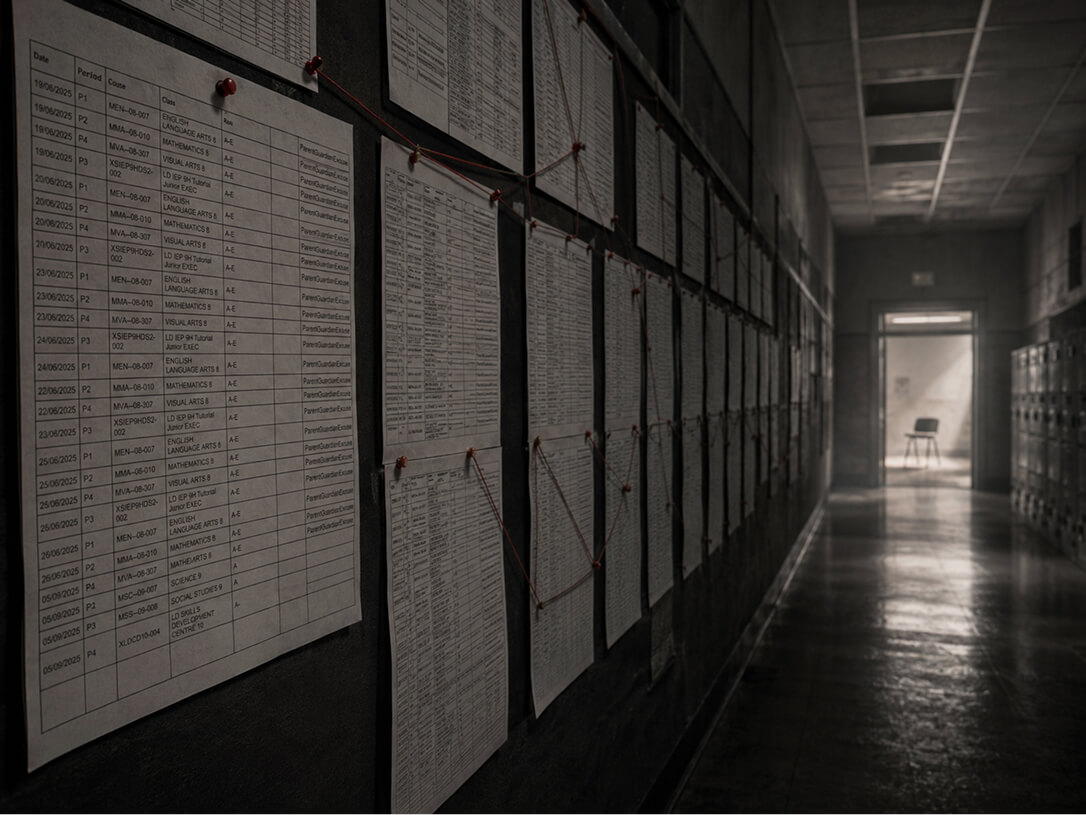
Remember that Dr. Seuss book promising unlimited potential? Oh, the places you’ll go!
Well, PBIS has places to take your kid too. And you’re not going to like where this journey ends.
It started with good intentions (it always does)
Schools adopted Positive Behavioural Interventions and Supports to reduce suspensions. To build better communities. To support students instead of punishing them.
The early days felt hopeful: point systems rewarding good behavior, school stores where kids exchanged earned points for small prizes, teachers recognizing positive actions instead of just tracking problems.
Districts celebrated reduced office referrals. Climate surveys improved. Everyone patted themselves on the back for being progressive.
But here’s what they didn’t tell you about where this was heading.
Enter the tech companies (follow the money)
Schools are broke. Chronically underfunded. Desperate for solutions that “do more with less.”
So when companies started offering digital platforms to “streamline” PBIS implementation, districts jumped at the chance. Mobile apps for awarding points! Automated reporting! Data showing which kids need intervention!
It all sounded so… efficient.
And that’s exactly the problem.
Meet Navigate360: The company turning your child into a data point
In 2022, a company called Navigate360 acquired PBIS Rewards, the leading behavioural tracking platform. They didn’t just want to track positive behaviours.
They wanted EVERYTHING.
Navigate360 now offers what they call “whole-child safety”—a terrifying package that includes:
- Behavioral compliance tracking
- Case management systems
- Threat assessment protocols
- Emergency response coordination
- Social-emotional screening
- And the piece that should make every parent’s blood run cold: Hall Pass Plus
Your kid needs permission to pee (and it’s being tracked)
Hall Pass Plus is Navigate360’s digital bathroom monitoring system. Let me break down what this actually means:
- Students must request digital permission to use the bathroom. Teachers approve or deny through an app. Every single trip generates a timestamp, destination, and duration.
- The system enforces individual usage caps. Go to the bathroom too many times? The app blocks your access. “Max reached! You have no more passes left today.”
- Algorithms prevent “unsafe meetups.” If two students the system has flagged try to request passes at the same time, one gets denied automatically. Can’t have those kids talking in hallways unsupervised!
- Every bathroom trip becomes evidence. Administrators can query the data to see patterns, compare students to “grade-level norms,” and identify kids who leave class “excessively.”
This is a panopticon. A literal surveillance prison where children internalise that their most basic bodily functions are monitored, timed, limited, and used as evidence against them.
“Safety” is the excuse. Control is the goal.
Navigate360 markets this nightmare as “modernisation.” As keeping kids safe. As providing “accountability and structure.”
But let’s be clear about what’s actually happening:
Schools facing budget cuts look at behavioural management like a business problem. How do we manage hundreds of students with fewer staff? How do we reduce “risk”? How do we make everything trackable, measurable, efficient?
The answer: Treat students like inventory. Like risks to be managed. Like problems requiring technological solutions borrowed from industrial optimisation models and prison management systems.
Hall Pass Plus literally advertises that administrators can “instantly see where students are expected to be.” Your child’s location, documented at all times. Movements analysed. Patterns flagged.
The students who get hurt first? Disabled kids.
Here’s what really happens when these systems roll out:
- Students with disabilities get flagged immediately. Frequent bathroom trips due to medical needs? IBS? Anxiety? Sensory regulation? The system marks them as “excessive users.”
- Autistic students who need movement breaks get blocked. Their “unusual patterns” trigger administrator reviews.
- Students with menstrual needs face restrictions. Too many bathroom requests during their period? Individual usage caps.
- PDA-profile kids who can’t tolerate this level of control? Their distress gets coded as defiance, generating referrals that feed into case management systems.
“We’re not targeting your disabled child—the DATA shows they have concerning bathroom patterns!”
The ten-year nightmare scenario (that’s already being built)
Navigate360’s trajectory reveals where this is heading:
In five years: Biometric bathroom access. Face scans or fingerprints to track every movement. Predictive algorithms determining which students are “high-risk” before they ever do anything wrong.
In ten years: Comprehensive surveillance where every student exists in a permanent state of locatability. Social-emotional screening produces “wellness scores” that follow kids across schools, districts, years. Behavioral data from every platform—hall passes, referrals, check-ins, threat assessments—accumulates into permanent digital files justifying exclusion.
Kids won’t just be students anymore. They’ll be walking data profiles, risk scores, behavioural predictions that determine their access to education, dignity, privacy.
“But it reduces costs!” (There’s that business logic again)
Navigate360 promises districts they can “eliminate the complexities of managing multiple vendors.” One platform. One contract. Maximum efficiency.
Translation: We’ve made it really easy for schools to surveil every aspect of childhood while extracting profit from that surveillance.
The company doesn’t hide this. Their marketing celebrates vendor consolidation, cost reduction, operational efficiency. They’re selling schools on treating students like manufacturing problems requiring industrial solutions.
The good news: This isn’t happening in Canada yet.
BC schools use MyEducation BC—a provincial student information system made by Fujitsu that tracks attendance, grades, and basic data. They implement Positive Behaviour Support through local frameworks and training, not through Navigate360’s commercial surveillance platforms.
Hall Pass Plus isn’t monitoring BC students’ bathroom use. Yet.
PBIS Rewards isn’t tracking behavioural compliance in Canadian classrooms. Yet.
Navigate360’s integrated threat assessment and case management ecosystem isn’t operating in our schools. Yet.
But here’s what you need to understand: This is where PBIS architects are taking the product. This is the trajectory. This is what happens when behavioural frameworks meet scarcity logic, corporate consolidation, and the irresistible promise of technological efficiency.
So the question becomes: Is this where we want to go?
Because we’re at a decision point. BC districts facing the same budget pressures, the same staffing shortages, the same desperate search for solutions that “do more with less” will eventually encounter Navigate360’s marketing materials. They’ll hear the pitch about vendor consolidation, comprehensive safety, data-driven decision making.
They’ll see American schools celebrating reduced office referrals and improved efficiency.
We get to decide
Do we want schools where students request digital permission for bathroom access? Where algorithms enforce usage caps and block “unsafe meetups”? Where every movement generates data feeding comprehensive behavioural profiles?
Do we want disabled students flagged through systems marking their bathroom patterns as excessive, their sensory needs as defiance, their differences as risks requiring technological management?
Do we want childhood transformed into a surveillance opportunity, with companies extracting profit by selling districts platforms that optimise the exclusion of students whose bodies refuse institutional rhythms?
Or do we recognise that behavioural support cannot be replaced by comprehensive tracking? That students need adequately funded schools with smaller classes, trained specialists, trauma-informed practices, genuine accommodation—not industrial solutions treating children as management problems requiring digital control?
Oh, the places we could go instead
Here’s the ending Dr. Seuss should have written, the one Navigate360 doesn’t want us to imagine:
Schools where students aren’t data points. Where bathroom trips don’t require algorithmic approval. Where behavioural support means actual relationship, accommodation, understanding—not comprehensive tracking integrated across emergency management systems and threat assessment protocols.
Where childhood gets to be childhood, not a surveillance opportunity.
PBIS promised to take us to better places. But companies like Navigate360 have built a very different destination.
-

Positive behavioural interventions and supports: a behaviourist rebrand
Positive behavioural interventions and supports circulates through British Columbia’s public schools with a gentle, polished confidence, offering administrators the comfort of matrices and fidelity tools, offering families soothing language about positivity and predictability, and presenting itself as an enlightened evolution of schoolwide discipline, yet what I see each time I study its structure is the unmistakable inheritance of applied behaviour analysis, because the system depends on reinforcement, compliance, adult surveillance, and engineered contingencies that shape a child’s conduct rather than honouring the child’s embodied reality.I have already written the truth of this across my work—across She graduated and this is…