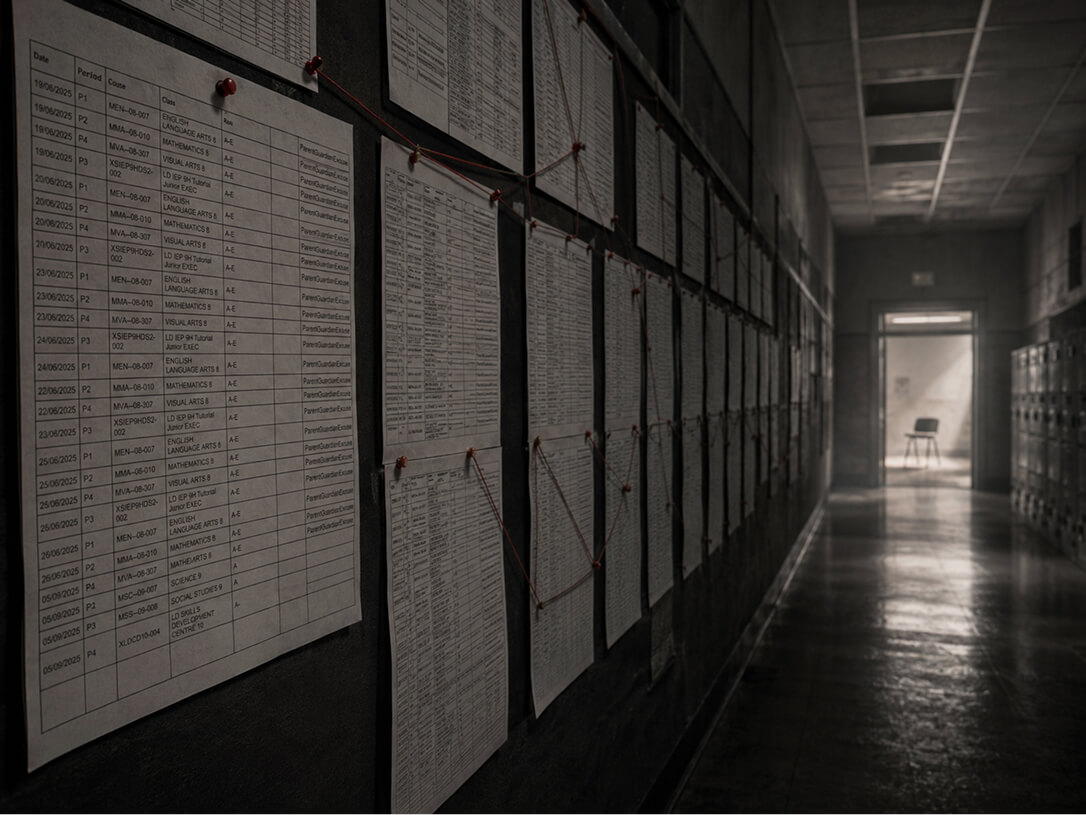
Enrolment data is meant to be the most transparent artefact a public education system produces. It records how many students are present, where they are placed, and how populations change over time. These figures determine staffing, funding, capital planning, and programme viability. They are the numerical infrastructure that underwrites every district claim about equity, inclusion, and responsiveness to demographic reality.
That is why enrolment data should be boring.
Instead, the thirteen years of district-level enrolment data released in response to a Freedom of Information request arrive riddled with redactions. Entire cells—covering district-wide counts by grade and category—are blacked out under section 22 of British Columbia’s Freedom of Information and Protection of Privacy Act, the provision intended to prevent identification of individuals. The result is a dataset that technically exists but cannot do what enrolment data is supposed to do: enable the public to understand how students move through the system, where they are served, and where they disappear.
Whether through misunderstanding, institutional overcaution, or policy design, the effect is identical: accountability failure.
-

A data story from Southeast Kootenay District
I lived in Nelson as a child. The racial diversity was low. I know it has increased over time, yet it remains a small community, and when a young child arrives from another country and is visibly a person of colour, that presence remains noticeable across the Kootenays. This context…
Privacy law and the question of appropriate application
Section 22 exists to protect children. It prevents disclosure of information that could identify a student struggling with addiction, subject to child protection involvement, living with disability, or otherwise vulnerable to harm if institutional knowledge were made public. It is an essential safeguard in a system that generates deeply intimate records about children’s lives.
The redactions throughout this dataset likely follow small-cell suppression protocols—standard statistical disclosure control that prevents publication of figures below a certain threshold, typically five to ten individuals. This practice serves a legitimate purpose: when data disaggregates across multiple sensitive variables, small numbers can enable deductive identification. Three Indigenous girls in Grade 6 receiving intensive autism support in a rural district becomes potentially identifying because local knowledge might narrow it to specific families.
Statistical agencies routinely suppress small cells when combining multiple attributes creates genuine identification risk. The question is whether this protocol appropriately applies to basic enrolment data by grade and district.
Aggregate grade-level counts—even small ones—rarely pose identification risk unless they have been subdivided into categories so granular that membership itself becomes identifying. Saying that School District 39 had 43 students in Grade 5 in 2015/2016 identifies no one. It is a demographic fact, not personal information. Figures become identifying only when students are tracked through administrative categories constructed around sensitive characteristics: specific diagnoses, rare placements, or exclusionary arrangements that effectively label children.
The redaction pattern therefore raises a fundamental question: are districts applying small-cell suppression because enrolment categories genuinely risk identifying individual students, or because institutional practice defaults to non-disclosure whenever numbers fall below a threshold, regardless of actual privacy harm?
The distinction matters. If suppression protects children from deductive identification, it serves its statutory purpose. If suppression instead reflects bureaucratic over-caution, inherited disclosure protocols from other sectors, or institutional culture that treats any potential risk as grounds for redaction, then privacy provisions designed to protect children function to protect institutions from scrutiny.
What makes this analytically significant is that even if every redaction is legally appropriate, the data structure still prevents enrolment data from performing its basic accountability function.
-

The question they refused to ask: adequate funding and the architecture of denial in BC schools
Between 2017 and 2020, BC reviewed education funding. The question asked: designation or prevalence? The question refused: what would adequate funding cost?