

Discipline
“Discipline” in schools is often framed as a way to teach responsibility—but in practice, it frequently functions as a system of control. From detentions and suspensions to exclusion from class activities and informal isolation, discipline disproportionately targets disabled, racialized, and neurodivergent students. It punishes distress, rewards compliance, and pushes children out of learning when they most need support.
This tag collects posts that examine how discipline is used in BC schools—formally and informally—as a response to behaviour that stems from unmet needs. It includes analysis of school and district conduct policies, Ministry guidance, suspension data, and human rights obligations. It also explores how classroom-level discipline (like loss of recess or group punishments) contributes to institutional harm.
We believe discipline, as it’s currently practiced, often prioritizes order over justice, and control over care. Real accountability doesn’t come from shame or exclusion—it comes from understanding what children are trying to communicate, and building systems that meet those needs without causing further harm.
-
Yukon schools under scrutiny for using restraint and seclusion on students with disabilities
The Yukon government says it is working to make schools safer after families raised serious concerns about the use of restraint and seclusion—particularly involving students with disabilities. Education Minister Jeanie McLean acknowledged that these practices have caused harm and stated that a review is underway to develop clearer policies and alternatives grounded in trauma-informed approaches.…
-
Dr. A.R. Lord Elementary (VSB SD39): a neurodiversity-informed conduct critique
Dr. A.R. Lord Elementary’s Code of Conduct promises a “safe and supportive environment” on school grounds, on field trips, and during online learning. It embraces the Vancouver School Board’s district-wide conduct framework (AP 350), explicitly affirms the BC Human Rights Code, and applies the values of the school’s P.R.I.D.E. matrix—Purpose, Respect & Responsibility, Integrity, Diversity,…
-

Nova Scotia bans collective punishment
Nova Scotia’s Provincial School Code of Conduct Policy underwent a significant update in April 2025, marking a substantial revision of the previous 2015 policy. The updated policy, set to take effect in September 2025, introduces clearer definitions of unacceptable behaviours, delineates new responsibilities for all school community members, and emphasises support for those affected by…
-

When fairness fractures: A response to “Collective Punishment in Schools” by Serene Leeyc
A recent article by Serene Leeyc, titled Collective Punishment in Schools: Fairness or Fostering Division?, offers a welcome and accessible overview of collective punishment in school settings—a practice that, while common, remains shockingly under-examined in public discourse. The piece attempts to understand the teacher’s dilemma, surveys common classroom scenarios, and suggests positive alternatives like restorative justice…
-
Recent BCHRT decisions expose systemic failures
After reading through a couple of of the recent BC Human Rights Tribunal findings, here are some thoughts: Ongoing delays erode trust Several rulings show how procedural deadlines and scheduling gaps thwart families seeking essential supports. In one decision the Tribunal dismissed parents’ allegations about inadequate consultation and discontinued specialist services because the events in 2017 and 2018 fell…
-
When school discipline undermines trust at home
There’s a problem in our schools. You’ll see it on a child’s face when they come home. You’ll hear it in the way they describe something that left them feeling humiliated, angry, or confused—and often, all three at once. It happens when school staff use discipline strategies that completely contradict the values a student has…
-

On moral injury and collective punishment
I did not want to file a complaint. I still don’t—not in the sense that people imagine, with anger or vengeance or a desire for punishment. What I wanted, what I asked for again and again with patience and clarity and increasing despair, was for the district to acknowledge that collective punishment is not just…
-

Every year we start over
We arrive at the school gates each September with anxiety rising in my chest, knowing that the forms, reports, and professional recommendations assembled over years have already demonstrated what is required for my child’s success; and yet, year after year, he steps across the threshold into an environment that has failed to prepare for him.…
-

School District 48 (Sea to Sky): a neurodiversity-informed policy critique
SD48 conduct decision flow (simplified) ⚠️ Critical analysis ✅ Strengths ❌ Gaps Neurodiversity lens: how the policy holds up Dimension Assessment Notes Disability justice ✅ Partial Equity and accommodation are mandated, but process and supports unspecified Neurodivergent alignment ⚠️ Weak No mention of executive function needs, sensory regulation, impulsivity, masking, or meltdown management Protection from…
-

SJ Burnside Continuing Education (SD61): a neurodiversity‑informed policy critique
SJ Burnside Education Centre is an Alternative Education program serving youth aged 13–18 in a small-group, flexible setting. Its published Code of Conduct emphasises high standards of conduct, honesty, integrity, and cooperation during all school-sponsored activities. It explicitly promotes peaceful problem-solving, community engagement, and maintains a personal device policy (e.g., cell phones may be removed if abused). Student Code of Conduct SJ Burnside conduct decision…
-

Reconciliation demands that we put collective punishment aside
Collective punishment in residential schools did more than punish children—it shattered the bonds between parents and children. For many parents who survived, the fear, shame, and trauma they endured complicated their ability to nurture trust in their own parenting. Emotional disconnection and disrupted parenting Adults who attended residential schools often struggle to form secure attachments…
-

Data tracking in the residential school system
The Canadian Residential School system (circa 1870s–1990s) was a network of church-run boarding schools funded by the government to forcibly assimilate Indigenous children. In theory, such a large system might have been guided by careful data collection – tracking student health, education outcomes, and well-being. In reality, government officials prioritized ideological goals and cost-saving “optics” over…
-

A perspective taking primer for educators
Perspective taking is the disciplined art of stepping outside one’s own cognitive scaffolding and entering, as fully as possible, into the sensorium of another person. It is not sympathy, which radiates concern from a safe emotional distance, nor is it projection, which mistakes one’s own feelings for universal truth. Instead, it is an intentional, methodical…
-
Collective punishment: unjust in schools, unjust everywhere
Collective punishment—punishing a group for the actions of an individual—is widely recognised as a violation of human rights. It is condemned in international law, yet it persists in various forms worldwide. From China’s persecution of human rights defenders’ families to Israel’s blockade of Gaza and the Taliban’s illogical governance, collective punishment disproportionately harms innocent people.…
-

Help please: call for Indigenous perspectives on collective punishment in BC schools.
We are seeking contributions from Indigenous scholars, knowledge-keepers, writers, parents, educators, and community leaders on discipline, punishment, exclusion, and accountability in British Columbia’s public schools. This project began from a concern that some school discipline practices — including collective punishment, exclusion, surveillance, public shaming, and informal removal — may sit within longer histories of colonial…
-

Collective punishment: it doesn’t work, but still it happens
Written by Dr Penny Rabiger, in 2016, this personal yet incisive piece, discusses the challenges the persistence of collective punishment in schools, despite its well-documented ineffectiveness. Drawing on both professional insight and a child’s perspective, the post illustrates how these tactics damage trust, inhibit learning, and punish children for behaviours beyond their control. The author…
-

What policy says about collective punishment in schools
Collective punishment is never explicitly mentioned in the School Act or BC education policies, but it is made very clear that the system is meant to be fair, accountable, and respectful. The School act states the discipline in schools must be “similar to that of a kind, firm and judicious parent” (Section 76(3)). I consider…
-

From corporal punishment to collective harm: why Section 43 still casts a shadow over Canadian schools
Section 43 still permits “reasonable force” in schools. This blog explores how it enables collective punishment and violates children’s rights.
-
Teacher Misconduct Case
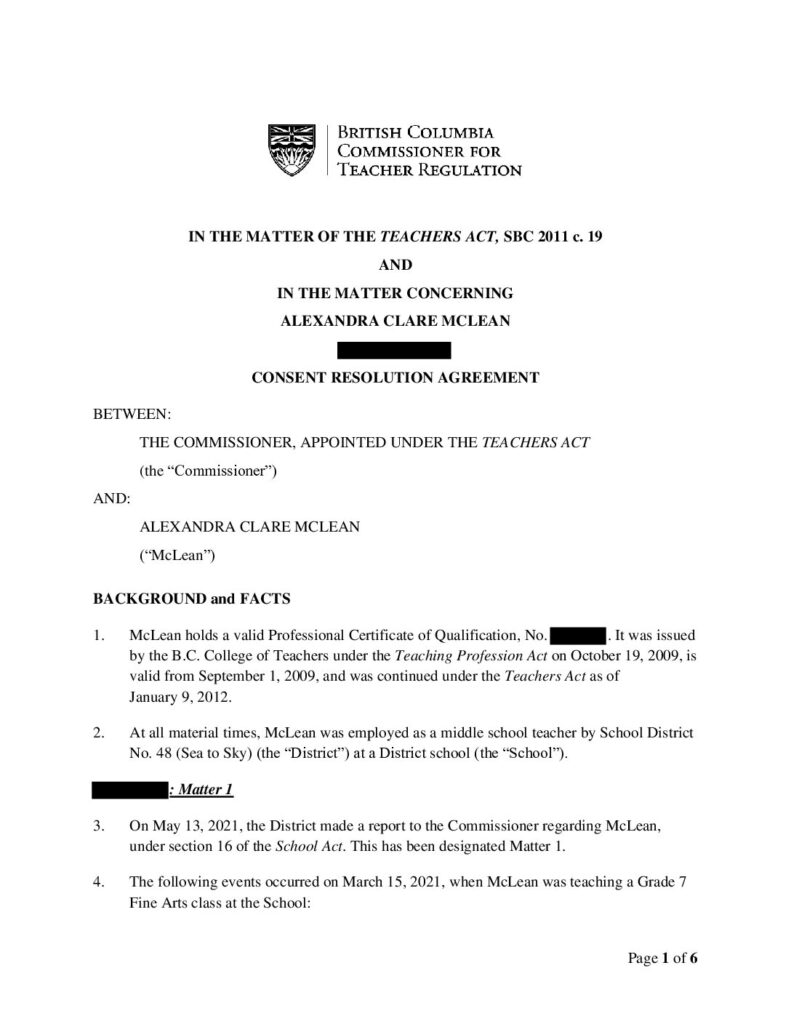
A recent case involving Alexandra Clare McLean, a BC teacher disciplined for yelling, humiliating, and physically handling students, highlights the urgent need for stronger accountability in schools. Despite multiple suspensions, warnings, and training, McLean’s harmful behaviour continued. This case reflects the broader issue of harmful disciplinary tactics like collective punishment. Both create fear, shame, and…
-

The cost of compliance – the foundational critique and case for change
When children are dysregulated, the response from educators is too often punitive. For neurodivergent students in particular, the cost of these responses is high: shame, trauma, social exclusion, and a deep erosion of trust. But it does not have to be this way. Restorative alternatives are not new. They are ancient practices found in many…