Public money should not be subsidising private advantage while public schools are told to make do with less.
That is the clean version of the argument. It is intuitive, politically useful, and often true. When governments claim there is not enough money for education assistants, specialist support, safe buildings, accessible classrooms, or meaningful inclusion, it is reasonable to ask why public funds are still flowing to private institutions that many families could never afford to enter.
But the clean version of the argument breaks down when disabled children enter the frame.
Because “private school families” are not one kind of family. “Leaving public school” is not one kind of decision. And “choice” is often the word systems use for an impossible decision made under duress.
Some families are buying advantage.
Some families are buying safety.
Some families cannot buy either.
If we do not hold those distinctions, disabled children become useful to everyone else’s ideology. They become evidence in an argument about public purity, private greed, parental betrayal, or fiscal restraint. They become the bodies everyone points to while almost no one asks what happened to them before the transfer form was signed.
Children cannot be treated as pawns in an ideological war over public education. Disabled children should not have to suffer in public school to prove that public education matters.
The fight we think we are having
When parents discover that their child’s supports have been stripped again — the EA reassigned, the hours cut, the sensory plan ignored, the safety plan quietly replacing an education programme — they tend to move in one of several directions.
- Some stay and fight. They keep writing letters, attending meetings, documenting harms, escalating complaints, and trying to sustain the belief that inclusion is real and the next intervention might finally make school safe.
- Some turn their grief sideways. They look at families who have left for private school, online learning, distributed learning, or home schooling and see people taking something away from the public system.
- And some leave. Many must mortgage houses, drain savings, reduce paid work, give up careers, get extra jobs, move children into online programs, register as home schoolers, or pay impossible tuition because the public system was not designed, funded, or staffed to support their child.
Those are not three separate moral categories. They are different responses to the same structural failure.
The province has built a system where disabled children’s unmet needs become private family burdens. Public institutions contain costs by making the conditions for disabled children intolerable and framing the decision to leave as a ‘choice.’ Families are left fighting over private school funding while the deeper economic function remains hidden: the public system saves money when the most expensive children disappear from view.
That is the part the private school funding debate keeps missing.
The transfers data
In data obtained by a member of BCEdAccess, we learned that there were this many transfers in two school years, from children with special education designations:
| Destination | 2022/2023 total | 2023/2024 total |
| Home school | 39 | 60 |
| Online learning | 273 | 290 |
| Combined | 312 | 350 |
The 2023/24 home-schooling data is especially stark. The Ministry recorded 60 students with inclusive education designations transferring from public school to home schooling. Of those, autism accounted for 25 transfers and intensive behaviour intervention or serious mental illness accounted for 15. Together, those two categories account for 40 of the 60 recorded home-school transfers — two-thirds of the total.
The online learning data shows the same basic pattern across a larger group. In 2023/24, the Ministry recorded 290 students with inclusive education designations transferring from public school to online learning. Autism accounted for 94 of those transfers, intensive behaviour intervention or serious mental illness for 62, and learning disabilities for 71. Together, those three categories accounted for 227 of the 290 recorded transfers to online learning — about 78%.
Across the two years of online learning data, the concentration remains clear. Autism accounted for 195 transfers, intensive behaviour intervention or serious mental illness for 109, and learning disabilities for 127. Combined, those three categories accounted for 431 of the 563 recorded online learning transfers in 2022/23 and 2023/24 — roughly 77%.
The numbers look small until you ask what they mean
Three hundred and fifty students.
Across a public system of roughly 580,000 enrolments, that number can be made to look negligible. It is the kind of figure a ministry can file without alarm, a district can absorb without explanation, and the public can scan past because it does not carry the aesthetic weight of crisis.
But an economic reading of this data does not ask only whether 350 is a large or small number.
It asks:
- What costs did the public system stop carrying when these children left?
- Who carries those costs now?
- Which children are showing up in the data?
These are not random departures. These are students whose needs often require sustained staffing, specialist support, sensory accommodation, relational repair, crisis prevention, family communication, and careful planning. They are also the students most likely to make under-resourcing visible when supports are not there.
Their distress shows up in absences, incident reports, partial days, phone calls for pickup, room clears, safety plans, and meetings where everyone documents the problem but no one supplies the resource.
When those children leave in-person public school, the system gets more manageable, with the existing budget.
What economists can help us see
J. Shahar Dillbary and Thomas J. Miceli’s Of Sinners and Scapegoats: The Economics of Collective Punishment is not about schools. It is about collective punishment, group liability, and the way institutions decide who should bear the cost when identifying or supporting the right person is difficult, expensive, or inconvenient.
Their central provocation is blunt: “Punishing the innocent” is often treated as an error, but “in reality, it is a choice.” They argue that enforcers can choose not only the probability and severity of punishment, but also the size of the group made to bear it. And they warn that even when an institution claims to be pursuing efficiency or deterrence, the cost imposed on the group can be “discounted or ignored,” producing serious welfare loss for the people made to absorb the harm.
That is the lens that makes the transfer data harder to dismiss.
Dillbary and Miceli help name a pattern: an institution can make its own problem cheaper by shifting the cost onto a group whose suffering it does not fully count.
While Dillbary and Miceli are writing about the justice system, their model helps illuminate a similar cost-shifting structure in schools.
In schools, the “punishment group” is a group of children and families made to absorb the cost of underfunded inclusion.
- The child absorbs the distress.
- The parent absorbs the labour.
- The family absorbs the lost income.
- The health system absorbs the crisis.
- The school system records a transfer.
And the ledger balances for another year.
The exit is not the event. It is the receipt.
A transfer to online learning or home schooling can look, administratively, like a family choice. A form is completed. A student moves. The file records an exit.
But that record captures the endpoint, not the process.
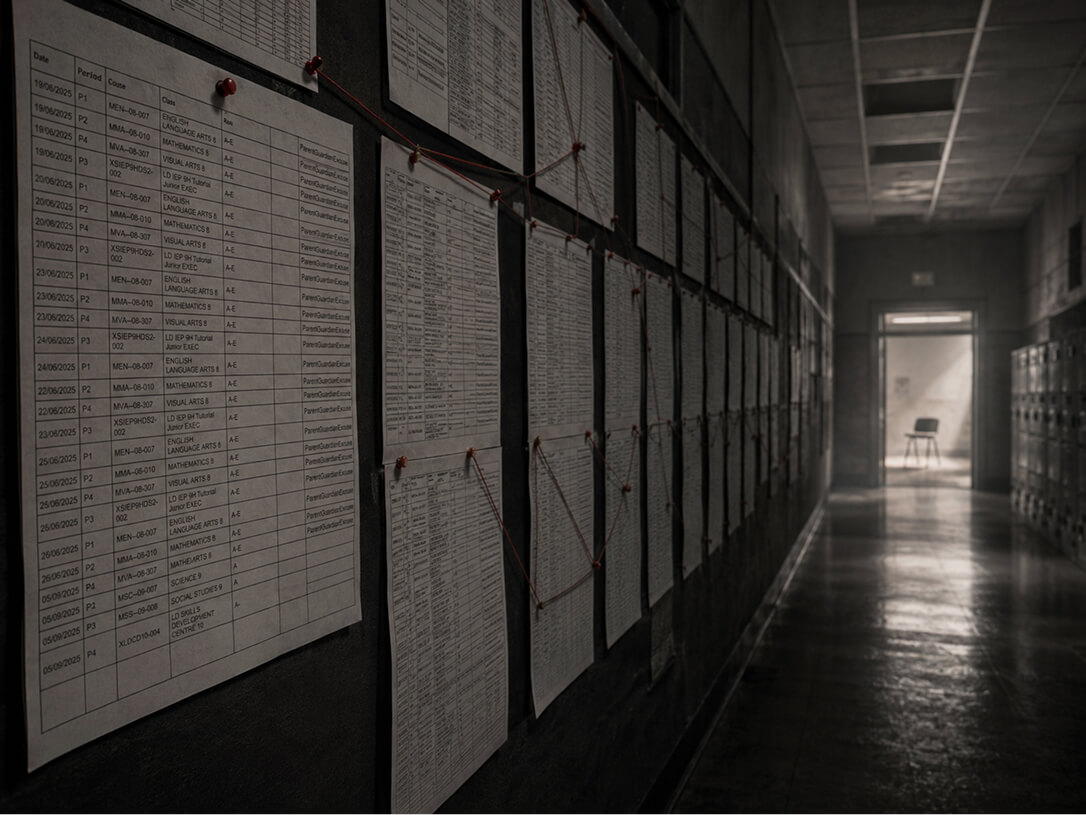
It does not show the six months of shortened days before the transfer. It does not show the parent leaving work again because the school called at 11 am. It does not show the “gradual entry” plan with no real path to full-time attendance. It does not show the safety plan that named the child as a risk while leaving the sensory environment unchanged. It does not show the behaviour plan that converted distress into documentation rather than support.
It does not show the child who stopped sleeping, stopped eating, stopped trusting adults, stopped learning, or stopped being willing to enter the building. It does not show the slow and grinding harm that accumulates over the years.
It does not show the meetings where parents were told the school had done everything it could, when what the school had actually done was reach the limit of what it was resourced or willing to provide.
So when a disabled child leaves public school, we should be careful about calling it preference. Sometimes it is preference. Sometimes it is ideology. Sometimes it is privilege. But often, for families of disabled children, it is the administrative trace of failed access.
The distinction no one wants to make
This is where the public-private debate often fails disabled children.
Religious private schools, elite preparatory schools, online learning programs, distributed learning, disability-specific schools, and home schooling are not functioning in the same way for families. They are not serving the same populations. They are not driven by the same motivations.
A family that enrols a child in a $30,000-a-year school because they want smaller classes, elite athletics, and social advantage is making a fundamentally different decision from a family that enrols a child in a $40,000-a-year disability-specific school because the public system sent their seven-year-old home at noon every day and called it support.
The first family may be purchasing advantage.
The second family may be purchasing survival.
Collapsing both into a single category called “private school families” is politically convenient, but it is not serious analysis. It allows us to talk about public education in the abstract while avoiding the harder question: why are some disabled children being made unable to stay in the public system at all?
My own family lives inside that question. My son has been unwilling to leave his room since March 2025. I am unlikely to put him back into a typical public school program after watching what attending one did to him. I tried to get my AuDHD daughter into Kenneth Gordon Maplewood and could not make the cost work. If I could have diverted half my wage to protect my child, I would have.
That does not make private education the solution.
It means the public system failed to remain a safe option.
-
I only asked for gentleness: on parenting a PDA child in a punishing world
There is a certain kind of child—intuitive, emotionally articulate, wired with a startling perceptiveness about power and tone, about coercion and…
-
She graduated and this is what she learned
On raising a badass advocate, unintentionally. I didn’t set out to raise an advocate—I set out to raise a child. A child who might feel safe in her body and steady in her breath, who might look out at the world and feel…
The economics of making children leave
The system does not need to formally exclude a disabled child to benefit from their departure.
It only has to make staying costly enough that the family eventually does what the institution will not say out loud: remove the child.
When a disabled student remains in an under-resourced public school, the system must manage the visible costs of unmet need. Staff need support. Administrators need plans. Districts need to respond to complaints. Classrooms need enough adult capacity to prevent crisis. Inclusion has to become material, not rhetorical. It is more than a poster.
When that same student leaves for home schooling, online learning, or a private alternative, many of those costs move off the school’s books.
The family takes over supervision, regulation support, educational scaffolding, crisis recovery, transportation, coordination, and care. The child absorbs isolation, lost peer connection, lost instruction, and the wound of being pushed out of the place that promised to include them. The parent becomes the education assistant, case manager, regulation support, recovery space, and unpaid crisis worker.
That is the cost-containment mechanism.
The public system can still say the child had options. It can still describe the transfer as a family choice. It can still count the departure as administratively neutral. But economically, the institution has shed a high-cost access obligation and redistributed that cost onto the family, the health system, and the child’s future.
This is why the transfer data matters. The number is small only if each child is counted as one enrolment change. It is not small if each transfer represents a public obligation converted into unpaid family labour.
-

Engineered famine in public education
In British Columbia schools today, we are not facing a behaviour crisis—we are facing a famine of care. This essay weaves together personal memory, systemic critique, and deep empathy for teachers and families alike to ask why our schools are starving the very…
The cost does not disappear. It travels.
When a child moves to home schooling, the public allocation drops dramatically. But the child’s needs do not drop. The work simply moves onto the family. A parent now provides the supervision, regulation support, educational scaffolding, planning, emotional repair, and daily crisis prevention that the school was funded to provide.
When a child moves to online learning, the shift can look less extreme on paper because the student remains within public education. But much of the access work still moves home. The platform may provide a teacher. It does not provide the adult sitting beside a distressed child, helping them initiate tasks, recover from panic, manage technology, rebuild trust, or stay connected to learning after school itself has become associated with harm.
That labour is real. It is skilled. It is exhausting. And it is usually unpaid.
The parent — most often the mother — reduces hours, leaves employment, turns down opportunities, loses income, loses pension contributions, loses career progression, and absorbs the psychological cost of becoming the emergency infrastructure for a public system that failed her child.
The health system picks up another part of the bill: anxiety, depression, sleep disruption, school refusal, regression, crisis presentations, specialist referrals, medication, and hospitalisation.
The education budget records a transfer.
The health budget records increased utilisation.
The family records the damage in lost wages, lost capacity, and a child who has learned too early that the place built for all children was not built for them.
Nobody draws the line between the budgets because the system is not designed to account for suffering once it has been moved off the school ledger.
Scarcity turns families into each other’s evidence
This is the political genius of scarcity.
Public school families watch resources stretch thinner every year. They see children unsupported, classrooms destabilised, educators overwhelmed, and inclusion reduced to a slogan without staffing behind it. In that context, private school funding can look like a direct theft from children who stayed.
Families who left public school carry a different wound. Many tried everything first. They attended the meetings, wrote the emails, agreed to the plans, waited for the assessments, accepted the phased returns, endured the phone calls, and watched their children deteriorate while adults used process language to avoid responsibility.
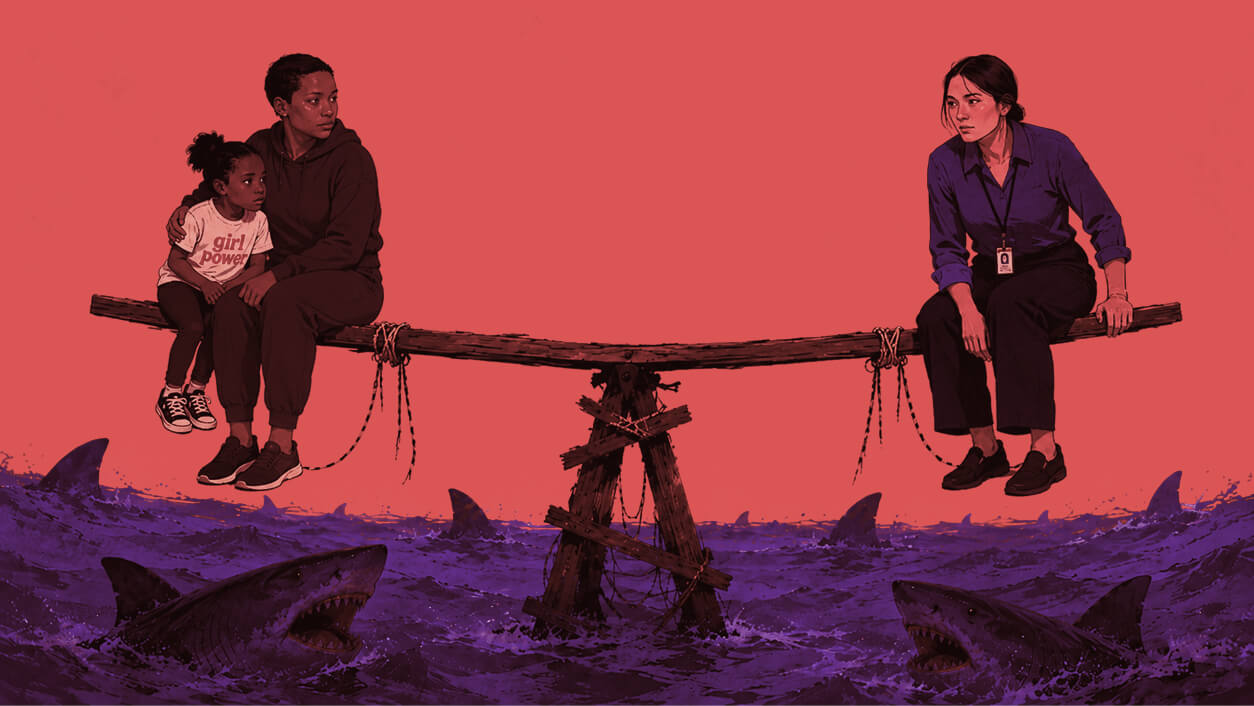
One group feels abandoned.
The other feels judged for escaping a burning building.
Families who cannot leave feel trapped inside the fire.
Everyone is right about their own pain.
Underfund the public system long enough, and people begin fighting over proximity to harm. Those whose children remain inside the system resent those who found a way out. Those who left feel accused of betrayal after making a decision they experienced as survival. Those without the money, flexibility, or social capital to leave are forced to absorb the deepest version of the failure.
Meanwhile, the province gets to stand at a distance from the conflict it engineered.
Who benefits from the binary?
The binary says you are either for public education or complicit in its erosion. It is clean, emotionally satisfying, and almost entirely useless for disabled children who were forced out of the public system.
It benefits the provincial government by redirecting public anger sideways. It benefits districts by turning exclusion into “choice.” And it benefits austerity politics by making education look like a zero-sum fight between groups of children, rather than a public decision about whether schools will be funded to include the children they already claim to welcome.
It does not benefit the children.
The real way to reduce private schooling
The most effective way to reduce private school enrolment in British Columbia is to make public schools tenable.
That is true for disabled students, but it is not only true for disabled students. Families look for exits when public schools become too strained to reliably offer safety, stability, manageable classrooms, meaningful instruction, responsive support, and enough adult capacity to notice what is happening.
For disabled students, the failures are often sharper and more visible: not enough education assistants, specialist support arriving only after collapse, sensory needs treated as behaviour, and inclusion reduced to documentation rather than access.
But the broader pattern is the same. Families leave when classrooms feel chaotic, bullying is not addressed, academic support is thin, teachers are stretched beyond endurance, and parents conclude that the public system may be principled in theory but unsafe or inadequate in practice.
Families do not drain savings because they love paying tuition. They do not generally leave careers because home schooling was their first dream. They do not move children to online learning because isolation is ideal.
Many do it because staying became too costly to their child and too costly to their family. That is induced demand: not organic preference, but the predictable result of the gap between what public education promises and what it delivers.
If public schools were safe, stable, accessible, adequately staffed, and genuinely inclusive, some families would still choose private education. But the survival market would shrink.
The data we still need
The Ministry’s transfer data tells us where some children went. It does not tell us what happened before they left.
That missing period matters.
A real accountability system would ask: how many of these students had chronic absence before transfer? How many were on partial-day schedules? How many had repeated calls for pickup? How many had safety plans, behaviour plans, or incident reports? How many families had requested support and been told there was not enough staffing, not enough specialist availability, not enough funding, or not enough capacity?
It would ask whether transfer rates are higher in some districts than others. It would ask whether they correlate with EA staffing, specialist availability, complaint volumes, exclusionary discipline, or designation categories. It would ask whether Indigenous students, rural students, racialised students, low-income students, and students with intersecting marginalisations are overrepresented among those who disappear from in-person public school.
The province holds more information than the public can see. But the data is structured in ways that make democratic accountability difficult. Suppression may protect privacy, but it also protects systems from comparison.
The public cannot fix what it cannot see.
And families cannot prove patterns the province is allowed to hold privately.
Children are not pawns
The strongest version of the argument against disproportionate private school funding is not the argument that private school families are taking something that belongs to public school children. The strongest version is that the government has manufactured a crisis in public education, watched families flee that crisis through the only doors available to them, and then invited the public to blame the families instead of the policy.
We do not need to fight each other. We need to aim our pitchforks at Victoria and demand that public education be funded at the level required to make it safe, accessible, and adequate for every child — including the children whose needs are expensive, whose behaviour is labour intensive to support, and whose presence makes the gap between policy and practice impossible to ignore. If the government met that standard, the debate over private school funding would not disappear, but it would be a debate about equity and ideology rather than a debate about survival.
Disabled children should not have to suffer inside public school to prove that public education matters. No child should be made a pawn in a war adults were manufactured to fight.
-

Protecting the ledger over the learner: operationalising scarcity in BC School Districts
British Columbia’s public schools are mandated to provide inclusive education for all students, but they do so in a context of chronic resource scarcity. Scarcity in education…