The monster is made before she speaks.
She enters with a binder, a water bottle, printed notes, and a voice rehearsed until grief has left the surface. She has softened the email, shaved down the sharpest sentence, changed harm to concern and discrimination to barriers. She has learned to say accommodation as though naming a right were an act of diplomacy.
The room begins translating her before the first sentence lands.
The binder becomes obsession. The notes become a case file. The calm voice becomes strategy. The legal language becomes threat. The grief becomes tone.
This is how schools make the monster.
They take the mother’s knowledge and call it bias. They take her memory and call it fixation. They take her documentation and call it escalation. They take her urgency and call it aggression. Then they write the meeting notes as though the problem arrived in her body.
The mother came with a record.
The institution saw danger.
Poise is the price of entry
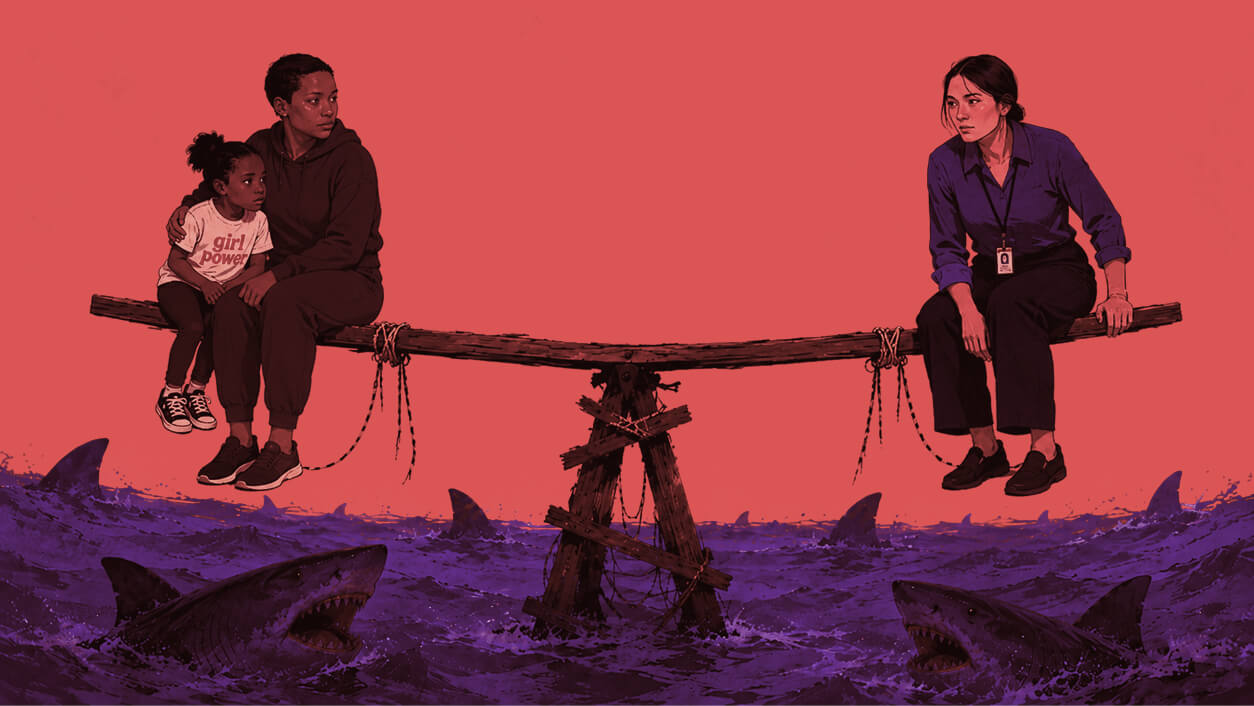
There is a way to sit in these rooms if you want to remain admissible. The face must show concern without accusation. The voice must carry urgency without alarm. The body must stay present enough to prove collaboration and contained enough to avoid becoming the subject of the meeting. Cry softly. Shake invisibly. Name harm gently. Make the room comfortable enough to keep failing the child in complete sentences.
This is called partnership.
The body learns the ritual first. The stomach tightens in the parking lot. The jaw locks before the agenda opens. The bladder becomes negotiable. Ordinary needs begin to feel tactically dangerous because leaving the room for two minutes can mean missing the sentence that decides access, placement, safety, or blame.
So the body stays.
It stays through discomfort. It stays through the urge to stand, interrupt, object, leave. It stays because the room has taught the mother that composure is the entry fee. Every visible sign of distress can be extracted, flattened, and returned later as proof that she was the unstable element.
Eventually, the body makes its own record.
A bladder infection.
Before the complaint file, the jaw. Before the appeal, the throat. Before the FOI, the heart palpitations. Before the timeline, the nervous system learning the route to the school.
Poise is institutional violence made socially comfortable.
The mouthless advocate
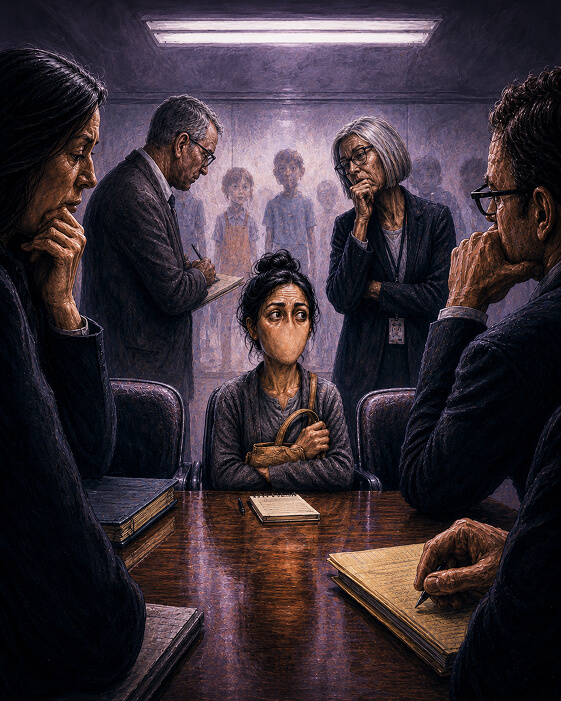
She sits at the centre of the table, though centre is too generous a word for a room arranged around her containment. Her chair is smaller. Her body is watched. Her bag is clutched to her chest like a shield. A notebook sits in front of her, open to a page she will barely use, because writing too much can also become a sign.
Her mouth is gone.
The mouthless advocate is the parent who has learned the cost of speech. She has watched her words appear later in softened notes, stripped of urgency and returned as parent expressed concern. She has seen grief documented as an event, as though the feeling were more remarkable than the harm that produced it. She has learned how quickly a sentence can be lifted from the living room of the body and placed in the cold storage of the file.
So she becomes careful enough to vanish.
She nods. She waits. She asks questions with blood hidden. She arranges her face into something the room can tolerate. The wide eyes remain because the body tells the truth the mouth has been trained to withhold. The eyes know where the exits are. The eyes know who looked away. The eyes know which adult changed the subject when the child’s pain entered the room.
Behind her stand the ghost children: the children already processed into codes, categories, safety plans, partial days, behaviour charts, attendance records, and polite euphemism. They are the reason she came. They are the reason she stays. They are the reason silence feels like betrayal and speech feels like risk.
The sealed mouth is evidence.
Truth has been made expensive.
Each document is a tongue
The parent who loses ordinary speech begins to write.
The follow-up email. The dated note. The screenshot. The doctor’s letter. The attendance record. The incident log. The policy question. The FOI request. The timeline built late at night from documents the school assumed would stay scattered.
Each document is a tongue.
The institution can survive fragments. One email. One meeting. One absence. One room clear. One “difficult day.” One missed support. One teacher away sick. One plan that needs more time. One child whose distress can be filed under complexity.
Pattern is the threat.
Pattern turns concern into evidence. Pattern turns evidence into structure. Pattern turns structure into indictment. Pattern gives the child’s suffering a spine.
So the record must be discredited.
The binder becomes obsession. The timeline becomes fixation. The follow-up becomes pressure. The FOI becomes hostility. The request for reasons becomes conflict. The mother’s memory becomes the new problem because memory keeps the institution from achieving its favourite remedy: forgetting by increments.
This is the institutional crime of continuity.
She remembered what they scattered. She connected what they isolated. She made a body out of fragments and carried it back into the room.
That is why they called her monstrous.
The archive grows teeth
There is a moment in school advocacy when the parent feels the record change inside her hands. At first it is evidence. Then it is armour. Then it is something alive.
The pages begin to hiss.
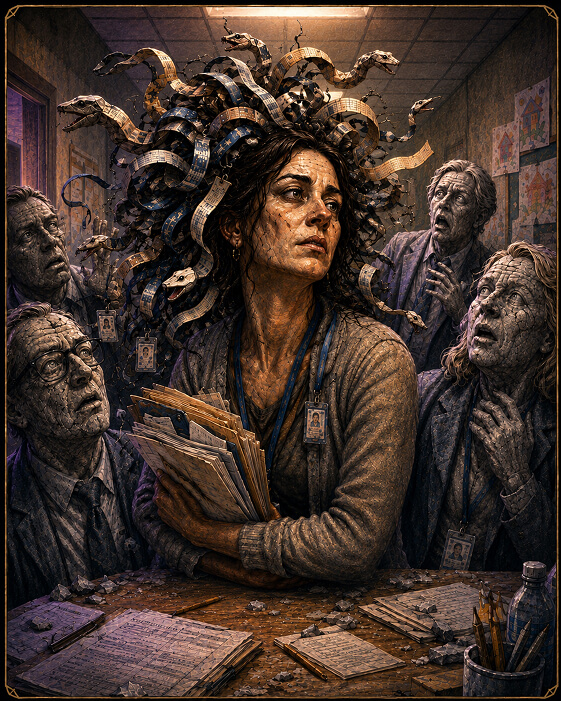
A doctor’s note remembers one injury. An email remembers one promise. A screenshot remembers one contradiction. A meeting minute remembers the shape of what was omitted. Each page grows a head because each page was forced to speak for a child whose pain kept being translated into process. The archive becomes serpentine because the institution made straight speech useless.
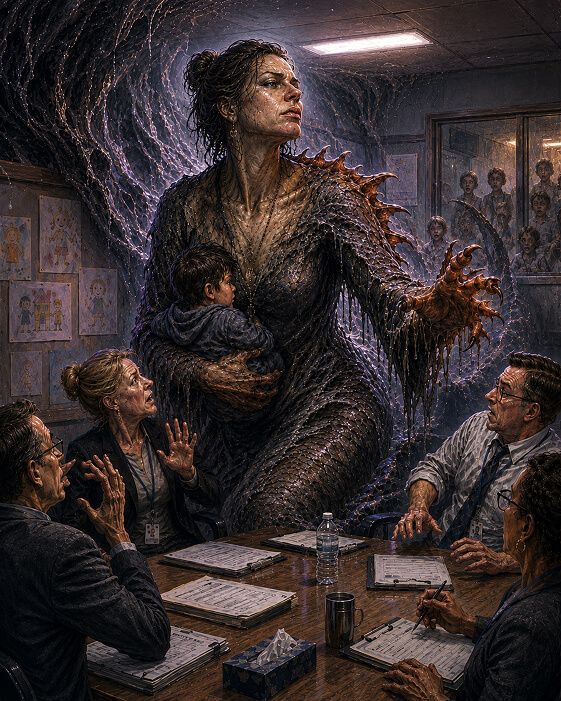
This is Medusa at the meeting table.
Her hair is made of records. Each snake carries a date. Each date carries a child. Each child carries a room, a hallway, a locked door, a missed recess, a lunch uneaten, a morning spent curled in bed while adults debated readiness.
The staff turn to stone because the record makes them see themselves.
Petrification is the body’s answer to recognition. It is the frozen face of an institution that built its self-image on care and then met the file. It is the pause after the parent says, “That is documented.” It is the glance between professionals when the story can no longer be softened by memory’s decay.
Medusa’s gaze is the archive looking back.
The pipeline
Monster-making has a sequence. Each step prepares the next.
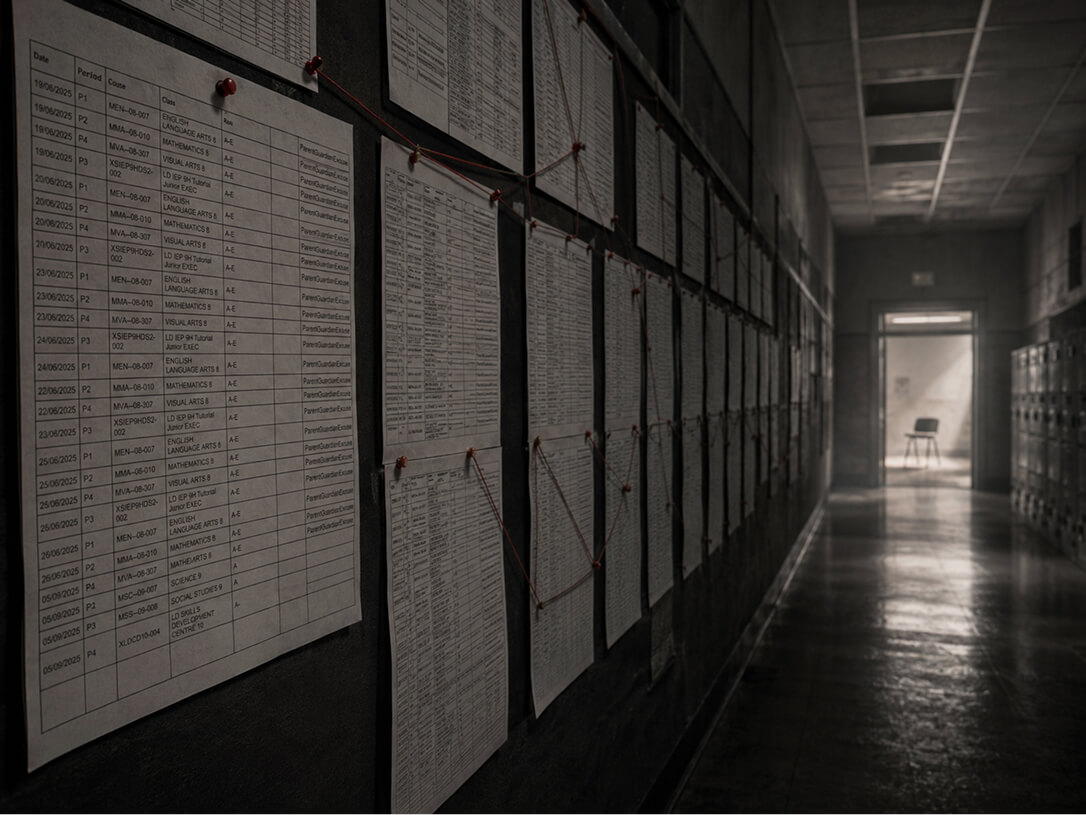
First, the parent’s knowledge is treated as contaminated by love. She is close to the child, so closeness becomes bias. She knows the history, so history becomes fixation. She has lived the mornings, evenings, meltdowns, refusals, shutdowns, stomach aches, tears, and slow collapses, so lived knowledge becomes emotional excess.
Then comes delay.
Delay arrives dressed as care. Another meeting. Another review. Another consultation. Another observation. Another term. Another transition. Another chance for the team to gather information about the loss of access while the child continues losing access. Adults preserve the process. The child pays the interest.
Process becomes the room where urgency goes to die.
Then comes distress.
The body registers what the institution keeps deferring. Sleep breaks. The jaw locks. The email gets written at two in the morning because three in the morning belongs to the child crying again. The parent begins to document compulsively because the harm keeps generating fresh material. The distress is proportionate. The room calls it instability.
Then comes tone.
Urgency becomes aggression. Grief becomes volatility. Legal clarity becomes threat. Precision becomes hostility. Memory becomes an inability to move forward. The school shifts the subject from the child’s exclusion to the parent’s conduct, and the file begins to fill with evidence of the complainant rather than evidence of the harm.
Then comes containment.
One communication channel. One administrator. Fewer meetings. More warnings. Formal complaint processes that turn injury into paperwork and time into a weapon. Conduct expectations delivered with the bright, smooth voice of someone who has found the lever.
By the end, the parent has been turned into a difficult parent.
The original harm has left the centre of the room.
That was the point.
The old stories knew
The old stories understood what happens to women who remember too much.
Grendel’s mother raged because her child was killed. The story made her a creature. The grief became monstrous when it moved. Mourning could have been tolerated as atmosphere; action made it dangerous. That is the ancient lesson. A mother may grieve in ways that decorate the room. She becomes a threat when grief develops a remedy.
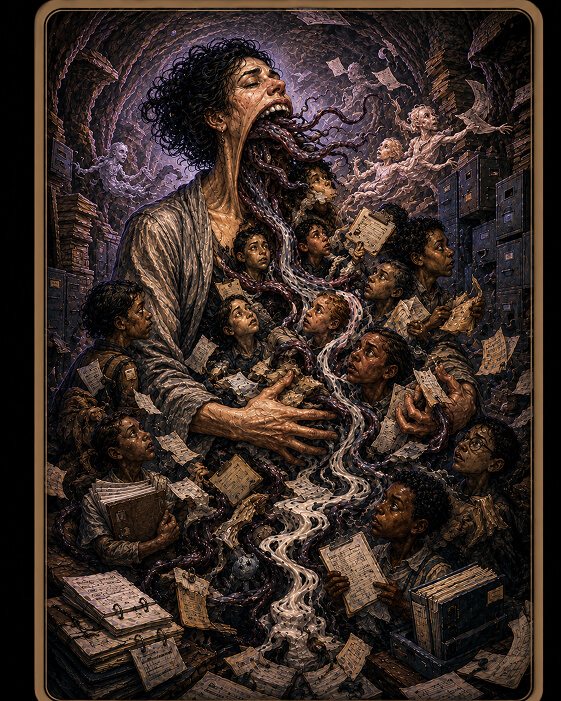
Spenser’s Error lived in a cave with too many children and too many tongues. She suckled her young and vomited books and papers. Her body produced what the hero called filth. The figure is almost too precise for school advocacy: too many dependants, too many records, too many words, too much evidence coming from the body of a mother who has been pushed underground.
Error is the patron monster of the parent archive.
Medusa made men into stone. The useful reading sits right there: she made them see. The horror was recognition. The institution petrifies in the presence of the mother who brings the record because the record returns its own face to it.
The Furies carried memory as pursuit. They came for violations of sacred bonds. They came when blood cried out and polite closure tried to move the story along. Every parent who refuses “moving forward” as a substitute for repair knows this lineage. Memory is monstrous to systems built on strategic amnesia.
The banshee keens. She is grief before agenda language. She is the sound that cannot be minuted, sanitised, redirected, or thanked for its contribution. She belongs to the earth, to the mound, to the place where the dead are held. Schools are built from air, metal, fluorescent light, and plausible deniability. The banshee rises from beneath the floor and ruins the meeting.
The old stories made grieving women monstrous.
Modern institutions give the trick a policy number.
The gaping mouth
Once the parent has been monstered, every sound becomes confirmation.
Calm becomes manipulation. Anger becomes aggression. Precision becomes obsession. Legal clarity becomes threat. Grief becomes instability. Silence becomes disengagement. Memory becomes fixation. Asking for the plan becomes demanding. Asking for the reason becomes adversarial. Asking for the policy becomes building a case.
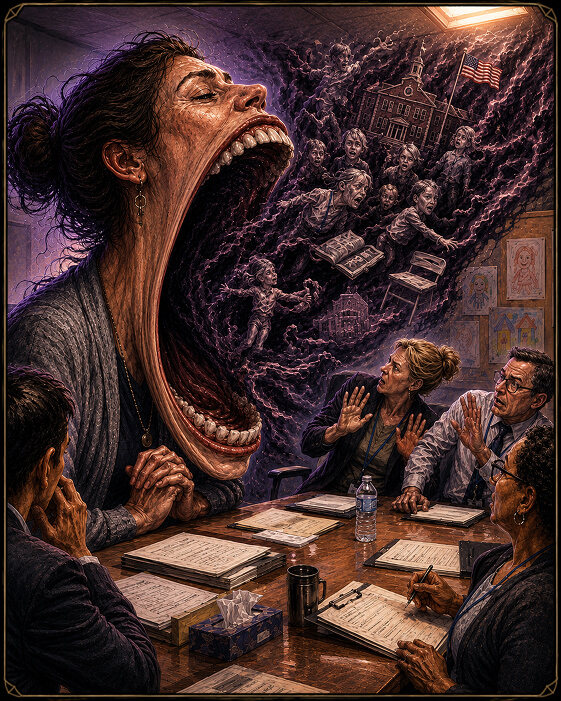
The mouth grows because ordinary speech has been ruined.
The gaping mouth is years of swallowed sentences given shape. It is every insult converted into diplomacy, every scream held behind the teeth, every email ending “thank you for your time” when the real sentence was “you failed my child again and I am documenting this for the record.”
What pours from the mouth is the archive the room refused.
Children. Hallways. Reduced timetables. Empty desks. Safety plans. Pick-up calls. Attendance codes. Doctor’s notes. Unanswered emails. Lost friendships. Lunches brought home uneaten. Shoes that stopped making it to the door. A school building floating in the dark with every light on and no one accountable inside.
The staff recoil because the mouth contains the whole pattern.
They organised themselves around fragments. The mouth returns totality.
They feared the mouth because the mouth was an archive.
What I did not scream
The sentences arrive later.
They come in the car, in the shower, in bed, in the hour after the meeting when the body begins to unclench and the true language walks in wearing boots. They arrive too late for the minutes and exactly on time for memory.
They are called insults because the room had no lawful place for honesty.
You held the knife and asked why we were bleeding.
You said “inclusive” like a spell you forgot the ending to.
You renamed violence as plan, as process, as best practice.
You passed exclusion around the table like a sacrament.
You filed your doubt under “due diligence” and my grief under “tone.”
You burned my child at the altar of neutrality.
You wore professionalism like armour and mistook my restraint for peace.
You performed concern while building the gallows.
You said “safety” twenty-seven times and offered none.
You archived harm and called it reflection.
You mistook my body — trembling, clenching, holding — as a threat, not a record.
These sentences sound excessive only inside the institution’s grammar. That grammar had already done its violence. It had renamed exclusion as transition, abandonment as independence, delay as diligence, and harm as complexity. It had converted children into categories and suffering into a data point. It had made cruelty sound reasonable by teaching everyone to say it softly.
The insult returns language to matter.
This is what I did not scream.
This is what the minutes could not hold.
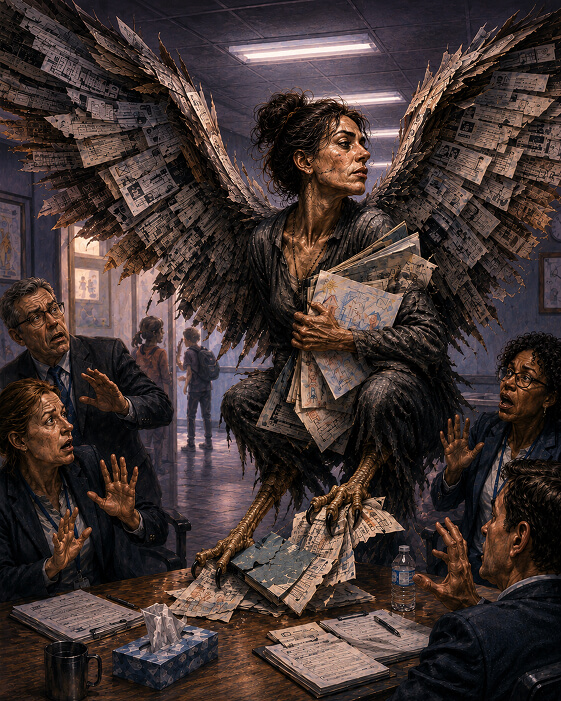
The harpy lands
There is another version of the mother.
She has stopped trying to stay seated.
She lands on the meeting table with talons in the agenda and wings made of evidence. The wings are doctor’s notes, emails, IEPs, FOI responses, attendance reports, complaint letters, screenshots, children’s drawings, drafts marked up at midnight, the document trail built from harm everyone else expected to evaporate.
The room recoils.
The talons are precision. They hold the page in place. They puncture the agenda’s smooth skin. They keep item two from sliding into item three while the child’s access still lies open on the table. The wings are weight. They are the accumulated proof required to make an institution admit what a child’s body already knew.
She is grotesque because she came back with everything.
She is frightening because she landed where everyone could see her.
She is disruptive because she made the meeting about the child again.
The door
Monster-making becomes most dangerous when the person who defines the monster controls the door.
Every school has a language of order. Respectful conduct. Appropriate communication. Safe environment. Productive dialogue. These phrases carry a pleasant surface and a sharp underside. They sound like community standards. They function as tools for deciding which forms of grief may remain in the building.
In BC, the door has a number. Section 177 gives school authorities a route for removing the person deemed to disturb or interrupt the proceedings of a school. The language sounds administrative. The power is affective. It decides which grief may remain indoors.
A quiet tear can be tolerated. A trembling hand can be managed. A mother who keens, who raises her voice, who refuses the agenda’s pace, who says the thing directly enough to interrupt the room’s self-image, reaches the threshold where pain becomes disorder.
The banshee lives at that threshold.
She is grief before translation. She is mourning that has escaped the action item. She is the sound of a mother whose child has been harmed by a system that still expects her to wait her turn, use the microphone, and thank the chair.
Institutions love order because order can be photographed.
Children disappear inside order every day.
What they feared
At the centre of every monster stands the same mother.
Eyes wide. Mouth sealed. Bag clutched to her chest. Binder on the table. Body trained to wait. Voice rehearsed until the grief has left the surface. Still trying, somehow, to remain acceptable enough to protect her child.
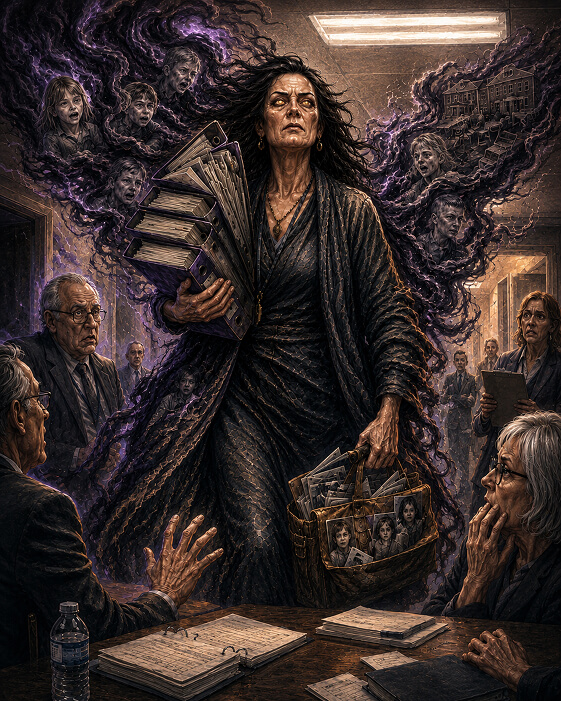
Around her stand all the forms the institution forced her to become: the many-tongued archivist, the paper-winged harpy, the Medusa with records for snakes, the Fury carrying binders through smoke, the banshee at the door, the gaping mouth full of everything the room refused to hear.
These figures are evidence.
They show what happens when caregiver knowledge meets institutional self-protection. They show what grows in the gap between a child’s harm and an adult system’s refusal to feel implicated. They show the labour required to keep memory alive when every process is designed to scatter it across meetings, years, roles, and files.
The advocate arrived human.
She arrived prepared. She arrived careful. She arrived alone. She arrived already grieving and already restrained, carrying a record because the record existed, carrying urgency because the child was still being harmed, carrying memory because memory was the only thing the institution had failed to control.
The institution made the monster it could survive.
It put teeth on the truth so it could call the truth dangerous. It gave the mother claws so it could talk about the claws. It made her enormous so it could avoid the size of what she carried.
What they called monstrous was maternal.
What they called excessive was documented.
What they called fixation was memory doing its job.
What they feared was the record.
What they feared was the child still visible inside it.
What they feared was my memory.
Also see
- Poise as pedagogy: feminised composure, coercive calm, and the disciplining of mothers and children in public education
- Maternal scream: embodied rage in a system that punishes and smiles
- Maternal grief, public ritual, and the refusal to behave at the IEP table
- Procedural policing of pain: what happens if I keen?
- Fierce is fair: when institutional tone policing meets legal obligation
- Looking in the mirror is hard: maternal rage and institutional cowardice
- Epistemic silencing of disabled children’s primary caregivers