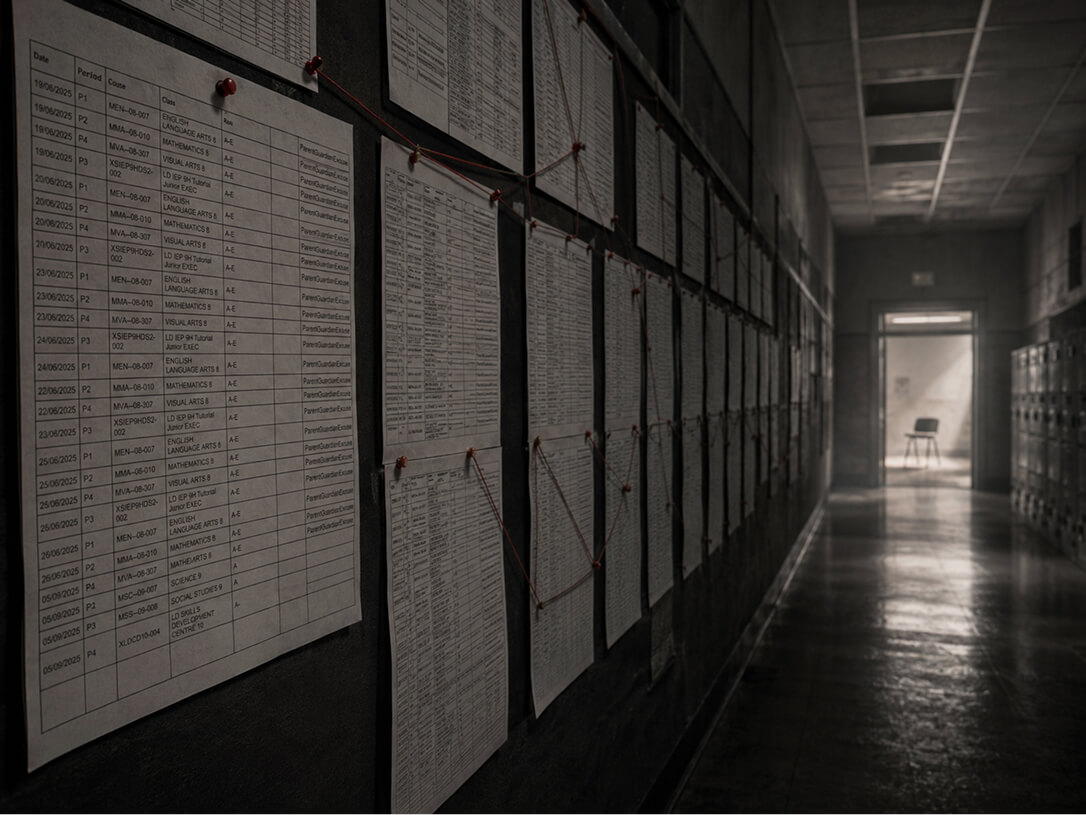
How collective punishment turns scarcity into compliance
The confusing thing about school harm is that it rarely arrives without care. While your child is being excluded, an Educational Assistant is finally assigned. A kind case manager begins sending thoughtful emails. Someone finds a program space you were told did not exist. A teacher sees something important in your child and makes their day safer. The help is real, and so is the exclusion.
This does not mean every kindness is calculated or every person working inside the system is acting in bad faith. Schools are full of people trying to care for children inside conditions they did not design. It means that care, punishment, access, and exclusion can all move through the same institution at once. The gift is one of the things that makes the larger system morally bearable: it reassures families that cooperation may still be rewarded, allows staff to know truthfully that they sometimes help, and gives the institution real examples of inclusion working.
But the larger machinery is punishment. Collective punishment and scapegoating allow institutions to obtain compliance, contain demand, and ration scarce resources while transferring the human and political costs to disabled children and their families. They discipline classrooms, deter parents, protect professional identities, divide the public, and make limits on education spending appear natural. A system does not need everyone to be cruel for this to work. It needs enough people to follow its rules, enough people to benefit from the existing distribution, and enough visible successes to make its failures seem exceptional.
Punishing innocent people can be an enforcement choice
In Of Sinners and Scapegoats: The Economics of Collective Punishment, legal economist J. Shahar Dillbary and economist Thomas J. Miceli ask us to consider something modern legal systems prefer not to admit: the number of innocent people exposed to punishment can itself be an enforcement choice.
Their model treats an enforcer as choosing among several variables:
The enforcer can spend more identifying the responsible person, change the severity of the sanction, or enlarge the group subjected to punishment. Enlarging the group increases the likelihood that the true offender is included without requiring the enforcer to pay the full cost of precise detection. The authors do not endorse collective punishment. They use the model to explain why institutions may adopt it, particularly when deterrence is prioritised and the harm imposed on innocent members of the punishment group is ignored or discounted.
The school analogy is not exact. Schools usually know which child engaged in the visible behaviour. What remains uncertain, or deliberately under-examined, is causation and responsibility. Why did the child run? What happened before they hit? Was the accommodation implemented? Had the child been signalling distress for hours? Was the environment accessible? Was the support plan adequately staffed? What did adults know, and what institutional decisions made the incident more likely?
Answering those questions requires investigation, time, expertise, candour, and often an examination of the institution’s own conduct. It may require changing the environment, providing more staff, repairing relationships, or acknowledging that a plan existed only on paper. Punishment offers a cheaper answer. The playground can be closed, the room cleared, the activity cancelled, the parent called, or the child sent home. Their day can be shortened. Their presence can be made conditional on behaviour the school has not adequately supported them to regulate.
These actions are not costless. They only look cheap from the position of the decision-maker. The child pays through lost education, fear, stigma, and fractured relationships. The family pays through unpaid supervision, lost work, private services, administrative labour, and health consequences. Other children pay through lost access, anxiety, peer conflict, and a more coercive classroom. Staff inherit damaged trust and recurring crises. But those costs do not necessarily appear in the school’s staffing allocation or the government’s education budget. From inside the institution, removal can therefore look more efficient than support.
Collective punishment as classroom management
At classroom level, collective punishment is more than an unfair consequence. It is a management technology. When a whole class loses an activity because of one child’s conduct, the school expands the enforcement audience. The identified child is no longer responding only to a teacher or principal. They are now exposed to the disappointment, scrutiny, resentment, and pressure of their peers.
The institution has delegated part of its enforcement work to children. Classmates learn to monitor one another. They report rule-breaking, pressure children to comply, distance themselves from peers seen as risky, and sometimes participate in their exclusion. The teacher no longer carries the entire burden of maintaining order because the social group begins to police itself.
Collective punishment can also produce anticipatory compliance. Children learn that their own good conduct cannot guarantee continued access. A rule violation elsewhere in the group can cost everyone recess, a field trip, a classroom privilege, or the use of a shared space. They must therefore do more than follow the rules themselves. They must also watch one another.
For disabled children, the lesson is especially sharp. Children who can suppress discomfort, tolerate sensory pain, remain still, interpret unclear expectations, and delay visible distress retain access and approval. Children who cannot become the point at which the classroom’s apparent order breaks. The room may become quieter, but that does not mean the children have learned responsibility or regulation. They may have learned something narrower and more dangerous: difference can cost everyone something.
Not every room clear or restriction imposed after an incident is collective punishment. Sometimes an immediate safety response is necessary. The distinction lies partly in what happens before and after: whether the danger was preventable, whether accommodation was provided, whether access is restored promptly, whether repair occurs, and whether the same child repeatedly becomes the reason everyone else loses something. When an institution repeatedly responds to one child’s disability-related distress by depriving the larger group, it creates a public connection between that child and collective loss. That connection does enforcement work.
The child as sinner and scapegoat
The disabled child can occupy two different positions at once. At the immediate level, the child is cast as the sinner: the person whose behaviour supposedly caused the room clear, playground closure, interrupted lesson, cancelled event, or demand for additional staff. At the structural level, the same child becomes the scapegoat: the person made to absorb responsibility for conditions created by inadequate funding, inaccessible environments, staffing shortages, refused accommodation, and institutional choices.
Scapegoating does not require denying that an incident occurred. A child may have screamed, hit, bitten, fled, refused, thrown something, or frightened another student. Harm to peers is real and must be addressed. Disabled children are not outside ordinary obligations to repair harm where they are able to do so.
The scapegoating occurs when the child’s visible conduct is made to explain far more than it can reasonably carry. The behaviour becomes the explanation for staff exhaustion, lost learning time, unsafe classrooms, inadequate supervision, cancelled programs, failed inclusion, and pressure on the public budget. The child becomes the reason the system cannot provide what it promised, while the institution’s contribution disappears.
The incident report records the hit but not the hours of escalating distress. The safety plan identifies the child as the risk but not the inaccessible environment. The attendance record shows absence without showing that the parent was repeatedly told to collect the child. Meeting notes describe the family’s resistance but not the unimplemented accommodation they were resisting. Documentation does not merely record events. It allocates causation.
Over time, the file accumulates proof that the child cannot succeed in the existing environment. What it does not accumulate with equal precision is proof of what the institution failed to provide. The child’s conduct becomes visible evidence, while the institution’s omissions remain background conditions. That is how a support failure becomes a behavioural failure.
One punishment, several audiences
Punishment in schools rarely addresses only the child who receives it. It communicates with several audiences at once. For the child, the message is direct: certain conduct will result in lost access, separation, or rejection. For classmates, it is general deterrence: this is what happens to a child who cannot comply. For staff, it demonstrates which responses produce immediate order with the least additional labour. For families, it shows what may happen when a child’s needs become too visible, complex, or costly. For the public, it establishes a connection between disabled children and the loss of shared resources.
The same action can therefore regulate a classroom, deter advocacy, reassure staff, and influence public spending preferences. This is deterrence in its widest sense. It does not require a formal threat. People observe patterns and adapt.
Deterring families without formally punishing them
Families remain dependent on the same institution they may need to challenge. That dependence makes deterrence possible without an explicit penalty. A parent knows that the school controls daily access, information, staff relationships, program referrals, accommodations, and many of the records that will later define what happened. Challenging the institution may feel necessary, but it rarely feels safe.
The parent learns to calculate. Should I correct this inaccurate meeting note? Should I ask for written reasons? Should I use the word discrimination? Should I challenge the attendance code? Should I say that my child was excluded, or accept the description of a collaborative reduced schedule? Could this email make things worse?
The family may continue to advocate, but the anticipated cost changes how they do it. Requests become smaller. Language becomes softer. Urgent needs are presented as suggestions. Parents agree to trials, delays, and informal arrangements because insisting on implementation may be characterised as escalation. Deterrence often does not produce silence. It produces constrained participation.
The system still receives the parent’s labour. They attend meetings, resend documents, coordinate providers, maintain timelines, correct records, and absorb supervision when the child is sent home. But they are discouraged from using that labour to challenge the legitimacy of the arrangement itself.
The treatment of one outspoken family also instructs others. Parents watch communication become colder, meetings move up the administrative hierarchy, and a persistent advocate become described as difficult, aggressive, or unwilling to collaborate. They notice that the family’s credibility is gradually placed on trial alongside the child’s behaviour. No one needs to announce that advocacy carries a price. The example teaches it.
The gift in the midst of punishment
This is where the gift matters. A new EA appears. A teacher makes an extraordinary effort. A principal approves something the family has requested for months. A program space opens. The child begins trusting one adult in the building.
The gift is not necessarily a bribe. The person offering it may be kind, principled, and entirely unaware of the broader institutional pattern. But its effect does not depend on strategic intent. The family is finally receiving something their child needs, and now they have something to lose. A complaint that felt urgent yesterday may feel dangerous today.
The parent wonders whether naming the exclusion will damage the new relationship, whether challenging the principal will jeopardise the EA, or whether demanding a formal process will end the informal flexibility keeping the child afloat. The support is real. So is the deterrent effect of making families depend on discretionary support while they challenge institutional harm.
This is why rights delivered as goodwill are structurally unstable. Gratitude begins to occupy the space where accountability should be.
Why the system needs winners
A system that harmed everyone all the time would be easy to identify. It would also be difficult to defend. Selective success preserves legitimacy.
Some disabled children receive excellent support. Some families find an unusually skilled teacher or case manager. Some schools build thoughtful programs. Some administrators use their discretion to protect children. Many children can meet ordinary classroom expectations and receive consistent access without having to fight for it. These benefits are not imaginary, but they can perform several functions inside an unequal system.
First, winners provide evidence of fairness. A school can point to disabled students who are doing well. A district can point to successful programs and individual inclusion stories. Staff can truthfully remember children whose lives improved because of their work. The success is then used to support a conclusion it cannot prove: if the system worked for this child, the child for whom it failed must be unusually difficult. Selective success converts structural inequality into apparent individual variation.
Second, winners fracture shared interests. Families who have secured scarce support may fear redistribution. Parents of non-disabled children may perceive EA time, specialist services, or classroom attention as resources taken from their children. Families begin competing for favourable placement, responsive staff, assessment, and access. The scarcity remains, but it no longer looks like a common political problem. It looks like a conflict between children.
Third, winners make rationing appear merit-based. The child who retains access is described as ready, resilient, responsive, or appropriately placed. The family receiving support is collaborative and realistic. The child denied access becomes too complex, too unsafe, or unable to benefit. Their parent becomes demanding or unwilling to accept professional judgement. A resource decision is rewritten as an assessment of worthiness.
The winners are not necessarily thriving. Often they are simply receiving ordinary education, safety, or responsiveness that has been made scarce. But relative advantage is enough to stabilise the distribution.
Care as relief from moral injury
Most educators did not enter schools intending to exclude disabled children. Many experience genuine moral conflict when institutional limits require them to participate in practices that contradict their values. The system needs ways to make that conflict bearable.
Procedure provides one form of relief. A person can experience an outcome as sad while believing it was legitimate because meetings were held, specialists were consulted, plans were written, the parent was invited, and policy was followed. Responsibility appears to sit in the process rather than in any person’s decision.
The child was not excluded; a team determined that a reduced schedule was necessary. The accommodation was not refused; the school was unable to implement it within current resources. The family was not ignored; consultation occurred. The program was not withheld; it was unavailable. Each sentence creates distance between the actor and the outcome.
Selective care provides another form of relief. The same principal who excludes one child may secure support for another. The same teacher who relies on coercive management may stay late helping a student. The same district may operate a genuinely excellent program while denying meaningful access elsewhere. These good acts matter. They allow people to preserve a truthful sense of themselves as caring professionals.
But they can also make systemic recognition harder. When people know they have done good, they may understand severe harm as an exception caused by an unusually difficult child or family, rather than as a predictable result of the institution’s design. The scapegoat carries what the collective cannot comfortably hold.
Once a child is established as exceptionally dangerous, resistant, or complex, exclusion can be understood as protection: protection of classmates, exhausted teachers, classroom learning, public resources, or even the child from an environment described as unsuitable for them. The institution does not have to understand itself as rationing care. It can understand itself as making a responsible professional decision.
A child may be described as too dangerous for a classroom staffed by trained professionals, yet safe enough to be sent home to one parent without support. The contradiction is rarely acknowledged. Risk becomes intolerable when the institution must absorb it and ordinary when a family must. This reveals that “safety” is not only a description of danger. It is also a mechanism for deciding who will be required to carry it.
The child is not removed from danger. The institution is removed from responsibility.
Turning public scarcity into personal blame
At the political level, scapegoating gives scarcity a face. The public sees disrupted classrooms, exhausted teachers, frightened children, frequent incidents, cancelled activities, and large amounts of money described as spending on inclusion. It does not see funding formulas in the classroom. It does not see the staffing position that was never created, the specialist caseload, the accommodation that remained unimplemented, the inaccessible building, or the prevention and repair work for which nobody had time.
The public sees the child.
This shifts the political question. Instead of asking what it would cost to provide education properly, the public is encouraged to ask how much more everyone else can reasonably be expected to give this child. The child’s access becomes a demand against the public rather than an obligation of the public system.
That shift matters because parents of disabled and non-disabled children often share material interests. Both need manageable class sizes, stable staffing, accessible buildings, specialist support, and teachers with enough time to teach. Collective punishment breaks that potential coalition.
When a playground closes after one disabled child’s behaviour, families are not encouraged to ask why the school lacked safe supervision or an appropriate sensory alternative. They are encouraged to associate the child with the loss. When a classroom is repeatedly cleared, parents are not shown the history of unmet need, inadequate prevention, or failed reintegration. They see their own children losing instructional time. When activities disappear under conditions of scarcity, disability support can be framed as the expense consuming what everyone else might otherwise receive.
Parents begin fighting over who should absorb the shortage. That conflict protects the spending decision that created it.
How care is rationed without admitting it
Governments determine education spending. Districts allocate the funding they receive. Schools ration the resulting staff time, specialist access, and physical space. Yet by the time scarcity reaches a child, it is rarely described as a political choice. It appears as professional judgement.
The child’s needs exceed the school’s capacity. The accommodation is impractical. The classroom cannot safely manage. The program is full. The current placement is not working. Other students have rights too. The family’s expectations are unrealistic. The financial limit becomes an attribute of the child.
This is one of scapegoating’s most important economic functions. It converts a decision about public expenditure into an apparently natural limit on what one person can reasonably receive. It also conceals cost transfers.
A shortened day may reduce immediate pressure inside a school, but it creates unpaid supervision outside it. Repeated pickups transfer staff shortages into parental lost wages. Refused specialist support becomes private therapy where families can afford it and unmet need where they cannot. School withdrawal reduces visible demand on the public system while increasing isolation, family labour, and private expense.
The public budget appears more efficient because the costs removed from it are no longer counted. Collective punishment supports this transfer by making continued access appear contingent on the child’s ability to stop creating costs for others.
The legal contradiction
The economic incentives point towards generalisation, removal, and cost transfer. Disability rights law points in the opposite direction.
Section 8 of British Columbia’s Human Rights Code prohibits discrimination in services customarily available to the public, including discrimination based on physical or mental disability, unless there is a bona fide and reasonable justification. In Moore v. British Columbia (Education), the Supreme Court of Canada framed disability-related supports as the means through which a student obtains meaningful access to the education available to others. They are not a separate benefit that can be removed while leaving the underlying educational service intact.
British Columbia’s provincial standards for school codes of conduct also direct schools, where possible and appropriate, towards restorative rather than merely punitive consequences, and require special consideration for students who cannot comply with a code because of disability.
Not every collective consequence is automatically unlawful, and rights do not require schools to ignore genuine safety risks. But the legal framework requires individualisation where the economic model rewards generalisation. It requires accommodation where the institution may prefer removal. It requires attention to disability-related barriers where the disciplinary record may present conduct as self-explanatory.
The central legal question is not simply whether the institution can identify a reason for restricting access. It is whether the child received meaningful access, whether disability contributed to the conduct, what accommodation was attempted, whether it was implemented, what alternatives were considered, and whether the claimed limit reflects genuine necessity rather than administrative convenience.
Collective punishment can make those questions disappear by giving the institution a faster answer: everyone lost something because of this child.
Making punishment expensive
The problem will not be solved by asking individual educators to take professional development course. The incentive changes only when exclusion, removal, and collective sanctions require more institutional work than accommodation and prevention.
A rights-based process would require written reasons whenever a child’s access is materially reduced. It would distinguish an immediate safety response from an ongoing educational placement decision. It would identify the evidence relied upon, the disability-related needs considered, the accommodations attempted, whether those accommodations were fully implemented, and which alternatives were rejected.
It would include firm timelines and review dates, so that a restriction imposed during an emergency could not quietly become the child’s permanent timetable. It would preserve continuity of education, because sending a child home should not end the institution’s responsibility for instruction, support, and reintegration.
It would record school-initiated exclusions honestly rather than attributing them to parent choice or ordinary absence. It would track room clears, repeated pickups, shortened days, informal exclusions, restraint, seclusion, and program removals. What is not counted remains cheap.
It would also examine costs beyond the school’s immediate operations: lost learning, family wages, increased care, damaged trust, private services, and the long-term cost of a child disengaging from education. And it would provide independent review. A family should not have to persuade the same people whose decision it is challenging that the decision was unreasonable.
These requirements do not eliminate difficult choices. They change who must carry the burden of those choices. When an institution must document causation, implement accommodation, preserve education, count transferred costs, and defend its decision within a fixed timeline, punishment stops looking free.
The system is not all evil
That is part of what makes it difficult to name.
The teacher who helps your child may be wonderful. The EA may change their life. The administrator who approves one support may sincerely believe the exclusion is unavoidable. A family can be helped and harmed by the same school, sometimes in the same week. These truths do not cancel one another.
The kindness explains why people stay. The successes explain why staff continue believing in their work. The gifts explain why families hesitate before naming the punishment. The relative winners explain why a coalition against scarcity is difficult to build.
But none of those truths answers the larger question: who is being made to pay for the system’s limits?
Collective punishment answers that question without saying it aloud. It places the cost on the disabled child whose distress becomes visible. It spreads some of that cost to classmates, then allows their resentment to reinforce compliance. It transfers care to families and calls the result parental choice. It offers selective relief and calls the distribution fair. It turns public underinvestment into a private problem of behaviour, complexity, and unreasonable demand.
The child becomes the apparent cause of scarcity. The family becomes the warning. The winners become evidence that the system works. And the spending limit disappears into the background, looking less like a decision every time someone says there was simply no other choice.
-

The goodwill ledger: how schools calculate inclusion allotments
Schools in British Columbia keep an invisible ledger—one that tracks not just budgets, but emotions, tone, and perceived worthiness. Families who ask too clearly, too often, or on behalf of more than one child are quickly marked as overdrawn. This essay continues the…