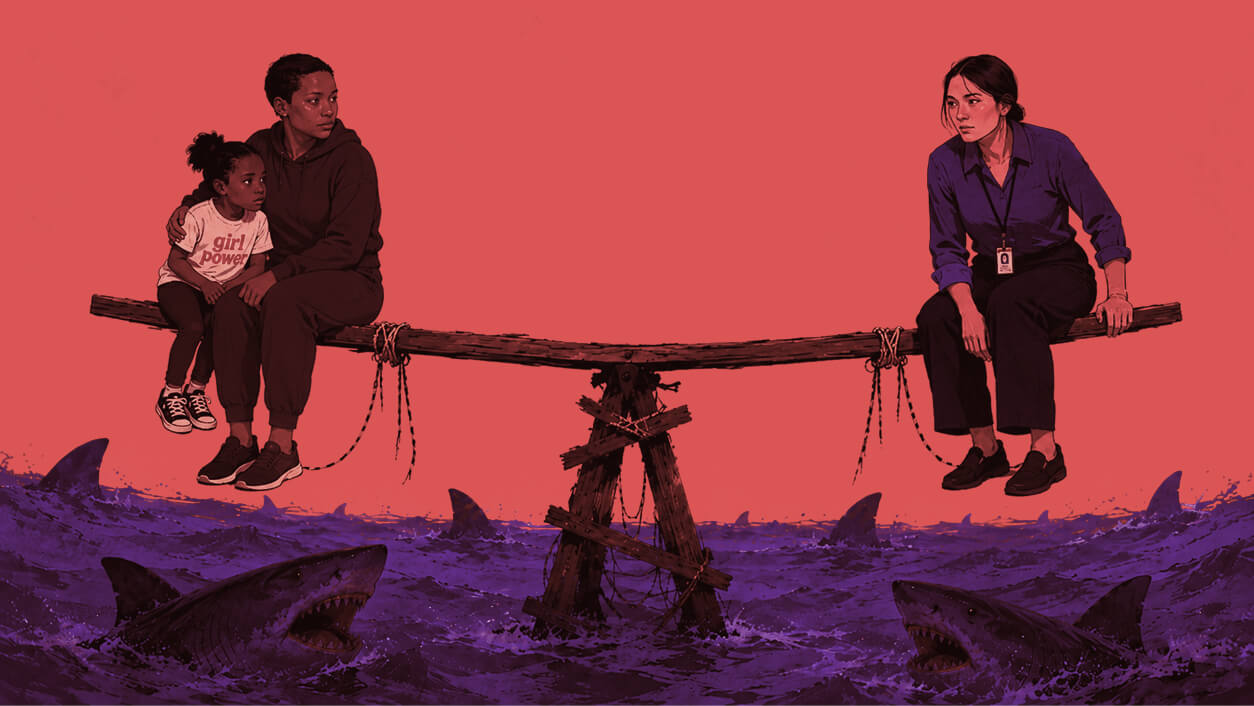
A motion passed unanimously in the PEI legislature this month, calling on the province to track student absences caused by bullying. Green MLA Karla Bernard brought it forward after years of families reporting that their children are staying home — and the system recording nothing about why. Education Minister Robin Croucher’s response is a masterclass in the institutional manoeuvre that keeps school exclusion invisible across every province in this country: he supports the idea “in principle” but cannot support it “in practice.”
The motion asks for one thing — a dropdown option in the attendance system that says “bullying.” That’s it. A single field in PowerSchool. The kind of change a database administrator could implement in an afternoon.
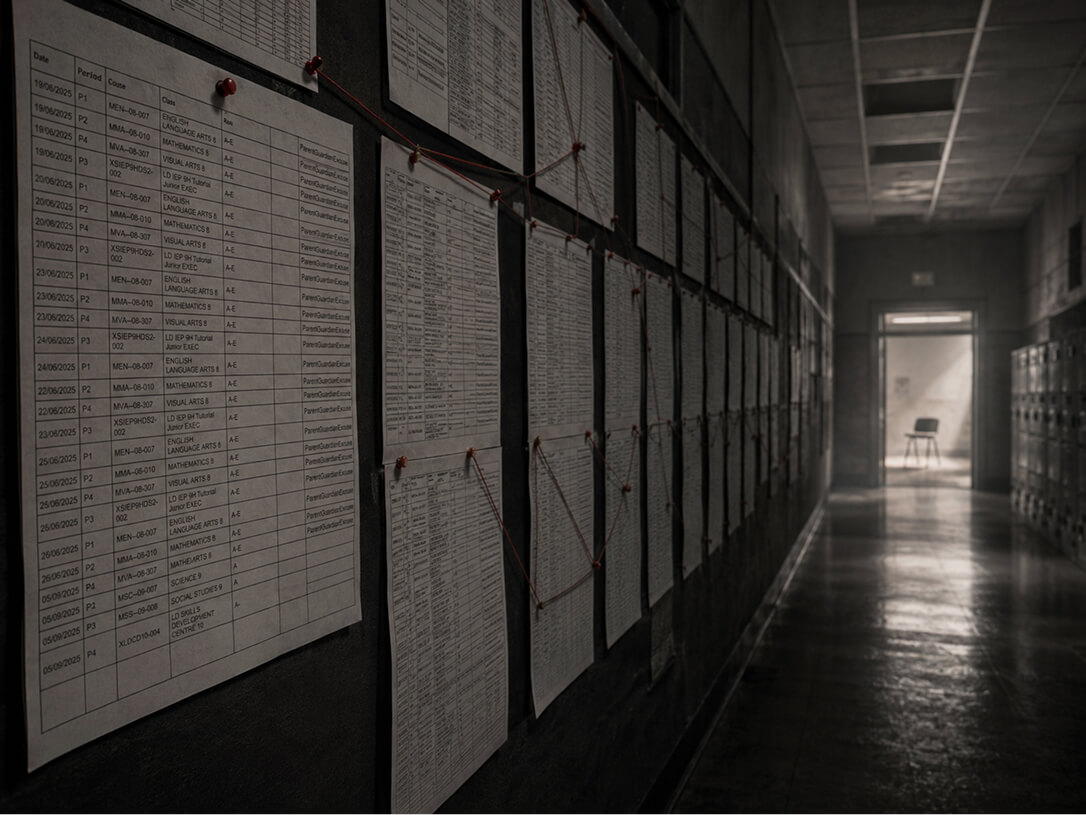
Croucher’s objection is that this is “too broad.” He wants to know what type of bullying. He wants specificity, granularity, root causes identified at the point of data entry. This sounds rigorous; it is the opposite. The current system codes every absence as excused, unexcused, or illness — three categories that flatten every possible reason a child might not be in school into a bureaucratic nothing. A child kept home because her classmates beat her at recess and the school did nothing is marked “excused.” A child whose parents pulled him out after months of daily harassment is “unexcused.” The system captures literally zero causal information, and the minister’s position is that the first step toward capturing any is too imprecise to bother with.
This is not a disagreement about methodology. This is a strategy.
The counter-proposal tells you everything
Croucher’s alternative is individual case tracking through PowerSchool — staff building files for each student, one at a time, documenting their specific circumstances. On the surface this sounds more thorough than a dropdown. In practice it guarantees three things: the tracking will never scale beyond a handful of cases per school; the data will never be aggregable into a provincial picture; and the records will sit buried in individual student files where no parent, researcher, or journalist can ever access them through freedom of information.
A dropdown produces queryable, aggregate, comparable data. It can be pulled across schools, across districts, across years. It can tell you whether bullying-related absence is rising or falling, whether certain schools have patterns, whether interventions are working. A minister who wanted to understand the scope of the problem would want exactly that kind of data. A minister who wanted to appear to address the problem while ensuring no systemic picture ever becomes legible would want exactly what Croucher is proposing.
The PEI COMPASS survey already tells us that 31% of students in grades 7–12 report being bullied — nearly double the national average of 19%. The province knows the problem is severe. What it does not have, and what Croucher’s approach ensures it will never have, is data connecting that severity to measurable outcomes like attendance. Without that link, every discussion about bullying remains anecdotal, dismissable, and politically manageable.
We’ve seen this before
In British Columbia, an advocate got student absence data disaggregated by inclusive education designation, through a Freedom of Information (FOI) request. What I found reviewing that data was that students designated with behaviour-related needs account for 43% of all suspension-coded absences province-wide, despite comprising a small fraction of the student population. The data revealed a system that was systematically pushing disabled students out of schools and calling it something else — or calling it nothing at all, because the absence codes were designed not to capture it.
PEI’s situation is structurally identical. The province is not failing to track bullying-related absences because it lacks the technology; PowerSchool can accommodate a new field. It is not failing because the problem is too complex to categorise; “bullying” as a starting category is infinitely more informative than “excused.” The province is failing to track because the absence of data is useful. It allows the minister to point to awareness campaigns and codes of conduct and Anti-Bullying Day — performative responses that require no measurement and produce no accountability.
Karla Bernard is right that a dropdown is a starting point. The minister is treating “starting point” as a disqualification, demanding a comprehensive solution before permitting a first step. This is how data suppression works in education: not through active concealment but through the perpetual deferral of collection, always in the name of needing something better, something more specific, something not yet ready.
-

BC schools are failing disabled students: an absence analysis
This analysis is based on a provincial FOI request to the BC Ministry of Education, file ECC-2025-52461, which was shared recently, bc BCEdAccess. The data covers absence rates, absence reasons, enrolment, and mid-year exits for BC public school students, broken down by inclusive education designation, across the 2022/23 and 2023/24 school…
What PEI advocates can do right now
You do not need to wait for the minister to act. PEI’s Freedom of Information and Protection of Privacy Act gives you the right to request records held by public bodies, including the Department of Education.
File an FOI request asking for student absence data disaggregated by inclusive education designation.
Here is what to ask for:
All records showing student absence rates (including but not limited to excused absences, unexcused absences, and suspension-related absences) for the 2023–2024 and 2024–2025 school years, disaggregated by inclusive education designation category, for each school and each school district in Prince Edward Island.
If the province collects this data, the request will surface it. If the province does not collect it — and refuses your request on that basis — you will have documented proof that PEI’s education system operates without knowing whether its most vulnerable students are actually attending school. That refusal is itself a finding, and it is powerful.
Send your request to the Department of Education’s FOIPP coordinator. You can find the access to information request process on the PEI government website. T
If you are a parent, a teacher, a school board member, or anyone who has watched a child disappear from a classroom and seen the system record nothing — this is how you make the invisible visible. Data does not fix systems on its own, but systems cannot be fixed while they are permitted to not know.
-

Calling the exclusion line
Every morning, when we dial the school’s sick line, we enact a ritual that ought to acknowledge more than a fever or a stomach ache. In theory, this system exists to safeguard children who cannot attend school due to illness. In practice, it masks the institutional harms that shape our…