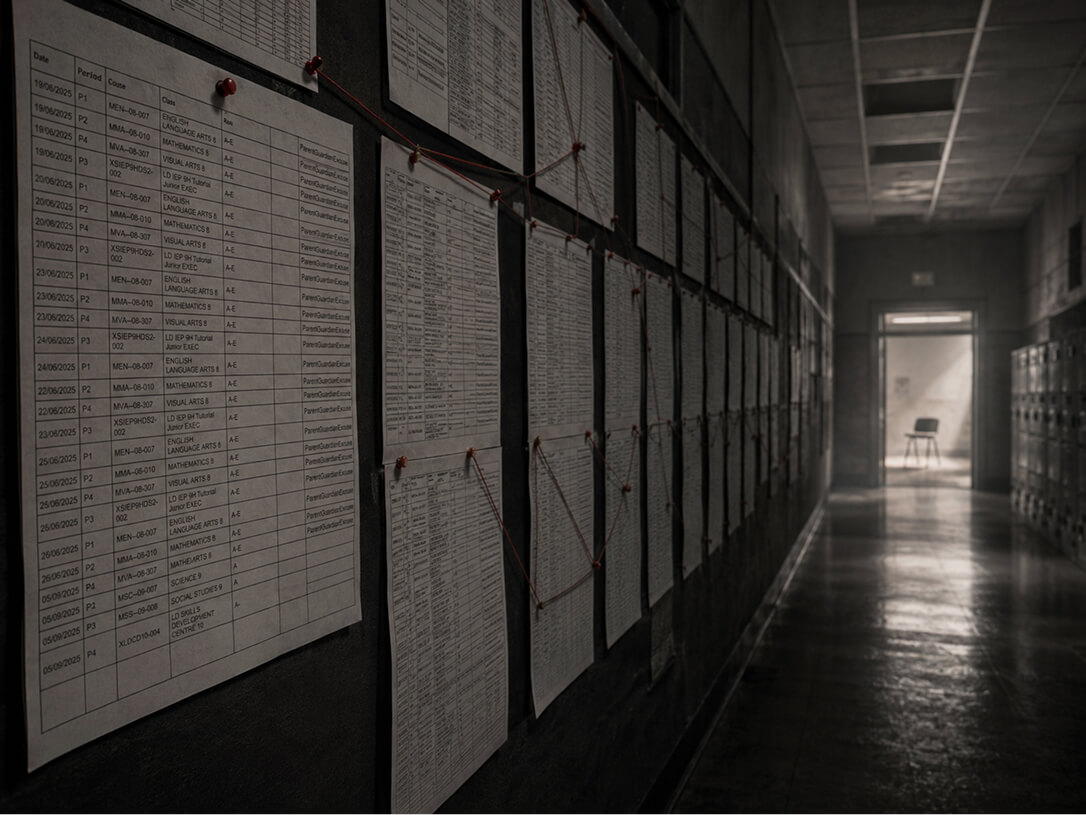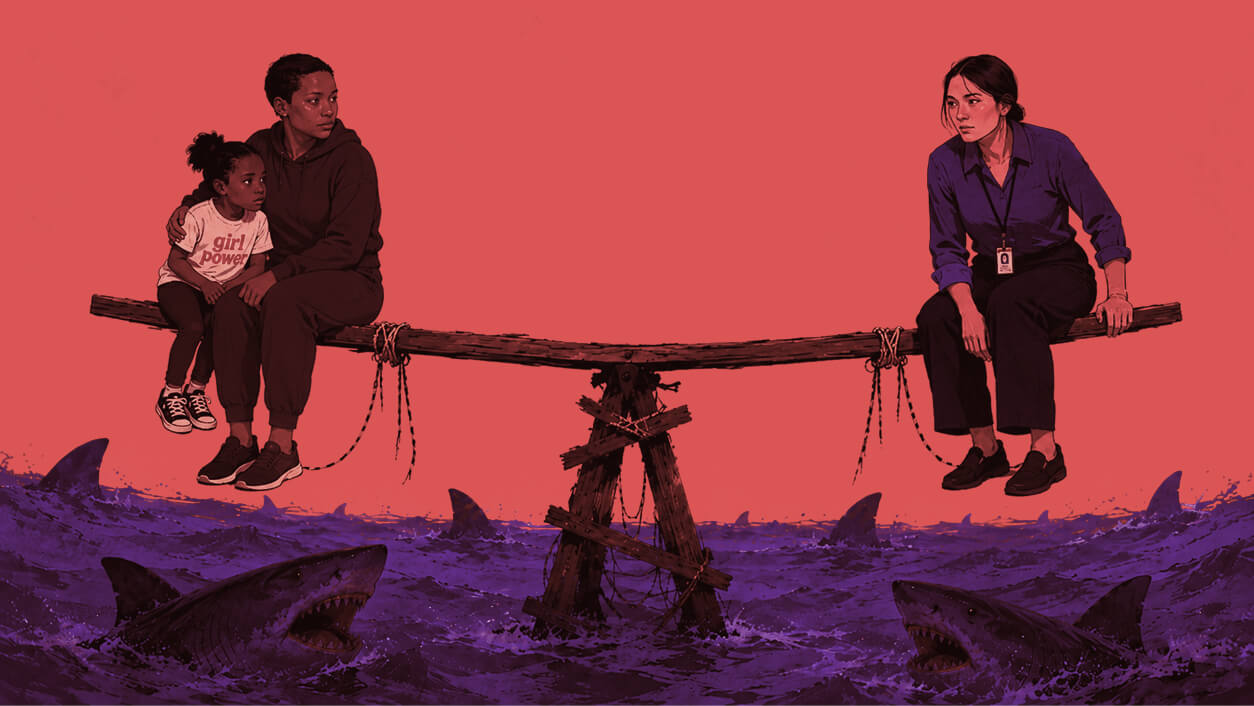
Exclusion takes many forms in BC schools, operating through formal disciplinary systems and through subtler mechanisms that distance disabled students from full educational access. The most visible exclusions carry names and documentation; the most pervasive forms operate beneath policy language, unmarked and untracked, shaping the daily reality of neurodivergent children who find themselves increasingly separated from their peers, their curriculum, and the conditions that make learning possible.
Room clears
Room clears involve removing all children from a classroom except the distressed child, isolating the struggling disabled student alone with adults who document their behaviour as a safety threat requiring quarantine from peers. The practice appears in school records as crisis intervention, framed through language of de-escalation and safety planning, yet the mechanism inverts collective punishment by marking the individual autistic child as the source of danger rather than recognising their distress as a response to environmental failure. Districts report room clears as minutes of educational access maintained; families experience them as profound social exclusion that teaches the child they are too broken for ordinary proximity, too dangerous for the company of other children.
Partial schedules
Partial schedules, sometimes called return to gradual entry, reduce the hours a disabled child attends school, often to a few hours daily or several days weekly, positioned administratively as temporary accommodation while resources are secured or plans are developed. The temporary arrangement extends across months and years, becoming the child’s permanent educational reality while the district continues to receive full per-student funding and the family struggles to maintain employment, cobble together childcare, and manage the material consequences of a school system that has decided their child’s presence is negotiable.
The practice appears nowhere in the BC School Act, which guarantees education to all children; it appears everywhere in the lived experience of autistic families whose children have been quietly removed from the system’s obligation.
Suspension and expulsion
Formal suspensions remove disabled children from school through documented disciplinary processes that frame autistic behaviours—stimming, distress vocalisations, shutdown responses to sensory overwhelm—as misconduct warranting exclusion. The BC Ministry of Education instructs districts to report suspensions and expulsions; many districts report low exclusions while families describe repeated removals, phone calls demanding immediate pickup, and informal arrangements that keep their children home without generating the documentation that would reveal systemic patterns. Expulsion remains the rarest and most visible form of exclusion, typically emerging after sustained periods of partial attendance, repeated suspensions, and accommodation refusals that construct the disabled child as incompatible with public education.
Accommodation refusal
Schools systematically refuse to implement IEP accommodations, determining that sensory supports, communication tools, alternative seating, or modified expectations are too disruptive, too expensive, or unnecessary based on the district’s assessment that the child can mask their distress sufficiently to approximate neurotypical performance. The refusal operates through delay—requesting further assessment, developing plans that never materialise into action—and through outright denial that reframes the family’s request as unreasonable, uninformed, or contrary to evidence-based practice. Children without accommodations experience daily harm; families advocating for legally protected supports find themselves positioned as demanding parents whose requests threaten the functioning of the broader system.
Peer alienation and social pariah status
Disabled children become pariahs among their classmates through institutional failures that position their basic needs as excessive demands on shared classroom resources, their distress as dangerous disruption, and their difference as something other children must tolerate rather than understand as ordinary human variation.
Adults refuse to teach neurotypical students that multiple ways of being exist and all of them belong in the classroom, declining to cultivate the social conditions that would allow disabled children to participate without becoming objects of fear, resentment, or fascination.
Schools withhold the accommodations that would prevent a child from entering fight-or-flight states, then frame the resulting meltdowns as evidence of the child’s inability to function among peers, creating a cycle where unmet needs produce crisis responses that generate peer rejection that intensifies the child’s distress.
The logic operates through manufactured scarcity—treating one child’s sensory supports or movement breaks as resources stolen from other children, teaching the classroom that disability accommodations diminish what is available to everyone else rather than recognising that environmental accessibility serves the collective.
Neurotypical children learn to see their disabled classmate as the reason the class is disrupted, the reason transitions take longer, the reason the teacher seems frustrated, and the disabled child internalises their status as the problem the classroom cannot solve.
The alienation deepens when meltdowns escalate to the point where the disabled child inadvertently harms peers, moments that could be prevented through proper accommodation but instead become proof in the eyes of other children and their parents that the disabled student is genuinely dangerous, genuinely other, genuinely incompatible with the shared social world of childhood.
Educational neglect and curriculum denial
Schools provide disabled children with modified programming that reduces or eliminates access to grade-level curriculum, substituting functional life skills, social and emotional learning (code for neuro-normative masking), behaviour management goals, or simplified academic content that ensures the child will never catch up to age-appropriate expectations.
The practice appears in IEP goals that prioritise compliance over learning, in decisions to deprioritise academic learning goals, and in tracking systems that funnel neurodivergent students toward diluted educational pathways while framing the diminished instruction as appropriate to the child’s abilities. Districts describe these decisions as individualised planning; families watch their children’s intellectual development constrained by institutional determinations that disabled children need less, can handle less, deserve less than the education guaranteed to their neurotypical peers.
Informal removal and constructive exclusion
Schools pressure families to keep their children home through repeated phone calls about behavioural incidents, suggestions that the child is not ready for full-time attendance, and descriptions of school as a dangerous or inappropriate environment for the student’s current functioning.
The pressure operates without formal documentation, leaving families in an impossible position where they must choose between sending their child to a system actively communicating that the child is unwelcome or accepting de facto homeschooling without the district’s acknowledgement that exclusion has occurred. The practice allows districts to reduce the presence of disabled students while maintaining official enrolment, preserving funding streams while eliminating the obligation to actually educate the child whose name remains on their roster.
-
Why I’m reviewing school codes of conduct
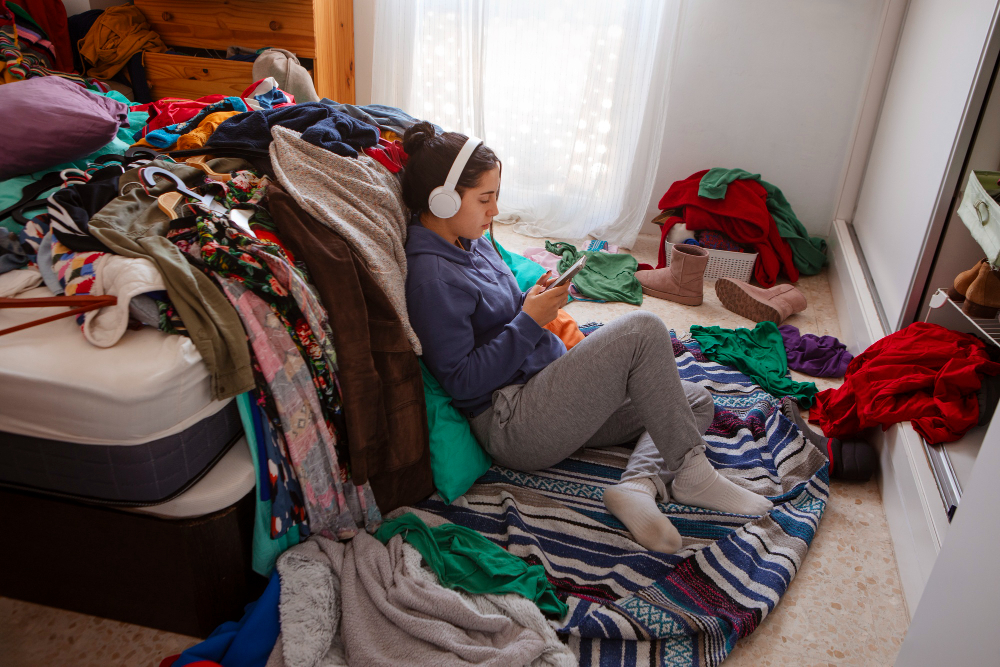
To the student who found this page because you typed something scared or confused or angry into a search bar—something like “are teachers allowed to take away recess?” or “can I be suspended for a meltdown?” or “why did my teacher say I wasn’t trying hard enough when I couldn’t…
Restraint and seclusion
Physical restraints and seclusion represent the most extreme forms of exclusion still practiced in BC schools, mechanisms that respond to distress by isolating children in separate spaces or restricting their movement through adult force justified as safety intervention. The practices appear in safety plans that authorise staff to remove children from educational spaces when behaviour escalates, framing confinement and physical control as necessary supports rather than recognising them as punitive responses to disability. Districts report these incidents inconsistently or not at all; families discover their children have been repeatedly restrained or secluded only through their child’s trauma responses, through accidental disclosure, or through FOI requests that reveal documentation the school never shared.
The cumulative architecture of exclusion
These mechanisms rarely operate in isolation. Disabled children experience partial schedules combined with room clears, accommodation refusals that precipitate behavioural crises leading to suspension, social exclusion that compounds educational neglect until the child’s presence in school feels impossible to everyone except the family insisting their child has a right to be there. The exclusions build upon each other, creating conditions where the child’s distress intensifies, the school’s narrative of incompatibility solidifies, and the family finds itself advocating against an institutional consensus that their child simply cannot be educated in the public system that exists to serve all children.
-
Safety plans, billion-dollar scripts, and the harm they keep in place
When a parent hears the words safety plan, there is often a breath held in the chest — a brief hope that the school has recognised the reality of the child’s distress, that they have stepped back to consider what would truly help, that they are inviting the parent to build…