Institutional capture refers to the process by which individuals — parents, children, advocates, even dissenting professionals — are absorbed into the operational logic of an institution to the point where they begin reproducing its framework, its language, and its priorities, without necessarily endorsing them or recognising what is happening.
It is distinct from agreement. You do not have to believe the institution is right to be captured by it. You only have to depend on it for information, for access, for the continuation of a relationship you cannot afford to lose. The capture happens through the ordinary mechanisms of participation: attending the meetings, reading the reports, using the forms, speaking the language back in order to be understood. Each act of participation is also an act of normalisation.
In the school context, institutional capture describes what happens when a parent starts tracking good days and bad days in the school’s terms; when a child starts identifying their own distress as a regulation problem; when the question are you being bullied or do you need help regulating feels like a reasonable binary rather than a loaded one. The framework does not require your consent. It requires only your presence inside it long enough for its categories to become the categories available to you.
Content note: This essay contains detailed documentation of a disabled child’s exclusion from school, institutional language applied to a six-year-old’s distress, and an account of maternal complicity in systems that caused harm. It also contains a parent’s account of her own late autism identification and the ways unrecognised neurodivergence shaped her participation in those systems. If you are currently navigating a school system with a disabled child, this piece may be difficult to read.
The sentence I said was ordinary. I was dropping them off — Robin, Jean, small and resistant in the back seat — and they didn’t want to go, and I said:
I have to work.
Which was true. Which has always been true. Which is the sentence the economic structure of single parenthood makes available to you on a Tuesday morning when you are already late and the children are already crying and there is no other sentence that will close the distance between the car and the door.
I wish I hadn’t said it. I wince now, when I think about it. I wasn’t wrong, but I didn’t know how that sentence would land on my children.
Because Robin received it with the precision that autistic children receive language — whole, literal, without the neurotypical subtext that might have cushioned it. What he heard was not:
I love you and I’m sorry and I wish the world were arranged differently.
What he heard was:
How you feel doesn’t matter. This must happen, no matter how much it hurts.
He heard an ultimatum. He was right to hear it that way. That is what I said.
Significant progress
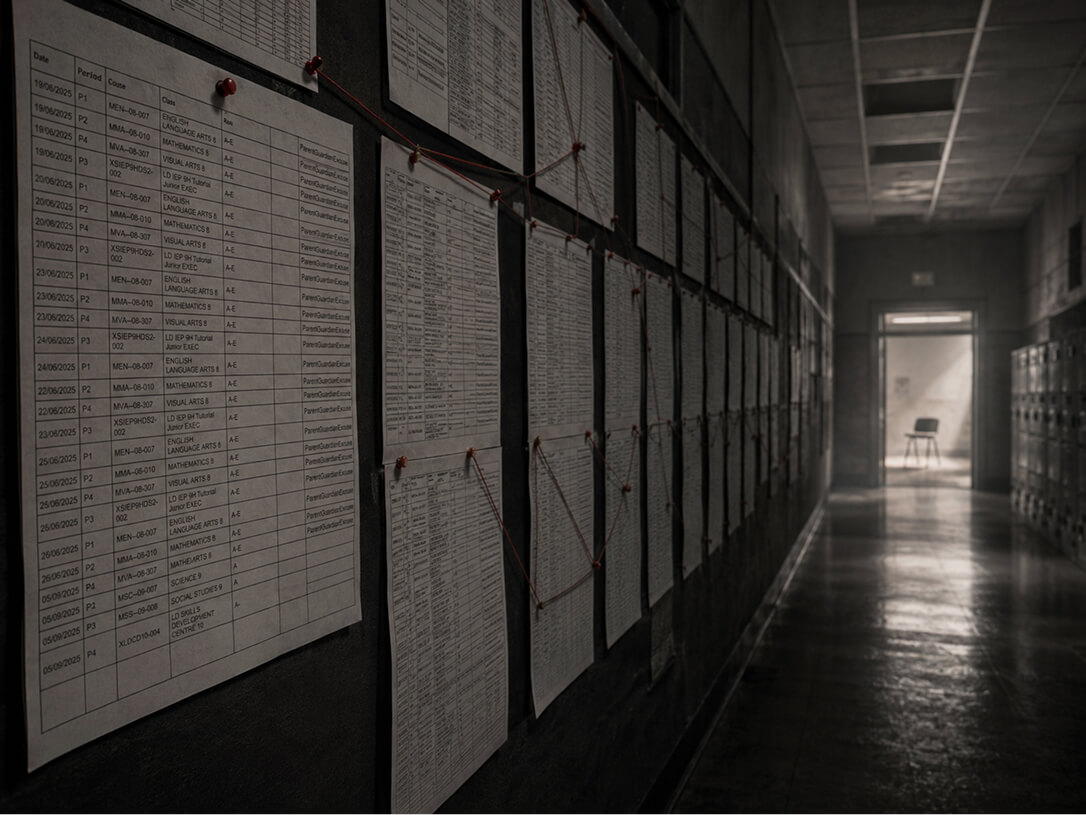
Robin started Kindergarten in September 2017. Within his first month, the school had requested a Behaviour Strategies Consultant to observe him. By October, a Short Term Intensive Behaviour Support worker had been assigned. By November, a dedicated SSA was working alongside him for at least half of every day. By early November, an Integrated Case Management meeting had been held, an IEP created, a MIST referral submitted. The principal’s letter to me that December listed fourteen separate interventions the school and district had undertaken in Robin’s first term.
The letter also said:
R has made significant progress.
Every one of those fourteen interventions was directed at Robin. Not one was directed at the environment producing the behaviour the interventions were designed to manage.
-

Wait and see: a mother’s warning
Before kindergarten began, we told them—unequivocally, painstakingly, with as much specificity as we could muster—that our son had been harmed in daycare, that he had a long line of diagnoses and was awaiting an autism assessment, that his nervous system was thrashed, and…
Possible solutions
Late in January, 2018, four weeks after the letter describing significant progress, the school convened a meeting. In the room: the principal, the resource teacher, a District Principal, a Behaviour Consultant, two MIST representatives, and both of Robin’s parents. The minutes recorded his strengths — artistic, likes music, documentaries, reading — and then moved to possible solutions for his ongoing difficulties.
The list read:
- Modified Day
- Alternative location
- Pick-up at 10:40
- At home instruction (can be applied for)
- Alderwood Program (can be applied for)
- Excel Program (can be applied for)
Six solutions. Every one a removal option. The meeting notes also recorded, in the same breath, that the team had observed Robin being overstimulated. They saw the overstimulation. They listed it as a finding. And then they generated six variations on: less of him, or none of him. The environment — the hallways, the thirty other children, the schedule, the staff changes the notes themselves identified as a trigger — stayed exactly as it was. The variable the institution proposed to adjust was Robin.
He was six years old. The formal autism diagnosis was still a week away.
So in many respects
The diagnosis arrived on at the end of January. By the following week — while managing a co-parent sick with flu, a work obligation, and a two-day-old piece of information that reframed her son’s entire life — I had typed up eight strategies from the assessing psychologist and emailed them to the school.
The psychologist’s language was careful and specific. Children with a demand avoidant profile, she wrote,
tend to respond better to a personal and relationship-based approach as opposed to a more traditional behaviour approach.
She recommended indirect language, minimal demands, following Robin’s lead, recognising “can’t help it” days when it would be unlikely to be productive to pursue any demands.
I closed my email:
So in many respects, we’ve all been doing the right things.
I was doing the emotional labour of the partnership. I was keeping everyone on side. I was being generous at the precise moment I had the most grounds not to be.
The principal replied the same morning.
Thanks for the update. Any information we receive will help us in supporting R.
And then: the SSA would not be at school the following day. There would be a substitute.
If you feel that this will be too difficult for R and that it would be better for R to stay home please let the school know.
The day after receiving eight strategies organised around relationship, consistency, and trust — the school’s operational response was to flag a staffing gap and offer exclusion as the solution. The strategies required a known adult, a familiar relationship, a predictable environment. The school’s answer was: unknown adult, unfamiliar, and perhaps don’t come.

When feeling regulated
The IEP, completed February, 2018, recorded Robin’s strengths with the warmth the form allowed:
verbose and articulate. Passionate and knowledgeable about special interests. Active. Curious. Very crafty and artsy.
Then it turned.
Although many of R’s triggers are known, reactions and their severity can be unpredictable.
Sit with that sentence. The triggers are known. The reactions are unpredictable. Those two clauses cannot logically coexist — if you know the causes, the effects are not surprising — and yet the IEP holds them together without noticing, because the framework requires it. To call the reactions predictable would be to follow the chain of causation back to its source, and its source is the environment, and the environment is not the subject of this document. The child is. Unpredictable locates the aberration in Robin and stops the analysis there.
The strengths section had said:
when feeling regulated, R is verbally very strong.
When feeling regulated. His articulateness is conditional. His curiosity is conditional. His personhood, in the language of the IEP, is accessible only in the compliant state; the rest is a list of concerning behaviours toward adults, peers, and inanimate objects. The chair he knocked over appears as evidence alongside the people he hurt, because in the framework of behaviour tracking, the chair and the people are equivalent data points. What the data points indicate, about a child in an overstimulating environment surrounded by known triggers, is not the subject of inquiry.
Priority goal:
self-regulate.
Not:
- reduce the stimulation.
- investigate the triggers whose existence the document itself acknowledges.
- examine why a verbal, curious six-year-old is not engaging in classroom activities regardless of whether they are preferred or non-preferred — which is the sentence of a child who has already, in his first five months of school, concluded that the environment is not for him.
The priority is that he manage himself better inside the place that is producing the behaviour being managed.
The second one
By 2021, Robin was in elementary school and fluent in the language the school had been teaching him since Kindergarten.
I know this because I have the transcript.
We were talking through a difficult stretch — kids who had hurt him, incidents that had escalated, a pattern of him arriving home depleted and swearing and then going quiet. I was trying to understand what was happening on the playground. He described K swinging a jump rope attachment near his face; he had told K to stop, K told him to go away, and Robin bit him. He described another boy kicking a soccer ball into his stomach, twice now, starting to feel like it’s on purpose. He described a girl poking him with a stick, running into him deliberately, calling him gay.
And then I asked him:
Do you feel like you’re being bullied at school, or more like you need help regulating and figuring out how to handle some of the things that are happening?
He chose the second one.
I was offering him the institutional binary, the same one the school had been offering him since he was six — your distress, or your regulation — and he had absorbed it so thoroughly that he chose regulation. His reactions were the problem he identified, not the boy swinging something at his face. I asked him whether he regretted biting the people who had hurt him, and he said:
I mean, they do deserve it. But I regret, yeah.
He held both truths at once — the accuracy of his read, and the shame of his response — and chose the shame as the actionable item. Because the shame was the thing the framework had trained him to act on.
Mom: If you had a choice, would you prefer not to have these big reactions?
Robin: Yeah. Then I wouldn’t feel so bad.
He wanted to stop because of how bad he felt afterward. That is the mechanism the school system runs on. The behaviour doesn’t need to be examined; the child just needs to feel bad enough about it that he works to suppress it. And he had learned, with thoroughness and precision, exactly what he was supposed to feel.
Jean was there too. I asked her what she had seen.
He was just minding his business. And they come over.
Her testimony corroborated everything Robin had said.
The greenhouse flower
I was doing it too. That’s the part I carry.
I read those logs. I felt the relief on the good days —
Robin was regulated, Robin showed pride, Robin had a great morning
— and the dread when the language shifted.
I was recruited by the rubric without knowing I was being recruited, the way a framework recruits everyone who depends on it for information. I offered my son.
Just a parent
I feel sick writing this.
I wrote
so in many respects, we’ve all been doing the right things
to a principal who had just listed removal programs as the solution to a six-year-old’s distress.
There is a story told about children like Robin, and it is told about their mothers. It goes: the child could not tolerate the environment because the mother made them fragile. She sheltered them — a greenhouse flower — soft and unprepared for fluorescent lights and institutional schedules and the ordinary abrasions of collective life. She withheld her trust from the school, and so the children learned distrust, and the distrust became the variable, the cause, the explanation that required no further examination of the environment.

This story is structurally convenient. If maternal distrust is the contagion, the institution is exonerated. The overstimulation the school observed and documented and responded to with removal programs is exonerated. The known triggers are exonerated. The Student Support Assistant who wasn’t there tomorrow, the staff change listed as an antecedent in the meeting minutes, the fourteen interventions all directed at the child and none at the conditions — all exonerated.
But here is what the story requires you not to know: I was doing it too. Going to the terrible places — the fluorescent-lit offices, the open-plan workspaces, the meetings in rooms built for thirty — over and over, filing my own distress under that’s life, because I had spent four decades in a world not built for my nervous system and learned, thoroughly, to treat my own discomfort as a calibration error rather than data.
I was not sheltering my children from difficulty. I was modelling the suppression of accurate self-knowledge so fluently that I didn’t always know I was doing it.
I didn’t make them fragile. I accidentally taught them what I had been taught: that the signal is yours to manage, and the world will not be adjusting.
As the truth
Robin did not fail seventh grade. Seventh grade is where the accounting came due — where the accumulated residue of years of signals received and filed as non-urgent, of triggers known and reactions called unpredictable, of removal programs listed as solutions and regulatory compliance listed as a priority goal, finally produced a number he could not argue with. He came home and did not go back. And what I understood, slowly and then all at once, was that he did not experience this as relief.
He experienced it as confirmation.
The school had been keeping score since Kindergarten — good days and unexpected days, regulated and unregulated, logged and tracked and sent home — and he had been keeping score too, a private parallel accounting, in the language they had given him. And when the accounting was done, the language told him what it had always been designed to tell him: that the variable was him, that the environment was neutral, that the reactions were unpredictable, and that the priority — the single, stated, formalised priority — was that he regulate himself.
He had learned it well. He had learned it the way autistic children learn things: completely, literally, without the neurotypical capacity to half-believe something, to hold institutional judgement at a slight ironic distance, to know the rubric is wrong and perform it anyway. He believed it because the language was consistent and the language was everywhere and no one around him — not the school, and not always me — had given him a counter-language fluent enough to displace it.
The sentence in the car said:
how you feel doesn’t matter.
The IEP said:
your reactions are unpredictable.
The removal meeting said: the variable we will adjust is you.
Today, Robin had unexpected behaviour.
And Robin, who receives language whole and literal and without the cushioning of subtext, heard all of it the same way he heard me in the car on a Tuesday morning when I was already late and there was no other sentence available: as the truth.
-

What 8 years of advocacy took from our family
I advocate because I love my children and I want them to be well. Because I know the accommodations they require are entirely tenable, requiring only modest shifts in how adults think and respond. Because it is unbearable to watch them be slowly…