Children do not match the institutional fantasy of the perfect witness. Schools expect crisp chronology, tidy sequencing, and emotion-free narration. What children offer is perception—sharp, immediate, and grounded in the sensory truth of what happened. I learned this when my daughter was still in elementary school, when a playground supervisor grabbed her arm, twisted it behind her back, and called her “deaf” as if disability were an insult. I cannot recite the exact order of each moment without checking my notes, yet I know the core truth with absolute clarity: the slur was used, the arm was twisted, and my daughter was hurt.
When I reported it, the principal seemed inconvenienced. The tone was weary, dismissive, the kind of response that signals a preference for keeping peace rather than naming harm. Only when I pushed did an investigation begin, and even then it unfolded along institutional lines rather than ethical ones: my daughter was questioned by HR in the presence of the principal and the matter quietly closed. I learned this months later, as if the dismissal should have been self‑evident when the same individual was trying to interact with my daughter. No one notified me that they had decided it was OK that she twisted my daughter’s arm or used deaf as an insult.
What became plain to me is that institutions look for coherence, not perception. They expect a child to sound like a credible adult. They treat sensory detail as unreliability and blunt honesty as instability. Yet my daughter told the truth in the way children tell truth—through the emotional charge of the moment, through the feeling of the hand on her wrist, through the shock of being insulted by an adult responsible for her safety.
The principal framed the outcome of the investigation as a clean conclusion, describing an absence of any finding under the code of conduct and presenting the matter as complete, with no further steps on their side.
For me, the incident hadn’t concluded and I made the school aware that this person was never to approach or care for my child again. What followed became its own indictment of the system, because I raised many separate complaints about subsequent approaches this person made toward my child—approaches that occurred after assurances of boundaries and after the school had communicated its expectations—and each approach unfolded without consequence, revealing a pattern of institutional passivity that left my daughter exposed to repeated harm.
The institution simply chose to protect itself instead of my daughter.
-

She graduated and this is what she learned
On raising a badass advocate, unintentionally. I didn’t set out to raise an advocate—I set out to raise a child. A child who might feel safe in her body and steady in her breath, who might look out at the world and feel…
When testimony collides with institutional loyalty
The next time my daughter was called to give witness, the institutional stakes intensified, because the adult in question was no longer a playground supervisor but a long-time teacher whose reputation hovered in the room like an additional participant. He had breached her privacy. By the time we sat before HR, and I watch her testimony I already began to wonder how she would be perceived. She swore, forgot the order of the incident, and admitted she had never liked him. I watched the HR representative’s face shift, watched the calculation flicker—the question was no longer what he had done, but whether the institution could justify harming the career of a seasoned educator based on the recollection of a child who appeared blunt, emotional, and insufficiently deferential. His authority filled the room even in his absence, and her honesty could be recast as volatility. Do institutions expect children to behave like adults, when they are witnesses? Do adults even behave the way institutions would treat as credible? What they received was a child describing the world exactly as she experienced it, and that should be enough.
The distorting authority of recorded evidence
A scratchy recording exists, the kind that requires listeners to lean forward, parsing consonants through static, straining to retrieve meaning from noise, and it performs the contradictory work institutional evidence so often performs: it corroborates her account while simultaneously softening his. It confirms the substance—what he said, how he approached her, how he framed the breach—yet his tone carries a kind of paternal joviality that flatters the narrative of good intentions. If you listen only to the his voice, you find yourself pulled toward a reading in which his method was clumsy but his intentions benign, because tone becomes its own form of testimony. The cognitive trap is that the effort required to decode the audio distracts you from the context: that she was newly returned to school after prolonged absence, that staff had been told she was exceptionally vulnerable, that he either did not receive or did not heed this information, and that he chose that moment—her first precarious day back—to take her aside and humiliate her within earshot of other students. The recording proves she told the truth. What it obscures, through its static and its tonal lure, is that he wielded authority in a way that violated her dignity and that the institution preferred the adult’s self-presentation to the child’s lived experience.
Parental perception, adolescent privacy, and patterned truthfulness
A few weeks ago my daughter asked me to play a TikTok game—put a finger down—where children rapid‑fire questions at their parents about what they suspect their kids have been doing, and I felt the sudden freeze of needing to balance honesty, intuition, and her right to privacy in real time. If I only lowered a finger when absolutely certain, she might imagine I had no grasp of her world; if I lowered a finger too eagerly, she might feel watched rather than held. So I responded based on my sense of her patterns, on the accumulation of small signals, on the knowledge parents gather without requiring disclosure, and afterwards she told me I had been entirely correct—an affirmation that mattered precisely because she had no incentive to offer it unless it was true.
The game reminded me of something I have always known: that my observational understanding of my children forms a reliable map even when we do not speak every detail aloud. This is why I trust them when they recount harm. Institutions misinterpret my momentary pauses as doubt rather than discernment, not understanding that memory evolves each time it is retrieved and that children may blur sequence without blurring truth. My children’s accounts shift at the edges, as all accounts do, yet their relationship to truth remains startlingly consistent. Their honesty forms a continuous pattern—sometimes indignant, sometimes wounded, sometimes sharpened by dislike—but always grounded in the integrity of their perception.
Autistic truth-telling and the machinery of exclusion
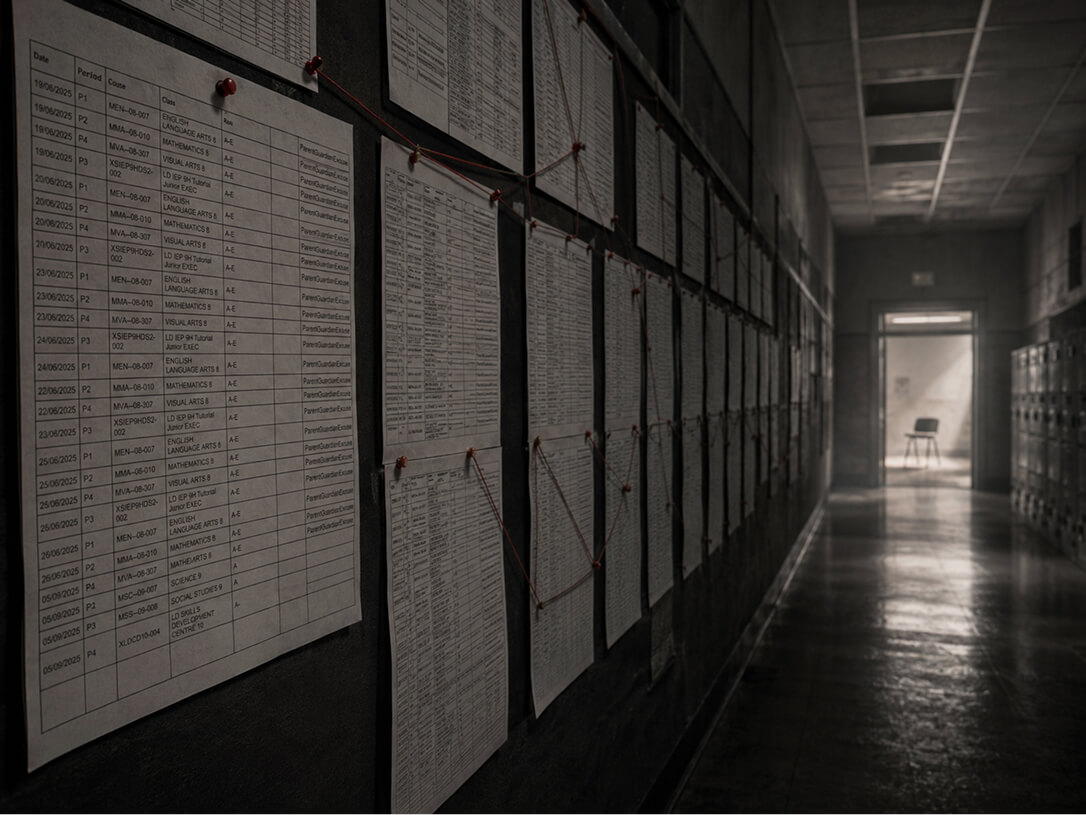
I think often about the role autistic truth‑telling plays in exclusion, because exclusion logs reveal the pattern with almost painful clarity: children are removed for “being rude to admin” or “swearing at adults supporting him,” phrases that reveal more about institutional discomfort than about student harm. Autistic children disrupt the choreography of submission that schools expect when authority is challenged; they name the hypocrisy, they correct the misstatements, they refuse the ritual of accepting punishment silently. Their honesty becomes the problem. A system built on adult infallibility interprets accuracy as insolence, clarity as disrespect, and emotional precision as defiance. The qualities that make autistic children reliable witnesses—directness, perceptiveness, refusal to soften the truth—become grounds for removal. What gets documented as non‑compliance is often the child’s refusal to lie. What gets framed as verbal aggression is often the child stating a fact the adult wishes to avoid. Exclusion becomes the institution’s method of managing truth: a way of removing the witness who threatens the illusion of fairness.
When classroom harm echoes earlier relational wounds
What deepens the complexity of the classroom incident is that the teacher’s tone carried a familiar emotional charge for her, because it echoed the patterns she associates with a family member: the paternalistic cadence, the condescension disguised as care, the performance of authority as though authority itself were a form of affection. Children respond not only to what is said in the moment but to the entire lineage of how similar tones have been used against them.
When he spoke to her in that familiar register, her body recognised the insult before her mind identified it. She felt the collapse of safety, the return of an old pattern, the sensation of being positioned as the object of an adult’s unresolved frustration. The institution sees only the reaction; they do not see the architecture of memory beneath it. Her response was not disproportionate. It was precise—a survival‑shaped recognition of a tone that once governed her sense of self.
The responsibility of schools to receive traumatised children with competence
Schools receive children whose histories shape every interaction—children who have experienced domestic upheaval, children who have crossed borders marked by conflict, children who have internalised the rhythms of hypervigilance, children who arrive with bodies trained by trauma and minds sharpened by survival, and children like mine who tell truth to power with a fierceness that unsettles adults accustomed to deference. A school must know how to hold these realities. It must recognise that trauma alters the meaning of tone, proximity, and power; that some children react sharply because condescension once signalled danger; that emotional intensity can be a form of integrity rather than volatility. Institutions that accept responsibility for children must be capable of receiving them as they are—not as theoretical students imagined in policy documents, but as actual young humans shaped by circumstance, history, and prior harm. The mandate is simple: avoid compounding existing wounds, create conditions for safety, and honour the truth a child offers even when that truth disrupts adult comfort.
Dismantling the grandfather trope in educational ethics
I want to dismantle the grandfather trope entirely—the myth of the benevolent paternalistic man whose genial tone is treated as proof of moral harmlessness, whose microaggressions are softened by nostalgia for an imagined past, and whose breaches of privacy are excused as generational quirks rather than ethical failures. Administrators rely on this trope because it protects them from confronting the fact that authority magnifies harm; it allows them to recast misconduct as charm, to reinterpret condescension as care, to treat paternalism as evidence of kindness rather than domination. Children deserve more. They deserve adults who understand that intention does not outweigh impact, that privacy is a boundary, that power requires accountability. A man who chooses to work with children accepts the ethical standards of the present, not the cultural norms of his youth, and no institution should shield harmful behaviour behind the sentimental mythology of age. Nostalgia has no place in the ethics of child protection.
Learning institutions must learn
A school is a learning institution, and learning must move in every direction; adults cannot treat themselves as exempt from the growth expected of the children they teach. The idea that students benefit from exposure to outdated or harmful behaviours—as though witnessing “dinosaur” conduct provides a useful lesson in resilience—is a fiction designed to protect adults from accountability. Children already understand power. They do not require additional instruction in enduring condescension. They require models of adults capable of self‑reflection, adjustment, and ethical growth. A school cannot treat fossilised behaviour as cultural heritage. It must cultivate spaces where adults evolve alongside students, recognising bias, revising practices, and understanding that safety arises from humility, not nostalgia.
Closing reflection
I keep circling around what these processes are meant to achieve, and I keep returning to the deeper question of epistemic justice, because these investigations do not simply evaluate events; they evaluate credibility itself. Children who are autistic, traumatised, perceptive, or emotionally intense are often granted a thinner measure of credibility than adults who occupy institutional power, and this imbalance shapes every interpretation before a single fact is weighed. I keep circling around what these processes are meant to achieve, because the HR investigation is presented as a pathway to clarity, a mechanism for accountability, a structure that should protect children as much as staff, yet the lived experience suggests something far more ambiguous. What happens when the truth a child offers does not align with the narrative the institution prefers? What happens when the entire process pivots on a question adults rarely articulate aloud: should the institution risk the career of a long‑serving professional on the testimony of a child whose memory is fluid, whose emotions are visible, whose honesty arrives in a form adults misinterpret as volatility?
What would justice look like if we recognised the testimonial injustice at the heart of these interactions—the way a child’s credibility is discounted before she speaks, the way trauma-shaped memory is treated as a liability rather than evidence of impact, the way autistic communication is misread through behavioural norms that privilege adult comfort? What would justice look like if we began with the child’s sensory truth rather than the adult’s professional standing? What would these investigations become if they recognised that inconsistency does not signal deceit, that emotional intensity is often the mark of accuracy, that trauma and perception often coexist in the same breath? How would our systems change if we treated a child’s testimony as data, not disruption—something to be understood rather than controlled?
And what does it mean for a school to claim the language of safety while participating in patterns that mirror broader institutional behaviour—the protection of hierarchy, the prioritisation of reputation, the reinterpretation of children’s truth as disorder rather than knowledge? And what does it mean for a school to claim the language of safety when its internal processes so often tilt toward self‑preservation? What would it require for an institution to examine not only the facts of an incident but the conditions that shape a child’s response—the relational echoes, the accumulated history of harm, the patterns that render certain tones unbearable? Could a process built around hierarchy ever hold the truth of a child who refuses deference?
I do not have answers, only a widening field of questions that press against the edges of institutional logic: questions about power, about whose memory is believed, about how systems decide which truths are legible and which are inconvenient; questions about whether any process rooted in hierarchy can adequately hold the testimony of a child who refuses the choreography of politeness that institutions mistake for credibility. I do not have answers. I am not sure the institution does either. Perhaps the better question is this: what kind of truth becomes legible inside a system that values coherence over perception, reputation over vulnerability, and loyalty over accountability—and what kind of truth is lost when a child is asked to fit her experience into a form the institution recognises before it can recognise her?