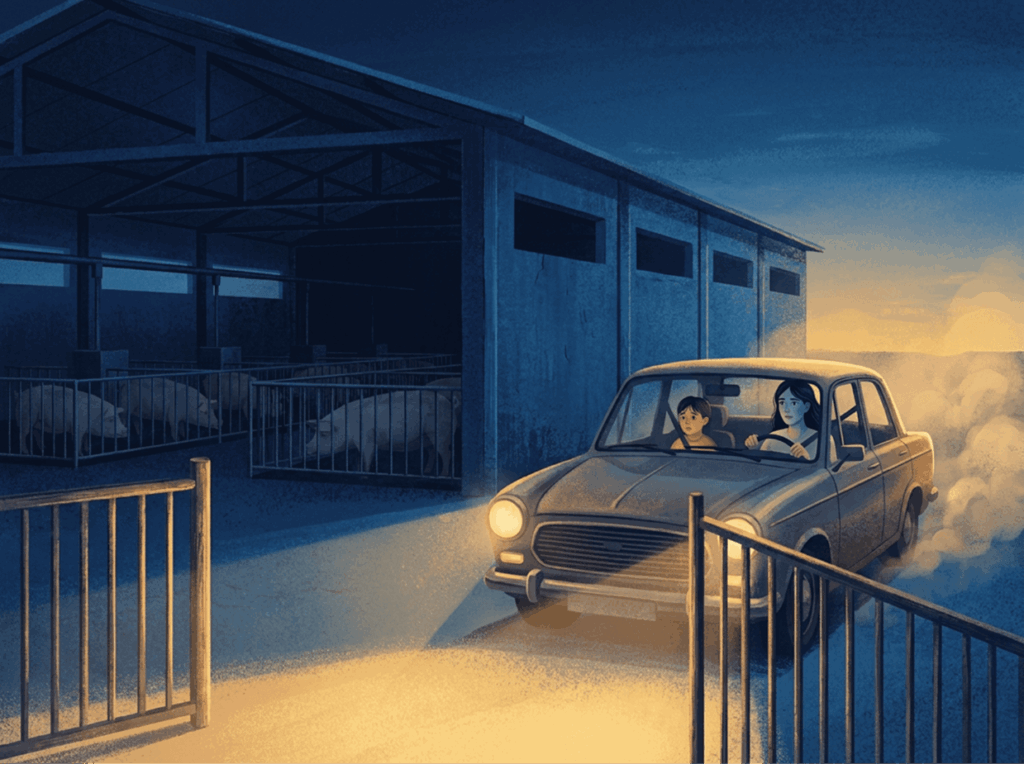
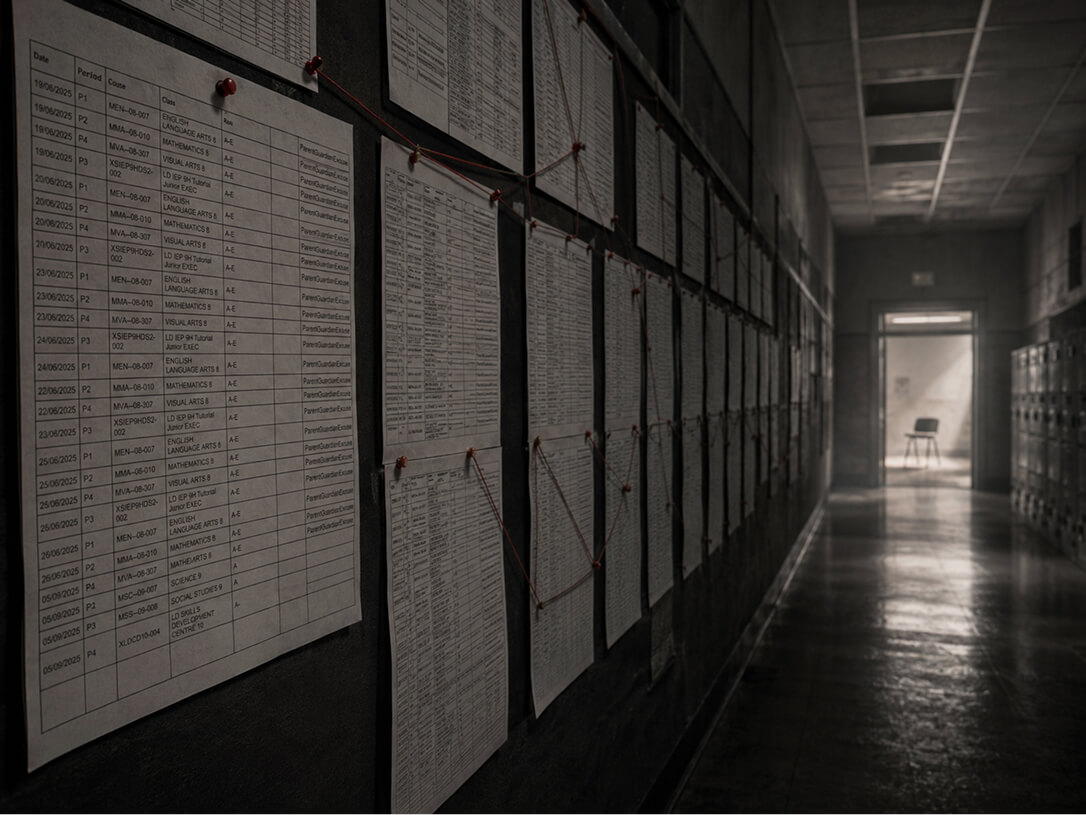
A version of you existed before all this, and she would have been horrified.
She would have watched you zip up that backpack, drive them to school, walk them to the door, and she would have known what you were doing: handing your child directly to the building that will hurt them today. Maybe the school will exclude them from a room. Maybe an adult will mock them in front of peers. Maybe staff will leave them alone in a hallway, or send them home at noon because the school has decided that their presence is contingent on a calm it has never once provided the conditions for. That version of you would have called someone. Filed something. Stood in the doorway and refused.
You did not refuse. You waved. And then you went home and fell apart: the wholly predictable response of a person so thoroughly processed by an institution designed to make falling apart feel like a personal failing rather than a political response.
The lowered bar
At some point, and you may struggle to name when, you stopped expecting the school to be good and started expecting it to be survivable. The distance between those two things is enormous, but the shift happened so gradually, through so many small defeats, that it felt like maturity. Like realism. Like you finally understood how the world works.
What you actually understood is how they work. You learned the specific grammar of institutional delay: the unanswered email, the meeting that produces a “plan” with no timeline, the IEP goal that counts as met because the school quietly revised the standard downward, the vice-principal who expresses such genuine concern while doing absolutely nothing that you leave the meeting wondering if you imagined the problem. You learned that the school would manage your distress before it addressed it. You learned that advocacy, in the school system, often means becoming expert in a bureaucracy designed to exhaust you into compliance.
And so you lowered the bar. You stopped asking for flourishing and started asking for safety. You stopped asking for safety and started asking for attendance. You stopped asking for attendance and started asking for a call that same day, not the next morning, when your child was hurt.
Each concession felt like strategy. Taken together, they are surrender. And the system knows it.
The barn, not the character
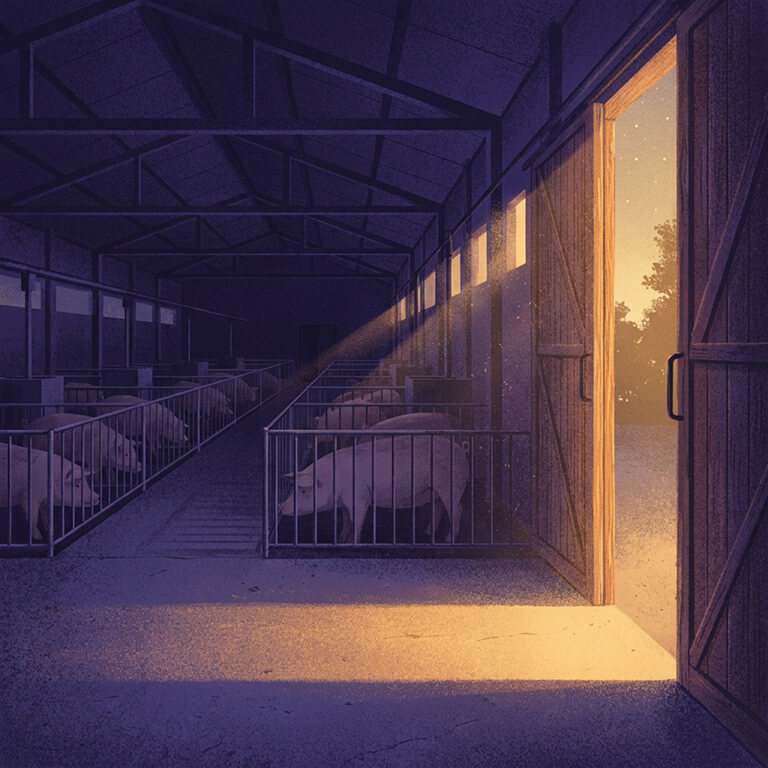
A well-documented phenomenon recurs in factory farming: sows, under the extreme stress of confinement, will sometimes kill or injure their piglets. The industry narrates this as evidence of the sow’s innate danger, her unworthiness for motherhood, the necessity of removing her young before she can harm them.
What they are actually describing is what confinement does to a mother. In conditions where sows have movement, socialisation, and the basic architecture of choice, they are attentive, protective, and remarkably tender, nursing with physical communication that researchers have documented as something resembling song. The aggression is not the sow. The aggression is the barn.
When a school tells you that your child is explosive, dysregulated, a danger to others, and describes their distress as a behavioural profile rather than a response to conditions, it is doing the same thing. It is describing the barn it built and calling it your child’s character. When it hands you a safety plan with a room-clear protocol and asks you to sign, it is asking you to authorise the barn. When you sign because the alternative is exclusion, and exclusion is worse, you have not consented to anything: they have coerced you into managing a harm you did not create.
The system is very good at making this feel like collaboration.
What it does to you
The psychological literature on chronic institutional betrayal, the experience of harm from systems you had no choice but to trust, documents something predictable: over time, the harmed person internalises the institution’s framing. You begin to monitor yourself for signs of unreasonableness. You pre-apologise. You write emails that spend two paragraphs contextualising your concern before you will permit yourself to name it. You become a skilled manager of other people’s comfort with your child’s pain.
This is adaptation. The system produces it deliberately, through architecture rather than conspiracy: complaint processes that require months of patience, meeting structures that distribute power asymmetrically, language norms that mark urgency as aggression and grief as instability. Sara Ahmed writes about how institutions manage those who identify their failures: the complainant becomes the problem, the friction, the one whose attachment to the issue begins to seem pathological. You have felt this. The email you rewrote four times to sound less angry. The meeting where they thanked you for your passion. The moment you heard yourself say I just want what’s best for everyone when what you meant was my child is being harmed and you are doing it on purpose.
And then you go home feeling deranged. Despite trying your best. Despite the research you did and the documentation you kept and the lawyer you consulted and the nights you spent awake running through every possible way to make this work. The derangement is a rational response to gaslighting at institutional scale.
The scheme
Let us be precise about what is happening.
Underfunded by design, its support workers cut, its class sizes bloated, its inclusion mandate unfunded, the school system has a structural incentive to make disabled students’ families absorb the cost of that underfunding. If the school cannot support your child in a class of thirty with no educational assistant, it can either advocate for the resources that would make support possible, or it can manage you into accepting less. Advocacy is expensive. Management is free. And mothers — particularly mothers of disabled children, who are disproportionately disabled themselves, who are disproportionately navigating poverty and precarity and the specific exhaustion of caring without support — mothers are a renewable resource for this management. You renew yourself every September. You walk back in.
The guilt you feel about sending your child into a building that has hurt them is accurate. The system needs you to experience that guilt as a failure of your mothering, as a correct reading of your character rather than a correct reading of a harmful situation. If you understood it as a structural problem, you would demand structural solutions. You might refuse. You might organise. You might stop managing the institution’s conscience and start naming its choices.
The guilt keeps you internal. It keeps you asking what am I doing wrong instead of who decided this was acceptable, and why are they still deciding.
The mothers who fell
The system reserves a particular erasure for the women who broke under this. The ones schools eventually reported to child protective services for the decisions they made trying to protect their children from school: whether they kept them home, withdrew them, or made a plan that looked from the outside like giving up. The ones who stopped answering the phone. The ones who arrived at a point where the harm of sending their children felt equivalent to the harm of keeping them home, and they chose home, and the system then turned on them for that choice.
They are documentation of what happens when institutions fail and make mothers carry it. Achille Mbembe writes about necropolitics: the management of who gets to live and under what conditions, the distribution of slow death through policy rather than explicit violence. The mother whom the system reports to a social worker because she withdrew her excluded child from a school that spent three years telling her she was overreacting: she is inside that framework. Her grief is not incidental. The system produced it.
What radicalisation looks like
People talk about radicalisation as if it is a sudden conversion, a moment when the moderate person tips into extremism. In the experience of mothers navigating school systems designed to harm their disabled children, it looks like a Tuesday morning in November when you are zipping up the backpack and you feel, with complete clarity, that you are complicit in something. It looks like the moment you stop apologising for your documentation and start reading it as evidence. It looks like the meeting where you bring a support person and the school’s entire register shifts, and you understand that what you had previously experienced as their sincerity was, in fact, their confidence that you would come alone.
Radicalisation, in this context, is the accurate perception of power. It is the recognition that your child’s distress is a response to conditions, and the people generating those conditions have decided they are acceptable. It is the understanding that the system’s designers built it around a different child, and it will continue doing what it does whether or not you remain polite about it.
Radicalisation means building strategy on an honest foundation rather than on the hope that you can eventually persuade the institution to want what you want. It means organising with other mothers who have made the same diagnosis. It means directing your precision — and you are precise; you have had to be — toward accountability rather than toward the management of your own presentation.
To the women at the school door
You are a person making impossible calculations under structural constraint, doing what the system has made the least harmful of a set of harmful options. The guilt is real. The love behind it is real. Both of those things coexist with this: you did not cause this.
The system has used up your accommodation of its failure for long enough. You lowered the bar because they wore you down, incrementally, through mechanisms designed precisely for the wearing. The derangement you feel is the sound of your perception working correctly in an environment that has spent years insisting otherwise.
You are not the barn.
They built the barn.