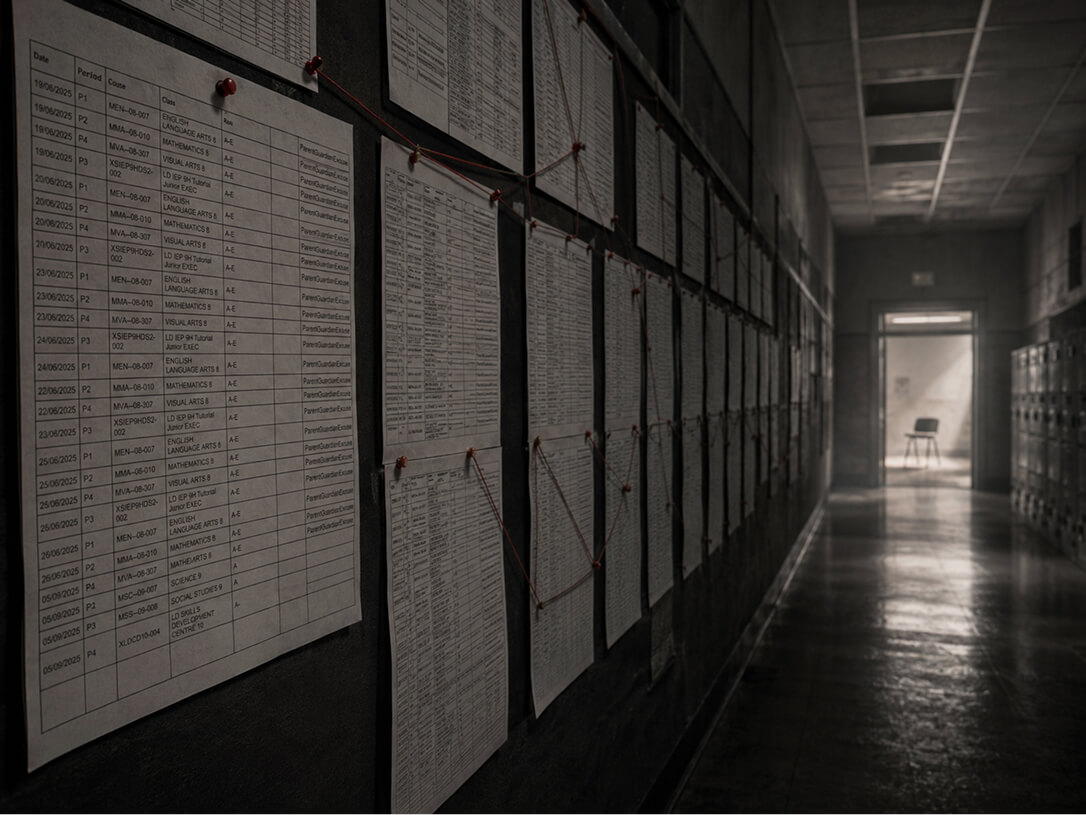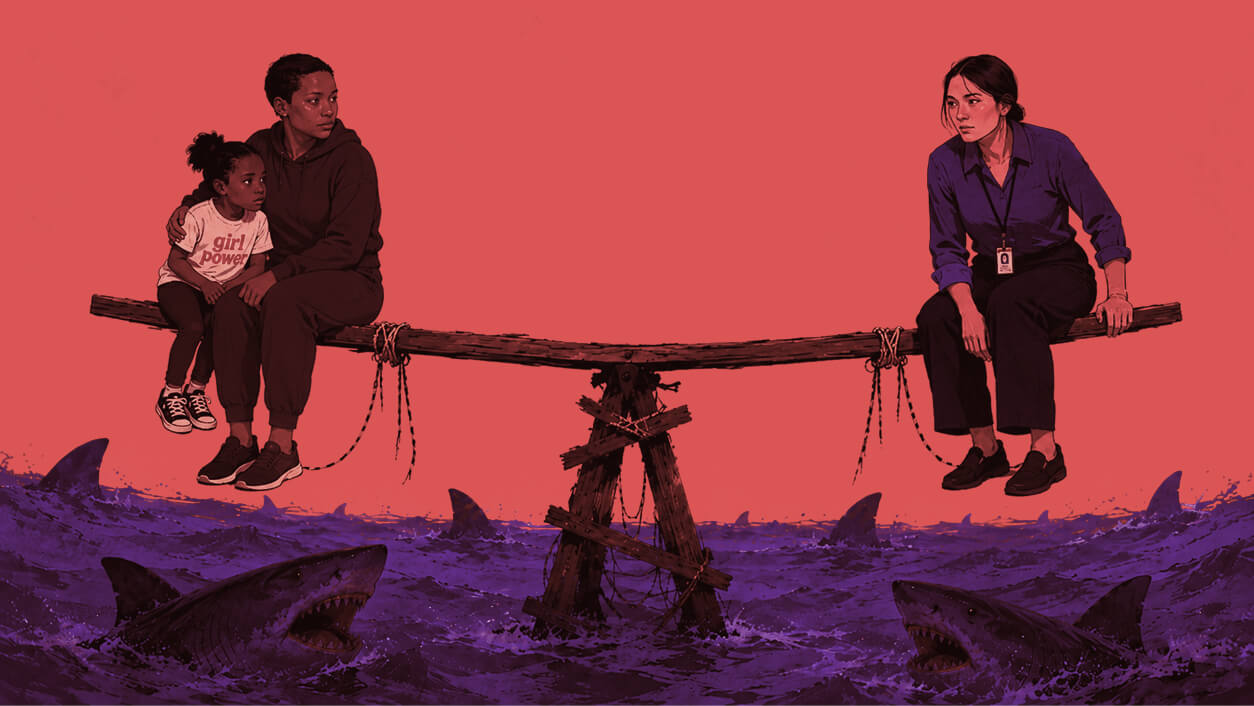
Every IEP written for a PDA student begins with the same quiet betrayal. The team gathers — parents, teacher, learning support, maybe an administrator — and the goals are drafted in language that sounds like care: manage responsibilities with support, self-advocate before becoming overwhelmed, organise materials and meet deadlines. The phrases are familiar because they are institutional boilerplate, imported from templates designed for children whose barriers are presumed to be skill deficits rather than nervous system realities. On paper, they look reasonable. In practice, they encode the very thing that makes school inaccessible for the child: an expectation of compliance dressed as accommodation.
The IEP names the child’s distress and then asks the child to perform their way out of it, inside a structure that has not changed at all.
This is not a design flaw that better goal-writing can fix. It is the logic of the template itself. The IEP assumes that the child is the site of the problem, that the adult environment is stable and neutral, and that progress means the child moving closer to the school’s existing expectations.
For a PDA student, those assumptions do not merely fall short. They become the mechanism of harm — a document that formalises demand and calls it support, that measures the child’s failure to tolerate coercion and calls it data.
-
Pathological Demand Avoidance (PDA)
Pathological Demand Avoidance is a neurobiological profile of autism rooted in anxiety, autonomy, and nervous system threat perception. For children with PDA, even simple requests can register as danger. A question, a suggestion, a cheerful invitation—all of these may activate a survival response, because the child’s nervous system experiences demand as threat. When this pattern is misunderstood, and the child is pushed, punished, or pathologised, the result is often emotional collapse, chronic shutdown, or explosive resistance. What may look like manipulation is actually an attempt to restore safety. What may seem like opposition is often an urgent bid for control…
PDA is not anxiety, and it is not behaviour
Schools tend to sort PDA into one of two familiar categories:
- If it is anxiety, the child should learn coping strategies: breathing techniques, worry journals, gradual exposure, cognitive reframing, conversations about feelings.
- If it is behaviour, the child should respond to structure: incentives, token systems, compliance charts, firm boundaries, consistent consequences, and the calm adult voice that says I know this is hard, but you still need to do it.
Both frames miss the central issue.
PDA shares visible features with anxiety — panic, avoidance, catastrophic language, refusal, escape — but the trigger is not abstract worry about a future event. It is the body’s real-time response to perceived coercion: the sensation of another person’s agenda being imposed, of timing and consent and self-direction being removed, of demand arriving as something that must be absorbed rather than negotiated.
Sara Ahmed‘s work on Affective Economies is useful here because Ahmed insists that affect does not originate inside the individual and radiate outward; it circulates between bodies, sticks to surfaces, accumulates in spaces. The PDA child’s distress is not a private malfunction. It is a response to the affective texture of the demand environment — the accumulated weight of adult expectation, institutional rhythm, social performance, and the ambient pressure of a room organised around compliance.
This distinction matters because it determines what the IEP targets. If adults understand PDA as anxiety alone, they reach for strategies that require the child to explain, reframe, tolerate, practise, and gradually expose themselves to demands before they feel safe — strategies that treat the child’s nervous system as the thing that needs correcting.
If adults understand PDA as behaviour alone, they reach for strategies that increase pressure: rewards for compliance, consequences for refusal, consistency as a synonym for inflexibility, and the quiet institutional conviction that the child would be fine if they just tried harder.
A PDA-informed plan starts somewhere else entirely. It asks: what demand landed too hard, what invisible pressure tipped the child’s system, and what part of the child’s autonomy was challenged — even if the adult’s intention was kind. It does not require the child to perform insight, gratitude, verbal explanation, or compliance before support becomes available.
The architecture of a compliance-framed goal
Consider the most common IEP goal structure for a PDA student: Student will manage their responsibilities with support. The objective beneath it reads something like Student will organise school materials, manage time, and meet deadlines. The strategies column lists chunking, classroom teacher support, classroom organisation systems, visual schedules, reminders, checklists. None of these tools are automatically harmful. A visual schedule can reduce uncertainty. Support can provide safety. Chunking can lower overwhelm.
The problem is not the tools. The problem is the framing. The goal assumes the child’s difficulty is organisational — that the barrier is a missing skill, and the intervention is to help the child comply more efficiently with a demand that may itself be triggering the distress the goal claims to address. The child is not struggling because they lack a checklist. They are struggling because the demand to organise, initiate, sustain, and complete — on someone else’s timeline, in someone else’s format, under someone else’s gaze — has registered as threat. The checklist does not dissolve the threat. It decorates it.
A second goal reads: Student will self-advocate for support, with the objective Student will recognise when they are fatigued and choose a break or ask for support before becoming overwhelmed. This sounds progressive. It centres awareness, names fatigue, offers a break. But examine the sequence it requires: the child must recognise their own escalation in real time, override the freeze or flight response long enough to deploy a socially acceptable signal, trust that the adult receiving the signal will honour it without consequence, and accept that no punishment, interrogation, or disappointed conversation will follow. For a PDA student in demand saturation, that sequence is itself a demand — a multi-step, socially complex performance embedded inside a goal that claims to reduce demands.
The problem is not that these goals exist. The problem is that they are often the only goals, that they consume the IEP’s entire aspiration for the child. The child must manage, organise, advocate, regulate, initiate, complete, transition, tolerate, and comply. The school must provide tools — fidgets, headphones, a wiggle stool — and wait for the child to improve.
That is not accommodation. It is delegated responsibility with a kind voice.
When care becomes coercion
Elaine Scarry argues in The Body in Pain: The Making and Unmaking of the World that pain destroys language — that the person in pain loses the capacity to articulate their experience at the precise moment when articulation is most needed, while the observer remains fluent, interpreting, narrating, assigning meaning from outside. Something analogous happens in the IEP meeting. The school describes the child’s distress in institutional language — dysregulated, avoidant, non-compliant, refusing to engage — and then designs interventions that require the child to produce the very language their distress has made inaccessible: I need a break, I’m feeling overwhelmed, Can I have help?
Care is not care simply because the adult feels caring while offering it.
Just a Parent
Intention matters so little, in terms of experience.
A check-in can be coercive if the child experiences it as surveillance. A break card can be coercive if the child must perform distress publicly to access it. A calm problem-solving conversation can be coercive if the child is not ready to process and the adult’s patience is conditional. A “choice” can be coercive if both options are adult-controlled routes to the same unwanted demand. A reward can be coercive if it turns access, praise, or relief into something the child must earn through compliance. Praise itself can be coercive if it carries the implicit message that the child’s value is contingent on having performed correctly.
A PDA-informed IEP cannot simply list caring interventions. It must specify how support will be offered — in what tone, at what proximity, through what modality, with what degree of the child’s consent — because the method of delivery is part of the accommodation. Support that arrives in the wrong form, at the wrong time, with too much adult need attached, does not land as safety. It lands as another demand.
“Evidence-based” is not a synonym for appropriate
Schools defend compliance-based strategies by invoking the phrase evidence-based as though it were a moral shield. Sticker charts, token systems, reinforcement schedules, planned ignoring, social-skills programmes, and visual supports are presented as neutral tools because research supports them somewhere, for some children, in some contexts.
But evidence-based practice does not mean applying averaged interventions to every autistic child as though diagnosis erases individual difference. Autism is not a single uniform learning profile. PDA children are not interchangeable with all other autistic children, and a strategy that supports one child may be irrelevant, ineffective, or actively harmful for another. The institutional habit of treating “evidence-based” as a categorical defence — this intervention has research support, therefore it is appropriate for your child — functions as a way to override parental knowledge, dismiss the child’s documented distress response, and avoid the more difficult work of individualised design.
The question is not Is this strategy evidence-based in the abstract? The question is Is this strategy appropriate for this child, given their demand profile, distress signals, processing style, communication access, and documented response to similar interventions? If sticker charts increase coercive pressure, they are not accommodation for that child. If verbal problem-solving overwhelms the child, it is not collaboration merely because the adult feels collaborative while doing it. If a self-advocacy goal requires the child to explain themselves before adults respond, it is another demand disguised as empowerment.
Individualisation is not a preference. It is what meaningful accommodation requires.
What PDA-informed practice actually demands of schools
The PDA literature — from the PDA Society, PDA North America, clinical practitioners, and the growing body of neurodivergent-led writing — converges on a point that schools find deeply uncomfortable: demand avoidance is not solved by better demand management. It is addressed by reducing coercion, restoring agency, and making participation possible without requiring the child to perform compliance as the price of access.
Low-demand practice does not mean abandoning learning, expectations, or structure. It means changing the route into learning so the child’s nervous system is not forced into threat before instruction can begin. The question shifts from How do we make this child comply? to What conditions make access, engagement, and safety possible?
Autonomy is not a reward. It is the intervention. PDA-informed practice requires genuine control over what, when, how, and with whom a child learns. This is not “choice time” offered after compliance — a reward contingency that keeps the demand structure intact and merely decorates its surface with the appearance of agency. For a PDA student, autonomy must be built into the learning pathway from the beginning. The child may need to help shape the task, choose the sequence of activities, decide how to demonstrate understanding, or negotiate the level of adult proximity. The point is not indulgence; it is regulation. A felt sense of agency may be the only thing that allows the child’s nervous system to remain available for learning at all.
An IEP that lists “choice of preferred activities” as an accommodation but frames every academic goal as something the child must complete on the school’s terms has not understood this principle. It has merely decorated the demand.
Collaboration cannot depend on verbal performance. Many progressive approaches move in the right direction by rejecting punishment and recognising that children do well when they can. But PDA-informed practice has to go further than adult-led problem-solving conversations. For many PDA and autistic students, talking about the problem — identifying feelings, explaining concerns, negotiating a plan in real time — can itself become a demand. A child who uses delayed processing, gestalt language, AAC, movement, avoidance, silence, or refusal as part of their communication and access system may not be able to participate in the kind of reflective dialogue adults imagine when they say collaboration.
A useful IEP cannot assume that verbal reflection is the highest form of regulation. It must allow for non-verbal communication, delayed processing, indirect support, written options, environmental change, and adult response that does not require the child to explain themselves before help arrives. Sometimes the child’s refusal, withdrawal, silence, or rejection of help is the clearest information they have given. The question is whether adults are listening to the communication they actually received, or waiting for the communication they wanted.
Regulation precedes academics. For a PDA student, the capacity to tolerate any academic demand depends on regulatory state. Teaching multiplication to a child in demand saturation is like teaching swimming to someone who is drowning — the lesson may be important, but the timing makes it inaccessible. A PDA-informed IEP should not treat regulation as a side objective filed under “personal awareness” while the main goals focus on task completion and grade-level performance. Regulation sits at the centre of the plan because it is the condition that makes access to instruction possible.
Crucially, regulation goals should not measure only whether the child performs regulation correctly — whether they used the break card, said the right words, deployed the calming strategy on cue. They should also measure whether adults noticed early signs of distress, reduced demands before escalation, honoured breaks without interrogation, and prevented shutdown rather than documenting it after the fact.
The environment must flex, not just the child. A low-demand environment is not a permanent state of zero expectation. It is a dynamic calibration of demand to the child’s current capacity, and that capacity changes — across days, across hours, across the accumulation of demands that are invisible to adults who experience them as routine. On a good day, a PDA student may engage enthusiastically with a challenging project. On a difficult day, the same student may need a quiet space, reduced workload, indirect support, or an alternative route into the same learning outcome. The IEP must account for that variability explicitly, naming what happens during periods of high demand saturation: reduced workload without penalty, flexible scheduling, alternatives to homework, permission to arrive late or leave early, temporary suspension of non-essential demands, and access to regulation spaces without verbal explanation.
These are the conditions under which learning becomes possible.
What a PDA-informed goal actually looks like
The difference between a compliance-framed goal and a PDA-informed goal is a structural inversion of who is expected to change.
A compliance-framed goal reads: Student will manage their responsibilities by organising school materials and meeting deadlines. The subject is the student. The action is compliance. The measure is the school’s convenience.
A PDA-informed goal reads: Staff will provide a low-demand transition cue at least five minutes before activity changes, offer the student two acceptable pathways for participation, and document whether the transition occurred without escalation, shutdown, or removal from instruction. With these supports in place, the student will participate in the next activity through an agreed format on four out of five school days. The goal still includes a student outcome, but it does not pretend the outcome belongs to the child alone. The adult responsibilities are named, the environmental conditions are measurable, the threshold acknowledges variability, and the documentation duty falls on staff.
A compliance-framed regulation goal reads: Student will recognise when they are fatigued and choose a break before getting overwhelmed. A PDA-informed regulation goal reads: When the student shows early signs of distress — as identified collaboratively with the student and documented in the support plan — staff will reduce verbal demands, stop non-essential instructions, and offer access to the designated quiet space without requiring explanation. The student may use a break card, gesture, verbal cue, movement toward the space, or another agreed signal. Staff will document whether the break was honoured without delay, interrogation, penalty, or later consequence. The difference is not cosmetic. The PDA-informed version names the adult response, removes the verbal demand of explanation, identifies the space, allows multiple forms of communication, and measures whether the accommodation was actually implemented — not whether the child performed the correct sequence of self-regulation steps.
A compliance-framed writing goal reads: Student will communicate ideas by translating them into text. A PDA-informed writing goal reads: During weekly writing opportunities, staff will offer the student a choice of topic, format, and production method before the task begins. The student may demonstrate understanding through typing, dictation, adult scribing, drawing, audio recording, speech-to-text, or another agreed format. Success will be measured by whether the student communicated an idea through an accessible modality, not by whether the student used handwriting unless handwriting is the specific skill being assessed. The learning outcome is the same: the child communicates ideas. The pathway is entirely different. The child controls topic, format, and method. The IEP names every alternative explicitly so no individual teacher can default to but the assignment says handwritten.
A compliance-framed self-advocacy goal reads: Student will ask for help when they do not understand instructions. A PDA-informed access goal reads: Staff will avoid requiring the student to publicly request help or disclose confusion. Adults will provide low-pressure access options — written instructions, visual examples, parallel modelling, silent check-ins, an agreed non-verbal signal — and document which options were offered and whether the student was able to remain engaged without escalation or withdrawal. This matters because “self-advocacy” in an IEP often functions as a transfer of responsibility from adults to children. The student should not have to repeatedly prove distress, explain their disability, or perform mature insight before the school provides support it already knows is needed.
-

Why the evolving understanding of childhood terrifies systems built on scarcity
Children now arrive at school shaped by homes that honour physiology over performance, autonomy over obedience, and co-regulation over fear, and this shift grows from a decade of relational neuroscience, trauma literacy, sensory understanding, and disability justice that families have absorbed far more…
The missing infrastructure
Even well-written goals collapse without implementation infrastructure, and this is where PDA-informed IEPs fail most consistently — not at the drafting table, but in the hallway, the lunchroom, the substitute teacher’s classroom, and the moment when the adult who has not read the plan decides to hold the line.
A designated safe space, available without permission
Many IEPs mention “breaks” and “headphones” but do not name a specific physical location the student can access without requesting permission. That omission is not administrative oversight; it is a structural gap that converts the break into another demand. Flight is always better than fight and giving students a friction-free retreat and supporting the use of this accommodation are very important safety adjustments.
If the child has to interrupt the class, attract adult attention, explain their distress, and wait for approval, the entire sequence reproduces the coercion the break was supposed to relieve. The IEP should state: The student may leave the classroom to [specific named location] at any time using the agreed signal or route, without verbal explanation. The safe space must be real, available, and known to every adult in the building. It cannot depend on whether a particular staff member is feeling generous. It cannot disappear because the room is needed for storage, testing, or meetings. If the accommodation only exists when convenient, it is not an accommodation.
A crisis and de-escalation protocol
PDA students experience shutdowns, meltdowns, elopement, aggression, or complete withdrawal when demands exceed capacity. These moments are routinely misread as defiance, manipulation, rudeness, or wilful refusal, and the adult response can either reduce the threat or deepen it.
The IEP must specify what adults do in crisis: they do not crowd, do not repeat questions, do not force eye contact, do not deliver lectures, do not set countdowns, and do not demand immediate explanation.
They reduce language, create physical space, lower social pressure, and wait. If proximity helps the child, the plan says so. If proximity escalates distress, the plan says that instead.
his protocol must be written, distributed to every adult who interacts with the child — classroom teachers, educational assistants, supply teachers, lunch supervisors, office staff, administrators, counsellors — and reviewed at every IEP meeting. Without a shared protocol, well-meaning adults default to strategies designed for neurotypical children and then blame the PDA student when those strategies fail.
Staff training with accountability
The IEP should include a commitment that every adult working with the child will receive orientation to their PDA profile: language strategies, environmental accommodations, de-escalation protocols, break access, and documentation expectations. This is not a nice-to-have. It is the condition under which every other accommodation functions. A fidget tool means nothing if a supply teacher confiscates it. A break card means nothing if the lunch supervisor insists the child finish eating first. A flexible schedule means nothing if the vice-principal marks the child truant. An alternative writing format means nothing if the classroom teacher says the student has to handwrite because “everyone else does.” The IEP must name the training, set a date, assign responsibility, and document completion. Otherwise the plan depends on informal goodwill, and informal goodwill is not an access system.
A review process that tracks adult implementation, not just child outcomes
Most IEP reviews ask whether the child met the goals. For PDA students, that question is insufficient without a second one: did adults implement the accommodations consistently enough for the goals to be meaningful? Were breaks honoured without verbal explanation? Were demands reduced before escalation, or only documented after crisis? Were staff using agreed low-demand language? Were alternative formats offered before refusal occurred? Were substitute teachers and supervisors informed? Were absences, late arrivals, and time in the safe space treated as access needs rather than misconduct? Without implementation data, schools can claim the child “did not use the support” when the real problem is that the support was unavailable, inconsistent, unsafe, or offered in a form the child could not access.
Rewriting the contract
The fundamental problem with IEP goals for PDA students is not that schools are malicious. It is that the IEP template was designed around a set of assumptions that PDA disrupts at every point: that barriers are skill-based, that progress is linear, that exposure builds tolerance, that adult direction is neutral, and that the child can be moved toward compliance through structure, consistency, and reinforcement. The PDA student breaks every one of those assumptions, and the result is a document that sounds like support but functions as a catalogue of expectations the child has already demonstrated they cannot meet under current conditions.
Writing PDA-informed goals requires a willingness to invert the template — to make the school’s behaviour as visible and measurable as the child’s, to treat autonomy as a precondition rather than an outcome, to define success not as compliance but as sustained access, reduced distress, and meaningful engagement through pathways the child can tolerate. It requires naming accommodations so precisely that no individual teacher’s discomfort with flexibility can override them. It requires documenting not just what the child will do, but what the adults will do, how often, and who will verify that they did it.
The IEP is supposed to be a contract — an agreement that the school will provide the conditions under which the child can learn. For PDA students, honouring that contract means accepting that the child’s nervous system is not a behavioural problem to be shaped into obedience. It is a reality the school is obligated to accommodate. The goal is not to dress demands up as choices. The goal is to dismantle the demand structure enough that learning can actually begin.
-

New science on punishment and rewards
A growing body of research from 2023–2025 offers a transformative account of how children learn, regulate, and respond to school environments, because these studies converge on a striking and deeply consequential insight: children learn through stability, safety, and relational reward, while punitive systems generate emotional…