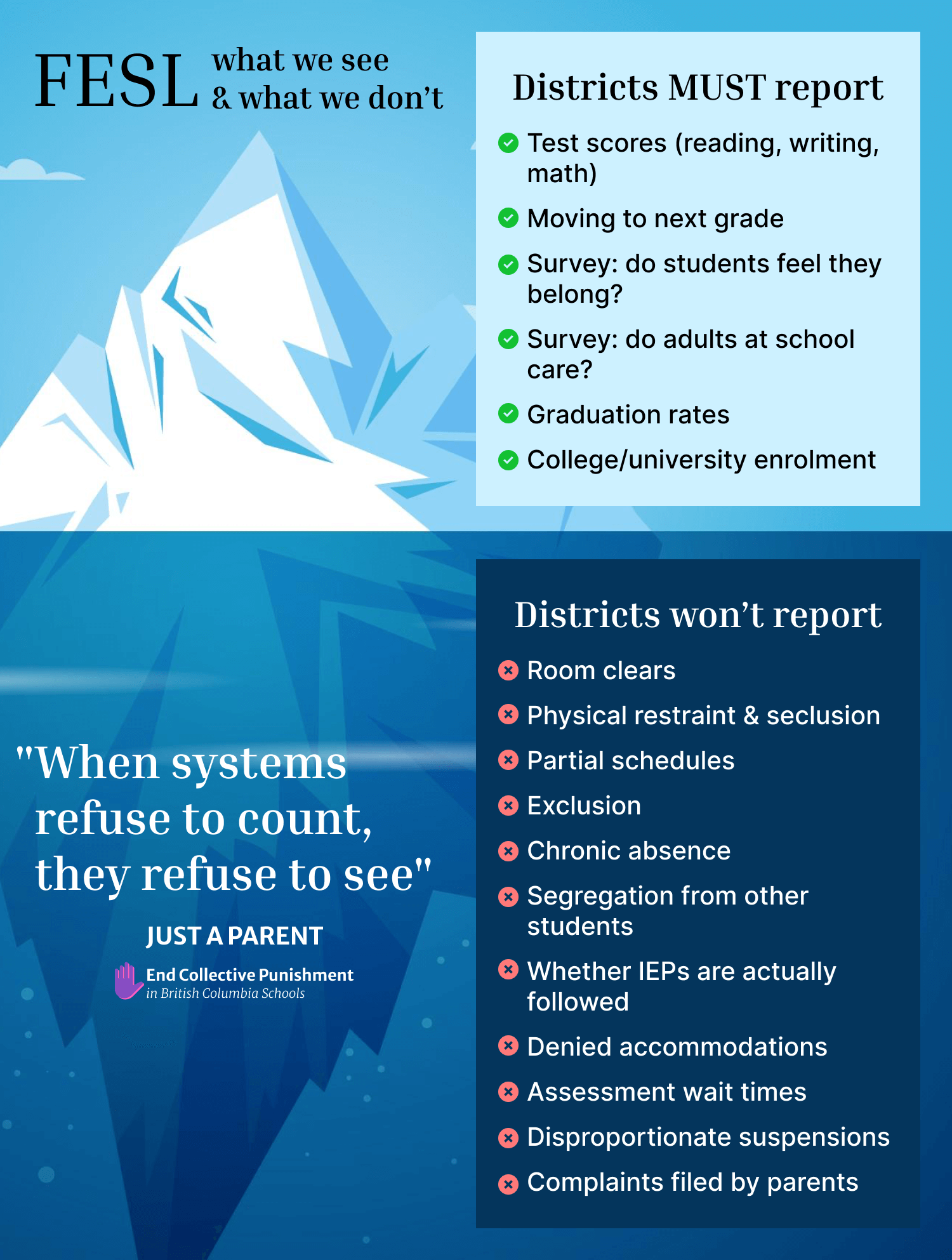
Canary Collective published an analysis of BC’s Framework for Enhancing Student Learning that identifies precisely what my forensic examination of Vancouver’s FESL report revealed through keyword analysis and theoretical critique: the accountability infrastructure exists, the reporting mechanisms function, the annual cycles continue, but the indicators being measured systematically exclude the conditions that determine whether disabled students can access education at all.
Districts are required to report literacy and numeracy outcomes from standardised assessments, student survey results on belonging and safety, and graduation rates tracked from Grade 8 forward. These metrics capture outcomes only for students who remain present in classrooms, who can participate in testing environments, and who progress through grades without interruption. They cannot capture the experiences of students who are removed from those environments before measurement occurs.
Canary Collective makes explicit what current FESL reporting renders invisible: the exclusionary practices that shape access to learning but disappear from accountability structures because districts are not required to document them publicly. The list is precise and damning—early dismissals, prolonged gradual entry beyond transition periods, shortened school days, formal and informal suspensions, classroom removals and segregation, restraint and seclusion, exclusions tied to disability-related care needs or staffing shortages, student absenteeism, and staff absenteeism and leave.
Each item represents a mechanism through which students lose instructional time, face barriers to participation, or are pushed out of learning environments entirely. Yet all remain outside formal reporting requirements. Districts can deploy these practices without documenting their frequency, duration, or disproportionate impact on disabled students, Indigenous students, students in care, or those at their intersections. The practices remain operational but analytically invisible—absent from public data and excluded from the accountability structures the Ministry claims ensure transparency.
-
Surrey FESL report shows why FESL is designed to fail
Surrey School District’s 2025-26 Enhancing Student Learning Report spans 42 pages across two documents, presenting what appears at first glance as a model of comprehensive educational accountability—extensive data visualisations tracking student outcomes across multiple measures, disaggregated by Indigenous identity, English language learner status, and disability designation, accompanied by detailed narrative analysis of gaps, strategic responses, and planned adjustments. The report demonstrates meticulous compliance with every requirement the Framework for Enhancing Student Learning establishes, documenting Surrey’s commitment to equity, continuous improvement, and evidence-based decision-making with the kind of procedural rigour the Ministry of Education explicitly requests. Yet something essential remains absent…
My analysis of Vancouver’s FESL report demonstrated this invisibility empirically. Accommodation appears zero times. Exclusion appears zero times. Partial-day, restraint, and seclusion appear zero times. The document devotes extensive space to continuous improvement processes and strategic priorities while erasing the material conditions of exclusion. This is not accidental oversight but structural design: reporting requirements that measure outcomes without measuring access, proficiency without participation, and belonging through surveys administered only to students still present in classrooms.
Canary Collective’s intervention is methodologically straightforward and politically essential. If the Ministry can require districts to submit K–12 literacy reports as part of FESL cycles beginning in 2026, then it has the administrative capacity to require reporting on the indicators that actually reveal whether students are accessing education. The literacy mandate proves that FESL requirements are policy choices, not fixed constraints: when the government requires districts to track something, districts track it.
The question, then, is what the Ministry chooses to make visible. Current FESL structures allow districts to meet every reporting requirement while operating exclusion systems that deny disabled students access to learning. Districts can demonstrate compliance, produce polished reports, and document improvement initiatives while students experience shortened days, informal suspensions, restraint, seclusion, and segregation that never appear in public data.
-

How FESL enables ongoing exclusion of disabled children
In 2020, the British Columbia Ministry of Education and Child Care brought into force the Framework for Enhancing Student Learning, a policy architecture ostensibly designed to guide the province’s approach to continuous improvement in public education, with particular attention to improving equity for Indigenous students, children and youth in care, and students with disabilities or diverse abilities. The Framework consists of two components: the Framework for Enhancing Student Learning Policy, which outlines responsibilities for the ministry and school boards, and the Enhancing Student Learning Reporting Order, which requires districts to publicly report on specific student learning outcomes each year. Executive summary Introduction The…
Requiring districts to report on the indicators Canary Collective identifies would not create new problems—it would expose existing ones. It would not introduce harm but make harm visible. It would not strain capacity but reveal the gap between stated commitments and lived conditions. These indicators measure the realities families navigate daily: the practices that determine whether children can attend school full-time, remain with peers, and access learning. Making them reportable would align accountability with access rather than allowing curated narratives of improvement to coexist with undocumented exclusion.
This matters because transparency about exclusion is foundational to evaluating equity claims. Without data on early dismissals, shortened schedules, classroom removals, restraint, seclusion, and absenteeism—disaggregated by disability, Indigenous status, care status, and their intersections—the system cannot identify who is being pushed out or why. It cannot distinguish declining proficiency caused by instructional challenges from declining proficiency caused by reduced opportunity to learn.
My analysis of Vancouver’s report showed how continuous improvement models substitute planning for provision and how process language displaces rights and material conditions. Canary Collective identifies what could interrupt that dynamic: expanded reporting requirements that make exclusion visible and therefore accountable, that track access rather than only outcomes for those who remain.
BC has the infrastructure, reporting cycles, and accountability mechanisms. Canary Collective has provided the roadmap. What remains is political choice: whether the Ministry will continue measuring what districts want the public to see or begin measuring what families need the public to know.
Families deserve accountability grounded in truth, not appearances. Until FESL requires districts to report on the mechanisms of exclusion, it will remain a framework for institutional performance rather than student access, for process compliance rather than material conditions, for improvement narratives rather than reality.
BC can do better. The only question is whether the Ministry will require it.