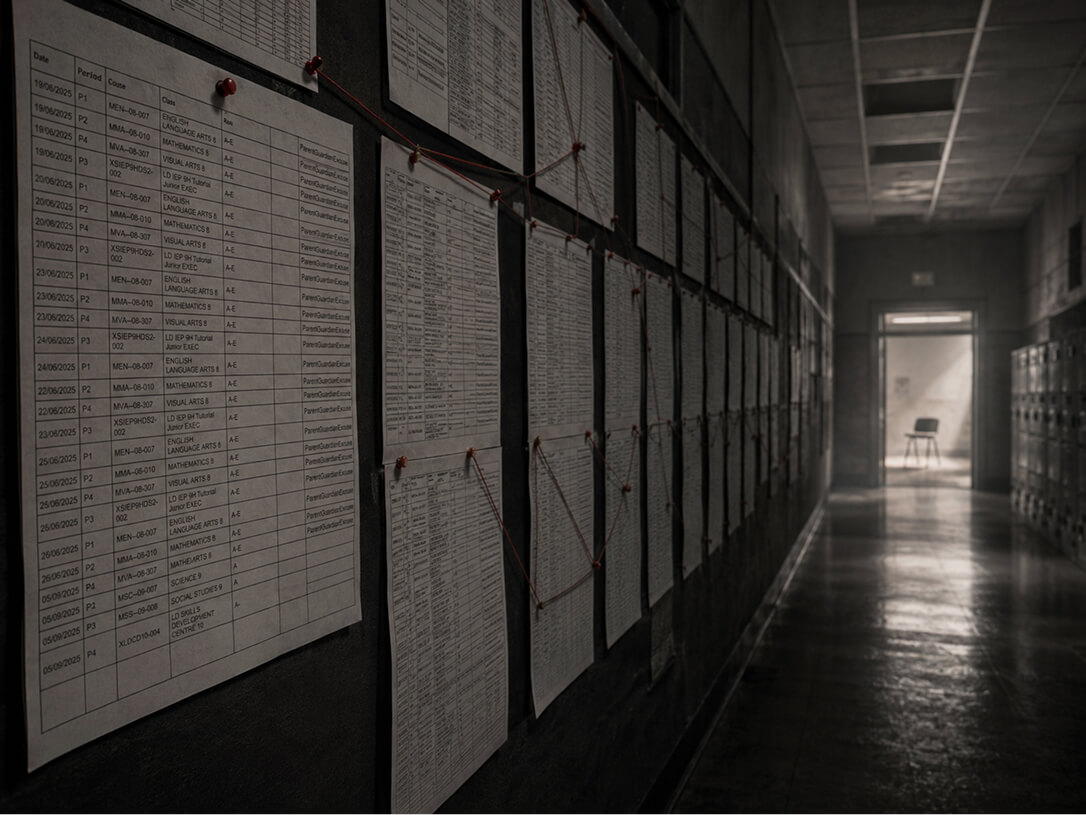
A partial schedule—sometimes called a shortened school day, modified attendance, or reduced hours—means a student attends school for fewer hours than their peers, often arriving late, leaving early, or missing entire days each week; in British Columbia, partial schedules are not accommodations by default, and when imposed without informed consent, clear educational justification, and a documented plan to restore full access, they may be unlawful under the School Act, the Human Rights Code, and the Charter.
Partial schedules are presented to families as temporary solutions, collaborative adjustments, or necessary supports, but they function as systematic exclusion—removing children from instruction, denying access to peers and curriculum, and shifting the burden of education onto parents while allowing schools to claim the student remains enrolled.
What partial schedules are supposed to be
In limited and exceptional circumstances, a partial schedule might be appropriate as part of a documented, time-limited plan to support a student’s transition back to full-time attendance following a medical absence, a significant life disruption, or a period of acute crisis; such a plan should be temporary, voluntary, and accompanied by instructional alternatives that ensure the student continues to access curriculum and make academic progress.
A legitimate partial schedule should include:
- Written documentation shared with parents
- A clear timeline for returning to full-time attendance
- Specific supports or services being provided during the reduced hours
- Instructional programming that maintains access to curriculum
- Regular review and adjustment based on the student’s progress
Partial schedules should never be used to manage staffing shortages, behaviour, disability-related needs, or district capacity constraints; they are not consequences, and they are not accommodations for institutional convenience.
How partial schedules function as exclusion
In practice, families report that partial schedules are:
- Indefinite. Parents are told the shortened day will last “for now,” “until behaviour improves,” or “as long as necessary,” with no end date, no benchmarks for progress, and no plan for restoration of full access.
- Required as a condition of attendance. The child is permitted to return to school only if the family agrees to a partial schedule, turning what is framed as a support into a coercive demand.
- Applied disproportionately to disabled students. Autistic children, children with ADHD, and children with complex support needs are far more likely to be placed on partial schedules, often in the absence of meaningful accommodation or behaviour support planning.
- Unaccompanied by instruction. The student loses hours in class but receives no alternative programming, no tutoring, no curriculum delivery—just absence, framed as safety or support.
This is exclusion by redefinition; calling it a “modified schedule” does not make it lawful when it denies education without due process, consent, or justification.
Legal concerns
A forced or indefinite partial schedule may violate:
- The School Act, which requires students to attend school and districts to provide access to education; there is no provision in the Act that permits schools to unilaterally reduce a student’s instructional hours based on behaviour, disability, or resource constraints.
- The Human Rights Code, which protects students from discrimination on the basis of disability; if a partial schedule is imposed because a student is autistic, has ADHD, or exhibits behaviour related to disability, and if the school has failed to accommodate the student to the point of undue hardship, the partial schedule constitutes discriminatory exclusion.
- The Charter, where loss of educational access impacts a student’s security of the person (s.7) or equality rights (s.15); courts have recognized that education is fundamental to a child’s development, dignity, and future opportunities, and exclusion from education—even partial exclusion—can constitute a Charter violation.
Framing exclusion as accommodation does not make it lawful; accommodation means adjusting the environment or approach to enable access, not reducing access and calling it support.
Why partial schedules persist
Partial schedules persist because they allow schools to manage capacity, staffing, and behaviour challenges without formal process, documentation, or accountability; they offload the consequences of institutional failure onto families, who must now arrange supervision, provide instruction, and absorb the loss of work hours and income that result from a child being home during school hours.
Parents are told the partial schedule is “in the child’s best interest,” that it reduces stress, that it allows the child to succeed—but these justifications often collapse under scrutiny; if the child is struggling, the response should be increased support, not reduced access; if the environment is harmful, the response should be environmental change, not removal of the child; if the school lacks capacity, the response should be advocacy for resources, not quiet exclusion disguised as care.
Partial schedules are designed for denial—denial of responsibility, denial of harm, denial of what is actually happening.
What parents can do
If your child has been placed on a partial schedule, ask the following questions in writing:
- What is the specific educational or developmental reason for reducing my child’s instructional hours?
- What legal authority permits the school to impose a partial schedule?
- What services, supports, or accommodations are being provided during the reduced hours?
- What is the timeline for returning my child to full-time attendance?
- What instructional programming is being offered to replace the lost classroom time?
If the school cannot provide clear, documented answers, the partial schedule is functioning as informal exclusion, and you have grounds to challenge it.
Use rights-based language from the outset; partial schedules that deny education are not supports—they are violations.
-

The slow boil: delayed support and collective punishment
I think a lot about lobsters, wrestled from the sea and placed in cold water that slowly heats—do they wonder if it’s getting hot in there? How do they decide where the line is and begin to panic? Is it a thought or…