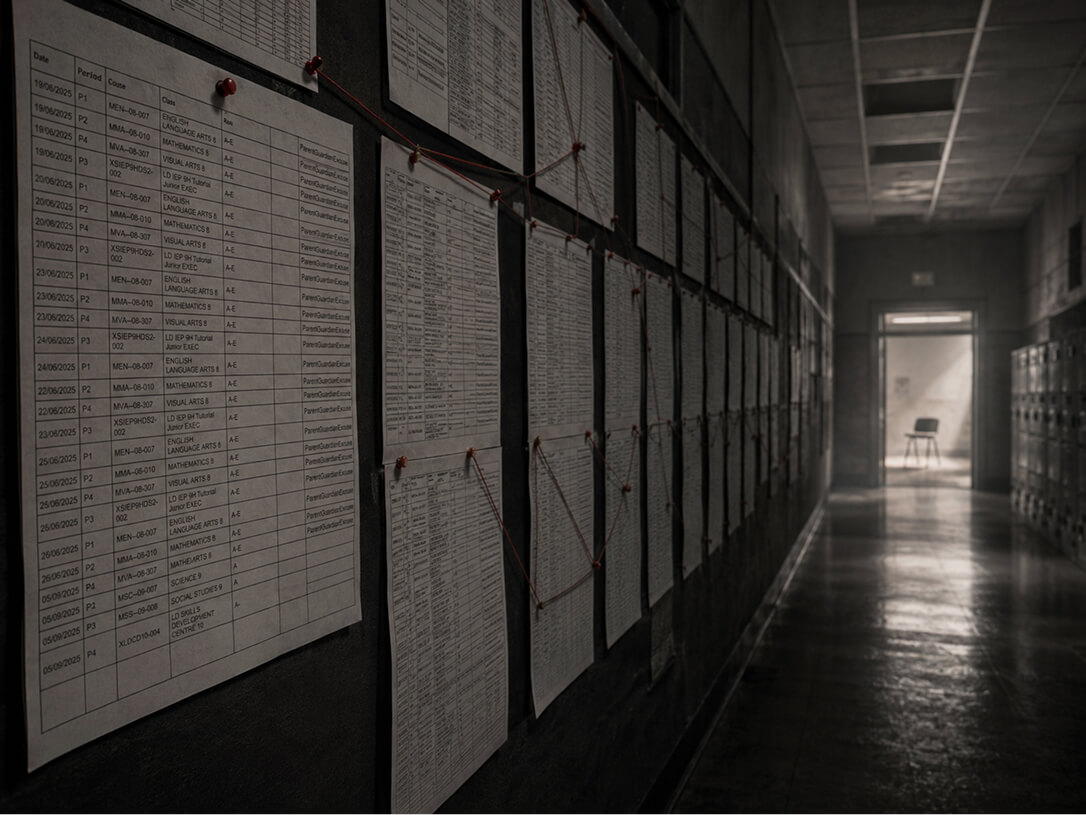
Jillian Enright identifies the central contradiction in Manitoba Education Minister Tracy Schmidt’s 2025 announcement of “positive, student-centred approaches” grounded in what the province calls positive behaviour agreements: these agreements present themselves as collaborative documents created between students and staff, yet the power imbalance renders genuine collaboration structurally impossible, leaving students to validate pre-determined behavioural expectations rather than co-design the conditions of their own safety and regulation.
Schmidt frames these agreements as an evolution beyond punitive measures like detention and timeout, yet the mechanism still operates through behavioural correction, still positions compliance as the marker of success, and still reduces complex neurodevelopmental signals to problems requiring management rather than communication deserving relational response. The rhetoric softens; the architecture endures.
PBIS in BC
British Columbia circulates an identical logic through Positive Behavioural Interventions and Supports, a framework I have described in Positive behavioural interventions and supports: a behaviourist rebrand as Applied Behaviour Analysis, replacing clinical language with warm institutional tones while preserving reinforcement schedules, compliance metrics, and tiered escalation systems that treat distress as defiance rather than as embodied testimony. PBIS saturates BC’s education landscape through district-level urgent intervention programs—Vancouver’s UIP, Surrey’s District Behaviour Specialists, Coquitlam’s massive Inclusion Support Team—all deploying functional behaviour assessments, token economies, and safety plans that mirror the Manitoba model Enright critiques, and all framing these interventions as supportive rather than disciplinary even as they condition children toward stillness, quiet, and manageability through environmental control and adult surveillance.
Behaviourism in Manitoba
Manitoba’s policy guide describes these agreements as tools to “curb behaviour that does not meet expectations,” language that exposes the system’s actual commitment: shaping conduct to align with institutional norms rather than transforming institutions to honour neurodivergent embodiment. Enright centres the power imbalance—school staff hold authority, resources, and procedural knowledge; students participate within constraints already established by adults—and this asymmetry appears across every behaviourist system I document in The behaviourist spine of BC’s urgent-response systems, where families engage in validation rituals disguised as collaboration, consenting to plans designed before they arrived and implemented whether or not they agree. The phrase “positive behaviour agreement” performs the same sleight as “positive behaviour support”: it positions coercion as care, frames compliance as collaboration, and treats the suppression of a child’s interior reality as a neutral act of teaching expectations.
-

Positive behavioural interventions and supports: a behaviourist rebrand
Positive behavioural interventions and supports circulates through British Columbia’s public schools with a gentle, polished confidence, offering administrators the comfort of matrices and fidelity tools, offering families soothing language about positivity and predictability, and presenting itself as an enlightened evolution of schoolwide discipline, yet what I see each time I study its structure is the unmistakable inheritance of applied behaviour analysis, because the system depends on reinforcement, compliance, adult surveillance, and engineered contingencies that shape a child’s conduct rather than honouring the child’s embodied reality.I have already written the truth of this across my work—across She graduated and this is…
Implications for PDA
For children with pathological demand avoidance profiles, these agreements function as demand wrapped in the language of partnership, triggering precisely the autonomy-threat response that behaviourist systems misread as defiance: the child experiences the agreement as a cage dressed as collaboration, recognises the coercion embedded in the performance of choice, and responds with the fight-flight-freeze patterns that schools then record as evidence that the agreement has been violated, the child remains unsafe, and more intensive behavioural intervention becomes necessary. My son could smell these traps instantly—the sing-song directive that masked compulsion, the “collaborative” meeting where adults had already determined the outcome, the safety plan that presented itself as support while functioning as a checklist for his inevitable failure.
Conclusion
What Enright reveals in Manitoba, I trace across British Columbia: a provincial spine built from behaviourist inheritance, gentle in language yet forceful in structure, marketed through the aesthetics of positivity while preserving a disciplinary core that measures success through observable action rather than relational trust, sensory accommodation, or collective responsibility for inclusion. These agreements do not liberate children; they script them into institutional legibility. The soft vocabulary conceals the hard geometry.
-

Non-coercive, trauma-informed alternatives to PBS/ABA in BC schools
Positive Behaviour Support (PBS) and Applied Behaviour Analysis (ABA) are behaviourist approaches widely used in schools to manage student behaviour. However, a growing chorus of neurodivergent advocates, educators, and researchers highlight that these methods often prioritise compliance and “normalising” behaviour over student well-being rcpsych.ac.uk. By focusing on making neurodivergent children appear neurotypical (meeting neuronormative standards), traditional PBS/ABA can neglect the child’s internal experiences and unmet needs rcpsych.ac.uk. For example, behaviourist programs might reward a quiet child or extinguish a stim without asking why the child is distressed – an approach that “fails to address the underlying reasons behind certain behaviours and the unmet needs they express” rcpsych.ac.uk. Multiple…