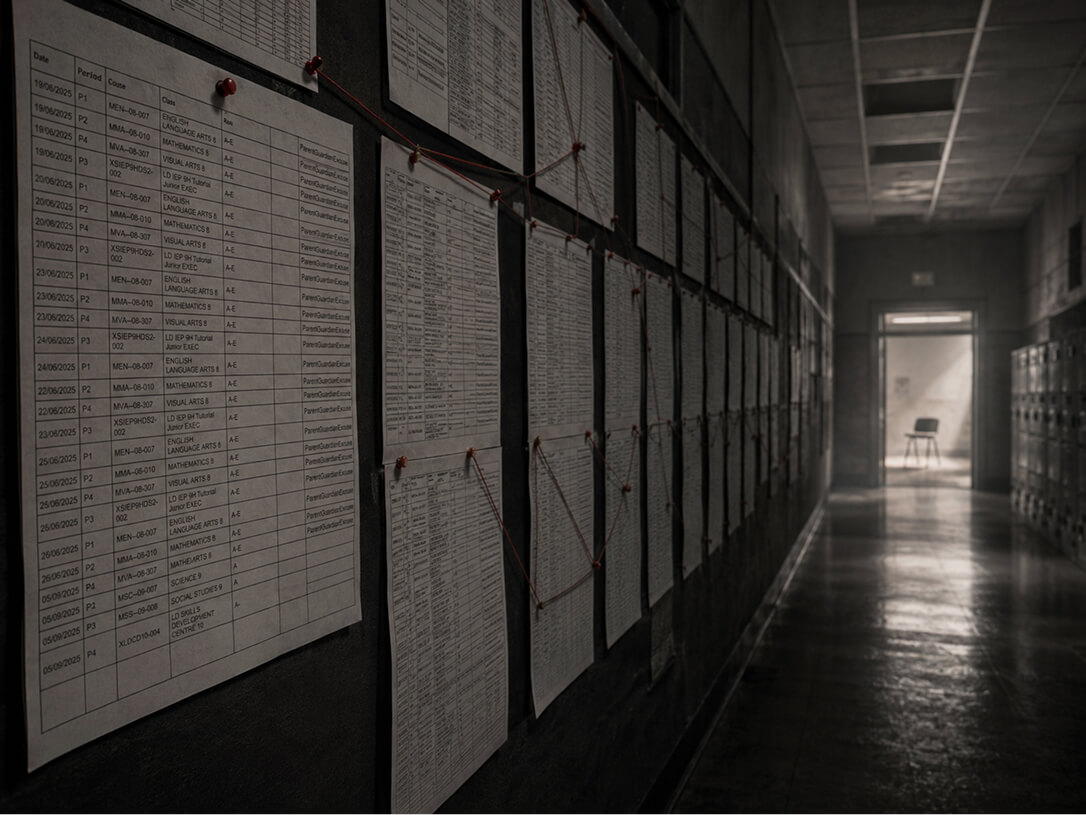
School District 83 (North Okanagan-Shuswap) has released one of the most transparent updates to date on the BC Ombudsperson’s province-wide investigation into student exclusion. The district’s October 21, 2025 Regular Board Meeting agenda includes a full briefing under the heading Equity, Diversity, and Inclusion — Ombudsperson: Student Exclusion from School, and the details offer an unusually clear picture of what the investigation currently involves.
Board-level acknowledgment of the Ombudsperson investigation
According to the agenda:
- The Board received an update on the province-wide investigation into student exclusion.
- SD83 submitted three years of exclusion and suspension data.
- Investigators are drawing on multiple sources, including:
- district-level reports
- the online exclusion tracker
- a province-wide survey
- in-district visits
- SD83 received an in-person visit on October 21, 2025.
- The Ombudsperson’s team identified SD83’s newly updated Administrative Procedure 350 (Supporting Inclusion of Students in Schools) as an example of proactive leadership.
- AP 350 was developed to provide clear, district-wide expectations, consistency in practice, and strengthened staff guidance around exclusion.
- The Ombudsperson’s final provincial report is expected in 2025!!! It’s going to be an interesting month.
This disclosure is notable because SD83 is one of the few districts that has clearly stated:
- that investigators visited the district,
- that multi-year exclusion datasets have been submitted,
- that exclusion policy was reviewed and updated during the investigation, and
- that the Ombudsperson identified their new procedure as a strong model.
This level of transparency directly supports province-wide accountability and strengthens our ability to compare practices across districts.
SD83 Administrative Procedure 350
The full text of AP 350 – Supporting Inclusion of Students in Schools was approved in September 2025. It is a comprehensive, highly structured procedure that distinguishes exclusion from suspension and sets out clear expectations for inclusive practice.
Key features of AP 350
Clear commitment to full participation
- Students have the right to full-day inclusion, including field trips, sports days, concerts, and all other school events.
Exclusion as a last-resort accommodation
- Exclusion occurs only after the duty to accommodate has been fulfilled.
- Schools must collaborate with Student Support Services and, when relevant, Indigenous Education.
Protection for families
- Parents cannot be required to accompany a child for their inclusion on field trips or special days.
Defined categories of exclusion
- Gradual entry (2–3 weeks, documented start/end dates)
- School reset days (in-school or out-of-school)
- Partial-day programming (K–9 and 10–12)
Consent and limits
- Parent consent is required for partial-day programming.
- Out-of-school reset days are capped at three consecutive days without higher-level involvement.
Documentation requirements
- MyEducationBC absence coding
- Journal entries for all exclusion decisions
- E-filed forms for gradual entry and partial-day plans
Data-informed planning
- Behaviour plans and safety plans must be updated after significant incidents.
- Success plans are required for Grades 10–12 when attendance is reduced.
Equity protections
AP 350 includes explicit safeguards for:
- Indigenous students
- students with disabilities or diverse abilities
- Children and Youth in Care
- students with complex mental health needs
Why this matters
AP 350 aligns closely with the themes the Ombudsperson is examining province-wide:
- clarity,
- consistency,
- documentation,
- duty-to-accommodate requirements, and
- meaningful parent involvement.
If the Ombudsperson identifies model procedures in the final report, AP 350 is likely to be one of the examples.
Considerations
Even though AP 350 represents one of the most detailed and inclusion-oriented procedures in the province, disability advocates may still identify several areas where families remain vulnerable to exclusionary drift, administrative discretion, or systemic inequity.
- Reset days still function as de facto suspensions
The creation of “in-school” and “out-of-school reset days” offers a softer label for what is functionally an exclusion. Renaming the practice does not change its impact on the student, and families may experience these resets as unrecorded suspensions that reduce accountability, obscure data, and shift responsibility away from the district’s duty to accommodate. - Principal discretion remains broad and largely unchecked
The procedure outlines multiple decision points where the principal “may require” a student to stay home based on behavioural, environmental, or mental-health considerations. Without explicit criteria, timelines, or independent oversight built into the process, families may still experience inconsistency, pressure, or subjective judgments, especially in moments of crisis. - “Building stamina” can mask an underfunded support environment
The document uses a developmental framing—students “build stamina” for school routines—that can be supportive when properly resourced and oppressive when staffing is insufficient. Advocates may worry that students are being asked to tolerate environments that remain inaccessible because adequate support has not been provided, rather than because the child requires gradual exposure. - Absence of explicit timelines for returning to full inclusion
While AP 350 requires “reasonable” timelines for returning to full-time attendance, it does not define what reasonable means, who determines it, or what recourse families have when timelines extend indefinitely. This opens the door to long-term partial days that become normalised. - Partial-day programming still risks creating shadow exclusion
Even with consent requirements, partial-day programming can become a default solution when staffing is inadequate. Families may feel compelled to agree because the alternative is an unsafe or unsustainable situation. Consent under constraint is still constraint. - Equity language without enforcement mechanisms
The procedure names equity-deserving groups—Indigenous students, Children and Youth in Care, students with disabilities, and students with complex mental-health needs—but does not specify what enhanced protections look like in practice. Values statements without enforcement structures risk becoming symbolic rather than operational. - No requirement for independent review of repeated exclusions
If a student experiences multiple resets or repeated partial days—even when “data-informed”—the policy does not mandate escalation to a district-level review, external support, or an independent oversight process. Advocates often argue that patterns of repeated exclusion require systemic intervention, not repeated school-level adjustments. - Continued reliance on compliance-oriented behaviour plans
Although AP 350 includes language about function-based planning, many advocates will note that PBSPs and safety plans in BC often lean heavily toward compliance and behavioural management rather than sensory adaptation, regulation support, or relational safety. Without explicit guidelines for neurodiversity-affirming practice, the default approaches can reproduce the same harms.
Release the files!
School District 83 has already affirmed that it gathered three years of exclusion and suspension data, compiled it into the Ombudsperson’s template, and submitted it during the province-wide investigation. This level of clarity places the district ahead of many others, and it invites a genuine question about the district’s reasoning for keeping that same dataset inside institutional boundaries when other boards have chosen full public disclosure.
-

The architecture of responsibility in systems that harm
When a system produces predictable, patterned harm — exclusion, restraint, academic abandonment, institutional gaslighting, attrition framed as “choice,” disability-based discrimination — that harm arises from the structural design of the system itself, because structures generate outcomes with the same reliability that rivers carve their beds, and structures reveal the priorities…