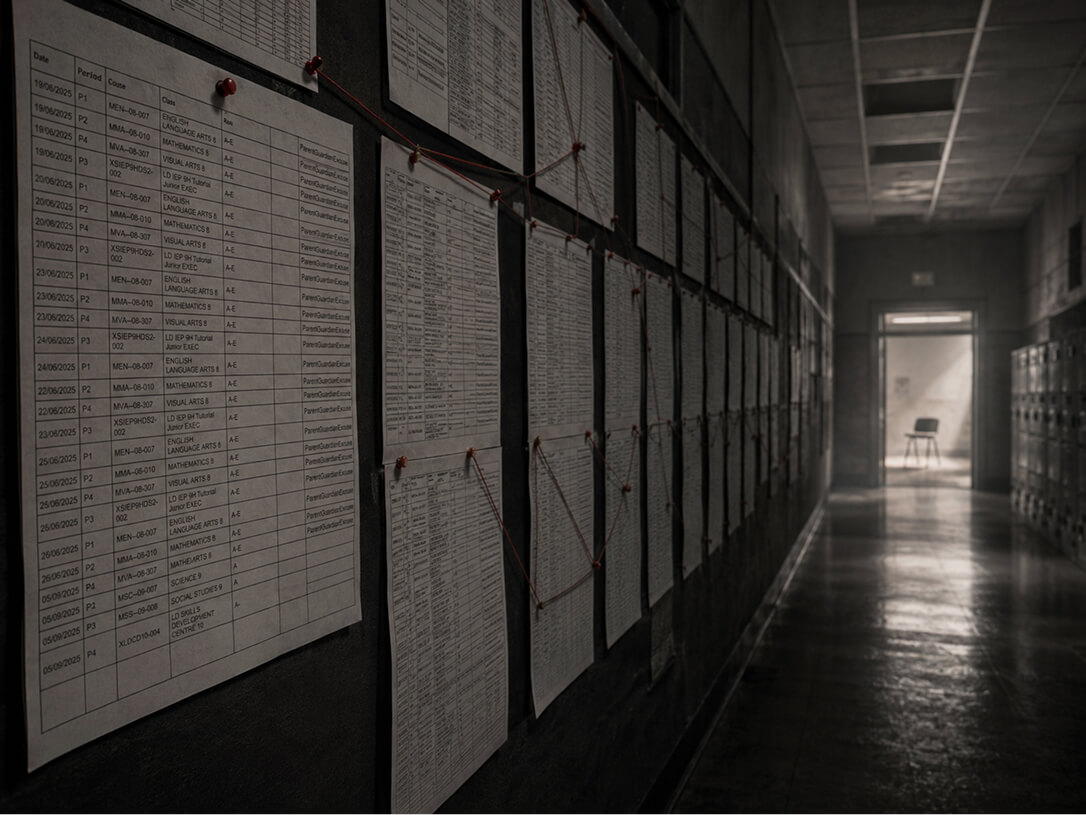
Between 2014 and 2023, education assistants in British Columbia filed more than four times as many violence-related injury reports with WorkSafeBC than teachers, a disproportion that exposes the material reality of who absorbs classroom harm where support has been systematically withdrawn.
According to WorkSafeBC data referenced in Want to Improve Schools? Education Assistants Have Ideas, teaching assistants made 2,120 reports compared to 453 from teachers over that period, reflecting not only workplace risk but a pattern of responsibility without authority that defines the education assistant role.
Education assistants occupy a grey zone between responsibility and authority, between witnessing harm and possessing the institutional standing to name it. This grey zone functions as infrastructure: it organises school labour such that the feminised tier absorbs systemic policy failures—failures subsequently narrated as individual inadequacy or unavoidable crisis rather than as deliberate outcomes of funding and staffing decisions.
Feminised labour and systemic devaluation
91 percent of education assistants in British Columbia are women, a demographic concentration that mirrors historical patterns in care roles stripped of economic and professional recognition. According to the Government of Canada’s Job Bank, women dominate the occupation even as it requires post-secondary education, apprenticeships, or significant on-the-job training.
Despite educational requirements and direct experience supporting students with diverse needs, many education assistants earn modest hourly wages. Recent labour market data shows median wages around $29.50 per hour in British Columbia, with low-end wages near $23/hour and high-end near $34/hour—figures that translate into annual incomes well below provincial norms when compressed into school-year schedules.
This wage structure, combined with truncated work calendars (typically aligned with school hours and unpaid summer breaks), places many assistants in precarious financial positions. Even when salaries seem competitive on an hourly basis, annual take-home earnings can fall below sustainable living thresholds because work is limited to school terms without paid breaks. The human cost of this compression becomes visible in individual lives.
One EA I knew, who my son loved, worked the night shift at a homeless shelter downtown, and then came to sit in a closet with my son all day at school, where they played cards and Trouble. She mentioned getting sick all the time from lack of sleep and getting bed bugs from being in close proximity to unhoused folks. She also mentioned she could not pay her rent from the salary she earned supporting my son.
Debby Kabesh notes that “some education assistants [work] two or three jobs just to get by.” Kabesh, a fifteen-year veteran education assistant in Delta who rotates across five classrooms daily, describes the central contradiction of the work: “It’s knowing that I can’t give every student the support that they need and deserve.” Qualified women perform essential, empathetic labour for wages that presume supplementary household income or permanent financial precarity, a presumption rooted in feminist political economy’s long documentation of how care work extracts capacity without compensation.
The legal grey zone as institutional strategy
The question of who bears legal responsibility for student and staff safety remains deliberately murky where education assistants are concerned. Under British Columbia’s School Act and teacher certification frameworks, classroom teachers carry an explicit statutory duty of care, legally positioned to stand in loco parentis—”in the position of a caring, responsible parent”—and thereby obligated to safeguard students under their supervision. Education assistants, by contrast, operate outside the Teaching Profession Act’s regulatory apparatus and possess no parallel statutory duty of care, despite routinely supervising students, managing behavioural crises, and absorbing physical aggression.
WorkSafeBC articulates a broader principle in its school safety guidance: “All workers, supervisors, and employers have a responsibility to help prevent workplace violence in schools,” a formulation that distributes obligation across the workforce without specifying how education assistants—who lack formal authority, standardised training, or enforceable procedural guidelines—are meant to fulfil that responsibility.
This diffusion of responsibility produces a familiar outcome. When a student strikes an education assistant, accountability fragments because:
- No clear standards exist against which to measure adequacy of EA support (there are no mandatory provincial training requirements);
- Incidents are systematically underreported (education assistants working without planning time lack capacity to file reports, and many schools maintain cultures that discourage documentation);
- WorkSafeBC investigations examine immediate incident conditions rather than systemic factors—chronic understaffing, fragmented training, rotation patterns that isolate EAs across multiple classrooms—that produce environments in which violence becomes statistically probable;
- Consequences for violations, when violations are found, remain minimal, generating no institutional pressure for structural change.
As Violence Against Education Assistants and Teachers Underreported, Say Unions documents, education assistants account for a disproportionate share of violence-related injury claims, yet remain structurally peripheral to safety planning and decision-making. They are workers when injured, but not professionals when safety protocols are designed.
In this sense, education assistants occupy what theorist Jasbir Puar describes as a condition of debility: positioned as having capacity—able to supervise, to intervene, to absorb—without status. They are required to labour under predictable risk without access to the professional protections or authority granted to teachers. The grey zone is not accidental. It functions strategically.
When violence occurs, the absence of clear regulatory standards allows districts to locate failure at the individual level. The education assistant lacked sufficient training. Misread the situation. Failed to de-escalate. The systemic conditions that made violence statistically foreseeable—insufficient staffing ratios, inadequate training budgets, inappropriate placements—remain unexamined. Legal ambiguity thus performs an institutional alchemy: systemic neglect is transmuted into individual culpability, protecting decision-makers while leaving the feminised workforce to absorb both physical injury and narrative blame.
-

Wait and see: a mother’s warning
Before kindergarten began, we told them—unequivocally, painstakingly, with as much specificity as we could muster—that our son had been harmed in daycare, that he had a long line of diagnoses and was awaiting an autism assessment, that his nervous system was thrashed, and…
Training fragmentation and individualised failure
Crisis intervention, behaviour management, and de-escalation skills constitute the practical core of education assistant work in classrooms where students experience significant distress. Yet British Columbia maintains no mandatory provincial training standards for education assistants. The education ministry is “currently working on a competency framework” for education assistant training programs in provincial post-secondaries, but the framework remains voluntary, ensuring that training variation across districts persists indefinitely.
The consequences of this policy vacuum have become visible across eight years of conversations with educational assistants assigned to support my child. Most arrived carrying minimal preparation and conventional assumptions that collapsed against pathological demand avoidance support strategies, which require approaches fundamentally opposed to traditional behavioural paradigms. Frequently embedded in those same schools was an institutional ideology insisting I would be “glad to drop my kid off” and “wouldn’t want to know what happened during the day.” Vancouver School District operates from a default assumption that parents neither care nor deserve information, that incidents can be brushed under the carpet without consequence. This presumption generated nightmares through the night and heart palpitations across every school day.
I understood how rapidly my child moved from frustration to biting, how easily dysregulation escalated beyond what untrained adults could recognise or contain. I found myself providing on-the-job training alongside insistence that I wanted the truth—that when my child bit someone, I required immediate notification so I could ensure appropriate care, trauma-informed intervention following relate-regulate-reason protocols Dr. Bruce Perry designed for exactly these moments of nervous system collapse.
One truth emerged from watching my child abused in daycare: when adults carry responsibility for children’s safety without possessing the skills that responsibility demands, danger becomes structural, inevitable, a question of when rather than whether harm will occur. I have witnessed many women dig deep in their roles as educational assistants, watched stress etch itself across their faces as they absorbed impossible positions—pushed into situations offering no remedy, no relief, no pathway toward competence or support, only the endless requirement to endure what amounts to institutional torture. This must end.
The pattern operates predictably. Education assistants earn poverty wages, receive minimal or no training, absorb regular violence, and are systematically excluded from planning and decision-making—the system fails them before they ever enter a classroom. Yet when an education assistant cannot successfully de-escalate a student in crisis, districts erase every structural gap they created—the missing training, the impossible caseload, the rotation across five classrooms, the absence of planning time—and replace all of it with a single narrative: this worker was inadequate. Fragmentation at the policy level generates failure at the individual level, failure districts then cite as justification for surveillance, remediation, or discipline of the worker herself, rather than as evidence that the institution engineered conditions no human could sustain.
The tragedy compounds for the children who depend on these relationships. When education assistants burn out, leave the profession, or are reassigned mid-year, disabled students lose the adults who understood their communication patterns, their regulation strategies, their trust. Precarity does not merely harm workers—it severs the relational continuity inclusion requires.
-

Exhaustion as governance in BC education
The spears came out fast when news broke that Coquitlam School District had spent $38,000 on a professional development retreat at Harrison Hot Springs—sharp, righteous, aimed directly at teachers who dared to spend two days somewhere pleasant while children sat in hallways, while…
The exclusion connection
Education assistant precarity does not merely correlate with exclusionary discipline—it enables it. Understaffing forces assistants into perpetual emergency mode, pulled between crises rather than delivering planned support. Students are excluded from field trips, activities, entire school days because no assistant is available. Participation becomes conditional on staffing rather than guaranteed by right. When incidents escalate, districts respond not by increasing support but by reducing access: partial schedules, room clears, “safety plans” functioning as containment. These practices persist because the adults most aware of their harm lack standing to challenge them. Education assistants witness patterns—who is sent home, whose distress is framed as danger—but possess no protected time, professional status, or continuity to document what they see. Precarity renders exclusion invisible: high turnover erases institutional memory, injuries go unreported, families are told accommodation is impossible, and workers who know otherwise leave before they can contradict the narrative.
The infrastructure made visible
British Columbia’s education assistants operate within deliberate architecture—one organising feminised labour to absorb systemic failure while preventing accountability. Legal ambiguity, fragmented bargaining, inconsistent training, information exclusion, diagnostic funding gaps, and chronic understaffing interlock to produce a system depending on education assistant vulnerability to function as designed. The violence data makes the cost visible: more than four times as many injury claims filed by education assistants as by teachers over the past decade, predictable outcomes of assigning risk downward while distributing authority upward. If education assistants possessed regulated training, full-time employment, professional standing, and decision-making power, the gap between inclusive education policy and exclusionary practice would become unbearable. That pressure is precisely what precarity absorbs. Until dismantled, exclusion will continue framed as necessity rather than choice, and the workers making inclusion possible will continue paying for its absence with their bodies, their income, and their silence.
-

Justice and dignity too expensive for BC NDP
In 2018, experts told BC exactly how to fix special education funding. The government has spent five years “consulting” instead. Meanwhile, your child sits in hallways. The 192% problem nobody wants to fund Between 2015 and 2024, autism designations in BC schools exploded…