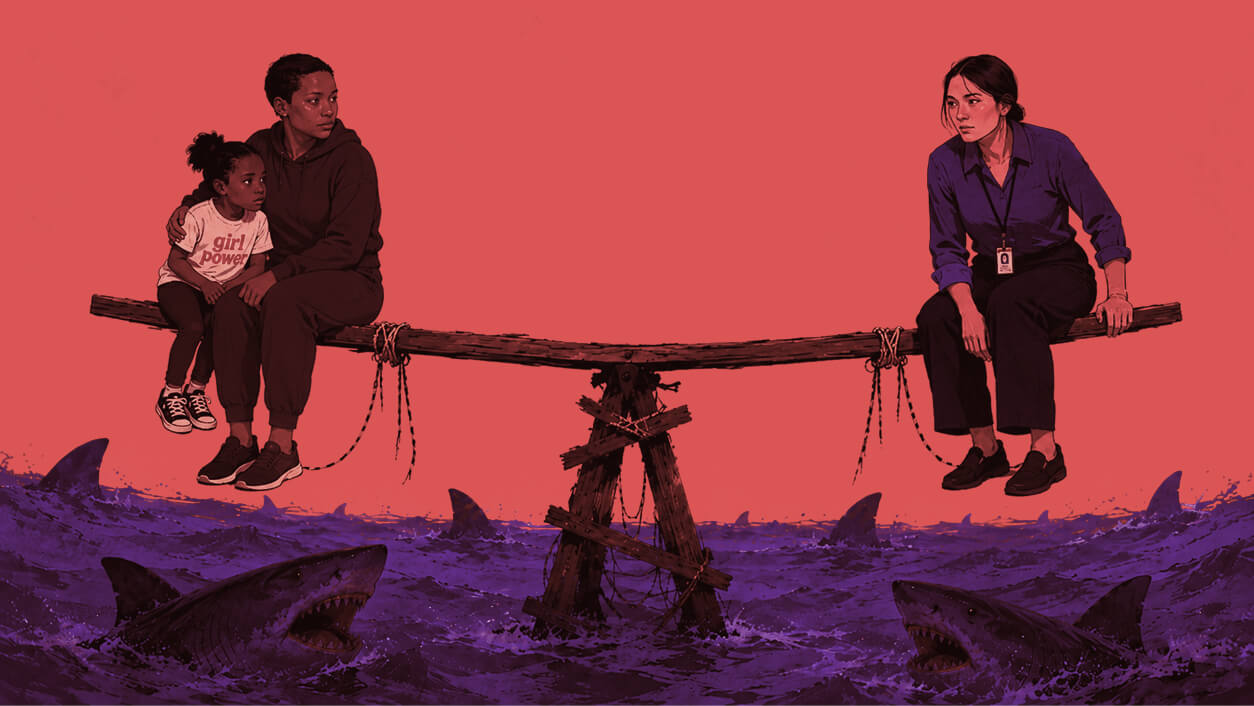
British Columbia’s inclusion failures arise from deliberate failure of BC education funding, which ensures inclusion cannot succeed while obscuring that failure as disabled children’s behavioural pathology, while assuaging the guilt of individual staff members. I’ve heard countless stories from parents, who’ve experienced first hand:
- the lipservice
- the bait and switch with endless meetings
- the gaslighting
- the behaviourism
- the criminalisation
- the room clears
- the acknowledgement of resilience and effort with no action
- the delays and foot-dragging, always kicking something forward a few months
- the insistence that every year is a fresh start, erasing institutional harm from prior years
- the shortened days masked as safety plans
- the constant phone calls demanding immediate pickup
- the suspensions for behaviour that is disability
- the expulsions dressed as placement recommendations
- the IEPs written but never implemented
- the accommodations promised then quietly withdrawn
- the assessments demanded then ignored
- the parent expertise dismissed as interference
- the strategies that work at home rejected as impractical for school
- the emergency evacuations performed as theatre demonstrating danger
- the collective punishments closing playgrounds and cancelling field trips
- the peer isolation engineered through systematic exclusion from activities
- the behaviour charts and token economies treating children as subjects requiring conditioning
- the lunch detention and recess revocation for dysregulation children cannot control
- the demands for medication as condition of attendance
- the demands for constant outside therapy as condition of attendance
- the constant shift in focus from how school supports the child to how things are going at home
- the threats of Ministry involvement if parents don’t comply
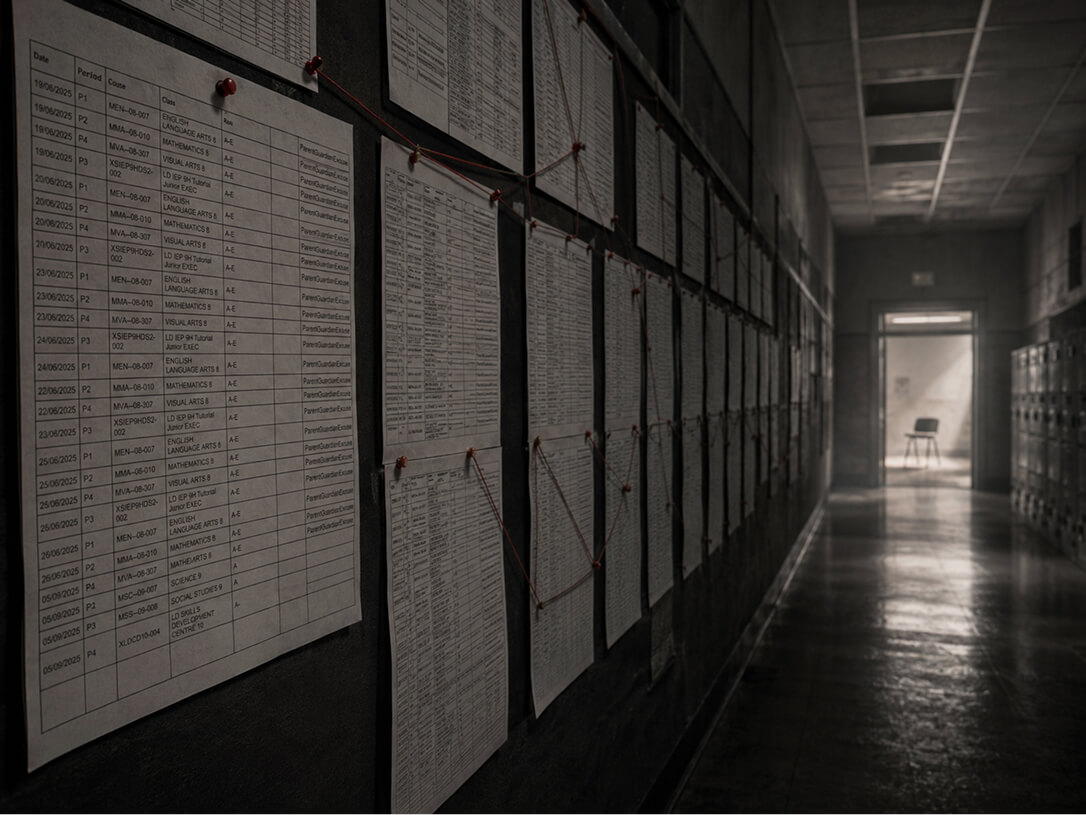
- the documentation of every meltdown building paper trail for removal
- the safety rhetoric weaponised against disabled children
- the appeals to other children’s rights positioned against disabled child’s existence
- the refusal to intervene when disabled children are being bullied or harmed
- the charitable framing of inclusion as generous accommodation rather than legal obligation
- the low expectations and warehousing of disabled children
- the alternative programming segregating children in basement classrooms
- the graduation plans streaming disabled children toward dead-end transitions
- the refusal to provide communication devices or mobility supports
- the refusal to provide sufficient communication enabling school-family collaboration
- the denial of sensory accommodations as too disruptive
- the positioning of stimming as behaviour requiring correction
- the treatment of shutdown as noncompliance warranting consequence
- the interpretation of demand avoidance as wilful defiance
- the framing of meltdown as manipulation
- the insistence that trauma-informed approaches enable bad behaviour
- the engineered resentment as other students blame disabled child for lost privileges
- the parent meetings where school presents united front of professionals explaining why inclusion cannot work for this child
- the quiet pressure to accept that some children simply cannot be served in public schools, that their needs exceed what reasonable accommodation requires, that separation serves everyone’s interests including the child’s own—wouldn’t the parents prefer a program designed specifically for children like theirs, somewhere else, somewhere smaller, somewhere separate, somewhere that isn’t here, ideally at home, on the family’s own resources
As one advocate said to me, they are keeping us busy, while our children swirl the drain.
Just a Parent
It’s a lot of dysfunction and victim blaming and I keep circling the question of where all this is coming from?
Drawing on Dillbary and Miceli’s economic analysis of collective punishment, this article extends their framework from legal enforcement to education policy, showing how provincial funding structures generate rational institutional practices—collective punishment and performative inclusion—that transform funding inadequacy into apparent evidence that disabled children themselves are the problem.
I demonstrate how BC’s designation funding model, staffing ratios, specialist allocation, infrastructure design, and professional development systems create impossible conditions at the school level. Within those conditions, schools rationally deploy costless sanctions and refuse labour-intensive supports, producing visible failure that justifies exclusion and engineers parent consciousness hostile to inclusion. This dynamic suppresses political pressure for adequate funding, ensuring provincial policy choices remain insulated from accountability. Breaking the cycle requires recognising disabled children as scapegoats for provincial austerity and implementing funding reform aligned with the actual material requirements of inclusive education.
-

Collective punishment: how schools displace guilt, erase harm, and preserve the collective
One of the things that was so traumatising about the collective punishment that was callously perpetrated against my daughter was the light and evasive tone of the principal. She said that the punishment had to be “swift.” I frequently wondered about the choice…
When British Columbia schools close playgrounds because a disabled child seeks sensory input, document chronic dysregulation without providing regulation support, or frame disabled students as threats to peer access, these are not isolated failures. They are predictable outcomes of funding structures designed to make inclusion fail while ensuring that failure is misattributed to individual pathology rather than to provincial policy.
This article analyses how BC’s education system operates as a multi-scalar justification mechanism. Provincial underfunding produces impossible conditions; districts and schools respond rationally to those constraints; parents witness only the resulting chaos. At each scale, actors reference constraints imposed by adjacent levels, creating a closed loop in which no institution appears responsible and exclusion becomes both normalised and politically invisible.
Using Dillbary and Miceli’s (2023) economic theory of collective punishment, I show how schools deploy group sanctions and refused supports not as moral failures but as efficient institutional strategies under scarcity. These strategies simultaneously manage immediate crises, generate documentation justifying permanent exclusion, and engineer parent consciousness that attributes system dysfunction to disabled children rather than to funding design.
The analysis draws on province-wide documentation of exclusion practices across British Columbia’s sixty school districts, policy analysis of funding and staffing formulas, and autoethnographic material from 19 years navigating these systems as a parent of disabled children. A previously published case study of a kindergarten child punished for ice-seeking behaviour illustrates how abstract funding constraints materialise as concrete disciplinary practices that manufacture peer resentment while withholding the supports that would enable inclusion to succeed.
-

Collective punishment at Vancouver School Board: when one disabled child’s behaviour closes the playground
On December 20, 2017, my kindergarten child Robin went onto an ice field during recess at his school in Vancouver. Robin loved ice—the sensory experience, the visual shimmer, the way it cracked and moved under small feet. The school had asked all students…
Scapegoating as political stabilisation in BC education funding
British Columbia’s education system is underfunded for all students. Overcrowded classrooms, insufficient staffing, degraded infrastructure, and reduced programming are not failures of inclusion but the predictable result of sustained provincial funding decisions.
In principle, this should produce a broad political coalition of parents demanding adequate investment. Parents of disabled and non-disabled children share the same material interests: manageable class sizes, sufficient specialist support, functional infrastructure, and schools resourced to serve diverse learners without rationing attention or care.
That coalition does not emerge. Instead, scarcity produces division. Under current conditions, disabled children are made visible as competitors for limited resources, while the provincial funding choices that create scarcity remain obscured. Parents of non-disabled children come to see disabled students as the source of diminished educational access; parents of disabled children are isolated into individual, exhausting struggles. Both groups interpret system failure as either inevitable or caused by inclusion itself, rather than as the result of deliberate underinvestment.
This division serves a clear political function. Collective punishment and performative inclusion ensure that the effects of underfunding appear as evidence that disabled children cannot be accommodated in mainstream settings, rather than as evidence that funding is inadequate to educate all children well. The resulting conflict redirects political pressure away from government and toward exclusionary solutions that require no additional investment.
The system therefore sustains itself. By preventing parents from recognising their shared interests and organising collectively, scapegoating stabilises chronic underfunding and justifies the continuation of the current model. Disabled children absorb blame for failures that harm everyone, allowing government to avoid the political cost of funding education at adequate levels.
BC education funding: structural design for inclusion failure
British Columbia’s Ministry of Education funds districts through mechanisms that systematically prevent disabled children from accessing appropriate education in mainstream settings while presenting this failure as an unavoidable technical constraint rather than a policy choice.
Categorical design
As I’ve written about previously in The right amount of agony in BC Schools, BC allocates supplementary funding through categorical designations tied to fixed dollar amounts that operate inversely to intuitive numbering—Level 1 designations receive the highest funding while Level 3 receives the lowest, structured according to the intensity of support required. The BC Ministry of Education and Child Care establishes these rates annually through its Operating Grants Manual, with 2025/26 allocations set at “$51,300” per student for Level 1 designations (encompassing physically dependent students and those who are deafblind), “$24,340” per student for Level 2 designations (including moderate to profound intellectual disability, physical disability or chronic health impairment, visual impairment, deaf or hard of hearing status, and autism spectrum disorder), and “$12,300” per student for Level 3 designations (addressing intensive behaviour interventions and serious mental illness).
These supplementary amounts function as additional allocations beyond the basic per-student funding, directed specifically toward students “with disabilities or diverse abilities” who require support infrastructure exceeding what the standard allocation accommodates, with provincial policy recognising that inclusive education demands “additional staff, specialised learning materials, physical accommodations or equipment, and assessments” to enable students to meet educational and social needs. The Ministry’s categorical framework divides these eight funded designations into what education policy documents term “low incidence” categories (A through H, which receive supplementary funding) versus “high incidence” categories (K through R, which receive no additional provincial allocation beyond the base per-student amount), establishing a funding architecture that presumes certain disabilities and diverse abilities impose measurably higher institutional costs than others—a presumption that carries profound implications for which students receive adequate accommodation and which must manage with resources already stretched across multiple competing demands.
Simple, right?
This system delays support until assessments are completed, disconnects funding from actual need, and incentivises administrative labour aimed at securing designations rather than providing timely accommodation. Most critically, it frames disability support as an exceptional add-on rather than a predictable feature of student populations that funding formulas should accommodate as baseline.
Students wait while districts pursue paperwork.
-

The right amount of agony in BC schools
After watching my children endure eight years of institutional failure, eight years of exclusion disguised as discipline and support withheld under the language of inclusion, I have come to several conclusions. Certain forms of suffering—like being agonised inside—do not draw support because they…
By assuming a normatively “typical” student and treating disability as deviation requiring special justification, the province ensures that inclusion remains structurally under-resourced regardless of how districts allocate funds internally.
Staffing ratios
Provincial funding produces class sizes averaging 1:24.4 secondary (Grades 8-12) and 1:25.8 intermediate (Grades 4-7) across BC, according to class size data collected by the BC Ministry of Education and Child Care, though urban districts face even more severe ratios—Vancouver operates with intermediate classes averaging 27.1 students and secondary classes averaging 25.2 students, with individual classrooms routinely exceeding these district averages while maintaining aggregate regulatory compliance.
Educational Assistant allocations flow from categorical funding formulas rather than individualised assessment of student need—district policy documents confirm that “schools receive an allocation of EA hours based on” district-level formulas, with supplementary funding “not targeted to specific students” but rather “provided to boards of education to support the needs of students within their district,” as SD60 explicitly states. These ratios make individualised attention, co-regulation, and relationship-based support structurally impossible. Teachers managing twenty-five to twenty-seven students cannot provide sustained regulation support or repair work after incidents. Educational Assistants shared across multiple students cannot prevent escalation. Specialists appear briefly, assess, and depart.
These ratios reflect funding choices that prioritise fiscal constraint over the labour inclusion requires, while framing resulting failures as inevitable workload realities.
Specialist allocation
Specialist services—speech-language pathologists, occupational therapists, behaviour consultants, psychologists—operate on consultation models dictated by collective agreement staffing ratios that render sustained therapeutic relationships structurally impossible: school psychologists serve minimum ratios of 1:1800 students, speech-language pathologists 1:1250, counsellors 1:600, and student support teachers 1:440. These caseloads permit specialists to conduct brief assessments, write recommendations schools cannot implement, and provide occasional consultation insufficient for understanding individual students’ needs developing over time in context. A psychologist managing 1800 students across multiple schools cannot establish therapeutic rapport, track developmental trajectories, or adjust interventions based on ongoing observation. A speech-language pathologist serving 1250 students cannot provide the weekly or biweekly sessions research demonstrates as necessary for meaningful progress in language development or articulation disorders.
This structure generates the appearance of support while ensuring that meaningful intervention cannot occur. Districts report compliance with minimum staffing ratios while specialists themselves operate in perpetual triage, assessing crisis after crisis without capacity for prevention, relationship-building, or longitudinal understanding of the students they ostensibly serve.
Infrastructure and environment
School buildings are designed for narrow sensory and physical profiles—fluorescent lighting triggering migraines, industrial acoustics amplifying noise, crowding preventing movement and regulation, playground equipment serving limited range of needs. These environmental conditions continuously overwhelm disabled students, producing predictable dysregulation that schools interpret as behavioural pathology requiring management rather than as communication about environmental hostility.
Don’t get me started about earthquake safety!!!
Professional development
BC emphasises one-off inclusion workshops without providing sustained coaching or collaborative implementation support. This allows the province to claim investment while ensuring that training cannot translate into practice under existing conditions.
-

UIP and the business of education
Vancouver’s Urgent Intervention Process—once called the Multi-Disciplinary Intervention Support Team, or MIST—was designed to respond when schools reached the limits of their capacity to support a child in crisis. The name once suggested a circle of professionals surrounding a child with care. As the system evolved,…
Collective punishment as rational institutional strategy
Dillbary and Miceli’s (2023) analysis explains why institutions punish groups for individual behaviour when sanctions appear cheap and enforcement resources are scarce. In criminal law contexts, enforcers sanction entire groups to identify perpetrators or create deterrence by making group members police each other’s behaviour.
The framework applies to schools when institutions penalise all students for individual disabled children’s actions—closing playgrounds because one autistic child seeks sensory input, restricting classroom activities because one student exhibits dysregulation, cancelling field trips because one disabled child requires accommodation the school refuses to provide.
Disabled children occupy the “sinner” position—identified as rule violators whose behaviour schools frame as threatening peer safety. Non-disabled children become “scapegoats”—innocent parties experiencing deprivation they learn to attribute to disabled peers rather than to institutional choices creating the connection between individual behaviour and group consequence.
This operates through economic logic: closing playgrounds requires no resources while providing supervision enabling disabled children’s safe sensory exploration would require adult time, planning, potentially additional staffing, and environmental modification. Dillbary and Miceli demonstrate that when punishment appears costless from enforcer perspectives, institutions consistently choose collective sanctions over individualised accommodation. Schools facing provincial funding constraints that make adequate support impossible deploy collective punishment as rational efficiency strategy achieving immediate behavioural management while producing no institutional cost.
Crucially, collective punishment operates through what Dillbary and Miceli identify as cost discounting—institutions systematically ignore harm to marginalised groups while carefully weighing costs to dominant populations.
Just a Parent
Schools calculating playground closure costs weigh administrative simplicity but never weigh disabled children’s social isolation, the engineered peer resentment. These costs remain invisible because disabled children’s wellbeing registers as irrelevant to efficiency analysis treating inclusion as optional accommodation rather than as legal obligation.
-

How schools plan to fail autistic girls while pretending to support them
In January 2025, my daughter’s school closed her Urgent Intervention Plan with a calm, administrative gesture that belied the violence of what had taken place—not only in the school hallways, but in the documentation itself. It came wrapped in phrases like gradual re-entry, verbal reinforcement, and classroom reintegration, but what it really contained was a careful distortion of reality, designed to shift blame, protect the institution, and deny her the right to be fully…
BC education funding: refusing the supports that would enable successful inclusion
Beyond collective punishment, schools perform inclusion while withholding the labour that would allow it to succeed. Rather than implementing regulation support, therapeutic reintegration after incidents, repair work enabling relationship building with peers, or environmental modifications addressing sensory needs, schools allow disabled children to remain in ongoing dysregulation, document behavioural incidents without addressing underlying causes, and permit crisis cycles to continue without intervention preventing recurrence.
This pattern emerges from identical cost calculation producing collective punishment. Providing adequate regulation support requires sustained adult presence, relationship building, co-regulation during distress, therapeutic processing after incidents, and repair work with affected peers—interventions demanding significant institutional labour within staffing ratios provincial funding makes impossible.
Refusing support and allowing ongoing dysregulation costs schools nothing while generating multiple institutional benefits: documented evidence positioning disabled child as dangerous to others, visible chaos other parents attribute to inclusion itself rather than to inadequate support, justification for collective punishment framed as protecting peers from legitimate threat, and accumulated incident reports building case for separate programming.
The regulation-reconnection-reflection sequence transforms behavioural incidents into learning opportunities enabling disabled children to develop skills, repair peer relationships, and reduce future crisis occurrence. Schools systematically refuse this work because it requires sustained adult labour: time with the disabled child during calm to process what happened and identify alternative strategies, facilitated conversation with affected peers acknowledging harm and rebuilding trust, follow-up ensuring strategies get reinforced, and ongoing adjustment based on what proves effective.
This refusal ensures behavioural patterns persist rather than improve, crisis cycles continue rather than diminish, and peer relationships deteriorate rather than develop—accumulating incidents and damaged relationships providing evidence justifying exclusion while the refused support work that would have prevented accumulation remains invisible in school documentation claiming the child “cannot function in mainstream environment despite supports provided.”
-

The moral cost of leaving children in fight-or-flight
Robin was eleven the day he fell and came up swinging. It was recess, and something had happened—a misstep, a bump, a collision on uneven ground. His body hit the pavement. And when he rose, disoriented and humiliated, the first thing in his path was his best friend. So he…
BC education funding provides multi-scalar justification and political insulation
The system’s power emerges from how justifications at each institutional scale reference constraints at adjacent scales, creating closed loop where no single level acknowledges designed nature of overall structure.
- Provincial scale: The Ministry positions itself as providing adequate resources while granting districts allocation autonomy. When inclusion fails systemically, the province references local decision-making—districts choose staffing, determine priorities, design professional development. This obscures that BC education funding levels structurally prevent adequate inclusion regardless of district choices.
- District scale: Districts facing BC education funding inadequacy position themselves as managing impossible constraints through efficient allocation. When schools exclude disabled students, districts reference provincial limitations while simultaneously deferring to school-level professional expertise. Districts claim they cannot override front-line practitioner autonomy, avoiding accountability for exclusion while appearing responsive to both provincial constraints and local judgment.
- School scale: Schools position themselves as lacking resources necessary to support disabled students while claiming inclusion commitment. Principals cite insufficient hours, overwhelmed teachers, limited consultation, competing demands. Schools frame exclusion as responding to observable evidence—ongoing dysregulation despite supports provided, needs exceeding capacity, safety risks requiring protective separation—never acknowledging their choices to deploy collective punishment and refuse regulation support that would enable success.
- Interpersonal scale: Parents of non-disabled children witness disabled children’s visible dysregulation, experience their children’s lost privileges through collective punishment, and absorb school explanations positioning disabled students as sources of problems. These parents develop understanding that disabled children create chaos, that inclusion compromises their children’s education and safety, that separation serves everyone’s interests.
This parent consciousness references all higher system levels as validating their conclusions—schools explain resource lack, districts confirm BC education funding constraints, province articulates inclusion values while providing insufficient investment. Parents interpret this as proving inclusion itself unrealistic rather than recognising funding inadequacy as policy choice.
Each scale positions itself as responding reasonably to constraints beyond its control while pointing to adjacent scales as decision-making loci. The province claims districts make allocation choices, districts defer to school-level judgment, schools cite resource limitations from province and district, parents demand exclusion or accept scarcity while blaming disabled children. This circular referencing ensures no institution accepts responsibility—each appears to function rationally within limitations others impose, obscuring that overall structure produces disabled children as scapegoats for insufficient BC education funding.
-

The material costs of educational harm
My son no longer attends school. He no longer wants anything the education system offers. He has taught himself programming, navigates Linux with expertise that exceeds my own knowledge, learns alone in his room because learning with others became too expensive to survive.…
Engineering parent consciousness: The political function
Collective punishment and performative inclusion combine to engineer specific consciousness in parents of non-disabled children—consciousness serving provincial political interests by ensuring blame for education system dysfunction falls on disabled children rather than on inadequacy of BC education funding.
When schools close playgrounds, restrict access, or cancel activities in response to disabled children’s behaviour, they create visible connection between individual disabled student and collective deprivation that non-disabled children and their parents experience directly. Parents receive clear message: disabled child’s presence costs your child privileges and opportunities.
What parents see: Disabled child seeks sensory input, playground closes for all students. Disabled child exhibits meltdown, their child loses learning time. Disabled child bites peer, their child fears school. Disabled child requires Educational Assistant attention distributed unevenly. Music and other enrichment programs cancelled to support disabled children.
What remains obscured: BC education funding formulas producing impossible staffing ratios. School’s choice to deploy collective punishment rather than provide supervision. School’s refusal to provide regulation support preventing meltdowns. School’s refusal to facilitate repair work enabling peer relationships after incidents. Economic logic making these institutional choices rational within provincial funding constraints.
This engineered consciousness produces two outcomes both serving provincial interests: Parents advocate for excluding disabled children, hearkening back to the golden era of segregation. Or parents accept resource scarcity as inevitable, concluding schools lack capacity for inclusion through unfortunate but unchangeable limitations, generating no political pressure for BC education funding increases.
Both outcomes ensure the province faces no organised political demand for funding BC education at levels adequate inclusion requires.
The crucial political function involves preventing formation of parent coalitions that would demand adequate BC education funding serving all children. Parents of disabled and non-disabled children hold common interest in adequately resourced education enabling individualised attention, reasonable teacher workloads, sufficient specialist support, and appropriate environments. Collective punishment destroys this potential coalition by engineering consciousness where non-disabled children’s parents attribute lost resources to disabled children’s presence rather than to provincial funding inadequacy, ensuring parents fight each other instead of organizing collectively to demand investment serving all children.
-

The role of infighting in maintaining scarcity, hierarchies, and exclusion
This piece is unfinished, but it feels necessary. I am still learning how to move through anger toward something that might resemble repair or solidarity. I am not writing a strategy or a manifesto; I am writing what I see, what keeps happening,…
Why reform fails and what adequate funding requires
British Columbia implements periodic inclusion reforms addressing rhetoric, training, or process without increasing BC education funding enabling actual inclusion practice. The province develops inclusion policies articulating values, mandates district plans, requires schools document accommodation efforts, funds professional development workshops. These reforms fail predictably because they address symptoms while leaving causal funding inadequacy intact.
Schools receiving inclusion policy directives continue operating within identical resource constraints—same staffing ratios preventing individualised attention, same specialist unavailability preventing sustained therapeutic relationships, same infrastructure hostility requiring constant regulation effort, same overwhelming demands producing teacher exhaustion. Schools cannot implement inclusion values when BC education funding prevents acquiring resources inclusion requires, so policy directives become performative documents demonstrating ideological commitment while actual practice continues excluding disabled children through mechanisms resource constraints make inevitable.
Adequate inclusion requires transforming BC education funding to enable: staffing ratios permitting individualised attention and relationship building (approximating 1:15 primary, 1:20 secondary, with additional Educational Assistant hours based on assessed need rather than categorical designation); needs-based funding replacing categorical systems that delay support and disconnect funding from actual requirements; specialist allocation structured as sustained therapeutic relationships rather than brief consultation; infrastructure investment creating sensory-appropriate environments through acoustic treatments, alternative lighting, quiet regulation spaces, varied seating and movement options; and professional development restructured as sustained implementation support with regular coaching, collaborative planning time, peer learning communities, and accessible specialist consultation.
These investments remain within provincial fiscal capacity but require acknowledging current underfunding as policy choice rather than inevitable constraint. The Institute for Public Education demonstrates that if British Columbia maintained education spending at the percentage of GDP rate the province allocated in 2000, current grants to school districts would increase by $3.8 billion—from $6.754 billion to $10.552 billion annually. This represents 56% increase restoring BC education funding to previous provincial commitment levels, not expanding beyond what BC historically considered appropriate investment.
Comparative provincial analysis reinforces that inadequate BC education funding reflects political priorities rather than fiscal impossibility. Despite recording fourth-highest growth in inflation-adjusted per-student spending between 2012/13 and 2021/22, British Columbia ranks eighth nationally in actual per-student spending—BC increased spending 6.7% over the decade while Quebec increased 33.7%, Prince Edward Island 21.6%, and Nova Scotia 12.3%. British Columbia maintains education investment below several provinces achieving better inclusion outcomes, indicating the province could fund adequate inclusion through modest reallocation matching peer jurisdictions’ commitment levels.
The province frames current spending as constrained by competing demands and limited revenues, but this framing obscures that education investment represents political choice about budget priorities. Other Canadian provinces allocate education resources at levels BC could match through revenue measures or spending reallocation the province declines to implement because avoiding those choices serves political interests—maintaining lower taxes or protecting other spending priorities the electorate might favour—while disabled children absorb costs through systematic exclusion the scapegoat mechanism prevents becoming politically salient.
-

The question they refused to ask: adequate funding and the architecture of denial in BC schools
Between 2017 and 2020, BC reviewed education funding. The question asked: designation or prevalence? The question refused: what would adequate funding cost?
Conclusion
British Columbia implements periodic inclusion reforms addressing rhetoric, training, or process without increasing BC education funding enabling actual inclusion practice. The province develops inclusion policies articulating values, mandates district plans, requires schools document accommodation efforts, funds professional development workshops. These reforms fail predictably because they address symptoms while leaving causal funding inadequacy intact—inadequacy rooted in historical destruction requiring remediation current reforms cannot provide.
The BC education funding crisis originates in deliberate policy choices during the Gordon Campbell and Christy Clark Liberal governments (2001-2017), which systematically dismantled public education through unconstitutional legislation stripping class size and composition protections negotiated through collective bargaining. The BC Teachers’ Federation challenged this legislative overreach through fifteen years of court battles, ultimately winning unanimous Supreme Court of Canada decision in 2016 (British Columbia Teachers’ Federation v. British Columbia, 2016 SCC 49) requiring restoration of illegally removed contract language. The ruling forced government to reinstate class size limits and composition requirements, costing approximately $322 million annually just to restore what was unconstitutionally stripped—but restoration to 2001 baseline occurs within context where student needs increased dramatically during sixteen years of funding inadequacy and systemic neglect.
This temporal mismatch creates compound deficit: the system requires BC education funding catching up sixteen years of deliberate underfunding while simultaneously addressing current needs that vastly exceed 2001 levels. Designations increased sharply, student complexity grew, infrastructure aged without adequate maintenance, specialist shortages intensified, and teacher retention crisis deepened—all while funding remained suppressed below levels required even for 2001 student population. Current government inherited catastrophic situation requiring massive investment simply achieving baseline adequacy.
But inheriting crisis does not absolve current policymakers from responsibility to remediate damage their predecessors inflicted. Assuming governing responsibility means accepting obligation to make difficult decisions, marshal political courage for unpopular choices, explain historical damage to electorate, and allocate resources addressing both restoration deficit and current need regardless of political cost. Current government chooses instead to implement inclusion reforms requiring no political courage—policy articulations, training workshops, documentation requirements—while declining to confront BC education fundinginadequacy those reforms cannot address without substantial investment increase.
Schools receiving inclusion policy directives continue operating within resource constraints reflecting this compounded inadequacy—staffing ratios preventing individualised attention, specialist unavailability preventing sustained therapeutic relationships, infrastructure hostility requiring constant regulation effort, overwhelming demands producing teacher exhaustion. Schools cannot implement inclusion values when BC education funding addresses neither historical deficit nor current requirements, so policy directives become performative documents demonstrating ideological commitment while actual practice continues excluding disabled children through mechanisms resource constraints make inevitable.
Adequate inclusion requires transforming BC education funding to enable: staffing ratios permitting individualised attention and relationship building (approximating 1:15 primary, 1:20 secondary, with additional Educational Assistant hours based on assessed need rather than categorical designation); needs-based funding replacing categorical systems that delay support and disconnect funding from actual requirements; specialist allocation structured as sustained therapeutic relationships rather than brief consultation; infrastructure investment creating sensory-appropriate environments through acoustic treatments, alternative lighting, quiet regulation spaces, varied seating and movement options; and professional development restructured as sustained implementation support with regular coaching, collaborative planning time, peer learning communities, and accessible specialist consultation.
These investments require political courage current government demonstrates unwillingness to marshal. The Institute for Public Education demonstrates that if British Columbia maintained education spending at the percentage of GDP rate the province allocated in 2000, current grants to school districts would increase by $3.8 billion—from $6.754 billion to $10.552 billion annually. This represents 56% increase restoring education funding to previous provincial commitment levels, not expanding beyond what BC historically considered appropriate investment. But even this restoration addresses only the funding baseline problem, not the increased complexity and support needs sixteen years of neglect produced.
Comparative provincial analysis reinforces that adequate funding remains achievable: despite recording fourth-highest growth in inflation-adjusted per-student spending between 2012/13 and 2021/22, British Columbia ranks eighth nationally in actual per-student spending—BC increased spending 6.7% over the decade while Quebec increased 33.7%, Prince Edward Island 21.6%, and Nova Scotia 12.3%. British Columbia maintains education investment below several provinces achieving better inclusion outcomes, indicating the province possesses fiscal capacity but chooses to prioritise political viability over adequate inclusion funding.
Current policymakers face difficult task explaining why education requires investment substantially exceeding pre-2001 levels, but this difficulty represents governing responsibility they accepted when assuming office. Adequate inclusion funding requires explaining historical damage, articulating compound effects of sixteen years’ neglect, demonstrating how increased student complexity demands greater resources, and making the case for tax increases or budget reallocation despite electoral resistance. These represent hard choices requiring political courage, but making hard choices constitutes the work of governance—declining to make them because of political difficulty allows the scapegoat mechanism to continue operating, ensuring disabled children absorb blame for system failures while funding inadequacy remains unaddressed and policymakers avoid accountability for choosing political safety over children’s rights to appropriate education.