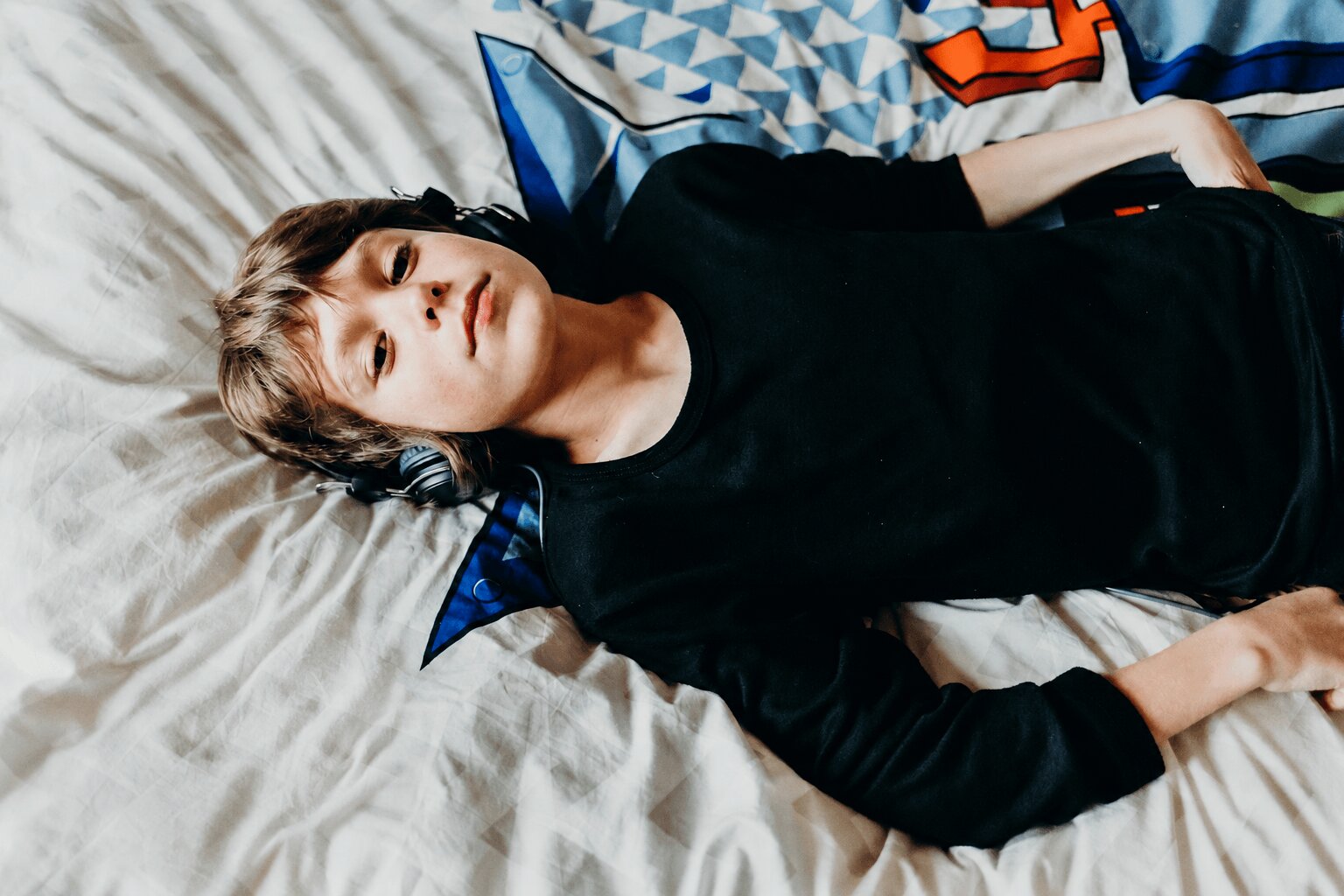
My Ollie has barely left his room since he came home exhausted from school one day last spring.
He slept twenty-three hours a day for months. He barely spoke for months and had difficulty with basic hygiene.
School chronically withdrew the supports he needed and pushed him to mask and comply until his nervous system refused.
My Ollie stopped being able to attend therapies — the occupational therapy, counselling, and appointments that had helped keep him regulated — because school had pushed him past what his nervous system could survive.
Our family has survived on the supports we accessed through autism funding. That included counselling for me, which has been necessary as I have slowly become ill from stress related to school advocacy.
That funding will be reduced.
#thisismyollie
Across BC, thousands of parents have been using #thisismyollie to name their own children: the verbal, masking, “Level 1” and “Level 2” autistic kids the Province says require less support now. Parents are listing therapies, counting dollars, explaining what regulation support actually does. They are explaining why cutting it will cause harm, and why their Ollies were already struggling under the existing system.
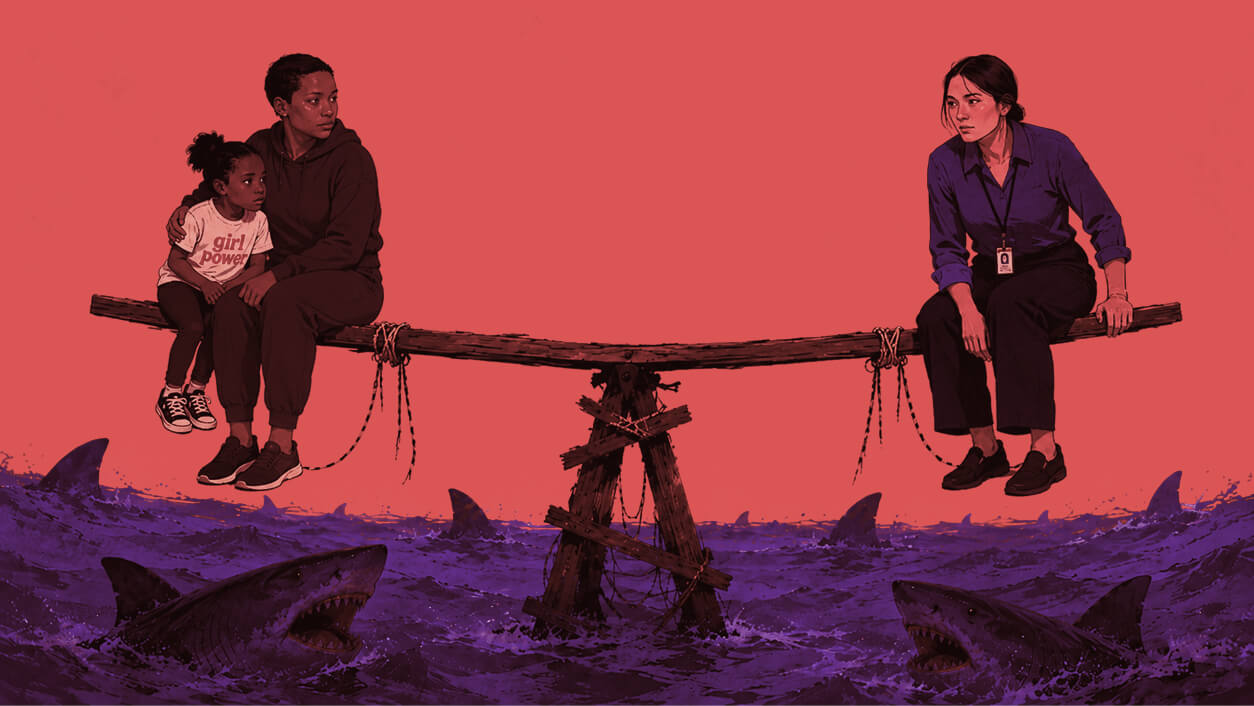
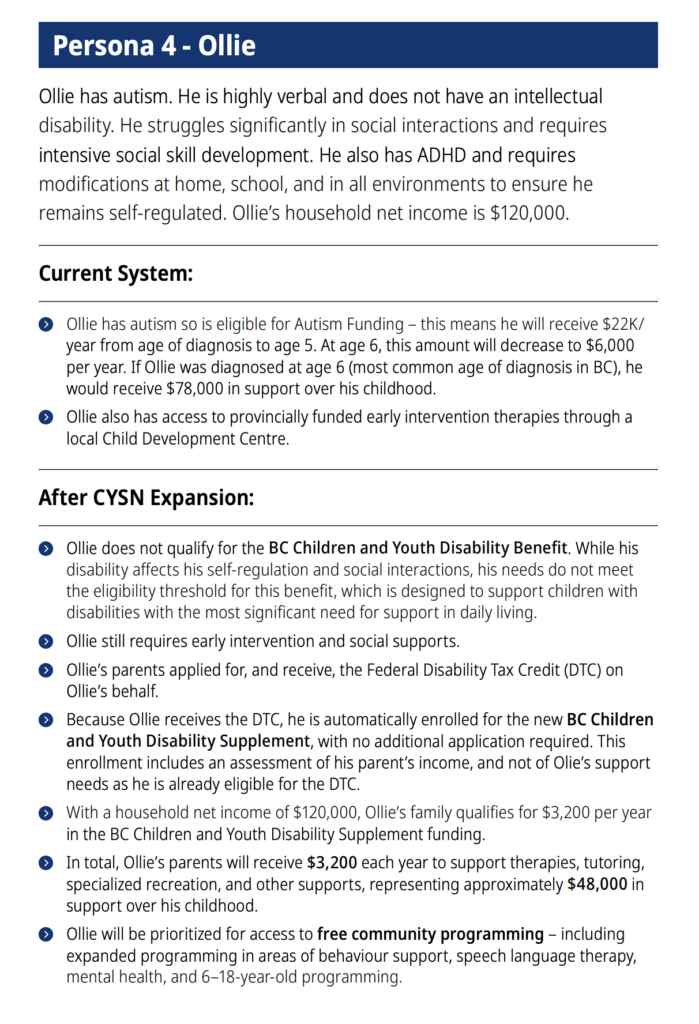
In its guide to the redesigned Children and Youth with Support Needs system, Ollie is a highly verbal autistic child with ADHD who needs modifications at home, school, and in all environments to remain self-regulated. The guide says Ollie receives a smaller, income-tested supplement and is “prioritised” for community programming instead of the autism funding families have relied on.
The guide presents Ollie as a child who will be fine under the new model.
Is Ollie really OK?
So here is the question the guide does not ask: how is the Province’s Ollie actually doing right now?
Did the Province check?
Did they ask families what life looks like for a verbal, masking, “Level 1” or “Level 2” autistic child in 2026? Did they sit with the parents who have been documenting collapse, school refusal, ARFID, burnout, and breakdown across this community for years? Did they listen to autistic adults who lived through childhoods that looked a lot like Ollie’s and who know exactly what masking costs across a lifetime?
Or did they write a paragraph about a child who would be fine, and then build a funding model around the paragraph?
Because if anyone had checked, the picture would not have looked tidy. The families using #thisismyollie are trying ridiculously hard to survive. They are caring for children whose schools have been quietly dismantling support for years. They are running their households on autism funding that pays for the therapy school cannot deliver, the counselling that helps the parents co-regulate, the speech therapy that should have been at school but was not, the behaviour intervention that addressed the harm school caused. They are doing the work of multiple systems with the resources of one.
And even with all of that, the children are often not fine.
You can see it in the midnight anonymous messages parents desperately voice dictate into forums. You can see it in the petition signatures. You can see it in the parents who turned up in Victoria and other major cities to protest, holding signs that named what their children were experiencing. You can see it in the social posts where #thisismyollie has become a chronicle of children who were already stretched thin, families who were already barely holding together, support systems that were already insufficient.
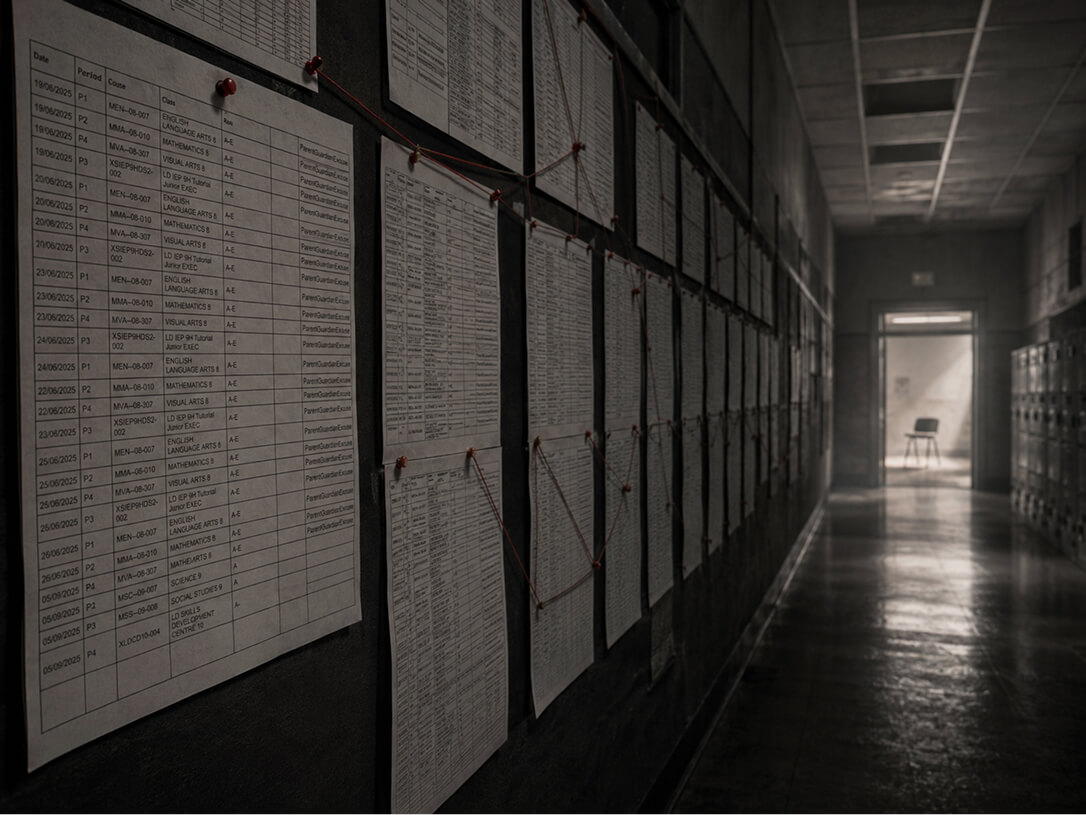
And you can also see it in the Ministry’s own data obtained by Freedom of Information request recently! We wonder, did they even check their own metrics in their own databases before they decided to present Ollie?
What the attendance data shows
My Ollie is not in these attendance statistics because he is not attending school this year. He sits in his room, depleted past the point where statistics can find him.
But children like Ollie are in BC schools right now, and the Ministry’s own data shows how often they are missing.
The figures below come from school-level absence rates for 2023/24, drawn from a provincial Freedom of Information request released by BCEdAccess. They are broken out by inclusive education designation and here I’m going to look specifically at two of those designations: G for Autism Spectrum Disorder and H for Intensive Behaviour Intervention or Serious Mental Illness.
This article also correlates that absence level with missed school days.
Here is a table that translates cohort absence rates into approximate days missed across a 180-day school year, so that the percentages stop being abstract and start becoming weeks, months, the bones of a school year going missing.
| School | District | G autism absence | Approx. days missed | H behaviour/mental health absence | Approx. days missed |
|---|---|---|---|---|---|
| Chilliwack Secondary | Chilliwack | 33% | ~59 days | 54% | ~97 days |
| GW Graham Secondary | Chilliwack | 24% | ~43 days | 47% | ~85 days |
| Sardis Secondary | Chilliwack | 16% | ~29 days | 37% | ~67 days |
| Royal Bay Secondary | Sooke | 22% | ~40 days | 41% | ~74 days |
| Terry Fox Secondary | Coquitlam | 22% | ~40 days | 44% | ~79 days |
These are standard secondary schools serving sizeable populations of designated students. They are not tiny masked cohorts. They are not special examples chosen because they are the worst in the province. They are ordinary BC public schools where the school year for many disabled students is being hollowed out from the inside.
If you are reading this and you have an Ollie, the numbers can land hard.
You may feel vindicated — finally, on a page somewhere, the experience you have been living is named in black and white, with a denominator and a percentage and a school district attached. You are not imagining the absences. You are not exaggerating the pattern.
You may also feel something closer to horror. Because seeing your private experience reflected in provincial data means understanding the sheer volume of how families are suffering across our province. It is a pattern. It is happening to thousands of children across BC right now. The phone calls asking you to pick your child up early, the partial schedules dressed up as support plans, the slow erosion of attendance across months — these are not the story of your family alone. They are the story of disabled children across this province, in district after district, year after year.
When I read these numbers I felt a grief that keeps surfacing at unexpected moments, days later. I feel a bodily ache for what has been stolen from our families through the degradation of our cherished public systems.
On designations
Ollie is autistic, so the G designation is the closest match. But the H designation matters too.
Many autistic and neurodivergent children are first understood through behaviour frameworks before their disability is properly recognised or accommodated. Their distress may be recorded as non-compliance, dysregulation, aggression, anxiety, refusal, or safety risk. Their need for accommodation may become a behaviour plan, a partial schedule, or a phone call asking the parent to pick them up early.
G and H are not perfect categories. They do not capture every child like Ollie. Some children are still waiting for assessment. Some are AuDHD. Some are gifted and autistic. Some are autistic girls whose distress is often internalised in ways the H designation was never built to recognise. Some leave, transfer, move online, or stop attending before the data can fully show what happened.
But these designations are two places where the system records students whose attendance often depends on whether support is timely, skilled, and accessible.
What this means for a child like Ollie
Terry Fox Secondary is useful to look at closely because its numbers sit in the middle of this comparison of relatively large student populations, not at the extreme. It is a large urban secondary school in Coquitlam. It is not a remote district. It is not a tiny cohort where one or two children can explain the pattern.
In the 2023/24 school year, Terry Fox had ~176 instructional days. An autistic student with a G designation attended an average of 137 of those days and missed 39. A student with an H designation attended only 99 — barely more than half the school year.
Ninety-nine days at school across a ten-month year averages out to roughly two and a half days a week.
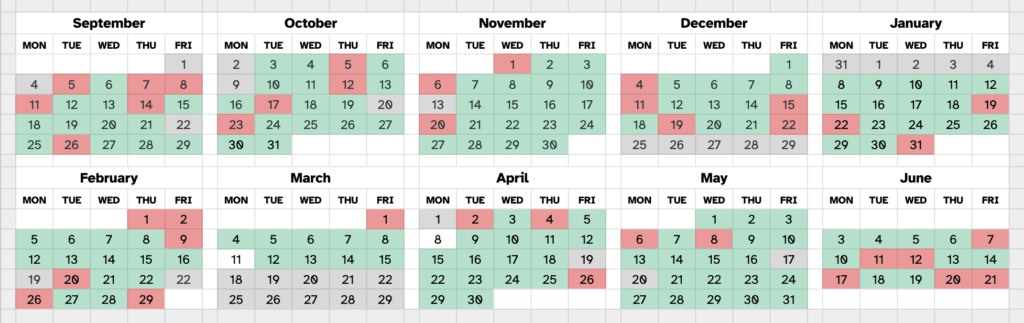
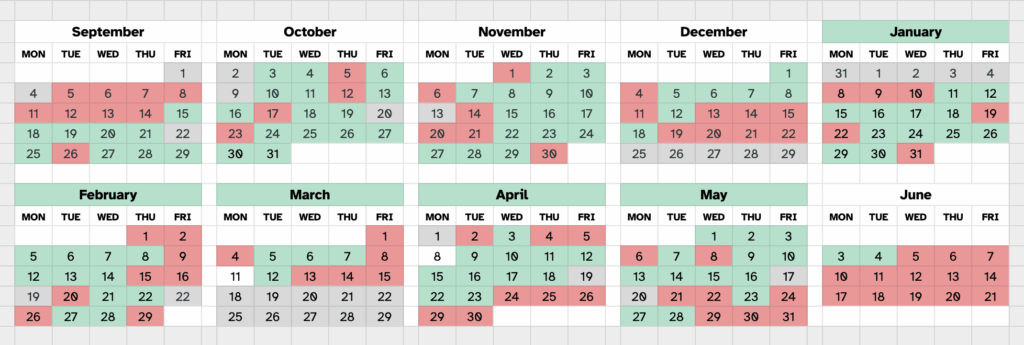
The calendars below show what 39 and 77 missed days look like distributed across an actual Terry Fox school year.
Each pale green square represents a day at school. Each red square represents a day absent. Each grey square represents a non-instructional day — statutory holidays, winter break, spring break, Pro-D days. The shape of the absences is not random. It clusters around the predictable stress points of an autistic child’s school year: the first weeks of September when supports have not yet been put in place, the post-Thanksgiving collapse, the weeks before winter break when end-of-term demands accumulate, the post-winter-break re-entry when an autistic body has to habituate to loud corridors and fluorescent lights again, and the year-end mask-and-collapse cycle that takes most of June.
G designation, 39 days absent
H designation, 77 days absent
The year-over-year change at Terry Fox is also worth naming. In 2022/23, autistic students missed an average of about 27 days. In 2023/24, they missed about 39.
Across two designation groups at this single school, students lost thousands of school days over two years.
And Terry Fox is not the most extreme example.
What helped keep Ollie in school
For families navigating autism, burnout, dysregulation, school trauma, and partial attendance, autism funding has often paid for the services that made school attendance possible: occupational therapy for sensory overload, counselling for anxiety and trauma, behaviour support, speech therapy, tutoring, parent coaching, counselling for the parent doing the co-regulation work, and trusted providers who could work with the child when leaving the house had become impossible.
These services were not extras.
They were scaffolding.
For children like Ollie, they could be the difference between attending school and disappearing from it. The attendance data shows that these supports were already insufficient.
And, here is what the Province’s redesign refuses to acknowledge: the children most likely to need that scaffolding are often the children least able to replace it with generic community programming.
Children in burnout may not be able to attend a clinic. Children with demand avoidance may not be able to connect with a new provider. Children who rely on trusted adults may not be able to start over when the provider who finally understood them is no longer covered. Children whose nervous systems have learned that school is unsafe cannot be restored by a waitlist, a group programme, or a promise of future access.
Therapy is not interchangeable. It was relational. It was built over months or years. It was calibrated to a particular nervous system by a particular adult who had learned how to be with that particular child.
Families are now being told to start over, or do without, while schools continue to struggle to provide the support our kids are legally entitled to receive.
The problem with calling Ollie “lower need”
The Province’s redesign treats many Level 1 and Level 2 autistic children as lower-need. Families across BC have been saying for years that this does not match real life.
This is not about taking support away from Level 3 children. Children with profound, visible disabilities may need intensive, round-the-clock support. Their families deserve every resource the system can provide. Nothing here should be read as saying Level 3 families have it easy.
The point is different.
Level 1 and Level 2 children are not automatically fine.
A Level 1 autistic child may be able to speak. They may be able to mask. They may hold themselves together in front of strangers, perform well during an assessment, and appear to be coping. But the cost of that masking can be enormous. The child may collapse at home, stop attending school, stop eating, stop sleeping, stop speaking, or burn out completely.
That collapse is often invisible to the framework that labelled them “lower need.” It is also invisible to a funding model that treats that label as proof they need less support.
The school absence data has a limitation: the G designation for autism does not separate Level 1, Level 2, and Level 3 students. We cannot say from this data which autistic students are driving the absences.
But that does not make it reasonable to assume Level 3 students are driving the whole pattern. Research suggests that children with the most profound forms of autism are a small minority of autistic children, and that autism levels are not always recorded consistently or tied neatly to real-world support needs. The Province has not shown that Level 1 and Level 2 children are outside the attendance crisis.
My son had 65 recorded absences in one school year, and even that understated the loss. It did not capture the partial days, the early pickups, the hours spent hiding in a tree on the playground, or the days he was technically present but not meaningfully included. So when the Ministry’s data shows students missing weeks or months of school, we should understand those numbers as the floor, not the ceiling.
That matters because the Province is reducing support for many children it has placed lower in the severity hierarchy. There is no evidence that this will be safe. There is no evidence that the Province checked whether these children are already missing school, burning out, or relying on autism funding to stay connected to education.
There is, however, plenty of evidence from families. The stories shared through #thisismyollie show children who are verbal, masking, bright, anxious, demand-avoidant, exhausted, traumatised, and not fine under the existing system.
Level does not measure support need. It measures how a child’s disability appeared inside a clinical framework at a particular moment in time. A Level 1 autistic child in burnout may have needs that are urgent, intensive, and life-altering.
The same framework that labelled them “lower need” has also taught schools to see them as not needing much. That is the danger.
What the Province says versus what the data shows
The Province’s Ollie already needs modifications at home, school, and in all environments. School is one of the environments where his disability-related needs must be met.
The Province is redesigning autism funding while its own education data shows students like Ollie missing large portions of school. These two realities cannot be separated.
The Province says the answer is community-based supports. Parents have been clear: waitlists are long, group time slots do not match real life, and for children who cannot safely access clinics, home-based services may disappear entirely.
Parents are asking the questions the redesign refuses to answer.
- Will we be forced to change providers?
- Will we lose the consistent care that took years to build?
- What happens to the home-based services that were the difference between our child attending school and our child no longer being able to leave the house?
- Will I be able to afford counselling after this?
The attendance data makes these questions urgent.
At Terry Fox Secondary, autistic students missed about 41 days in 2023/24, up from about 27 the year before. Students with H designations missed about 83 days. These are students already in the system, already identified as needing support, already attached to categories that are supposed to trigger additional resources.
The funding did not prevent the crisis. For some children, it may have kept them attending longer than they would have without it. For others, it kept the family system functional while the school system failed.
My Ollie stopped being able to attend therapies because he was so burnt out from enduring inadequate support at school. The counselling I accessed through autism funding helped me keep going. It helped keep our family system from collapsing while school support eroded around us.
Community programming cannot replace what we are losing.
Track attendance, really
If the Province wants families to believe children like Ollie will be supported, it needs to show that children like Ollie can attend school.
That means publishing designation-based attendance data every year, by district and school. It means identifying the schools where autistic students and students with behaviour and mental health designations are missing weeks or months of school. It means asking what supports are present where attendance is stronger, and what barriers remain where attendance is collapsing.
It also means tracking absence honestly. If “unspecified” is doing most of the work in the attendance data, fix the tracking. If partial days, repeated pickups, and informal exclusions are not captured clearly, fix the categories. If staff do not have the time or tools to record attendance accurately, resource the work.
Do not collect the data, ignore what it shows, and then cut the supports families have been using to survive the gap. Things aren’t fine. This isn’t going to help things be fine!
What the Province owes families
Children like Ollie are missing school now.
At Chilliwack Secondary, students with H designations missed the equivalent of about 101 days last year. Across five schools, across two designation categories, the pattern is clear: disabled students are losing access to education while the Province promises that community programming will fill the gap.
Half a school year, gone.
That is the emergency.
The Province cannot redesign autism funding as though schools are meeting these children’s needs when its own education data shows they are not. It cannot reduce the flexible supports families have used to keep children regulated, connected, and barely afloat, then point to community programming as if that replaces the right to attend school. It cannot label Level 1 and Level 2 autistic children as lower-need while its own data shows them disappearing from school at rates the system refuses to explain.
Children like Ollie deserve more than symbolic support. They deserve schools they can attend, supports they can rely on, providers they can keep, and a Province willing to look at its own data and act on what it shows.
The attendance data shows what happens when support is not there.
The redesign is about to make that worse.
-

BC schools are failing disabled students: an absence analysis
This analysis is based on a provincial FOI request to the BC Ministry of Education, file ECC-2025-52461, which was shared recently, bc BCEdAccess. The data covers absence rates, absence reasons, enrolment, and mid-year exits for BC public school students, broken down by inclusive education…