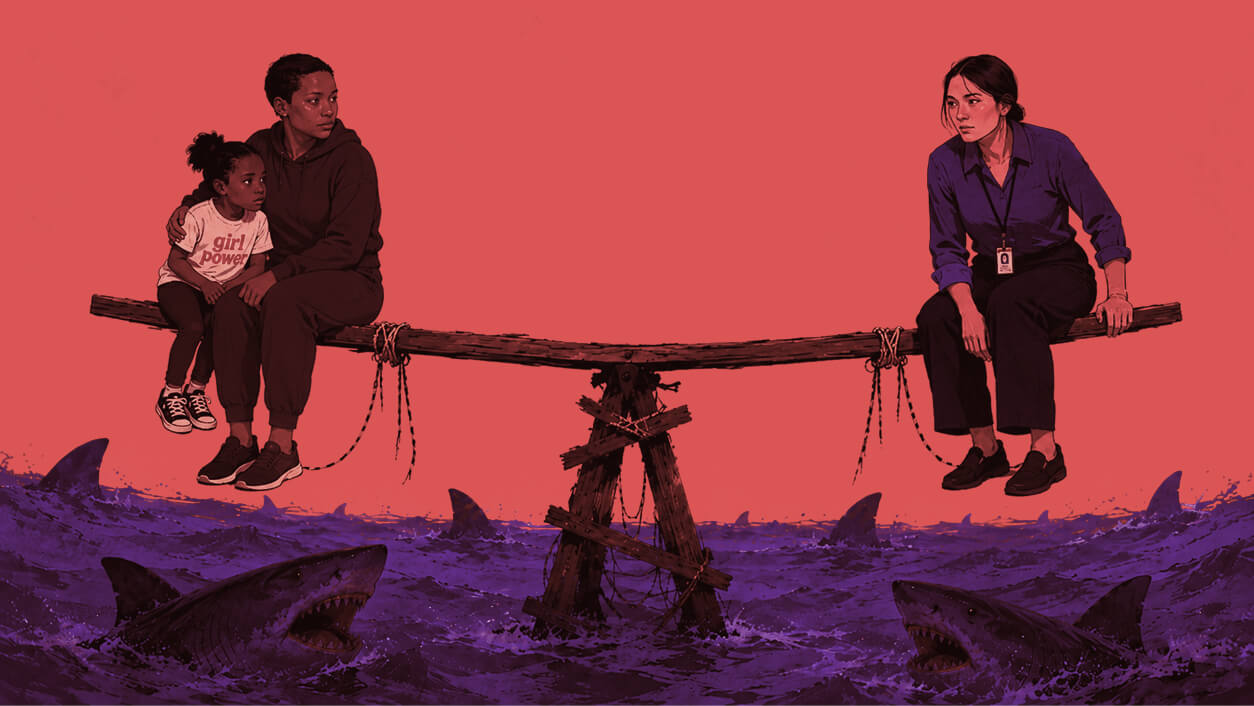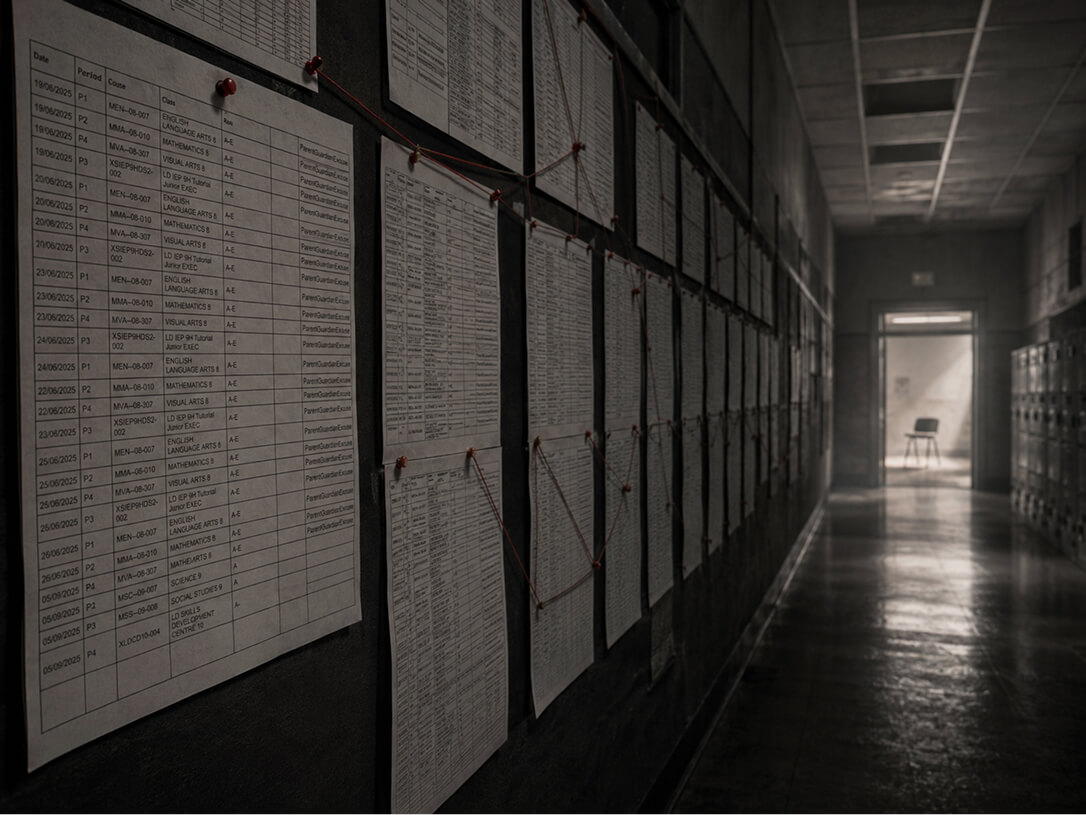
I read my son’s permanent record on a screen, flipping through the absence report pages over and over — forward, back, forward again — the way you work at a puzzle that keeps almost resolving. Five columns: Date, Period, Course, Attendance Code, Reason. The font is small, the rows are dense, and the patterns kept sliding out of reach at reading distance, so eventually I screenshotted every page and tiled the screenshots onto a single canvas, because this is a document that becomes legible only from far away — up close it is administration, and at a distance it is a shape: grey columns of code running three school years deep.
Somewhere in the flipping, the nausea arrived and stayed. Part of it was volume — hundreds of rows, the longest text the school district has ever produced about my child, all of it attending with perfect discipline to a single subject: absence.
And part of it was the opposite, the rows I kept reaching for and failing to find, because my own notes hold days my son was absent that appear nowhere in this record at all — absences the school never entered, mornings I know happened because I lived them, missing from the document whose entire purpose is to count them.
A hard day
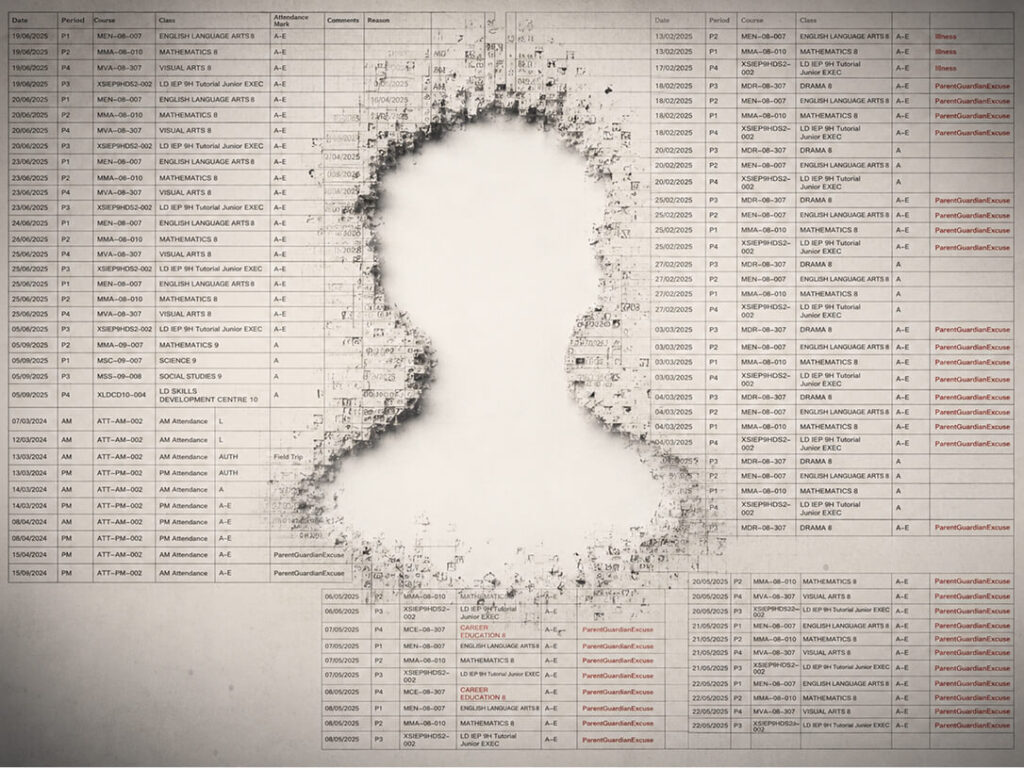
The reason column in Robin’s permanent record is mostly blank — hundreds of rows that log an absence code and leave the why unrecorded — and when a reason does survive into the record, ParentGuardianExcuse is usually what survives.
The phone rings at 11:12 with the school’s number. I reflexively screenshot the call, to add it to my records. The voice on the other end is melodious and cheerful, as if I am being told I won a sweepstakes: Robin is having a hard day. Can I come? I say yes because I don’t want him to struggle and hurt other children. There’s nothing to do now but pick him up.
I post in Slack — emergency pickup of child. BRB — and get some ‘care’ emojis.

The rain starts before the on-ramp. The wipers swoosh a beat that will get stuck in my head for the rest of the day. I don’t speed because I’ve had a talk with myself about not trying to die on the way to pick up my child.
Robin comes coatless as soon as my car slows down, hair soaked, smelling like hay, as he slumps into the seat. He mumbles that Jean wants to come home as well. I put my four-way flashers on and walk toward the office.
The secretary asks, like she’s delighted to see me, how my day is going. She asks if I want to take Jean home too, already dialling the classroom to retrieve her, knowing I won’t want to turn around and come back again. I sign the paper with a pen on a chain that has a cloth flower attached to the end.
Jean always wants to come home too, if it’s just a few hours. Her brother leaving at lunch reads as a prize, and the unfairness of it burns: he gets to go home, and she has to stay and hold her smile up for three more hours.
So I take them both, and this is how I learn what actually happened — because Jean talks from the moment her seatbelt clicks. She narrates the morning like a broadcast: the game at recess where the boys kept poking Robin, saying they were just joking, and the supervisor who watched from the covered area as Robin exploded.
Somewhere around Boundary Street there is a version of me who pulls over and explains to my children what has just been done to all three of us — that the school’s sentence, Robin had a hard day, has already overwritten Jean’s sentence, the kids were mean and nobody stopped it, and that by tomorrow a database will overwrite them both. Epistemological violence, administered by dropdown menu. I do not pull over. I have a 1:30 call.
The next morning I dial the sick line and perform the ritual — Robin received insufficient support and supervision, resulting in dysregulation and significant distress when he was bullied on the playground — and the day enters Robin’s permanent record as ParentGuardianExcuse.
The word itself
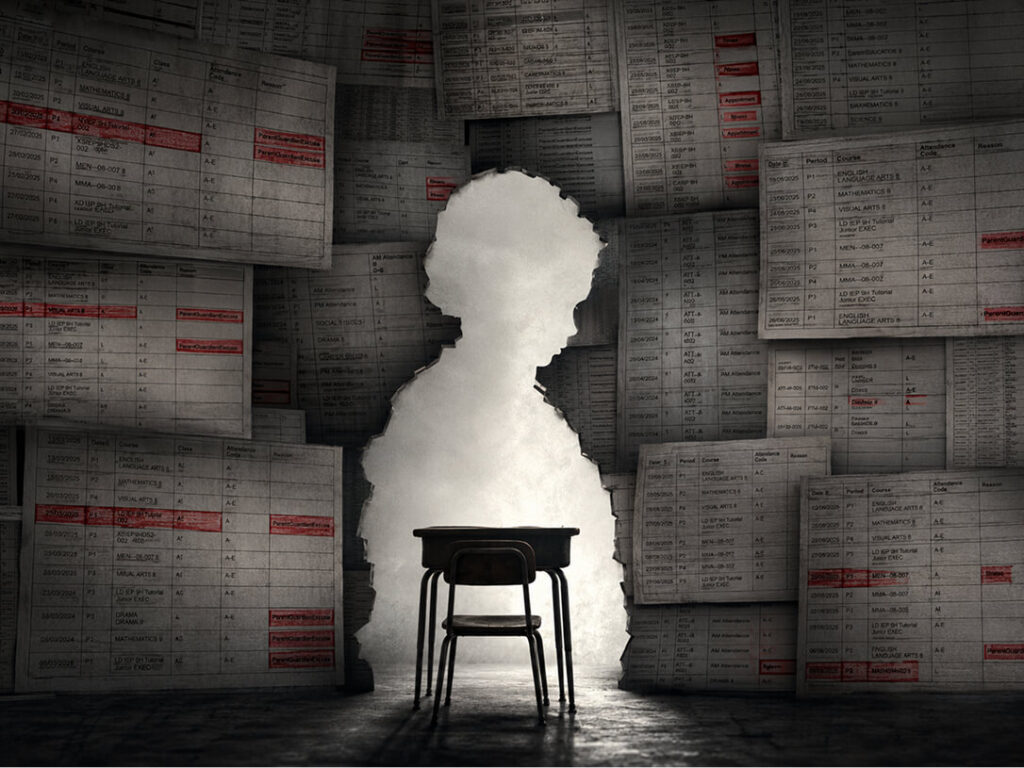
ParentGuardianExcuse. One word, no spaces, written for a database column by someone who never had to say it out loud.
Take it apart and it does exactly what it says. Parent/Guardian names the agent — me, the woman who answered the phone. Excuse names the act. An excuse is what you offer for a failing; what is excused has been pardoned, and what is pardoned was first a fault. The school decided. The record says I excused.
I used to think my reasons were being lost in transit — that somewhere between my mouth and the district database, the nuance dissolved. The reasons arrive intact and get translated into the one language the system speaks, in which an absence either says nothing at all or says parent approved.
The schema is a policy
Read the full record and notice who never appears. There is no code for RoomClear, for UnstaffedSupport, for RecessWentUnsupervised. Every absence in the schema has an author, and the schema offers exactly one candidate — and its default, when nobody chooses at all, is the empty cell. Somebody decided a reason is optional, that an absence record is complete without a cause.
The reason column is a dropdown, and a dropdown is a list someone wrote. In British Columbia the list ships inside the provincial student information system, procured under contract, deployed to all sixty districts, consulted by school secretaries every morning around the second bell.
Somewhere there was a requirements meeting. A vendor, a projector, reasonable people choosing reasonable categories: Illness, Appointment, Authorised, Late, ParentGuardianExcuse. Children get sick. Families take holidays. Parents excuse. Nobody in that room was ever going to be described by the list they were writing. And the room produced, without anyone proposing it, a piece of provincial policy: in the official memory of British Columbia’s schools, a school has never caused an absence. Not one.
The schema was purchased from experts. It passed through a procurement office rather than a public meeting. It binds every family in the province and appears on no agenda, and it accomplishes what no trustee would put to a vote — the permanent, retroactive innocence of the institution — by making the alternative unrecordable.
The record has teeth
For a long time I thought the worst thing about the record was what it erased. Then I looked at when the reason column gets filled in.
For two school years it ran almost entirely on silence — absence after absence logged without a cause. Then in the spring of 2025 somebody started completing it. Row after row, April through June, the same value: ParentGuardianExcuse. I have no memo explaining the change — a new secretary, a new directive, a threshold crossed in an office I will never see.
The rows accumulate, and past a threshold they convert into arithmetic against the family. District letterhead knows how to worry: the letters note the number of missed days in bold, the essential nature of regular attendance, an invitation to meet about strategies for improvement.
But they made attendance impossible.
No excuse for exclusion in BC schools
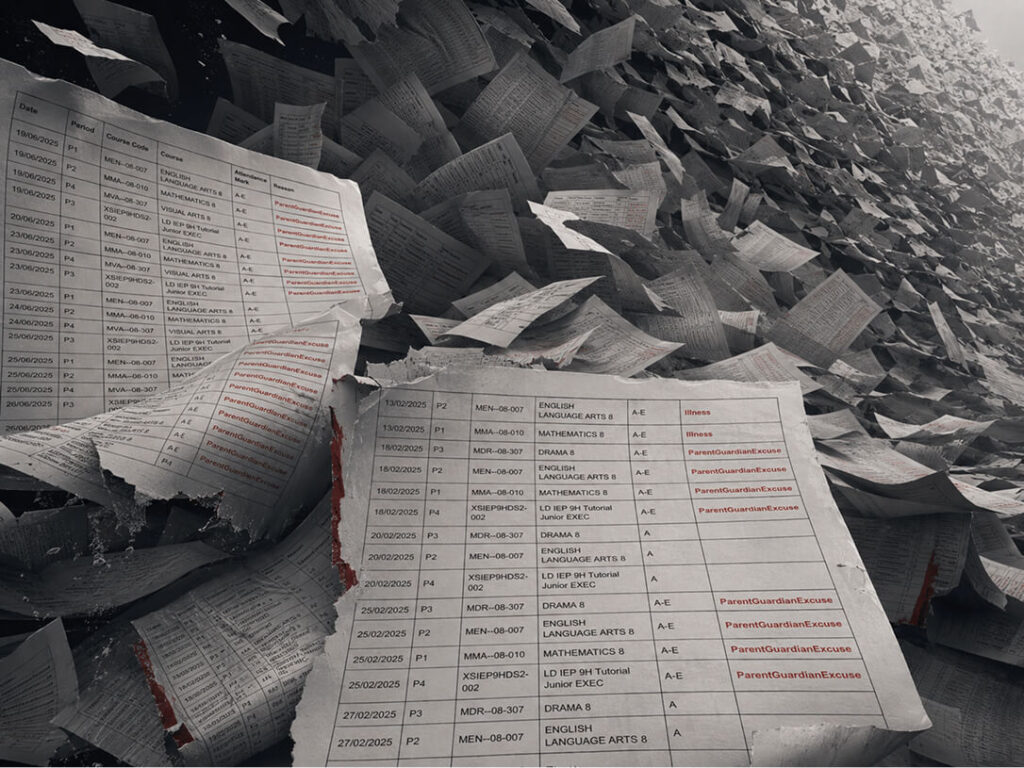
The screenshot of the 11:12 call. The Slack messages with their care emojis. The notes dictated in the parking lot with the engine running. The emails I send back after meetings “to confirm my understanding.” The freedom-of-information requests that pry the district’s own correspondence into daylight. Every family I know in this situation keeps one; we are a province of parallel archivists, maintaining at our own expense the context column the system declined to build.
The demand, stripped down, is small. A field. A free-text box on the absence form. A sick line rebuilt as a reporting line, where “my child is home because the school removed him” can be said and — this is the whole demand — retained. The province redesigns forms constantly; it renumbers codes, migrates systems, retrains staff. The missing field is a choice, renewed every year the list stays as it is, and the choice has a beneficiary: the only party the current schema can never name.
The scale is provincial. Absence rates for designated students are climbing across British Columbia — districts log it, the ministry compiles it, and the figure gets discussed as an attendance problem when it measures harm. And it is an undercount by design: the blank cells, the misattributed rows, the after-recess departures that generate nothing, the absences never entered at all, repeated across sixty districts. The published rate is the tip of the iceberg.
I did not excuse my son from school that day.
I rescued him from their neglect.