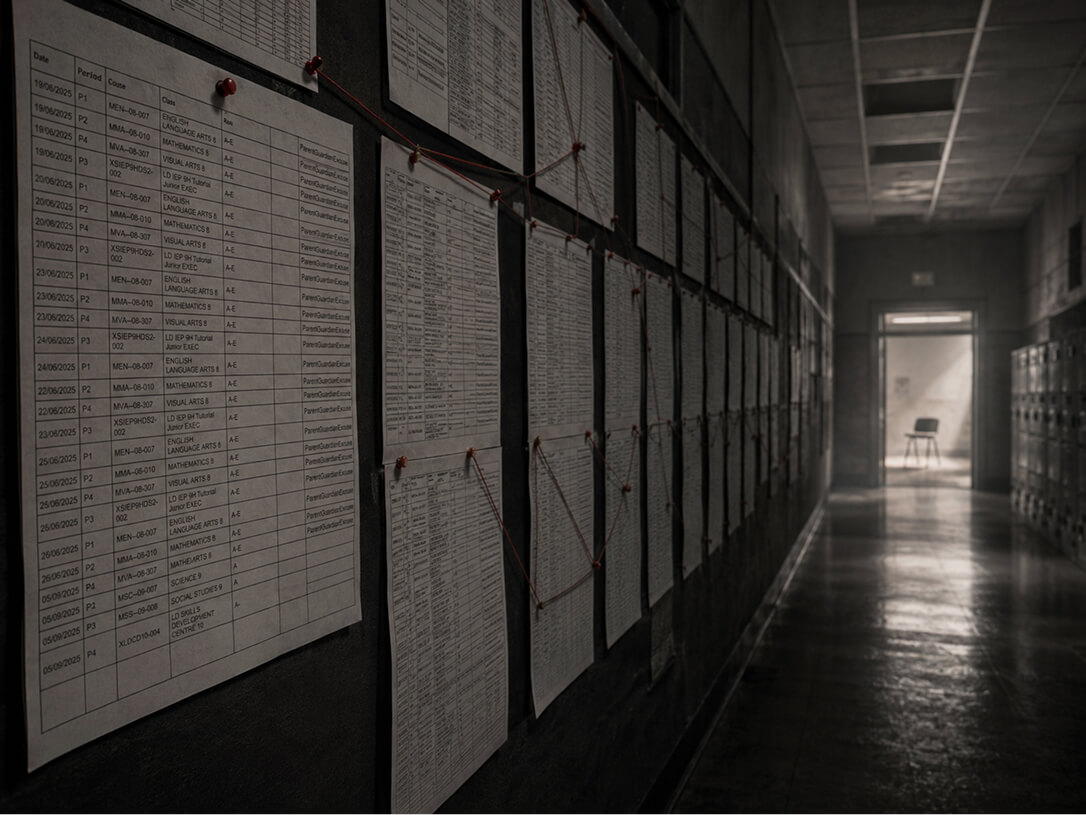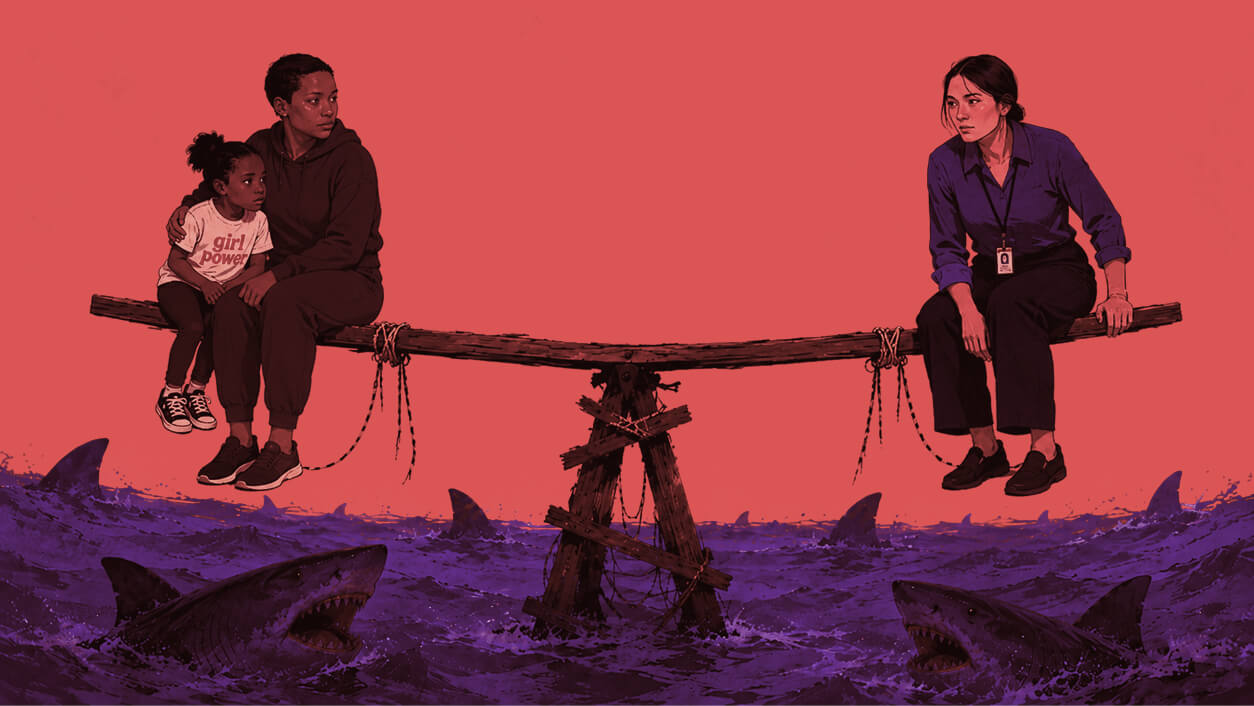
Before school taught them who was good and who was difficult, they played tea party—careful negotiations about which cup held more juice, taking turns being the one who served and the one who got to say thank you. Jean insisted everything be pink during that phase, dressing her stuffed animals in coordinated outfits while Robin tolerated her aesthetic tyranny with the kind of sibling forbearance that passes for love when you’re small. She could be critical of him, sharp-edged in the way older sisters sometimes are, even though she was only a few seconds older, but the structure held. Fairness meant everyone got a turn to serve and be served, complaints dissolved into the next game, benevolence formed the substrate beneath the bickering.
Seven years later, I cannot say with certainty whether one would fetch the fire extinguisher if the other caught flame.
School did that, through the steady accumulation of role assignments, the quiet conscription of one child’s capacity to mask into institutional infrastructure while rendering the other hypervisible, the systematic transformation of sibling care from mutual play into coerced labour.
In this essay, I trace what happened to my children’s relationship and how institutions erode sibling bonds while labelling the damage “family dynamics,” exploiting one child’s capacity to avoid supporting either, and then pathologising the resentment they produce.

The roles assigned
From kindergarten, people considered Robin the bad twin. He could mask extensively and then collapse—what school personnel called “going from zero to sixty” as though his nervous system’s protective mechanisms constituted a character flaw rather than a disability feature.
Jean, they considered the good twin because she could mask longer, more completely, with less visible aftermath.
The fact that she was performing continuous interpretive labour to survive each school day, that her capacity had limits, that her distress simply looked different—none of that registered as requiring support. Her competence became evidence she needed nothing.
School used this manufactured binary to solve their staffing problem: if Jean could help de-escalate Robin, they wouldn’t need to provide trained support for either child. When Robin melted down, they called upon Jean to manage him—using a seven-year-old’s capacity to sometimes reach her brother as a resource they could deploy rather than a sibling connection they were obligated to protect.
I want to give you the theoretical frameworks that name what many of you have watched happen in your own families—the slow erosion of sibling affection under the pressure of schools that refuse to provide what both children need.
Just a Parent
Sibling-focused parentification: When children become caregivers
Parentification describes what happened to Jean with clinical precision. The term, extensively researched in family systems literature, refers to role reversal where children assume developmentally inappropriate levels of responsibility within their family—taking on tasks and emotional labour that properly belong to adults. When this role reversal centres on caring for a sibling rather than a parent, researchers call it sibling-focused parentification.
A comprehensive 2024 systematic review by Levante and colleagues examining sixty studies across multiple countries found that sibling-focused parentification constitutes the second most investigated psychological construct in research on siblings of persons with disabilities, precisely because it occurs so frequently and causes such significant harm.
The research reveals patterns that map exactly onto Jean’s experience at elementary school. Studies consistently show that families identify which siblings have capacity that can be exploited—typically the sibling who can mask their own distress, usually a daughter due to gendered expectations about care work—then organise support systems around that unpaid labour rather than an adult completing the labour.
Levante’s review found that siblings conscripted into caregiver roles experience what researchers describe as both “negative outcomes (e.g., mental ill-health, impact on schooling in terms of negative school performance because the caring or being bullied because of the disability of their brother or sister, and a lack of support) and positive outcomes (e.g., increased maturity).” The negative outcomes, however, far outweigh any perceived benefits: parentified siblings show elevated rates of anxiety, depression, distress, and damaged relationships with both their brother or sister with disabilities and their parents.
What happened to Jean illustrates this research with painful precision. School personnel identified her capacity to sometimes calm her brother and converted it into an expectation, a role, a responsibility that should have belonged to trained adults but got offloaded onto a child because she happened to share a womb with the student they refused to support adequately. The transformation happened gradually—first, teachers would mention that Jean had successfully redirected Robin during a difficult moment, framing her intervention as sweet sibling care. Then they began positioning her near him during transitions, treating proximity as accommodation. Eventually they explicitly called on her when he melted down, treating her emotional labour as a resource the school could access rather than a relationship they had an obligation to protect from institutional exploitation.
Jean learned through years of practice that her brother’s needs would always supersede her own, that her capacity to help him meant she was obligated to help him regardless of whether she had the energy or wanted to provide that support in any given moment, that her role was helper rather than student requiring her own accommodations and attention. School taught her this, then acted surprised when she developed resentment toward the brother whose needs had colonised her school experience and toward the mother whose advocacy seemed always directed at him rather than her.
The parentification framework helps explain not just what happened to Jean but why it happened and why it continues happening to siblings across families dealing with inadequate school support. Schools systematically identify which siblings can be conscripted into care work, then organise classroom and behavioural support around that unpaid labour rather than providing what disabled students actually need. The sibling’s capacity becomes infrastructure—something the institution depends on to function—while the cost to that sibling’s own education, emotional wellbeing, and relationship with their brother or sister gets rendered invisible or reframed as the sibling “learning empathy” rather than experiencing exploitation that research consistently shows produces lasting psychological harm.
-

Double the love, double the discrimination
Public education systems punish families of multiples by forcing impossible choices between their children—often withholding support until one child reaches visible crisis, while the other’s suffering is…
Community values as exploitation framework
School personnel framed Jean’s labour as evidence of the school’s values—responsibility, respect, inclusion, and engagement. When she helped Robin, interrupted her own learning to regulate him, or endured unwanted physical contact to keep him calm, administrators treated this as success. Her coerced care work was praised as responsibility, her compliance reframed as kindness and integrity, her responsiveness to her brother held up as community engagement. What should have been recognised as institutional failure was instead celebrated as moral achievement.
This values rhetoric did important work. By invoking ideals that feel self-evidently good—community, kindness, mutual support—the school moralised what was, in material terms, a staffing failure. Abstract commitments to care were used to justify extracting labour from a child rather than providing trained, compensated adult support. A systemic refusal to resource inclusion was reframed as character development.
Jean was an autistic girl whose boundaries were repeatedly violated through forced contact she explicitly resisted. She masked throughout the school day, absorbing exhaustion the institution never acknowledged. She needed protection, accommodation, and adults willing to take responsibility for meeting her needs. Instead, her capacity to cope was treated as evidence she could absorb more.
The values framework made refusal illegible. If helping her brother was responsibility, then declining was irresponsibility. If compliance was kindness, then boundary-setting became unkind. If care work signalled engagement, then prioritising her own needs became disengagement. The school did not merely fail to protect Jean’s boundaries; it redefined those boundaries as moral shortcomings.
This inversion was especially cruel because Jean herself required the very supports the school claimed to value. She needed respect for her testimony and bodily autonomy. She needed adults to take responsibility for providing support rather than offloading that responsibility onto her. She needed integrity—honest recognition that forced intimacy violated her dignity and that exploitation remains exploitation even when framed as kindness. She needed inclusion that did not require sacrificing her body or education to compensate for institutional neglect.
The consequences were predictable. Years of coerced care and boundary violations produced resentment toward her brother—resentment later pathologised as evidence of her moral failure rather than recognised as the outcome of sustained exploitation. The institution that created the conditions for this harm then used that harm to further indict her character.
Jean understood community perfectly. She understood that ethical community requires adults to provide adequate support, institutions to protect boundaries, and care to be freely given rather than extracted. What she learned instead was that capacity creates obligation, that boundaries are negotiable when institutional convenience demands it, and that values language exists to make neglect feel virtuous.
She deserved more than moral rhetoric in place of support. She deserved a school willing to practise the values it demanded: by funding staff, protecting children’s boundaries, and refusing to convert a disabled child’s coerced labour into evidence of institutional virtue.
-

Epistemic silencing of disabled children’s primary caregivers
Epistemic silencing in BC schools discredits mothers’ knowledge, reframes advocacy as aggression, and erases disabled children’s pain, leaving families punished for truth.
The labour school refused to see
Caring for my children at home was full-time work—not the sentimental version where parents claim all childrearing requires total devotion, but the literal version in which two autistic children with significant support needs required at least one adult’s complete presence simply to get through the day. This was not optional labour or enrichment; it was survival work. The house grew messy because helping them regulate after school left no energy for dishes. Bureaucratic tasks lagged because the late hours after they finally settled were the only time to write advocacy emails. Bills, laundry, paperwork, the basic maintenance of household life accumulated because my children needed my full cognitive and emotional capacity just to navigate daily existence. I made the only choice that allowed us to endure: they got my attention; everything else waited.
At school, that labour was declared unnecessary. Jean needed nothing because she could mask distress. Robin needed nothing beyond his sister’s unpaid care because she could sometimes reach him when he was overwhelmed. The institution operated on a convenient fiction—that children who required constant support at home became low-need the moment they crossed school property, that the labour of keeping them safe and regulated evaporated during school hours rather than being redistributed onto a child and a parent already at capacity.
Out-of-school care made the contradiction impossible to ignore. OSC refused to accept Robin without one-to-one support, and even with that support in place, staff described his care as too demanding. Outside school, his needs were immediately recognised as intensive and costly. Inside school, those same needs were minimised, reframed, or rendered invisible.
School administrators attended the same meetings where I arrived visibly exhausted. They read the advocacy emails written late at night after both children were finally settled. They watched a family barely holding together under the weight of providing what public systems refused. They understood my capacity was finite. What they decided—explicitly or not—was that this finitude could be exploited.
Nancy Fraser: offloading care into the private sphere
Nancy Fraser names this process clearly in Contradictions of Capital and Care. She argues that modern public systems routinely sustain themselves by displacing the labour of social reproduction—the work of maintaining bodies, emotions, relationships, and survival—into the private sphere, where it is treated as morally mandatory and functionally infinite. When institutions face resource constraints, they do not eliminate care needs; they privatise them. Disability care, in particular, exposes this logic because the labour cannot be hidden. Someone must do it. When schools refuse, families absorb the cost.
This is not an oversight. It is a structural dependency. Schools remain operational precisely because families, and especially mothers and siblings, perform the care labour the institution declines to provide. The system relies on exhaustion while denying it exists.
That decision did not remove the work; it displaced it. The labour the school refused followed my children home each afternoon. After days of inadequate support, both arrived dysregulated and withdrawn, carrying the residue of school stress into the household. Evenings became a second shift: calming nervous systems pushed beyond endurance, repairing emotional harm, restoring enough safety for sleep to be possible. What should have been provided by trained staff during school hours was absorbed into domestic life, intensifying care labour and stretching it late into the night. The school preserved its resources by exporting the cost—onto children who arrived home depleted, and onto a parent expected to make them whole again by morning.
Fraser describes this as a crisis tendency: when public systems overdraw from private care networks, they produce breakdowns they then misrecognise as personal failure. This helps explain the final violence of the arrangement. After extracting extraordinary labour from families, institutions point to the visible strain—burnout, resentment, sibling conflict, parental exhaustion—as evidence of family dysfunction rather than institutional abandonment. The harm they generate becomes proof that families are inadequate, rather than that the system is.
This is the lie at the heart of inclusion rhetoric. Schools claim to support all students while systematically relying on unpaid labour from disabled children’s siblings and relentless labour from their parents.
Just a Parent
They call this partnership, resilience, or family dynamics. Fraser gives it a clearer name: the privatisation of care under conditions of institutional refusal. What families experience as collapse is, in fact, the predictable outcome of a system built to survive by consuming them.
Forced intimacy and vanishing boundaries
The conscription intensified as Robin’s distress intensified. He needed peer connection support, sensory regulation tools, and communication strategies that respected his PDA profile—supports the school could have provided but chose not to. Instead, staff allowed him to remain attached to his sister, treating her tolerance as sufficient accommodation. When he sought comfort by hugging her and she asked for help because the contact violated her boundaries, staff called it cute, said it was fine because they were siblings, and declined to intervene. Even after the issue was raised with the principal, the forced contact continued.
Mia Mingus: Forced intimacy as violence
Disability justice writer Mia Mingus names this dynamic forced intimacy: a form of violence in which disabled people are expected to accept unwanted touch or bodily access because care is framed as necessity or affection. In her essay Forced intimacy: An ableist norm, Mingus explains how systems treat disabled people’s boundaries as negotiable, teaching that needing support means surrendering the right to refuse. Care becomes moral cover for violation.
Jean’s experience shows how forced intimacy can be produced not only through direct service relationships but through institutional reclassification of the family itself. Rather than treating Robin as a student entitled to support, the school treated his needs as a family responsibility. Once the family was positioned as the site of accommodation, Jean’s body became available for conscription. Siblinghood provided the justification. What may have been recognised as a serious boundary violation between unrelated students was reframed as natural affection, even when it was explicitly unwanted.
When Jean said the contact was unwelcome, when she asked for help, staff responded with some version of “but he’s your brother” or “he’s just showing affection.” Her refusal was treated as misunderstanding rather than as a legitimate boundary. The institution chose not to teach Robin alternative ways to seek comfort or to provide the sensory supports that would reduce his need to grab onto his sister. Instead, it relied on her body as an informal, unpaid extension of his support plan.
This arrangement harmed both children. Robin learned that his need for regulation overrode his sister’s autonomy, that grabbing her was acceptable because adults allowed it, and that her protests did not require response. Jean learned that her body was available to meet others’ needs, that asking for protection would not produce intervention, and that sibling violation was uniquely normalised. The resentment that grew between them was not a failure of family dynamics but the predictable result of sustained, institutionally sanctioned boundary violations.
Mingus argues that forced intimacy teaches disabled people they deserve less bodily autonomy and control. What this case makes visible is that when disability is treated as a family condition rather than an institutional responsibility, the same lesson is taught to siblings. Their boundaries become conditional, their consent secondary, their bodies absorb the costs of inadequate support. The school produced this harm and then read its consequences as private family dysfunction rather than as the outcome of its own refusal to intervene.
Also see:
- Alison Kafer, Feminist, Queer, Crip — Develops a relational and political understanding of disability, showing how harm emerges from institutional arrangements and futures imagined for disabled people rather than from individual bodies or family dynamics.
- Rosemarie Garland-Thomson, Misfits: A Feminist Materialist Disability Concept — Articulates disability as a mismatch between bodies and environments, helping explain how institutions normalise harm by treating boundary violations and exploitation as solutions to structural misfit.
- Margaret Price, Mad at School — Examines how disabled people’s refusals, boundaries, and self-advocacy are rendered illegible or punished in institutional settings, illuminating how boundary-setting becomes framed as moral or cognitive failure.
The gendered architecture of care extraction
The exploitation Jean experienced wasn’t random—it followed the deep grooves of gendered expectation about who performs care work, who sacrifices their needs, who becomes infrastructure rather than person requiring support.
Eva Feder Kittay: Dependency and the daughter’s obligation
Eva Feder Kittay, a feminist philosopher whose work examines dependency, care, and justice, has spent decades analyzing how liberal political theory’s assumption of independent citizens erases the reality that humans are fundamentally dependent beings who require care throughout our lives. In her book Love’s labor: Essays on women, equality, and dependency, Kittay argues that care work gets systematically devalued and pushed onto women—particularly mothers and daughters—through ideologies that frame dependency as shameful and care as natural feminine labour rather than work requiring resources, training, and compensation. She describes how families with disabled members face what she calls “dependency work”—the labour of caring for someone who cannot be fully independent—and how that labour gets distributed along gendered lines, with mothers expected to provide most care and daughters expected to apprentice into the role, learning young that their capacity to help obligates them to help regardless of cost to their own flourishing.
Kittay’s analysis illuminates why school conscripted Jean: they identified her as the appropriate person to provide care labour because she was a girl, because cultural narratives about feminine nurturance made her seem like the natural helper, because institutions routinely treat daughters’ capacity to assist as evidence they should assist without questioning whether the daughter consented to that role or whether extracting her labour serves her interests. The school didn’t just fail to support Robin adequately—they specifically exploited Jean’s gendered position as sister to avoid providing the support his disability required.
Kittay writes about how dependency work often falls to women within families because broader social structures refuse to provide collective support for dependency needs, forcing families to absorb costs that should be distributed across society. School’s decision to use Jean as Robin’s de-escalation resource illustrates exactly this dynamic: rather than hiring adequate staff or training teachers to support an autistic student with a PDA profile, they identified the girl sibling as available labour and organized their behavioural support approach around her unpaid, untrained, non-consensual care work. Jean became what Kittay calls a “dependency worker” at age six, learning the bitter lesson that many women learn eventually—that capacity to provide care translates into obligation to provide care, that feminine labour gets extracted and devalued simultaneously, that institutions will exploit women’s care work while calling it love rather than labour.
What makes this even more insidious is that Jean herself needed support—she was autistic, she was navigating a school environment that didn’t accommodate her needs, she was performing continuous masking labour just to survive each day. But because her disability looked like competence to adults who couldn’t or wouldn’t see the effort masking required, because her distress stayed quiet instead of disrupting institutional functioning, school treated her as a care resource rather than a student requiring care. She experienced the double bind Kittay describes: expected to provide dependency work for her brother while receiving no recognition that she herself experienced dependency needs that required institutional response.
The gendered dimension of this exploitation can’t be separated from its ableist dimension—school saw a girl who could mask her autism and decided she existed to help her brother rather than recognizing both children deserved support, both children had dependency needs, both children required accommodations and attention and care that adults should have provided instead of extracting from a six-year-old whose capacity to help became evidence of obligation to help. Kittay’s framework gives us language to name how schools exploit daughters specifically, how they follow grooves worn deep by centuries of women’s unpaid care labour, how they conscript girls into roles their brothers would never be assigned and call it natural sibling affection rather than gendered exploitation.
Who gets witnessed, who disappears
The advocacy calculus was impossible from the beginning. Robin’s needs were urgent and visible and immediate; Jean’s needs were chronic and invisible and accumulating. I made the only choice that seemed survivable in the moment—I focused on the child whose distress was legible to institutions, whose meltdowns generated documentation, whose struggles could be framed as requiring intervention.
Sara Ahmed: The politics of visibility and complaint
Sara Ahmed, a feminist theorist whose work examines how power operates through emotion, institutional culture, and everyday practices, has written extensively about complaint, visibility, and whose suffering institutions recognize as legitimate. In her book The promise of happiness and later work on complaint and institutional life, Ahmed argues that institutions organise themselves around particular affective economies—some feelings get recognised and validated while others get dismissed or pathologised, some people’s distress generates institutional response while other people’s distress gets treated as their personal problem. She describes how institutions often reward those who don’t complain, who can perform happiness or competence despite experiencing harm, while punishing those whose distress becomes visible or disruptive.
Ahmed’s analysis helps explain why Jean’s suffering remained invisible to school while Robin’s generated constant attention: his distress disrupted institutional functioning—he melted down in ways that required staff response, his dysregulation made him unable to participate in classroom activities as planned, his needs created problems the school had to address even if they addressed them inadequately. Jean’s distress, by contrast, stayed quiet. She could mask her overwhelm, could perform compliance despite the enormous effort required, could survive the school day without generating the kind of visible crisis that would force institutional acknowledgment of her needs. Ahmed would say Jean’s capacity to not complain—to not disrupt, to not generate visible distress—meant school could ignore her needs while maintaining the fiction that they were serving all students adequately.
The visibility differential produced an attention differential that Jean experienced as preference—as evidence that I loved her brother more, cared about his suffering more, valued his needs over hers. The truth was more complicated and more cruel: I was triaging under conditions of engineered scarcity, making impossible allocations of finite energy because school refused to provide what both children deserved. I focused advocacy efforts on Robin because his distress was legible to institutions in ways that generated documentation, because fighting for his access to education required responding to the constant crises school created through their inadequate support, because his meltdowns produced a paper trail while Jean’s quiet suffering left no institutional trace.
Ahmed’s work on complaint helps illuminate why this happened: institutions respond to disruption while disappearing suffering that doesn’t threaten their functioning. Robin’s meltdowns were disruptive—they required staff attention, they interrupted classroom activities, they generated incident reports and emergency calls home. Jean’s suffering was invisible—her masking meant she could continue participating in school activities even when exhausted, even when overwhelmed, even when experiencing continuous distress. School interpreted Robin’s visible dysregulation as evidence he needed support (though they still refused to provide adequate support) while interpreting Jean’s invisible distress as evidence she was fine.
Ahmed also writes about how institutions distribute recognition—how they decide whose experience matters, whose testimony counts, whose complaints deserve institutional response. Jean’s experience illustrates the particular cruelty of being disappeared through competence: because she could survive school without generating visible crisis, because her distress stayed manageable from the institution’s perspective, school treated her as a student requiring minimal accommodation while simultaneously exploiting her capacity to help manage her brother. She became doubly invisible—her own needs unrecognized and her labour in meeting her brother’s needs treated as natural sibling affection rather than work the school was extracting from a child.
Five years after Robin’s autism diagnosis, I pursued Jean’s assessment in grade six, finally securing recognition of what I’d always known about her neurotype. I advocated for her throughout those years, but the distribution felt wrong to her—felt like Robin absorbed my energy, my attention, my capacity to fight while she absorbed the responsibility of holding herself together and helping hold him together too. She experienced the advocacy differential as evidence of preference because school’s refusal to witness her suffering meant her needs never generated the same kind of institutional crisis that would have forced my visible intervention on her behalf.
Ahmed’s framework reveals how institutions create these impossible choices—they make some students hypervisible through inadequate support that produces constant crisis while making other students invisible through just enough neglect that those students can continue functioning without forcing institutional response. Then they step back and watch families tear themselves apart trying to meet needs institutions should have addressed, treating the resulting family conflict as pathology rather than the predictable outcome of engineered scarcity and strategic inattention.
The privatisation of dysfunction
Each year, my children returned to school carrying the effects of what the school had done to them—exhaustion, dysregulation, fractured trust, accumulating harm. Each year, those effects were treated as evidence of family dysfunction rather than institutional responsibility. What schools refused to acknowledge was simple: the difficulties my children arrived with were not pre-existing problems we failed to manage at home. They were the predictable residue of inadequate support, coerced care, and unwitnessed distress. This section names how institutions create harm and then export responsibility for that harm into the private sphere, where families are left to absorb it without recognition or repair.
Jennifer Freyd: institutional betrayal
Jennifer Freyd, “Institutional Betrayal” — Provides language for understanding how institutions cause harm through neglect or exploitation and then deny responsibility, reframing predictable injury as individual or family pathology. What happened to my family can also be understood through what psychologist Jennifer Freyd calls Institutional Betrayal. Freyd developed this framework to describe the specific harm that occurs when institutions people depend on for safety and care—schools, hospitals, universities, child welfare systems—fail to prevent injury, exploit vulnerability, or deny responsibility for predictable harm. Institutional betrayal is not just about what an institution does or fails to do; it is about the breach of trust that occurs when people are harmed by systems they are forced to rely on, and then told the harm is their own fault.
Freyd argues that institutional betrayal often takes the form of omission rather than overt abuse: understaffing, inadequate training, failure to intervene, refusal to acknowledge harm, minimisation of injury, and reframing systemic failures as individual pathology. This pattern maps precisely onto what happened at school. The institution failed to provide adequate support for two disabled children, benefited from the unpaid labour extracted from one of them and from an exhausted parent, and then declined responsibility for the predictable damage that followed—boundary violations, sibling resentment, family strain.
Crucially, institutional betrayal does not end with the original harm. It deepens when institutions deny that harm occurred or reinterpret it in ways that protect themselves. Freyd shows how organisations often respond to evidence of injury by shifting the narrative: what looks like institutional failure becomes “family dynamics,” “sibling conflict,” “behavioural issues,” or “coping problems.” The injury is acknowledged only insofar as it can be relocated—away from the institution and into the private lives of those it harmed.
This is exactly how the school responded to the damage it created. They conscripted Jean into unpaid care labour, permitted repeated violations of her bodily boundaries, disappeared her distress because she could mask it, and offloaded the cost of their inadequate support onto home. When resentment developed between the siblings, when the family strained under the weight of constant care and repair, school treated those outcomes as evidence of dysfunction rather than as predictable consequences of their own practices. The institution remained intact; the family absorbed the harm.
Freyd emphasises that institutional betrayal is especially damaging because it forecloses repair. When institutions refuse to acknowledge their role in producing harm, there is no mechanism for accountability, no opportunity for meaningful change, and no validation of the injured party’s testimony. The people harmed are left carrying not only the original injury but the additional burden of being disbelieved, minimised, or blamed. For Jean, this meant learning that her boundaries did not matter. For Robin, it meant learning that his distress justified violating others. For me, it meant being positioned as the problem—an exhausted parent unable to manage “family issues”—rather than as someone responding to institutional abandonment.
Understanding this as institutional betrayal matters because it relocates responsibility where it belongs. The harm to my children’s relationship was not an unfortunate side effect of disability, nor the result of parental failure, nor an inevitable feature of sibling dynamics. It was produced through institutional decisions: to under-resource support, to extract unpaid labour, to permit boundary violations, to ignore testimony, and then to deny responsibility for the damage those decisions caused. Naming this betrayal does not undo the harm, but it does refuse the lie that the harm was private, accidental, or self-inflicted.
-

Disgusted by my advocacy
I have become hyper-attuned to the particular curl of a staff member’s lip, the slight recoil in their chair, the clenched tone when I insist—again—that my child…
What witnessing requires
The school said Jean seemed happy and well adjusted. When I told them she came home screaming about the injustices of the day, crying uncontrollably almost every afternoon, they looked at me with something like disgust. Because they didn’t witness her distress, it did not exist to them.
Jean needed more than accommodation, more than support—she needed what Kelly Oliver calls ethical witnessing: recognition that honours a person’s testimony about their own experience even when that testimony contradicts institutional narratives or threatens institutional comfort.
Kelly Oliver: Witnessing as ethical obligation
Kelly Oliver, a feminist philosopher whose work examines trauma, testimony, and recognition, argues in Witnessing: Beyond Recognition that traditional frameworks of recognition—being seen, acknowledged, or labelled—are insufficient when people’s accounts of suffering are dismissed or disbelieved. Oliver proposes witnessing as a deeper ethical practice: not simply observing someone, but receiving their testimony, believing them when they name what hurts, and responding in ways that honour their account rather than substituting institutional interpretation for lived reality.
Drawing on survivor testimony, Oliver shows how people who experience harm are often subjected to a second injury when institutions refuse to believe them—especially when acknowledging that testimony would require recognising institutional complicity. This refusal to witness becomes a form of violence in itself. Ethical witnessing, Oliver argues, requires response-ability: not just the capacity to respond, but the responsibility to do so, even when the testimony is inconvenient, uncomfortable, or destabilising to existing systems.
Jean needed witnessing in exactly this sense. Not just visibility, but belief. Not just acknowledgement that she existed, but recognition that her testimony about her experience mattered. She could articulate her distress calmly, without meltdown, and that very capacity was used against her—treated as evidence of wellbeing rather than recognised as masking, as continuous labour, as a sign of unrelieved strain.
At one point, the principal said she didn’t understand why Jean wouldn’t talk to her about her feelings. I felt sick, as adrenaline poured through my system. Like of course it was because Jean didn’t think she would be believed or they would care, because she had been taught that repeatedly. There was a long silence before I said, “She told me—and that should be enough.” School failed to witness Jean because she could perform the compliance they demanded. They mistook her capacity to cope for proof that she did not need care.
Oliver’s concept helps explain why Jean’s suffering was not merely invisible but actively unwitnessed. When Jean said school was hard, when she came home exhausted, when she described being overwhelmed, needing breaks she wasn’t getting, struggling with sensory load, staff filtered her words through their own framework of what autism was supposed to look like. They had already decided she was the competent twin, the easy one, the child who required little support. Once that narrative was fixed, her testimony could not penetrate it.
Oliver argues that witnessing requires relinquishing the fantasy of objective observation in favour of subjective testimony—accepting that the person experiencing harm knows something the observer cannot. School could not do this for Jean because witnessing her suffering would have required acknowledging that they were exploiting her capacity while denying her support. It would have meant admitting their assessments were wrong and providing accommodations they had avoided precisely because she could survive without them.
The failure to witness had cascading effects. Because school did not receive Jean’s testimony, her distress did not generate documentation, meetings, or urgent responses. My advocacy attention, shaped by crisis, was pulled toward Robin, whose needs triggered immediate institutional disruption. Jean’s suffering accumulated quietly. I believed her. I pursued her assessment. I requested accommodations. But in a system that responds only to visible breakdown, quiet harm is allowed to deepen unchecked.
Oliver writes that being disbelieved can be as damaging as the original injury. Jean endured both: the harm of inadequate support and coerced labour, and the secondary harm of having that experience dismissed. Her distress was treated as less legitimate because it did not disrupt school functioning; her needs disappeared because she could endure them—at enormous cost.
What Jean deserved was witnessing in Oliver’s sense: institutional response that honoured her testimony, adults who believed her even when she could perform compliance, recognition that her account of her own suffering carried more epistemic weight than adult observation of her behaviour. She deserved to have her pain count even when it stayed quiet. The failure of witnessing was systemic. School could not receive testimony that would have required them to acknowledge harm, responsibility, and change—and so Jean’s suffering remained legible only at home, where it arrived each day, undeniable and already too late.
The costs we carry
The tea party years are gone. The careful negotiations about who got which cup, the small reciprocities that siblings build when no one has assigned them permanent roles as helper and helped, caregiver and care-receiver, good and bad—school took that. They took the possibility of mutual support by making support Jean’s job. They took the possibility of sibling friendship by failing to protect either child’s boundaries or meet either child’s needs. They took the benevolence and left resentment in its place, then called the resentment a family problem rather than an institutional product.
Jean’s anger mostly directs toward me now, not toward school, not toward the administrators who conscripted her into labour and denied her support, but toward her mother who seemed to choose her brother over her because I was constantly advocating for him while she held it together without complaint. The displacement makes sense—I’m safer to be angry at than the institutions that actually harmed her, I’m present in ways school personnel aren’t, I’m the one who made the visible choices about where to direct advocacy energy even though those choices happened under conditions I didn’t create. But the displacement doesn’t make the anger hurt less, doesn’t change the fact that I’m constantly trying to make up for her feeling like he got more of my love and attention when what he got was more of my crisis management because school manufactured crisis around his needs while disappearing hers.
The framework I want parents to take from this is simple but devastating: schools destroy sibling relationships through strategic inattention. They conscript one child’s masking capacity into institutional infrastructure while rendering the other hypervisible, then treat the resulting resentment as family pathology rather than institutional product. They create the conditions for sibling harm—forced intimacy, coerced care labour, differential support, advocacy triage—and then refuse responsibility for the relationships they’ve damaged.
Levante and colleagues, writing primarily about family systems, help us identify how siblings—most often girls—are parentified, drawn into caregiving roles that exceed what can reasonably be expected of children and framed as natural expressions of family responsibility. What their work makes visible inside families, this account extends into schools. Educational institutions replicate and intensify these dynamics by treating sibling availability as an informal resource, allowing family-based caregiving patterns to substitute for staffed support within the school day.
Nancy Fraser clarifies the political logic that enables this extension. When public systems refuse to fund or provide adequate care, they do not eliminate the need for it—they offload it into the private sphere, where it is absorbed by families and, within families, disproportionately by women and girls. Mia Mingus reveals how this displacement depends on normalising boundary violations, reframing unwanted intimacy as sweetness or connection when it serves institutional convenience. Eva Feder Kittay illuminates the moral architecture that makes daughters especially vulnerable to this exploitation, casting their care as obligation rather than labour extracted under conditions of dependency. Sara Ahmed explains why these arrangements persist: institutions respond to suffering only when it becomes disruptive, while quiet endurance, masking, and compliance disappear from view. Jennifer Freyd gives us language for what follows—institutional betrayal—when schools cause harm through neglect or exploitation and then deny responsibility, reframing the predictable consequences of their failures as family dysfunction. Kelly Oliver describes what ethical response would require instead: witnessing that honours testimony over appearance, recognition that believes suffering even when it stays quiet, and an institutional willingness to receive accounts that threaten institutional self-conception.
Taken together, these frameworks show that what happened between my children was not a private family failure but the foreseeable result of institutional design choices: conserving resources by exporting care, relying on children’s capacities rather than providing support, and denying harm by refusing to witness it. Understanding this as systemic does not repair what was broken between them. It does not restore the tea-party years or guarantee mutual rescue now. But it does clarify where responsibility lies—and refuses the move that relocates institutional damage into the moral character or emotional health of families.
Conclusion
What happened to my children’s relationship was not the result of temperament, parenting style, or unavoidable family strain. It was produced through ordinary institutional practices: inadequate support framed as inclusion, crisis management substituted for care, sibling capacity treated as available labour, and quiet suffering dismissed as evidence of resilience. Year after year, the effects of these decisions were returned to our family and reinterpreted as our dysfunction, as though the system had no memory of the conditions it created. But institutions do not get to offload harm and then claim innocence. When schools extract unpaid care, normalise boundary violations, disappear quiet distress, and refuse to witness testimony that would require change, they do not merely fail families—they actively reorganise family life around their own scarcity.
Naming this matters because so many families are still being told that what they are living with is private trouble rather than public failure. The frameworks woven through this essay—parentification, forced intimacy, gendered care extraction, differential visibility, institutional betrayal, ethical witnessing—do not exist to intellectualise pain. They exist to give parents words for what they already know: that the damage did not originate in their homes, that resentment did not arise from nowhere, that love was not lacking but exploited. Testimony is a political act precisely because it interrupts institutional amnesia. When parents insist on telling the story of what was taken—the sibling bonds strained, the labour extracted, the suffering denied—they refuse the privatisation of harm. They return responsibility to where it belongs, and in doing so, make it harder for institutions to keep calling structural violence “family dynamics” and walking away.
-

The poison of silence: on complicity, healing, and speaking the truth
I had so much pain stuck in my chest and throat. Cancelled screams. Unsaid truths. Every meeting where I stayed quiet, every time I swallowed my words to seem reasonable, every time I hoped that portraying myself a certain way might stop my…