While I was looking for more disclosures from school districts to the Ombudsperson, I stumbled on this older document that summarises suspensions in School District 23. The document offers a valuable complement to the exclusion data disclosed by other districts, because it reveals how disciplinary frameworks operate alongside accommodation-framed removals, and this pairing creates a fuller understanding of how educational access contracts when systems experience strain.
The document covers 2018-2019 to 2023-2024, slightly outside the current Ombudsperson investigation timeline, yet it still provides a crucial reference point, because its reasons and volumes echo patterns already visible in the exclusion datasets released by SD5 and SD40, and this resonance strengthens the case for province-wide, standardised reporting.
-

District exclusion reasons
A review of exclusion records from New Westminster (SD40) and Southeast Kootenay (SD5) reveals a consistent pattern: the stated reasons for exclusion drift toward biography, circumstance, and administrative decisions rather than the educational factors that legitimately shape access to full-time schooling. The records describe personality traits, incidental details, and complex life contexts, while offering limited […]

What the numbers say
Across six years, the SD23 dataset shows a very stable hierarchy of suspension reasons and a very clear concentration by grade.
By category
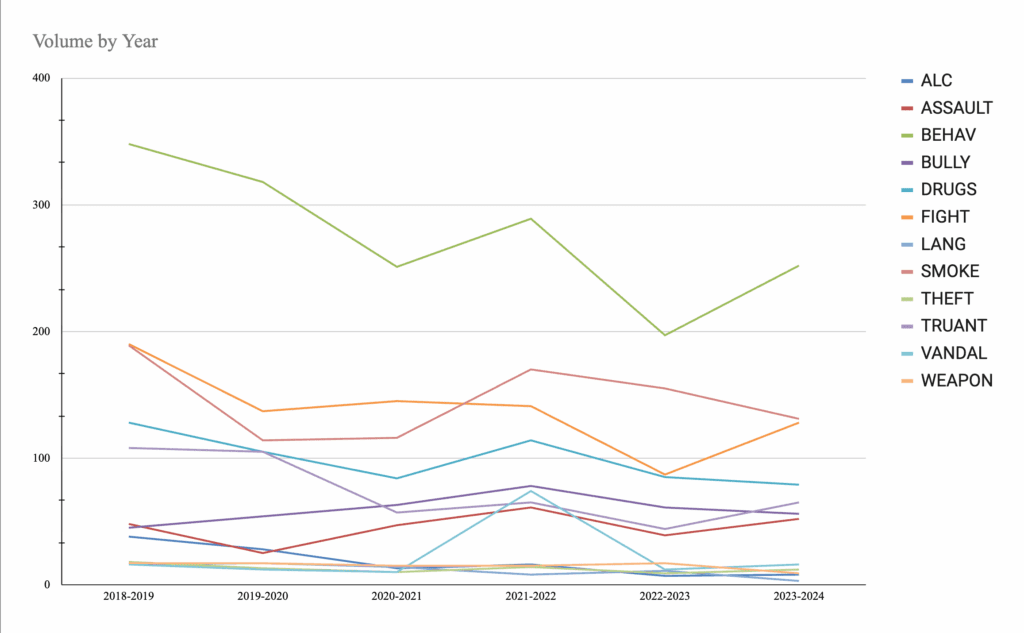
- Behaviour sits at the top every year and across the full period, with annual ranges roughly between 200 and 350 incidents and never drops below any other category.
- Fighting and smoking/vaping form the next tier.
- Drugs, truancy, bullying and vandalism occupy a middle band, present in every year with steady volumes.
- Weapons, theft, alcohol, language, attendance issues and administrative concern appear as smaller but persistent categories; together they still represent hundreds of suspensions.
By year
- Definite suspensions fall from 1,161 in 2018–2019 to 811 in 2023–2024, a sizeable overall reduction, although the last year jumps 90 suspensions higher than 2022–2023.
- The memo’s own analysis lists three categories with the largest recent increases: behaviour, truancy, fighting ; the only highlighted decrease appears in smoking.
By grade
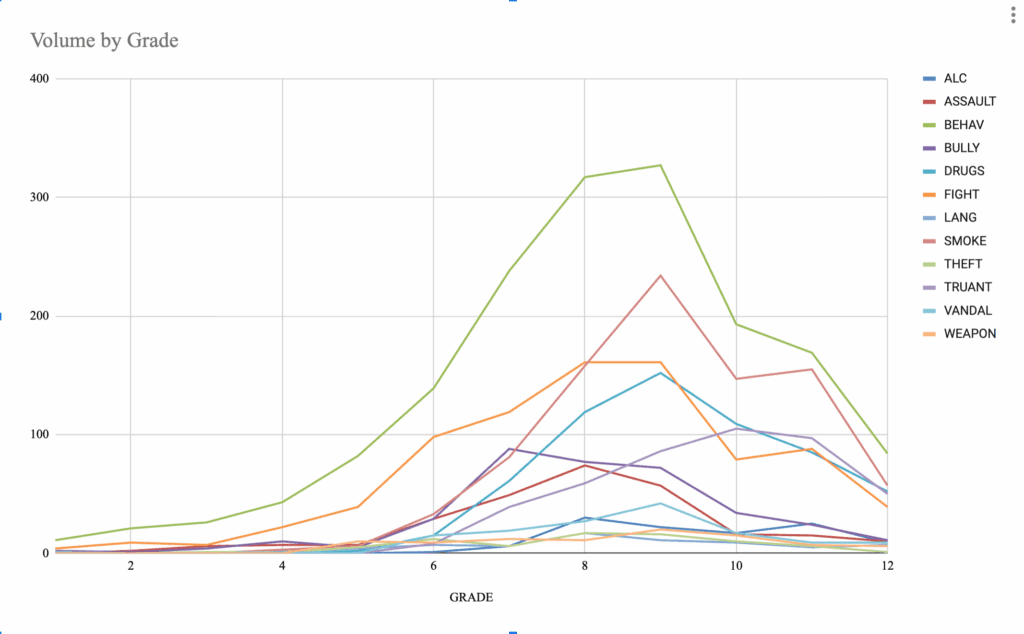
- Suspensions remain very low from kindergarten through grade three, then climb steadily through grades four, five and six.
- The dataset peaks in grades seven to ten, which carry the majority of suspensions for behaviour, fighting, smoking, drugs and truancy; the memo confirms that 76.7% of male suspensions and 86.8% of female suspensions fall in grades seven to eleven.
- Grade ten reaches the highest overall volume, especially for behaviour and substance-related categories.
Indefinite versus definite
- Indefinite suspensions sit in the low single digits each year; the memo reports three indefinite suspensions in 2023–2024, all for boys in grades nine and ten, primarily under assault and behaviour.
- Definite suspensions remain the main tool, with hundreds of incidents every year and wide distribution by school and grade.
These patterns already tell a clear story: SD23 primarily uses definite suspensions, relies heavily on a broad behaviour code, and applies removal most intensely in the middle-secondary years.
How SD23 explains its own numbers
The memo offers an explicit narrative about what these numbers mean for the district.
In the superintendent’s comments, suspensions appear as a “necessary and effective” way to address behaviour, framed as a serious but legitimate response that follows careful consideration and progressive discipline.
The analysis section emphasises two main messages:
- Indefinite suspensions stay low and therefore represent a success story.
The memo highlights a trend of fewer than three indefinite suspensions per year in recent years and praises this as an “encouraging indicator” of proactive, positive approaches, especially in light of much higher counts in the 1990s. - Definite suspensions have reduced since 2018–2019 and this reduction signals effective intervention.
The text stresses that the current total of 814 definite suspensions sits well below the 1,161 incidents recorded in 2018–2019, even while acknowledging a recent year-over-year rise.
For causes, the memo repeatedly attributes positive trends to district initiatives and external partners: ARC programs, Foundry mental-health clinicians, Community Youth Safety Officers and RCMP involvement, behaviour teachers, social-emotional learning staff, and various diversion programs such as Alternatives to Suspension.
The memo also ties discipline directly to the Code of Conduct, which staff must “vigorously and appropriately” enforce, and locates the issue in “students who present with challenging behaviour.”
In short, the official story emphasises: fewer indefinite suspensions, fewer definite suspensions than historic highs, effective partnerships with police and community agencies, and strong, progressive enforcement of behaviour expectations.
A disability-justice reading
A disability-justice lens pays attention to who appears in a narrative, who disappears, and which structures receive scrutiny. Reading the SD23 memo through that lens reveals several silences and distortions.
Disability and neurodivergence remain almost entirely absent from the analysis
The regulations contain a single acknowledgement that “special needs students” require consideration of their intellectual, physical, sensory, emotional or behavioural abilities and referral to the school-based team. The suspension summary does not return to this commitment when it interprets the large volumes in behaviour, fighting, truancy and substance-use categories. The memo spends pages on category counts, gender splits and program partnerships, yet leaves untouched any question about whether disabled and neurodivergent students carry a disproportionate share of those numbers, or how the district’s own design decisions around support, sensory environment, and curriculum shape the behaviour it records.
Behaviour language absorbs structural issues into a single category
The data show behaviour as the dominant code year after year, with the memo itself listing “general behaviour” as the category with the largest recent increase. Disability justice asks which unmet needs, inaccessible environments and systemic exclusions live inside that word. In a district that describes a wide network of behaviour teachers, RCMP partnerships and ARC diversion programs, a large “behaviour” category functions as a container for everything the system treats as individual conduct rather than as a predictable outcome of unmet disability-related needs, racialised marginalisation, trauma or poverty.
Celebrates low indefinite suspensions while leaving the scale of definite suspensions unexamined
Three indefinite suspensions appear in 2023–2024, which the memo describes as “among the lowest numbers on record” and therefore evidence of successful proactive practice. At the same time, hundreds of definite suspensions continue each year, with behaviour, fighting and smoking alone accounting for many hundreds of days of removal. A disability-justice frame asks how families experience that level of disruption, especially families of students with disabilities who already navigate partial days, informal send-homes and “support” withdrawals that fall outside this document.
Analysis treats police and carceral partners as unqualified protective factors
The text credits RCMP officers, Youth Safety Officers and community agencies with the reduction in drug-related indefinite suspensions and overall suspension levels. Disability justice and intersectional analysis raise different questions: which students receive diversion and therapeutic support, which encounter criminalisation, and how these arrangements feel to racialised, disabled and poor young people who sit at the intersection of surveillance, mental-health systems and school discipline.
Centres gender counts without exploring gendered vulnerability
The analysis describes female indefinite suspensions as “relatively negligible” and celebrates their reduction, while calling for continued monitoring. A disability-justice reading remembers that girls and gender-diverse students with disabilities often experience high levels of internalised distress, masking and self-blame rather than outwards conflict, and therefore may disappear from suspension data while still enduring severe educational harm. The memo’s focus on male versus female suspension totals, without attention to how different groups express distress or how staff interpret similar behaviours through gendered lenses, leaves those dynamics in the shadows.
Toward a different set of questions
Taken together, the charts, raw tables and memo show a district that applies suspensions most heavily in grades seven to ten, relies on broad behaviour labels, partners closely with carceral and clinical agencies, and celebrates reductions in high-severity categories while hundreds of lower-severity suspensions continue each year.
A disability-justice approach invites a different kind of data story, one that would ask:
- Which students sit inside the behaviour, fighting and truancy lines, and how many of them live with disability, neurodivergence, trauma histories or poverty.
- How many days of education students lose through definite suspensions, informal removals and partial attendance, especially in the middle-secondary years.
- Which interventions exist before suspension and how families experience those interventions, particularly families of disabled students who already navigate complex care systems.
SD23 has taken the rare step of publishing a long, detailed suspension memorandum. That transparency creates an opening for a richer conversation, where disability, race, poverty and systemic design move into the centre of the analysis, and where “behaviour” no longer carries the burden of explaining away an entire structure of educational harm.
Convenient vagueness
The province speaks with striking precision when it names the conduct of students and with striking vagueness when it names the conduct of systems, because behavioural categories such as smoking, fighting, drugs, or truancy offer a tidy story about individual choice while the real drivers of exclusion—unmet disability needs, unstable staffing, unsupported regulation, inaccessible environments, and programmatic shortfalls—would require systems to name themselves as active agents in the harm. This pattern creates a reporting culture that becomes highly specific when describing children and highly evasive when describing institutional responsibility.
-
The architecture of responsibility in systems that harm
When a system produces predictable, patterned harm — exclusion, restraint, academic abandonment, institutional gaslighting, attrition framed as “choice,” disability-based discrimination — that harm arises from the structural design of the system itself, because structures generate outcomes with the same reliability that rivers carve their beds, and structures reveal the priorities of the province long before […]

When will the government choose transparency?
This raises a deeper question that the data itself cannot answer but continually points toward: when will the provincial government commit to tracking the metrics that matter for understanding systemic oppression rather than the metrics that preserve institutional comfort?
Suspension data delivers detail because the state is willing to name the actions of children with precision; exclusion data dissolves into blanks and euphemisms because naming structural failure demands political courage, resource investment, and a public reckoning with the conditions that produce educational harm.
A transparent system would count every form of removal, document the supports attempted, track disability-and race-related disparities, and acknowledge the cumulative impact of partial days, informal send-homes, and administrative safety decisions.
A just system would resist the urge to translate structural strain into behaviour codes and would instead trace how school environments, staffing patterns, and policy choices shape the very behaviours for which children are held responsible.
The absence of these metrics is not an oversight but an ethical decision, and the moment demands a government willing to replace opacity with accountability.
-
What the BC government wants us to see: data and public education
Governments build their authority through the quiet choreography of information, and educational systems refine this practice into a disciplined structure where the presence of data becomes a symbol of competence while the absence of certain measurements becomes a strategy that protects institutional dignity, and across decades of policy and public communication the pattern of what […]