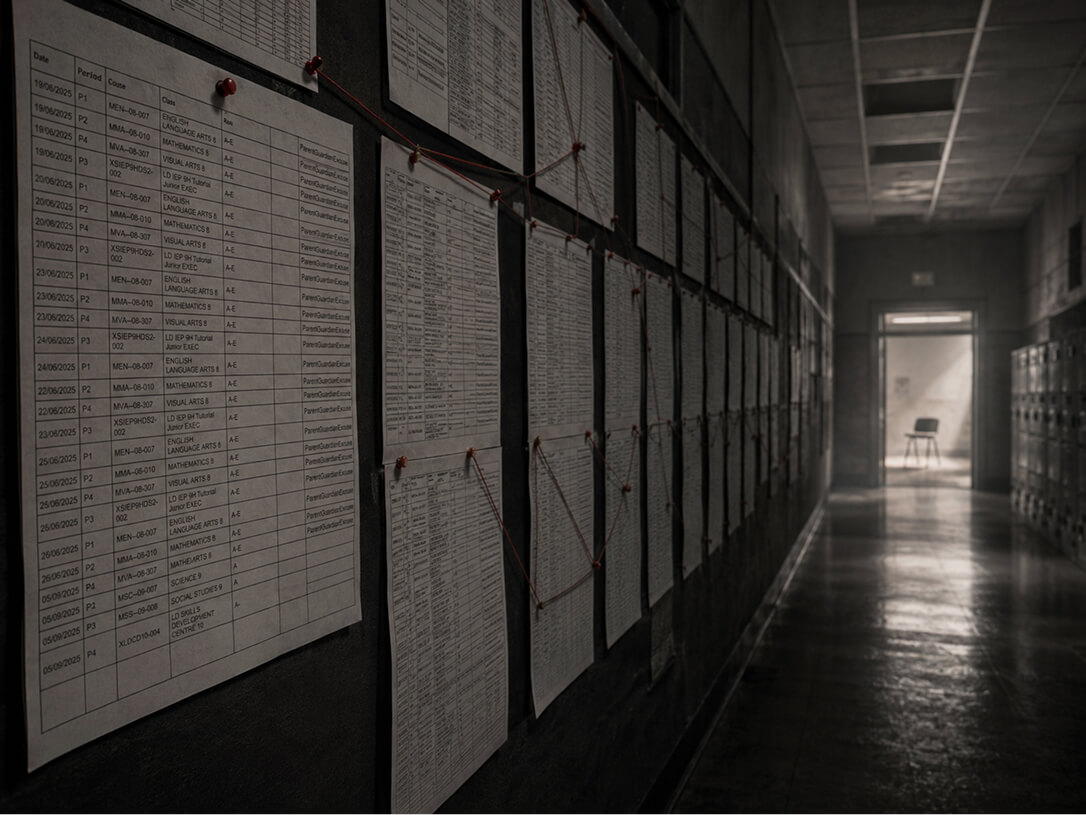
I’m a business analyst by trade, so I naturally wanted to understand how things work in schools, but resist the temptation to let schools draw you in!!!
School districts speak a language designed to obscure accountability, using administrative complexity as armour against obligation, converting urgent need into bureaucratic procedure, and replacing immediate legal duty with deferred technical explanation.
Parents find themselves trapped inside frameworks they were never meant to understand, frameworks that districts themselves invoke selectively, frameworks that exist primarily to diffuse responsibility and delay response.
This trap operates through a simple mechanism: when parents ask why their child remains unsupported, districts reply with process—allocation cycles, triage models, funding formulas, staffing protocols, intake timelines, assessment waitlists, committee review structures, and provisional planning phases—as though complexity itself constitutes justification for inaction.
The trap closes when parents internalise this logic, when they begin believing that understanding the system’s internal machinery is prerequisite to securing their child’s rights, when they accept that accommodation depends on procedural fluency rather than legal obligation.
The externalisation of internal failure
Districts routinely externalise their internal organisational challenges, transforming operational inadequacy into parental responsibility.
When schools claim they cannot provide support because allocation decisions happen quarterly, or because staffing requests require district approval, or because budgets were finalised in June, or because the principal lacks authority to act unilaterally, they are describing internal administrative arrangements—not legal constraints on accommodation.
Yet these internal processes are presented as immutable conditions, as though organisational structure somehow supersedes Charter rights, as though a child’s entitlement to accommodation must wait for the next funding cycle or the next committee meeting or the next fiscal year.
Parents absorb this framing, learning district vocabulary, memorising esoteric language, Googling district administrative procedures, studying budget approval hierarchies, attempting to navigate systems designed to defer rather than deliver.
The externalisation succeeds when parents mistake procedural explanation for substantive justification, when they believe that because the district has described how their system operates, they have therefore explained why a child remains unsupported.
-

Debility versus disability: what the system cannot acknowledge
My son Robin took to bed two weeks before March break. He had been soldiering on through the aftermath of a school transfer the district assured us would help him, though his body told me otherwise from the first day he arrived. I’ve…
Legal obligation precedes process
The Supreme Court of Canada established in Moore v British Columbia that accommodation is a legal duty, immediate and non-deferrable, contingent only on the reality of need and the threshold of undue hardship—not on internal administrative convenience, not on staffing cycles, not on budget approval timelines, not on organisational capacity.
When a child’s disability-related needs clearly demand support, the district faces immediate obligation to provide accommodations unless doing so imposes undue hardship—a threshold defined by significant difficulty or expense, not by procedural inconvenience or administrative inertia.
Districts hold legal responsibility to structure their systems in ways that enable timely accommodation, which means that when their internal processes prevent them from meeting this obligation, the problem lies with the process design, not with the child’s timing.
Parents carry no responsibility to understand, navigate, or optimise district business processes.
Parents hold only one responsibility: to communicate their child’s needs clearly, to provide relevant information when requested, and to insist on accommodation.
Everything else—staffing decisions, budget allocation, resource deployment, timeline management, committee structures, approval hierarchies—constitutes internal operational detail that districts must resolve internally, without externalising delay as though complexity itself justifies withholding support.
The hierarchy as institutional theatre
Surrey’s Hierarchy of Student Needs exemplifies this trap, presenting itself as evidence-based triage while actually encoding institutional priorities that centre staff comfort, visible disruption, and medical legibility over emotional safety, relational harm, and internal distress.
When schools deploy such frameworks, they perform technical rationality, suggesting that support decisions emerge from objective assessment rather than subjective judgment, from neutral criteria rather than value-laden interpretation, from necessity rather than choice.
Parents studying these hierarchies, attempting to position their child’s needs within these frameworks, attempting to demonstrate that their child meets the criteria for urgent support, attempting to speak the language of institutional legitimacy, are participating in a system designed to ration care by manufacturing scarcity through complexity.
The hierarchy’s actual function is not to guide support allocation but to justify denial, to provide procedural cover for decisions already made, to transform “we choose not to support this child” into “this child does not meet priority criteria according to our established framework.”
-

The right amount of agony in BC schools
After watching my children endure eight years of institutional failure, eight years of exclusion disguised as discipline and support withheld under the language of inclusion, I have come to several conclusions. Certain forms of suffering—like being agonised inside—do not draw support because they…
Process as disciplinary technology
Districts use process to discipline parents, to reward those who comply with bureaucratic norms and punish those who resist, to separate the “reasonable” parent who understands operational constraints from the “difficult” parent who insists on immediate accommodation.
This disciplinary function operates through several mechanisms:
- Information asymmetry: Districts control process knowledge, determining what parents are told, when they are told, how much detail they receive, which frameworks are invoked, which policies are cited, which timelines are emphasised—using selective disclosure to maintain advantage.
- Procedural gatekeeping: Districts require parents to navigate intake processes, assessment protocols, referral pathways, district review structures, each stage introducing delay, each transition requiring parental labour, each gate controlled by district personnel who determine whether parents have satisfied prerequisites for advancement.
- Compliance conditioning: Districts reward parents who demonstrate fluency in institutional language, who frame requests using approved terminology, who acknowledge resource constraints, who express gratitude for incremental response, who perform patience while their children suffer.
- Exhaustion engineering: Districts design processes that require sustained parental engagement over extended timeframes, that demand repeated meetings, that necessitate ongoing documentation, that impose emotional/administrative labour through forced collaboration with personnel who have harmed their children, that manufacture fatigue as barrier to persistence.
Parents who refuse to engage with these processes, who insist that need itself constitutes sufficient justification for accommodation, who reject the premise that districts may defer obligation pending procedural completion, who assert legal entitlement rather than request institutional favour, are labelled adversarial, unreasonable, uncooperative—as though maintaining boundaries against institutional overreach constitutes problematic behaviour.
-

The material costs of educational harm
My son no longer attends school. He no longer wants anything the education system offers. He has taught himself programming, navigates Linux with expertise that exceeds my own knowledge, learns alone in his room because learning with others became too expensive to survive.…
The composition rules mechanism
Schools operationalise exclusion through ostensibly neutral policies—classroom composition guidelines, behavioural support frameworks, safety planning protocols, partial schedule arrangements—that function as tools for scapegoating disabled children to excuse manufactured scarcity.
Composition rules exemplify this mechanism, establishing numerical limits on how many designated students, or students with behavioural needs, or students requiring one-on-one support may be placed in a single classroom, framing these limits as pedagogical necessity or safety requirement rather than administrative convenience.
When schools repeatedly separate children from their best friends, invoking composition rules to justify each separation, they are using procedural language to obscure deliberate choice, converting “we do not want these two children together because they talk too much” into “composition guidelines require redistribution.”
These rules operate as cover, transforming targeted exclusion into technical necessity, allowing schools to avoid accountability by claiming they are simply following policy, simply applying frameworks, simply adhering to established protocols.
Parents challenging these decisions find themselves arguing against abstraction, attempting to demonstrate that the rule’s application in their child’s specific case produces harm, attempting to prove that the rule’s stated purpose does not justify its actual impact, attempting to request exception without acknowledgment that the rule itself may be pretextual.
The stabilisation-then-withdrawal pattern
Districts often withdraw support the moment a child stabilises, treating stability as evidence that support was unnecessary rather than evidence that support was effective, operating from a logic in which accommodation becomes justified only through ongoing crisis rather than recognised as essential foundation for functioning.
This pattern reveals the system’s actual priorities: districts seek to minimise resource allocation, not maximise child wellbeing; they measure success by staff relief, not student flourishing; they define appropriate support as the minimum necessary to prevent emergency, not the amount necessary to enable learning.
When schools removed support from my son each time he stabilised, they were enacting this logic, treating his improved functioning as permission to reduce accommodation rather than reason to maintain it, operating as though his need for support exists only when he is actively struggling rather than understanding that support itself prevents struggle.
Parents trapped in this pattern find themselves advocating for ongoing accommodation while schools present their child’s current stability as evidence against continued need, forcing parents into the impossible position of either accepting withdrawal or arguing that their child remains in crisis when they have, in fact, improved.
The trap closes when parents recognise that the system interprets their child’s success as grounds for abandonment, when they understand that stability itself becomes punishable, when they realise that the only state that justifies ongoing support is perpetual emergency.
-

Collective punishment: how schools displace guilt, erase harm, and preserve the collective
One of the things that was so traumatising about the collective punishment that was callously perpetrated against my daughter was the light and evasive tone of the principal. She said that the punishment had to be “swift.” I frequently wondered about the choice…
What parents owe—and what they do not
Parents owe districts:
- Clear communication of their child’s disability-related needs
- Relevant documentation when requested and available
- Participation in collaborative planning when offered in good faith
- Reasonable responsiveness to district communication
Parents do not owe districts:
- Understanding of internal staffing processes
- Fluency in allocation frameworks
- Patience with procedural delay
- Acceptance of resource constraints as justification for unmet need
- Emotional labour performing gratitude for inadequate response
- Participation in systems designed to exhaust rather than support
- Compliance with business processes that defer legal obligation
When districts present their internal operational arrangements as barriers to accommodation, parents may respond simply: “Your internal processes are your responsibility to resolve; my responsibility is to ensure my child receives the support they are legally entitled to receive.”
When districts explain that staffing requests require approval, that allocations happen quarterly, that budgets were finalised months ago, that committees must review, that timelines constrain response, parents may respond simply: “How you structure your systems to meet your legal obligations is your decision; whether you meet those obligations is not negotiable.”
When districts invoke frameworks, hierarchies, protocols, policies, procedures, parents may respond simply: “My child has a known disability, requires specific accommodations to access education meaningfully, and is legally entitled to receive those accommodations unless providing them imposes undue hardship on the district—nothing you have described constitutes undue hardship.”
Refusal as resistance
Parents refusing to engage with district business processes, refusing to learn allocation timelines, refusing to track staffing request procedures, refusing to map approval hierarchies, refusing to participate in procedural theatre, are not being uncooperative—they are maintaining appropriate boundaries between parental responsibility and institutional accountability.
This refusal constitutes resistance against a system designed to transfer institutional failure onto families, to obscure legal obligation beneath procedural complexity, to transform immediate duty into indefinite process.
Parents exercising this resistance may face district frustration, may be labelled difficult or unreasonable, may be told they are impeding collaboration or refusing to understand constraints—but these responses reveal the trap’s operation, exposing how districts use cooperation rhetoric to secure parental complicity in their own children’s abandonment. Your responsibility is to your child, not to being perceived as nice by the district.
Refusal means asserting: “I do not need to understand your staffing allocation process to know that my child is legally entitled to accommodation; I do not need to understand your process to recognise that you hold responsibility for meeting your obligations; I do not need to learn your timeline to insist that this need is urgent.”
Refusal means rejecting the premise that parents must become amateur administrators, must learn district vocabulary, must internalise institutional logic in order to secure their children’s rights.
Refusal means insisting that accommodation is obligation, not favour; that delay is choice, not necessity; that process explains how districts organise their work, not why they fail to do it.
-

Nobody is going to thank you
Nobody tells you that you can pour every last scrap of yourself into advocacy and still feel your bond with your child begin to strain. There is a familiar story passed among parents—one in which you step in, do a little advocacy, and…
Conclusion
Disabled children deserve support because they are entitled to accommodation. Full stop.
When districts launch into explanations about their processes you may respond: “I hear that you have to jump through a lot of administrative hoops and for that I am sorry, but that has nothing to do with me or the immediate needs of my child. My focus is on your legal obligation to help my child and we could save a lot of time not having these detailed conversations about your administrative workload.”
Their internal processes are their problem to solve. Your job is to name the need and insist on accommodation. That’s it.
How they organise their staffing? Not your concern. When they run their allocation meetings? Not your responsibility. Which forms require whose signature? Not your problem. How many approval layers exist between principal and superintendent? Not relevant to your child’s rights.
Every minute spent learning their system is a minute stolen from your child, a minute spent doing work that belongs to them, a minute participating in theatre designed to exhaust you into acceptance.
So refuse. Refuse to learn their vocabulary. Refuse to track their timelines. Refuse to map their hierarchies. Refuse to treat procedural complexity as though it constitutes justification.
When they describe their constraints, acknowledge them without absorbing them: “That sounds challenging for you to manage internally. Now, about my child’s accommodation…”
When they explain their process, redirect without engaging: “I understand that’s how you’ve structured your workflow. When will my child receive the support they’re entitled to?”
When they request your patience with their administrative realities, decline without apology: “My child’s needs are urgent. How you organise yourselves to meet your legal obligations is not something I can help you with.”
Your children are suffering now. Their business processes are not your responsibility. Their administrative burden is not your problem. Their organisational constraints are not your child’s to accommodate.
Need is sufficient. Obligation is immediate. Everything else is noise.